Snow everywhere — not the city snow, which is so quickly trampled and smirched, and which one gladly sees carried off in carts on its swift way to slush and mud, but the clean, white, lasting country snow. It covered the paths, the roads, the fields, lying in great drifts against the buildings and fences; each low roof had its frozen white covering, fringed here and there with icicles; the mountains were gray to their tree-clothed summits, matching the gray sky, from which tiny flakes fell now and again.
Over the fields trudged Nan and Ned, caring nothing for snow or drifts, for on their feet were strapped big snowshoes and they scuffled along securely enough.
“First fall!” cried Ned, as Nan inadvertently pointed her big shoe into the snow, stuck, and settled hastily and ungracefully onto the ground.
“Give me your hand, Neddy. What a dunce I am!” Up she scrambled, shaking the white powder from her scarlet toboggan-suit. At ten degrees, there is little danger of dampness from a tumble into a drift.
“Now for a race,” said Ned. “I’ll give you a start, and beat you to the little bridge.”
“Thank you for nothing. You needn’t give me a start, my boy — I’ll beat you just the same. Ready!”
Off scuffled the two, Nan with careful attention to keeping her feet flat.
“Good for you, Nan!” Ned called, as his sister kept close beside him. “It’ll be nip and tuck, sure enough.”
Suddenly the boy’s toe struck a projecting rock. Over he went, while Nan, a little in advance at that moment, pushed on without seeing. She arrived triumphant at the goal, then turned to look for her opponent. Halfway back sprawled a dark-gray figure; a handkerchief fluttered from one elevated foot, while close to this flag of truce stood two small figures she didn’t recognize.
Back rushed the victor.
“Oh, Ned! You’re not hurt?”
“Oh, no — just resting. Strap’s broken. Sorry I can’t rise and bow and congratulate you, ma’am. It was nip and tuck, wasn’t it? I got nipped and you tucked it.” And the vanquished one sat up and began to mend his snowshoe with some string. Having offered her handkerchief and a further store of cord from her own pocket, Nan turned her attention to the newcomers — a boy of about her own age, and a girl several years younger.
“Good morning,” she said pleasantly.
“Morning,” said the girl, in a low voice.
“You’re strangers in the village, aren’t you?”
“Yes. Father’s here for his health; we’ve just come. Mother’s going to take in washing, because father can’t work now.”
“Find it rather cold, don’t you?” said Ned.
“Yes, it’s awful cold. But father likes it, and the doctor says it’s good for him.”
“That’s so. We know all about it — we’ve always lived here. We’re the doctor’s children.” And Nan nodded pleasantly to the two, noticing their coarse yet neat clothing, and their somewhat sad young faces.
“You’re lucky to be here for the first snow,” said Ned, scrambling up and stamping his foot to test the mended fastening. “And Christmas, you know, is the day of all the year that makes everybody feel jolly.”
“We’re not going to have any Christmas this year,” the girl said.
“Can’t help yourselves, I guess,” was Ned’s cheerful reply. “December 25th brings it every time — and that’s tomorrow, sure enough!”
“Gerty means we can’t have presents,” the boy put in. “But we don’t mind, do we, sis? It costs a lot, and it cost so much to come here, we can’t hang up our stockings. We always have before, though,” he added quickly.
“Dave’s real good about it. But I can’t help minding a little. I wish Christmas didn’t come so expensive,” Gerty sighed, after a pause during which Nan and Ned had looked at them in silence.
“Where do you live?” asked Nan at last.
“Down that road, along the river, beyond the pines. First there’s a blue house, and ours is the second pink one. Dave tried coasting down that funny open place in the pines — it looks like a V turned upside down. He tried it on a board and got stuck; the snow was too soft.”
“Oh, that’s Santa Claus’ Pathway,” laughed Nan. Then, as the strangers stared: “That’s what we were told when we were little. Santa Claus is the only person who can coast down it — the reindeer know the road, you see. And sometimes they run down so quickly that things drop out of the sleigh. Ned and I used to look for them when we were small, didn’t we?”
“Yes, indeed — many a time. Well, goodbye, youngsters. Come along, Nan.”
Left alone, Gerty and Dave looked at each other a moment.
“Isn’t she beautiful?” said Gerty at last, with a long-drawn sigh. “And, oh, Davy — let’s go there and look tomorrow. Will you?”
The boy laughed. “Yes, if you like. But don’t expect anything. It’s only a story.”
Nan’s spirits were low that afternoon. The thought of the two new children troubled her, and she could think of nothing to do — her last penny had been spent on her own Christmas preparations, and all her spare things had already gone into the big packages her kind mother put together for the poorer village families at this time of year. A talk with Ned brought no comfort; he was equally penniless.
“Dead broke, my dear,” he said, “and no use. Father’s already advanced some of my January allowance. But we could ask him.”
“No, we mustn’t. Mother told me he’s given away more than he can afford. It’s hard times for him too. I don’t see why it should make a difference with a doctor, Neddy — people have to be sick just the same,” she said, more to herself than to him.
Ned offered no explanation. Nan retreated to her own pretty room to look, for the twentieth time, at the dainty ribbon-tied packages she had prepared for the morrow. It must be just horrid not to have any Christmas fun, she thought.
The next day dawned bright, sunny, and crisp — a perfect Christmas morning. The doctor’s household was stirring early, for four stockings with their abundant overflow had to be inspected, and Ned and Nan, youthful tyrants on that one day, tapped early at their parents’ door. Who does not know the fun of rummaging a Christmas stocking!
By their usual custom, Dr. Lowe looked at his gifts first, being, as Ned said, “the oldest child.” Few of his patients would have recognized their grave physician as he guessed and peeped and pulled out his presents as eagerly as any boy. Nor was Mrs. Lowe one bit less excited when her turn came.
“Mother and father are two spoiled children,” said Ned, laughing, and casting a sideways glance at the large package leaning against the fireplace beside his own stocking. Could it be the wished-for toboggan? “They get so many presents, they’ll end up like the little girl who had Christmas every day.” For the doctor’s family was remembered by nearly everyone in the village.
“What a beauty! Oh, father — how did you know I wanted it so?” cried the boy, as the new toboggan was unwrapped and admired.
Down in the deepest depths of his stocking Ned found a tiny box: From Grandma Lowe. Nan looked on with interest, for the shining five-dollar gold piece would certainly have its match among her own gifts. And so it did. The girl’s quick brain was immediately busy with plans — a decision reached in an instant. Now the long-wanted gold beads could be bought!
Breakfast was soon over. Down the toboggan-slide and up again the children sped and clambered with tireless enjoyment. Ned and Nan were fearless and sure of their balance, and neither could understand why their rapid rush — standing upright from top to bottom of the snow-clad hill — was considered a difficult feat by their companions.
“Get on and have a slide,” said Ned, noticing among the little group of onlookers the two strangers from the day before. “Hold on tight — if you’re not used to bumps you’ll fly off.”
Down sped all four, Gerty’s small shriek lost in the laughter her hasty rise and fall aroused. Ned had caught her quickly, sparing her a tumble.
“You’ll like it better next time — let’s try again,” he said encouragingly.
“We can’t; there’s the church bell, Ned,” said Nan. “We must hurry.”
As Nan stooped to tie a refractory shoelace, she overheard Dave say to Gerty:
“Now you’ve had a Christmas treat, you see, Gerty — even if we didn’t find any dropped things on Santa Claus’ Pathway.”
Nan’s preparations for church were hasty, but she and Ned were ready in time to follow their father and mother into the pretty little church, pine-trimmed and holly-decked; and Nan’s clear voice rang out sweetly as the congregation sang the Christmas hymn:
Peace on the earth, good will to men, From heaven’s all-gracious King; The world in solemn stillness lay To hear the angels sing.
Over in the corner sat Gerty and Dave. They were singing too, and once Nan saw Gerty stop and furtively wipe her eyes.
O ye, beneath life’s crushing load, Whose forms are bending low,
sang Nan — and wondered. Now the meaning of the words came to her. She had not thought of it before.
The doctor’s daughter did not listen to the sermon. Her Christmas sermon had already been preached to her in that first hymn, and she was thinking it over seriously, and not without some inward struggle. Poor Gerty and Dave! A sick father, a hard-working mother with barely enough. Nan stole a look at her own strong, well-dressed parents, then glanced once more at the sad-looking pair in the corner. For them there was, as Gerty had said, no Christmas.
But the village shops close early on Christmas day, and they have so few nice things in them anyway, whispered a selfish little voice in her heart. And Grandma Lowe meant you to buy something for yourself with that money.
There was a soft rustle as the congregation rose for the recessional:
O holy Child of Bethlehem! Descend to us, we pray; Cast out our sin, and enter in, Be born in us today.
Nan wiped tears from her own eyes as she sank to her knees.
“Ned, I need to speak to you,” she whispered, nearly dragging him down the church steps as the congregation filed out.
“Those Lowe children are never happy long under a roof,” laughed someone, as the two ran off along the boardwalk.
The pink house down by the river was not the most cheerful place in the world that Christmas afternoon. Its few furnishings were not yet entirely unpacked; the big stove smelled of fresh varnish; and the invalid, seated by the curtainless window, was having one of his bad days. The poor man looked doleful enough. Sick and suffering, he felt himself the cause of his family’s hardship.
“There comes the doctor’s sleigh, with his pretty daughter,” he said. “He rides in style. Why — it’s stopping here!”
“Father sends the sleigh,” Nan began, after the usual greetings, “and hopes you’ll like to take a little drive, as he isn’t using it today.”
The invalid glanced out at the beautiful black horses with their jingling bells and scarlet plumes, at the sleigh heaped with fur robes.
“Your father’s too good, Miss,” he stammered, his face flushing with pleasure.
“And perhaps Gerty and Dave might like to go coasting with us — Ned and me.”
“Got your boots on, Dave?” called Ned. “Then we’ll go through the pines.” He chatted merrily as they set off, the two girls tucked up cozily on the toboggan, the boys acting as steeds for the chariot.
Santa Claus’ Pathway stretched up beside them like a great white tent as they skirted the hill. “Hello!” said Ned. “Er — we might climb up and see if — er — there’s anything there. St. Nick might have dropped something.”
“He didn’t,” said Gerty. “Dave and I looked.” Ned and Dave exchanged a glance.
“‘Try, try again,'” suggested Nan. “You and I’ll go too, Gerty. It isn’t deep, and it’s dry as dust.”
Up scrambled the four of them.
“Let me do the talking, Ned,” Nan murmured. “You hesitate, and they’ll suspect.”
“Well, how can a fellow think up things all of a sudden?” Ned whispered back, with some feeling.
“Oh — oh! Look!” cried Gerty, pointing to a patch of red half-hidden by the snow. “There — near that pine!”
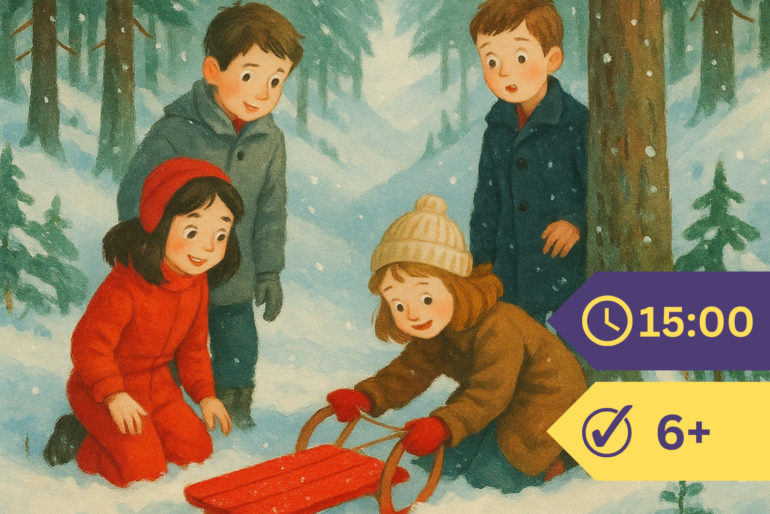
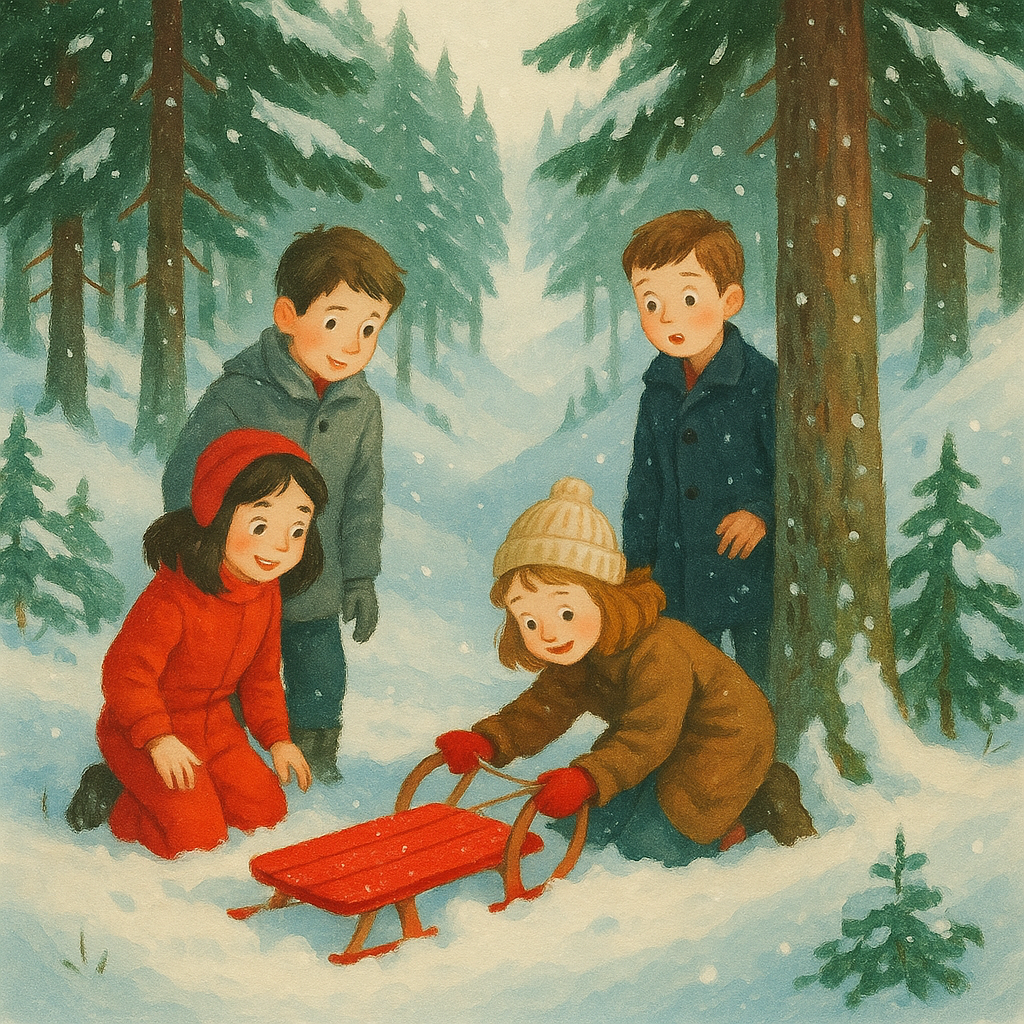
The others ran forward. Ned hung back, letting Dave pull out the scarlet sled that rewarded his search.
“Whew! That’s a beauty!” cried Dave. “How did it get here? Someone must have lost it.”
“Santa Claus, to be sure,” said Nan; and Ned added: “Finding’s keeping.”
“Do you really think so?” said Dave, wistfully, unable to quite believe his good fortune.
“Certain sure,” returned Ned. And since his own hands had put it there, who could have known better?
“Somebody told me there wasn’t any Santa Claus,” said Gerty, nodding her head with satisfaction, “but I guess he’s been here.”
“See here!” she cried. “And they’re marked Gerty.” She held up a box containing a warm hood, a pair of mittens, and a box of candies.
“Oh, goody, goody! And look — here’s a game! We can play it evenings, Dave; maybe father would like it too. But,” she said quickly, “you ought to take something — we can’t have them all.”
“That wouldn’t be fair — we had our presents this morning,” replied Nan. “Probably these things were left here for you because Santa Claus didn’t know where you’d moved to.”
This explanation seemed to satisfy Gerty entirely, and she began searching again with fresh interest.
“These must be yours, Dave.” Ned held up a pair of mittens just as Gerty cried:
“What a beautiful doll! Just to think it’s mine! Oh, you dear dolly!”
“And here’s a book with my name in it,” called Dave a moment later.
“I guess that’s all,” said Ned, after a few more minutes of searching.
“Hasn’t it been wonderful?” said Gerty to Nan as they descended the hill. Nan thought decidedly that it had.
“Say,” said Dave to Ned, as they waited for the two girls to settle themselves — one on the toboggan, one on the newly found sled — “I’m pretty sure you and your sister put those things there. Gerty believes in Santa Claus — she’s little, you see. But — I don’t know how to say it — we’re awful much obliged.”
Tucked up warm and snug on the toboggan, Nan was softly singing, under her breath, a joyous Christmas carol.