One day in Russia, there was a heavy snowstorm. The snow lay deep on the ground, and in the forest the branches of the trees bent low under its weight.
Through that forest, a little girl was struggling along. There was no path for her to follow, for the snow had covered them all. Her name was Paulina. She was bundled in a long fur coat, with a fur cap, mittens, and boots, so that she looked more like a small furry animal than a little girl. On she tramped, not the least bit afraid — when suddenly she heard a cry.
“Help! Help!”
“Coming! I’m coming!” she called back. She hurried toward the voice and soon saw a man making his way toward her, dressed in the rough clothes of a peasant.
“Would you kindly show me the way out of this forest, little one?” he asked. “You must know the paths around here.”
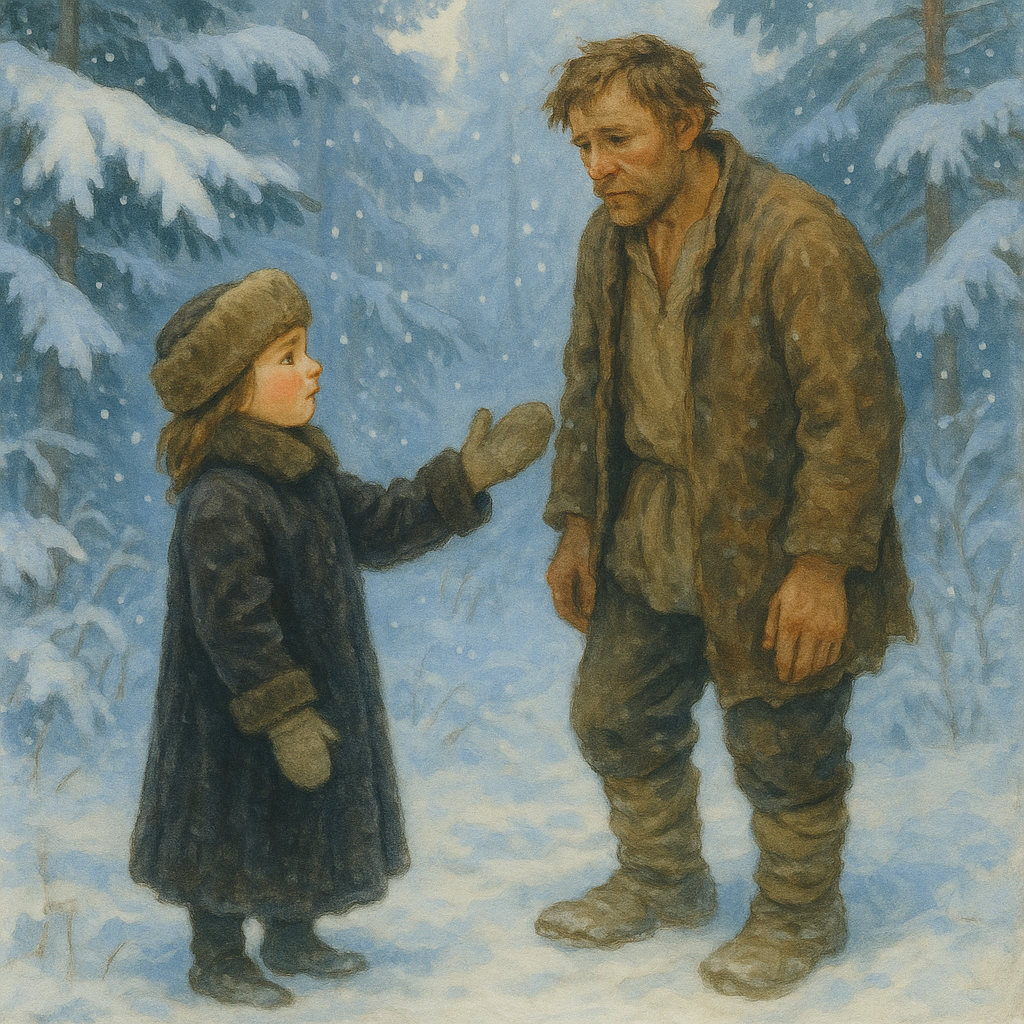
“No, I’m a stranger here,” Paulina answered. “I live in Kiev — that is, I did live there. But I’m on my way to my father.”
“And where is your father?”
“He is in Siberia. They banished him.”
“But little one,” said the stranger, “that is a terrible place for a child to travel to — that frozen country, where they send wicked people!”
“Oh, yes,” said Paulina simply, “but my father is there, you see.”
“And who is your father?”
The little girl was just about to tell him, when she caught a flicker of keen interest on the stranger’s face. So instead she said, “Did you say you’d lost your way? Do you live far from here?”
“Very far. I’m lost, and nearly perishing with hunger and cold. How far is it to the next village?”
“They told me it was some miles on,” said the child. “But come — I’ll take you back to the woodcutter’s cottage where I spent last night. The woman there is kind-hearted. I’m sure she’ll give you shelter.”
“That is good of you, little one,” said the stranger, “but you’ll be delaying your own journey if you do.”
“I know my father would want me to be kind to someone in need,” Paulina said, “even if it slows me down a little.”
“You must have a fine father, to raise you so well. Why did the Emperor send him into exile?”
“Oh — my father had enemies who lied about him to the Emperor, and he was never given a chance to explain. So the Emperor sent him away to Siberia. And now I’m trying to find my way to him.”
As they walked on through the forest, the stranger told Paulina about his own little daughter, who was waiting for him to come home for Christmas. At last they reached the woodcutter’s hut. The woman greeted them warmly, and while Paulina went into the next room to help prepare the evening meal, the stranger stayed by the fire, warming himself and gently rocking the cradle with his foot.
Once, Paulina thought she heard voices — as if the stranger were speaking with someone. But when she came back, she found him alone, still warming his hands and rocking the cradle.
That night the stranger slept on the floor before the fire — there was nowhere else — but he was thankful to be safe from the storm outside.
Early the next morning, the two set out again through the forest. They would have to hurry to reach the next village before dark. The storm had passed, and the day was cold and clear and beautiful. They came out on the far side of the forest early in the afternoon — and there before them stood a splendid sleigh drawn by four horses, with four servants waiting beside it.
“What a beautiful sleigh!” cried Paulina.
“Yes — I wonder where they’re bound. Let me ask.” The stranger stepped over and spoke to the men.
“We are driving for our master, to Igorhof,” they said.
“Why, that’s where my own daughter is!” said the stranger. “If only I might ride with you, I could spend Christmas with her — for tomorrow is Christmas Day. And little one,” he added, turning to Paulina, “you could spend Christmas with us too.”
“Oh, no,” said Paulina. “I mustn’t take the time. I have to hurry on to my father. But it would be lovely to ride in such a beautiful sleigh.”
“You could stay the night with us, and then we’d set you on your way again — because you’ve been so kind to me,” the man said.
The servants agreed to let them ride, and soon they were gliding swiftly over the snow toward the great city. Once, the stranger took a scarf from a pocket on the side of the sleigh and wrapped it around his neck. Paulina frowned, and promptly took it and tucked it back where it belonged.
“It isn’t right for you to touch things in the sleigh — they belong to someone else,” she said gravely. “I’m beginning to fear you may not be an honest man.”
The stranger only laughed. But he did not touch the scarf again.
On they sped over the snow, until darkness fell and they reached the city. They turned into a great courtyard, and the stranger took Paulina by the hand and led her through a narrow passage and up a small winding stair.
“Where are you taking me?” asked Paulina. “I feel almost certain now that you’re not an honest man. I think you may even be a thief!”
The man laughed again. “No — I am an honest man. You’ll believe me when you see my little daughter. I trusted you in the forest. Now you must trust me.”
He led her into a large room, and they sat down together on a sofa. “We’ll wait here until my daughter comes,” he said.
Soon the door opened, and a beautiful little girl, about Paulina’s own size, came in. She looked puzzled at the sight of the rough-dressed man with the strange child. She stepped close and looked into his face.
“It’s my father!” she cried, and threw her arms around his neck. “But why are you dressed like a peasant? Has there been an accident? And who is this little stranger?”
The man took her on his lap and told her everything — how his sleigh had overturned in the storm, how he’d found a peasant’s hut where they gave him dry clothes, how he’d set off alone through the forest and was nearly dying of cold and hunger when this little girl rescued him. If not for her, he said, he would have perished in the snow. He told how Paulina was making her own way to Siberia to find her father, and how he had quietly arranged for the sleigh to meet them on the far side of the forest.
“Oh!” Paulina interrupted. “Then there was someone talking with you, while we were making supper!”
“Yes — and everything happened just as I planned. And do you know, my daughter, this Paulina wouldn’t even let me put my own scarf around my neck. She thought I was a thief! She is an honest little girl. But she still won’t tell me her name. She doesn’t trust me.”
“But why should I trust you,” Paulina asked, “when you won’t tell me who you are, or anything about yourself?”
“Please trust my father, Paulina,” the beautiful little girl said. “I’m sure he can help you. He’ll tell you who he is soon, I know.”
“Yes, little one,” said the stranger. “I know someone who could speak to the Emperor about your father — perhaps he could even be pardoned. Tell me your name, and before you leave I’ll answer any question about myself you care to ask.”
“Do tell him, Paulina,” the little girl urged.
Paulina threw her arms about the stranger’s knees. “Oh, if only you could get the Emperor to pardon him! But I don’t ask for a pardon — he has done nothing that needs pardoning. All I ask is that he be given justice. My father is Vladimir Betzkoi.”
The stranger’s face grew grave for a moment. “There has been some mistake,” he murmured. “He must be a good man, to have so honest a little daughter.” Then he said aloud, “Do you believe now that I am an honest man, since you’ve seen my daughter?”
“Oh, yes — indeed I do. You couldn’t help being good and honest. She is so lovely. I think her face is just what a queen’s should be,” Paulina answered eagerly.
The stranger and his daughter both smiled. “Well,” said the man, “and I believe that your father is an honest man, now that I’ve met you. And I can promise you — I know that he will be pardoned.”
“Tell her, Father,” his daughter whispered. “Tell little Paulina who you are.”
“Until your father comes back to you, little one, you shall stay here, and I will be a father to you — as I am father to all the people of Russia. For I am the Emperor.”
Just then, bells began to ring, and outside, voices rose in song — for it was the dawn of Christmas morning.
And Paulina said, “This is the happiest Christmas morning I have ever known.”