Maarten van der Mey was a carpenter. The best in Alkmaar, people said. He could build a roof beam, mend a bridge, and hang a door that never stuck again. But on this September evening in 1573, there was no hammer in his hand. He was holding a jumping pole — and inside that pole was a secret.
Alkmaar was in terrible danger. For weeks, an enormous Spanish army had surrounded the town: sixteen thousand soldiers, with cannons pounding the walls day and night. Inside the town there were only eight hundred soldiers and thirteen hundred townspeople who could fight. Yet they held on. Women hauled kettles of boiling water up to the ramparts; boys and girls threw stones at anyone who tried to climb the wall. But everyone knew: we cannot hold out forever.
There was one plan that could save the town. One plan so wild it just might work.
“Water,” the mayor had said. “If we cut the dikes, the land around the town will flood. Spaniards do not like wet feet. They will have to leave.”
But the dikes lay outside the town. Someone had to slip past the entire Spanish army to carry the message. Someone who knew every ditch and every reed bed.
Everyone looked at Maarten.
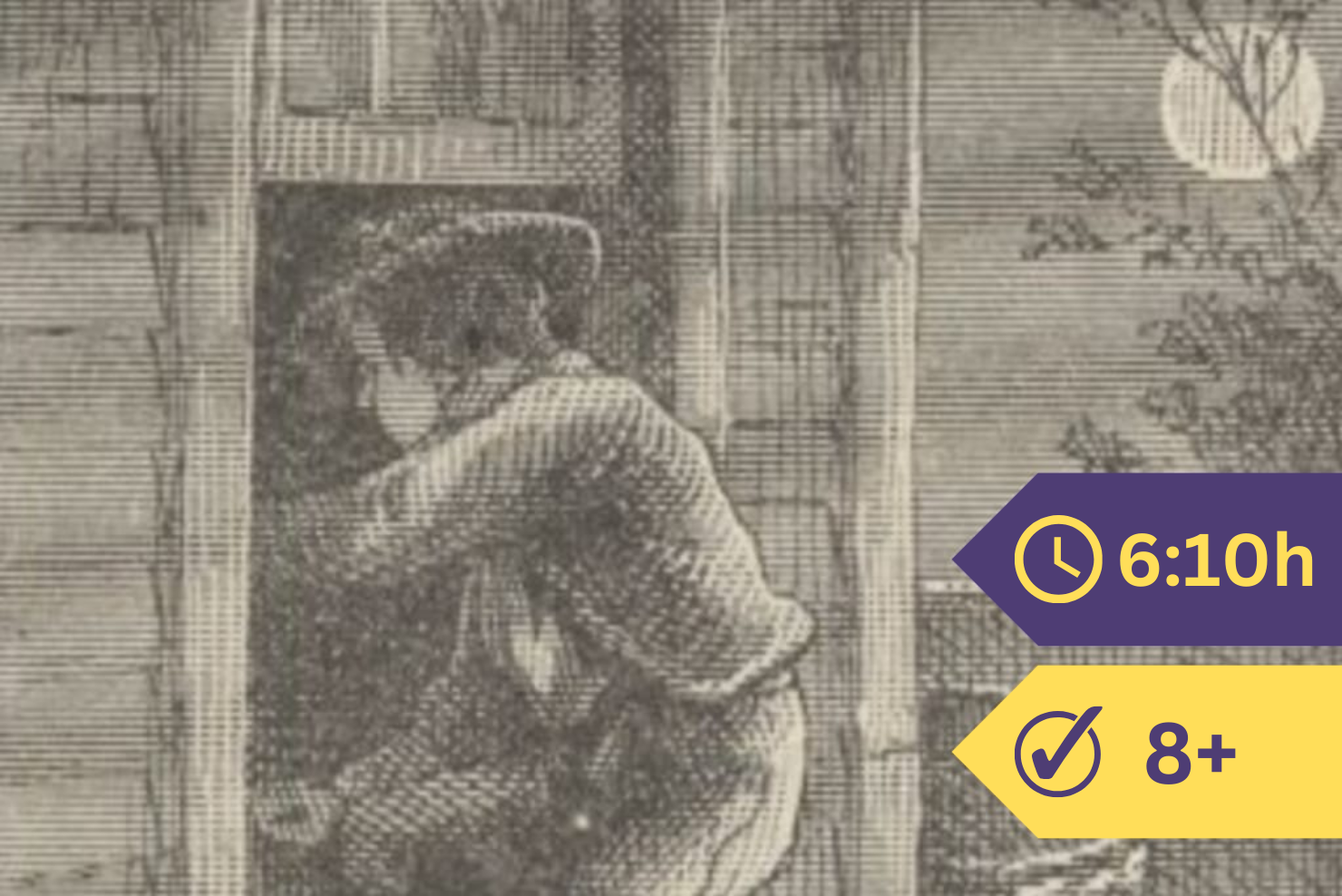
That evening, Maarten drilled a hole in his jumping pole, just as he had learned to do as a carpenter. The letter was rolled up tight, wrapped in a piece of pig’s bladder to keep out the water, and slid into the hollow. A little wooden plug on top. No one could see a thing.
At ten o’clock, the gate opened a crack. “Good luck, Maarten,” whispered the guard. And off he went, into the dark night.
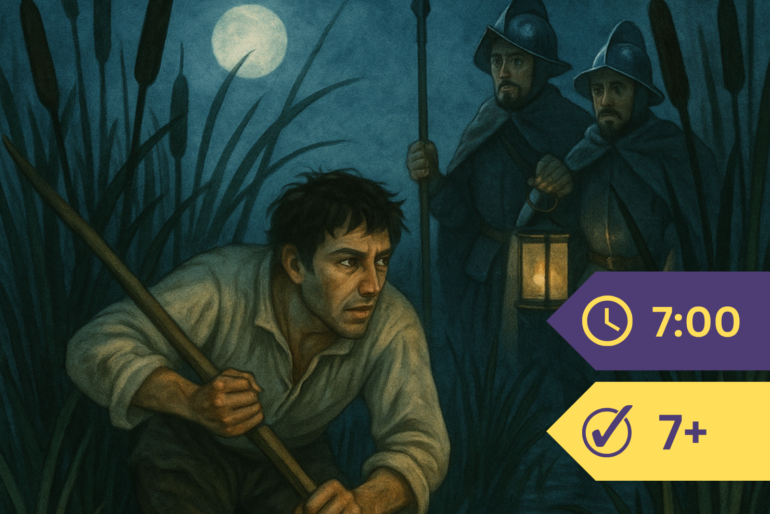
Maarten left the road at once. Roads were watched. He stepped into the marsh, in among the tall reeds, where the water came up to his knees and the mud sucked at his shoes. Step by step he edged forward. He bent the reed stems aside instead of breaking through them, because a snap in the night sounds as loud as a gunshot.
Somewhere close by, he heard Spanish soldiers talking. Sentries. Maarten held his breath and crept on, slow as a snail.
And then — flap-flap-flap!
In the dark, his hand had touched a sleeping duck. The bird shot into the air, quacking wildly, and all around him startled waterbirds burst from the reeds.
“¿Qué es eso?” a sentry shouted. What is that?
Footsteps. Boots splashing through the water, coming closer and closer. Maarten dropped flat into the mud, his face half in the water, and did not move. His heart hammered so hard he was sure the Spaniards could hear it. A spear jabbed into the reeds, an arm’s length from his head.
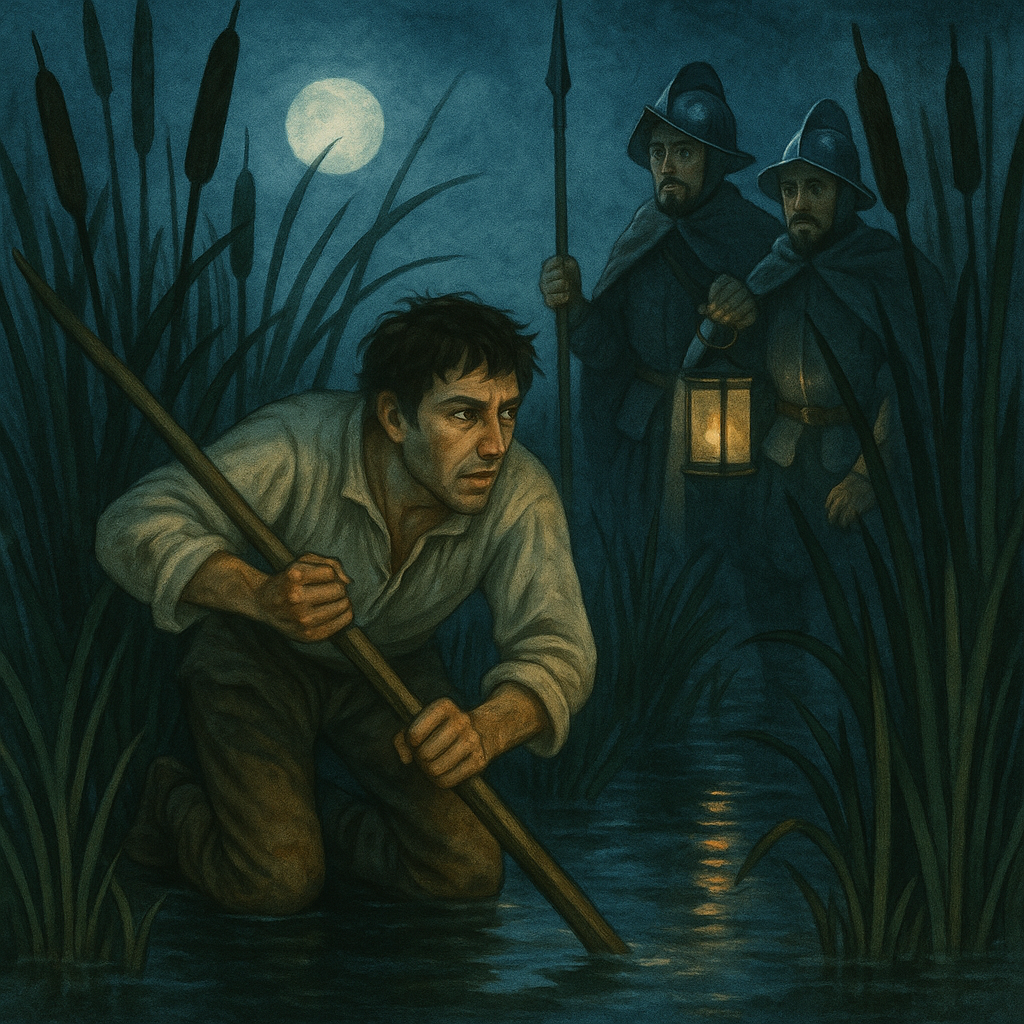
“Bah, a fox,” the soldier grumbled. “Or an otter.” The footsteps faded away.
Maarten waited until he saw the tower light of Alkmaar — the agreed signal that the coast was clear. Then he crawled on, hour after hour, until at last the marsh ended and he stood on dry ground in the first light of dawn. Wet, cold, covered in mud — but through.
In Schagen he brought the letter to Sonoy, the commander of the north. Sonoy read it and nodded gravely. “Cut the dikes. A good plan. But for that I need permission, Maarten. The land that floods belongs to the farmers and the gentlemen. Go to Hoorn, to the States, and ask them.”
So Maarten walked on to Hoorn, six hours further. There, in a grand hall full of grand gentlemen, he told them about Alkmaar. About the cannons. About the children on the walls.
“Cut the dikes,” he begged. “It is the only way to save us.”
But the gentlemen shook their heads. “Put our land under water? Our cattle, our harvest? Alkmaar has only been under siege for three weeks. Haarlem held out for seven months. Wait until All Saints’ Day — then we shall see.”
Then Maarten grew angry. Truly angry. “Wait?!” he cried. “If you were inside Alkmaar yourselves, you would weigh the lives of women and children a little heavier than the lives of your cows!”
You did not say such things to the grand gentlemen. They wanted to throw him in prison — until one man stood up. A farmer, of all people: Frederik Ottens. “Shame on you,” he said. “This man has risked his life while we sit here in safety. He has earned the right to a sharp word. I will vouch for him.”
Maarten was allowed to go. And Ottens gave him one piece of advice: “Go to Delft, lad. To the Prince of Orange. If he gives the order, no one can say no.”
The Prince of Orange received the carpenter kindly, listened to everything he had to tell, and wrote letters that very day: to Sonoy and to the town council of Alkmaar. Cut the dikes. This is an order.
The letters were too big for the jumping pole. So Maarten put them in a pig’s bladder, tied it firmly to his pole, and set off on the journey back — first past Schagen, where Sonoy got to work at once, and then on towards Alkmaar, carrying the letter for the town council. Once more the reed marsh waited. Once more the sentries. It would be all right; he had done it before.
But the rains had made the marsh deeper. In the middle of the darkness his pole plunged into a hole. Maarten pitched forward and went under, head and all, into the black water. He could not swim! Thrashing and gasping, he clung to his pole, fought his way through the reeds, and at last felt ground under his feet again.
Only when it grew light did he see it: the bladder was gone. The Prince’s letters — lost, drifting somewhere in the marsh.
Maarten could have wept. He could not search the marsh, and he could not go back to Delft. There was only one thing left to do: get into the town himself and deliver the news by mouth.
What Maarten did not know: the wind was slowly pushing the bladder towards the shore — to the exact spot where a Spanish sentry stood. The sentry fished the strange thing out of the water, felt papers inside, and took it to his commander-in-chief, Don Frederik himself.
Don Frederik opened the letters and began to read. With every line, his face turned whiter. The dikes… to be cut… the seawater… rolling straight towards his army. Before his eyes he could already see his cannons sinking beneath the waves.
“Break off the siege!” he ordered. “Move the guns. Now!”
And so the strangest thing in all of Alkmaar’s history came to pass: the letter that never arrived, arrived exactly right. The enemy read it — and fled.
Maarten knew none of this. After one more night of creeping, a borrowed little boat, and a sentry he had to shove clean overboard, he was hauled into the town at the bulwark. All of Alkmaar cheered at his story. And from the ramparts they saw it with their own eyes: the water around the town was rising, and the Spaniards were dragging their cannons through the mud, cursing, away from Alkmaar.
On the 8th of October 1573, the last Spanish soldier was gone. The gates swung open. People ran out into the free fields and breathed deep.
Victory begins at Alkmaar — so they still say in the Netherlands. And in Alkmaar it is celebrated every year on the 8th of October.
But when you see the fireworks above the Great Church, spare a thought for a carpenter with a jumping pole. For a man who crawled through the reeds, shook his fist in grand halls, and lost the most important thing he carried.
Sometimes a mistake is not a disaster. Sometimes a lost letter saves a whole town.