On Christmas Eve, towards nightfall, Johnnie Graham and his sister Minnie were curled on the floor near the kitchen stove, poring over the pictures in an old magazine. Little Minnie was explaining each one to her brother. Outside, the Kansas wind was howling around the house and driving the snow high against the windowpanes. Beyond the glass there was only darkness, save for a few lights to the west where the village of St. Maure’s lay. At the table beside the children, Mrs. Graham was washing the dishes.
“Halloa!” cried Johnnie, jumping to his feet. “I hear someone coming!” And he rushed to the door.
The sound of feet shuffling through the snow was followed by an impatient knock. Johnnie threw the door open and found himself facing a man with a telegram in his hand.
“It’s for your father, and it’s immediate.” With those words the messenger disappeared back into the darkness.
“I hope it isn’t bad news,” said Mrs. Graham.
“May I run to the stable and bring it to Papa?” cried Johnnie.
“Yes, dear.”
“And may I go too, Mamma?” asked Minnie.
At their mother’s nod, the two went tripping through the snow and soon reached the stable, a stout building just a stone’s throw from the house. There were four horses inside — one of them, Witch Winnie, was the finest horse in the West. Mr. Graham was a devoted lover of horses.
“Papa, here’s a telegram!” cried Johnnie.
“And it’s marked immediate,” added Minnie.
Mr. Graham, who had been fondly stroking his favourite racer, hurried from the stall and tore open the envelope. His face changed as he read:
Topeka, Kansas.
Your sister is dying and calls for you — not an hour to spare.
John Talbot.
“Is it something bad, Papa?” asked Minnie, catching her father’s right hand, while Johnnie, saying nothing but looking no less worried, took the other.
“Yes — your auntie is very ill. I have about three quarters of an hour to get ready and catch the train. Come, little ones, we must tell Mother at once.”
“Surely it never rains but it pours,” exclaimed Mrs. Graham when she heard the news. “Yesterday poor John was called away to the side of his dying mother in Kansas City.”
John was their man-of-all-work, a steady and faithful young fellow who, after his love for every single member of the Graham family, was devoted heart and soul to the horses.
“I hate to leave you alone on any night, my dear,” said Mr. Graham, “but especially on Christmas night.”
“But you must go to Annie’s side. And besides — I’m not afraid. Everything is secure. We’ve lived here over two years now, and nothing has gone wrong.”
“And, Papa,” said Johnnie anxiously, “if you go — do you think Santa Claus will still come?”
“Why, of course! I’ve sent him word that I’ve put the Christmas tree in the hay-loft so he won’t make the mistake of coming to the house. Tomorrow morning when you and Minnie wake up, you may run over to the stable — you’ll find that Santa Claus can get through the stoutest door in Kansas, even with the strongest lock.”
“And Papa,” said Minnie, “what time does Santa Claus come?”
“Oh, about twelve o’clock.”
Half an hour later Mr. Graham was kissing them all farewell.
“Papa, may I keep the key to the stable?” asked Johnnie.
“Here it is. Don’t lose it, my little man.”
“And may we go over and see Witch Winnie just once more tonight, Papa?” chimed in Minnie.
“Of course. Well, goodbye, dearest, and God bless you all.”
Johnnie had been asleep for some hours in his little cot when Minnie tiptoed into the room.
“Johnnie,” she whispered at his ear.
The child turned uneasily.
“Johnnie,” she whispered again.
“What’s the matter? Is it Christmas?”
“Oh, Johnnie!” she continued as the boy sat up in bed. “It’s just eleven o’clock.”
“I want to go back to sleep. Go away,” said the brother, lying down again.
“But wouldn’t you like to see Santa Claus?”
“What!” cried the lad, leaping out of bed.
“You know — Papa said he’d come about midnight. I haven’t been able to sleep for thinking of it. Let’s go over to the stable and keep perfectly quiet, and maybe we’ll see him.”
“We daren’t go,” said Johnnie.
“Yes, we may,” answered Minnie. “Don’t you remember — I asked Papa if we could go over and see Witch Winnie tonight?”
“That’s true.”
A few minutes later, two small figures glided over the snow, unlocked the stable door, and slipped inside.
“Shall we leave the door open for Santa Claus?” asked Johnnie.
“I think not,” Minnie answered. “It might hurt his feelings.”
Johnnie locked the door.
“It’s so dark in here — I’m frightened.”
“Hush!” cried Minnie. “I have matches, and we can light the candles if we like. But then Santa Claus might see us watching for him, and maybe he’d be displeased. Come — let’s get into Witch Winnie’s stall and climb up into the manger. She’ll be company for us.”
Witch Winnie gave a little neigh of joy when she felt the hands of her two dearest little friends caressing her. Then there was an unbroken silence.
One minute passed — though Johnnie thought it an hour — when a stealthy step was heard outside.
“He’s coming!” cried Minnie, breathing quickly.
The steps ceased at the door. Then there came a low whistle.
At the sound, Witch Winnie gave another neigh of joy.
“Why — even our horse is glad Santa Claus is coming!” whispered Johnnie.
“Shh!” hissed Minnie.
For a minute or two there was a fumbling at the lock.
“I think I’ll go and help Santy,” whispered Johnnie. “Maybe he’s not used to that kind of lock.”
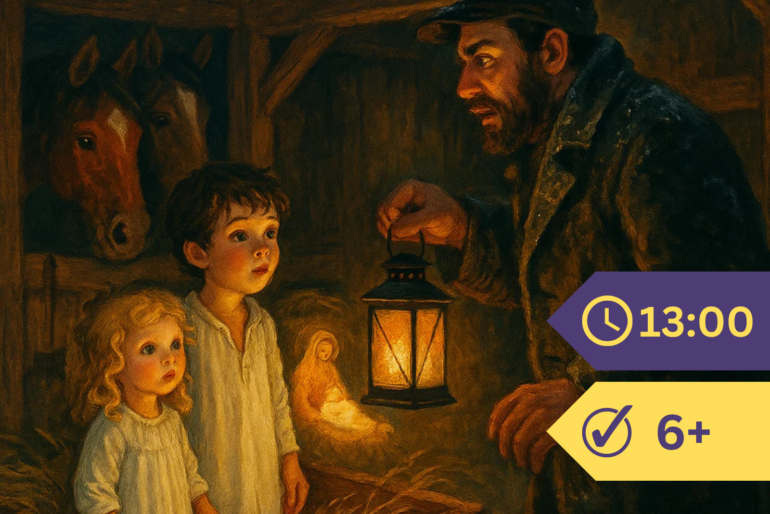
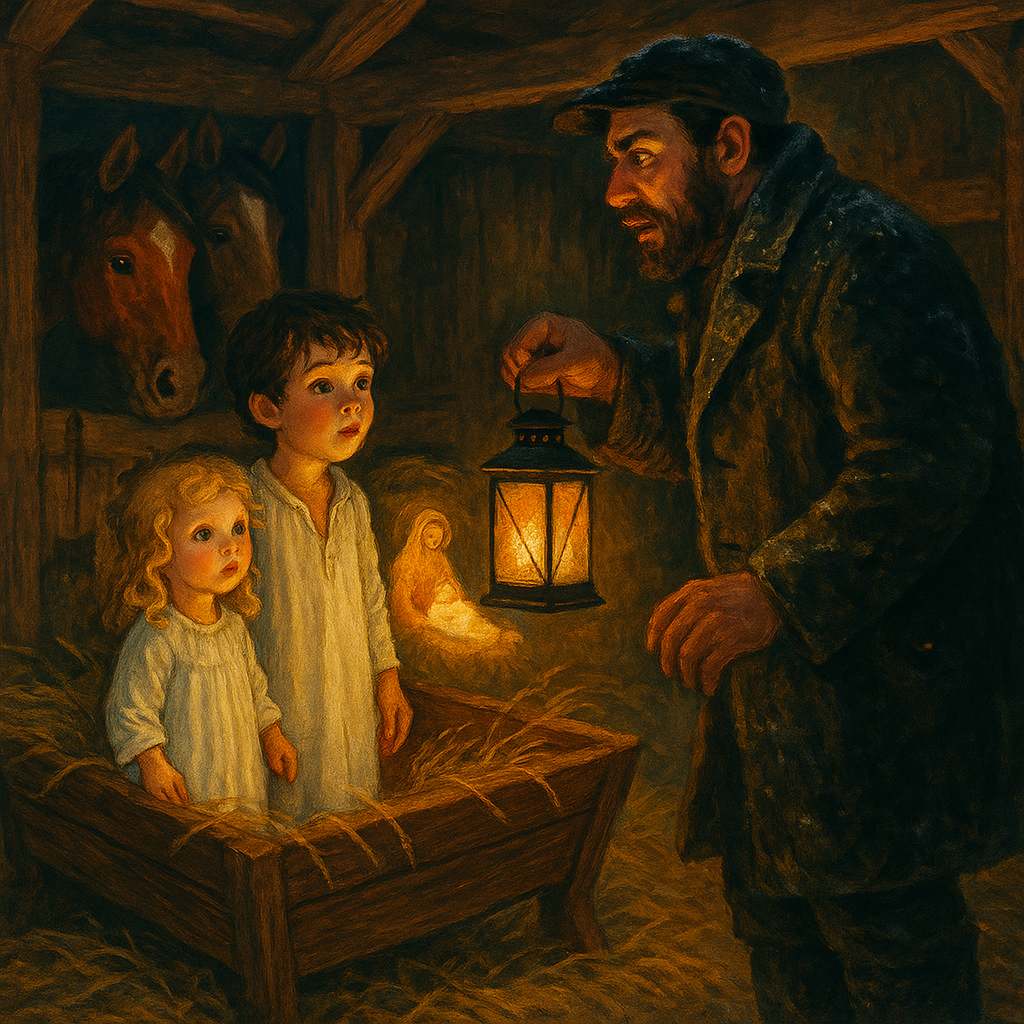
He was about to leap from the manger when the lock turned, the door swung open, and in the light of a lantern they saw a man standing in the doorway.
He was wrapped in a heavy coat crusted with snow — so far he resembled the pictures of Santa Claus. He wore a beard, too — but it was black. There was no pack on his shoulders and no smile on his face. In one hand was the lantern; in the other, a pistol. He was frowning and did not look jolly in the least.
Johnnie’s heart sank. He began to have doubts about whether it was Santa Claus at all.
The man stood still for a moment, then whistled as before.
Witch Winnie answered with a low, joyful neigh.
“Ah — there she is,” the man muttered under his breath.
Johnnie could stand it no longer.
“Halloa, Santy Claus!” he cried out, his voice a little shaky.
The man gave a start, then raised his pistol to full cock and threw the glare of the lantern full upon Witch Winnie and the two small figures in the manger.
It was a striking picture — the mare with her fine head turned eagerly toward the newcomer, Minnie on one side of her and Johnnie on the other, both of them looking steadily and without fear at the man with the cocked pistol.
“Aren’t you Santa Claus?” cried Minnie.
The stranger lowered his pistol and stepped forward.
“Yes, my little ones,” he said. “I am Santa Claus.”
“I knew it!” cried Johnnie. “Even Witch Winnie knows it — see how glad she is to see you! She looks at you just the same as she looks at Papa. Oh, I’m so glad to see you, Santy. But where is your pack?”
“It’s outside. Do you little ones expect presents?”
“Of course we do!” answered Minnie. “This is Johnnie, and I’m Minnie. Papa told us you were coming tonight, so we sneaked over to see you come in.”
“Well, little ones,” said Santa Claus in a rather stern voice, “it’s against my rules to let anyone watch me at work. Now — if you want the very nicest Christmas presents, you must make me a promise.”
“All right, Santy Claus!” cried Johnnie.
“You must go straight back to the house, go to sleep, and not say another word until sunrise tomorrow. Do you promise?”
“Cross my heart,” cried the boy.
“And so do I,” added Minnie, “but first, dear Santa Claus, I want you to do something for me. Papa told us that you come in place of the Infant Jesus. Is that so?”
“Y — yes,” said Santa Claus, coughing uneasily, and putting his pistol away as though ashamed of it.
“Well — we know how much you must love the little Infant. And I thought you’d like to take a look at the crib Papa fixed up for us. There are twenty candles, and the little Infant is just lovely. Come on, Santa Claus — here’s my hand.”
Santa Claus shivered as the child put her trusting hand in his. He was in a great hurry. But a little child led him — led him across to the far side of the stable and into a vacant stall.
Striking a match, Minnie lit a row of coloured candles, and their warm glow fell upon a beautiful wax figure of the Child Jesus lying with folded arms upon a small platform.
“Auntie Jane was in Paris,” explained Minnie, “and she bought it for us. Isn’t it sweet?”
“It is,” said the man. A faint moisture had broken out on his brow.
“Now, Santa Claus — I know you’ll want to kneel down and pray. Johnnie and I always do.”
Santa Claus knelt. He bowed his head, and did not see what Minnie was doing. Suddenly he gave a start. Looking up, he saw Minnie sinking to her knees, while from the little platform beneath the figure came a sweet, tinkling Christmas melody — Adams’ Noël — and he shivered again, and the moisture on his forehead gathered into beads as he listened.
“Look,” whispered Minnie.
The waxen infant opened its sweet blue eyes. The tiny waxen arms uncrossed themselves and extended outward, as though they would enfold the whole world in their warm embrace.
“Isn’t it beautiful?” whispered Johnnie, and his voice was like a prayer.
Then the arms slowly folded again, and the sweet blue eyes were curtained once more. The child was asleep. After a moment’s pause, the tinkle of the Adeste Fideles made the silence lovely.
“Let’s sing for Santa Claus,” whispered Johnnie.
At the word, both broke out into the glad notes of the Christmas hymn, singing with the sweetness of clear, young voices and the full conviction of living faith.
Before they had finished, Santa Claus laid his pistol before the shrine as an offering. He was done with it.
“Would you like to kiss the Infant?” asked Minnie.
“I dare not,” he answered hoarsely.
A faint sound came from the distance — a horse galloping at full speed.
“God bless you — you — you darlings. God bless you, and forgive me.”
With those last words he was rushing for the door, and then he was gone, swallowed by the dark, while nearer, louder, clearer came the sound of hoofbeats.
The children hurried to the door and looked in vain for any sign of Santa Claus. Even as they were straining their eyes into the darkness, a horseman on a foaming horse came dashing up.
“Why — it’s Papa!” cried Minnie.
“Merry Christmas, Papa! We’ve seen Santa Claus, and he ran away when he heard you coming!”
“Is Witch Winnie all right?” cried Mr. Graham, leaping from his horse.
“Yes!” answered Johnnie, and, with Minnie filling in the details, he told the whole night’s adventure.
Mr. Graham listened with his face very carefully held.
“It’s too bad, Papa, that you frightened Santy away,” said Minnie when Johnnie had finished. “He didn’t bring our Christmas presents yet.”
“Yes, he did. Come up and see.”
And they went up and saw. It was the finest Christmas tree in Kansas, and every gift Minnie and Johnnie could have wished for was waiting there.
“Now, my little darlings — let’s go down to the crib, and say thank you.”
And so they knelt — Minnie and Johnnie giving thanks for their beautiful Christmas gifts, and their father giving thanks for the safety of Witch Winnie from the hands of her former groom, who had forged two telegrams, who had entered the stable as a horse-thief, remained in it as Santa Claus, and left it touched and softened and repentant, through the sweet visions of innocence and of the Infant Jesus vouchsafed to him there.