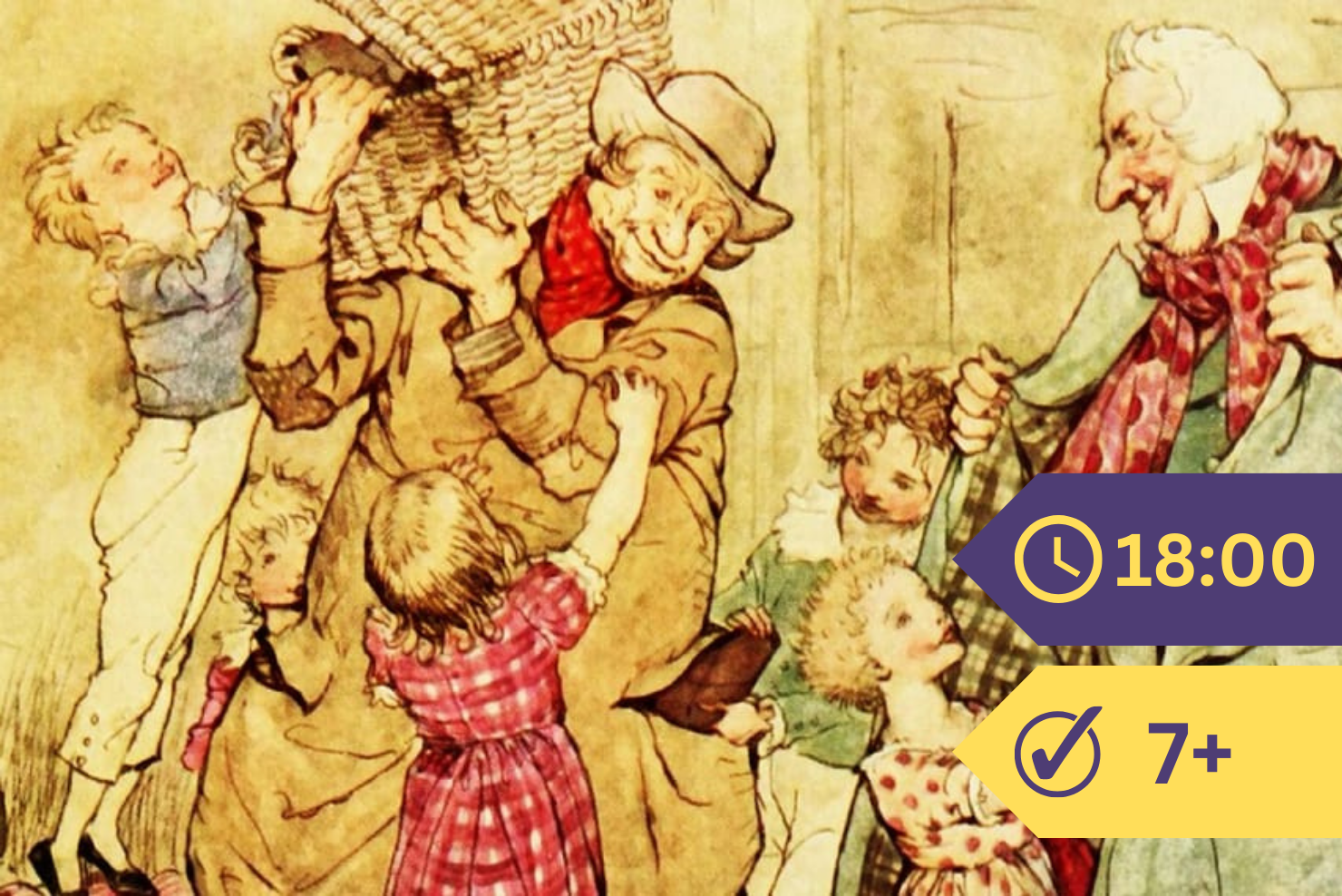
The very air was full of Christmas! Everywhere, happy children were busy writing letters to Santa Claus. Sea Bird declared that even the sparrows on the chimney-tops were watching for him — and oh, how she wished she could turn herself into a sparrow, just for a little while!
Everyone in the Lester household was keeping some sweet secret, and it kept their lips curved in mysterious little smiles. Every day Mrs. Lester took Grace into the city to shop. But they never forgot Deborah, whose days were growing harder as Grannie Orr became deafer, more helpless, and more difficult to please. Deborah tried hard to be patient — and it was easier now that she had her doll to keep her company, a friend to whom she confided all her many cares and her few small joys.
Although dear Dollie was as deaf and unseeing as Grannie herself, she always smiled — and in the little orphan’s life, smiles had been very rare.
And Sea Mew, the kitten dozing contentedly by the fire, never knew what a comfort she had been either. In her heart, Deborah always called her “my good fairy.” Whenever she thought Grannie wouldn’t miss her, she made quick trips to the Lesters’ beautiful grounds — her own private fairyland — and peeped through the hedge, hoping to catch sight of the kitten. When she did, she’d snatch it up with a fierce hug and a kiss, then dart back out and hurry down the long rough road that led far away from fairyland.
One day, after Grace had visited Grannie’s with a well-filled basket, her thoughts were so heavy that her pretty head drooped low, and she nearly walked straight into Mrs. Lester as she rounded a corner.
“Oh, Mrs. Lester! What do you think!” she cried, catching her breath in a sob. “Santa Claus has never once visited Deborah! I told her she must write him a letter, and that I’d write one too, and ask him to be sure to call on my friend. But they have no fireplace, only a stove, and of course we couldn’t ask him to drive down through that — so we planned that Deborah should climb up onto the roof (she can climb like a squirrel!) and hang her stocking on the chimney, and one of Grannie’s too. Wouldn’t that do?”
“It might,” said Mrs. Lester gently, tucking her hand under the little uplifted chin and smiling down into the eager face, “but it would be dangerous. I think we can find a better way.”
“I knew you could help Deborah!” Grace said. “I told her I’d ask you. And you know — when she shouted into Grannie’s ear that Christmas was coming, Grannie opened her eyes so wide we thought for a moment she could see. She clasped her hands and laughed like a child! It frightened Deborah, because she’d never once heard her laugh. Grannie asked if she’d ever hung a stocking, and then she said, ‘Yes — there were four: Jennie’s, and Bennie’s, and Billy’s, and mine. Mother hung them. And when I grew up and married, I had a little stocking of my own to hang. Where is my little boy? I’ll go and find him, and he’ll be so glad to see me, because I’m his mother, and we’ll have Christmas together.’ And then, in a few minutes, she fell asleep.”
Something in the story told Mrs. Lester she was needed there, and she went at once.
She found Deborah seated beside the bed, the doll in her arms, softly repeating the wonderful story of Santa Claus just as Grace had told it — never realizing that a great, quiet presence had entered the room. Grannie had slipped away in her sleep. She had gone to find her little boy — and now, surely, they would have their Christmas together forever.
After the funeral, Mrs. Lester took Deborah home to live with them, and the pale, pinched little face soon grew bright and happy. But one night she whispered to Dollie, in an awed voice:
“I’m afraid I’m terribly bad — because I just can’t feel sorry that I’m glad.” Dollie didn’t scold her. She only smiled.
“See, Grace? Doll says it’s all right, so I think I’ll just go on being happy. Wouldn’t you?”
“Why, of course. What’s bad about being glad, I’d like to know?” said Grace, cuddling Sea Mew closer.
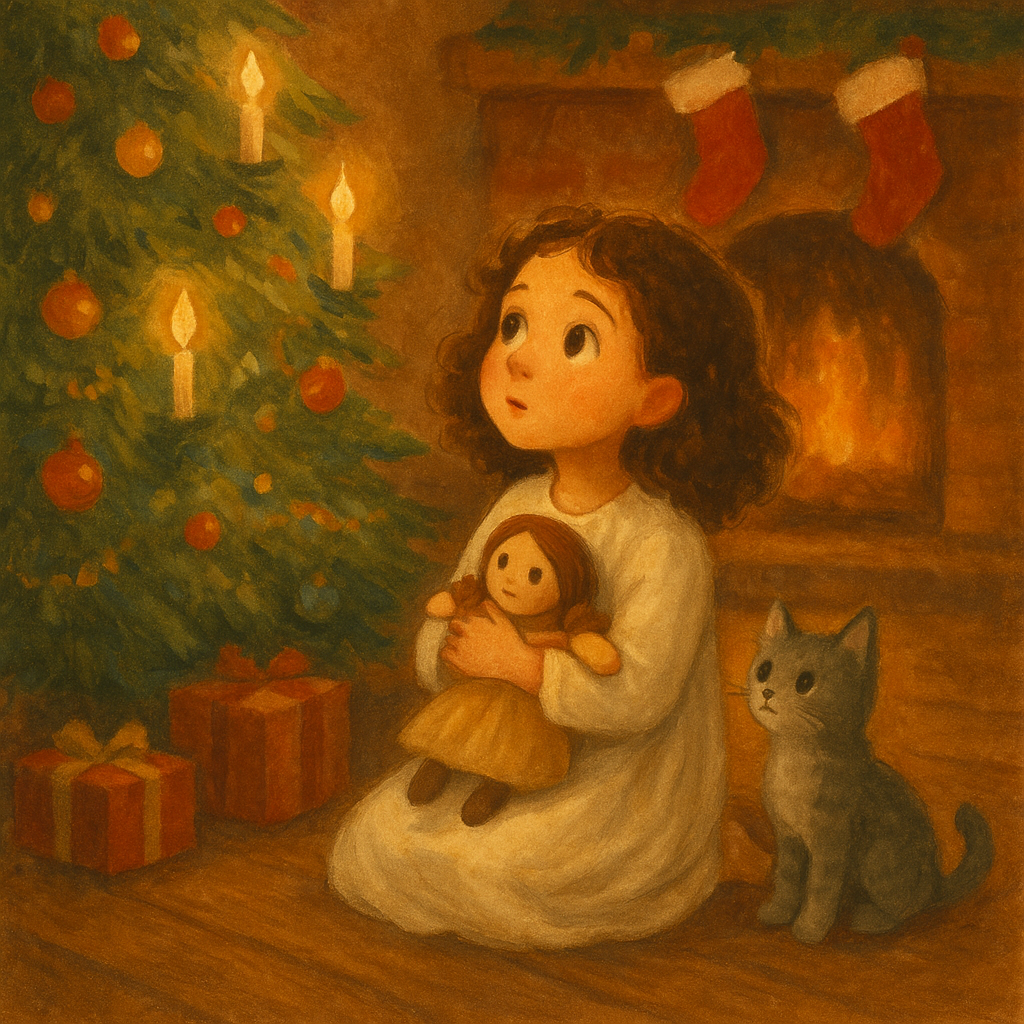
“But don’t you see — if Grannie hadn’t died, I wouldn’t be here. You don’t suppose I’m glad she died, do you? That’s what troubles me.”
“I don’t think you are,” Grace said gently. “I think you’re just glad to be loved and safe at last — and there’s nothing wrong with that. Grannie has her own little boy now, and you have us. You can be glad for both.”
“But — it’s so nice to be glad! I never was glad before in all my life.”
“Then never mind, Deborah,” said Grace, hugging her. “Your heart knows it means no harm — and that’s what matters.”
And so Deborah was comforted, and went on being glad.
“Christmas has so many surprises,” said Mr. Lester on Christmas Eve, with a mysterious twinkle in his eye as he stroked Grace’s hair. Mrs. Lester’s eyes fairly danced as John suddenly slipped out of the room, and Paul began to sing:
‘Twas the night before Christmas,
When all through the house
Not a creature was stirring,
Not even a mouse—
And lo! the door opened by John’s hand — and in walked Grace’s own father and mother!
With a great glad cry, Grace sprang into her mother’s arms, and her father’s arms closed around them both. And watching them, it dawned on Deborah that there might be something even better in the world than Santa Claus and Christmas.
The two happy little girls hung their stockings that night in the good old-fashioned way. And in the morning — glad Christmas morning! — I hope you can all picture just how much joy there was in exploring those stockings, from the very top down to the toe. Since it was the first time Deborah had ever known the goodness of Santa Claus, you can imagine her delight when a beautiful Christmas tree appeared after the stockings — and even Dollie and Sea Mew and Jet were remembered!
“I wish tomorrow could be Christmas too,” Deborah sighed as Mrs. Lester kissed her goodnight.
“So do I,” echoed Sea Bird.
“You little ones should live in Mexico,” laughed Mrs. Lester, “where the Christmas festivities last for days. There the children don’t hang stockings or have a tree at all. Instead, all the toys and sweets are hidden inside a big container of brightly coloured paper, hung from the ceiling — it’s called a piñata. The children are blindfolded one at a time and given a stick, and they take turns trying to hit it. They miss quite as often as they hit — but when someone finally breaks it open, down comes a shower of toys and candies and fruit, and all the children make a wild, laughing scramble for it!”
A little later, as Deborah’s brown curls settled onto the pillow, she counted on her fingers: “I have six good friends — Santa Claus, the Lester family, the Grace family, Dollie, Sea Mew… and everyone who’s been kind to me.” And she felt richer than the richest little girl in all of big New York.
“You ought to be thankful most of all for the love that found you, Deborah,” said Grace softly.
“Yes… I am… dear…” — but the happy little girl fell asleep before she could finish. And that was all right, for love already knew exactly what was in her grateful little heart.