The boys and girls had fastened the last sprig of holly to the church walls and then gone home, leaving the old building silent and empty. The sun had set in a sky as clear and yellow as topaz. Christmas Eve had come at last, and now the moon was rising — a full moon — and all the world lay white in its silver light. Every bough of every tree sparkled with a delicate coat of frost; the pines and cedars were great shapes of dazzling snow; and even the ivy on the gothic tower hung in a glittering arabesque against the gray wall. Never was there a lovelier night.
That warm light over there comes from the window of old Andrew, the sexton. Inside sits his grandson, little Roger, eating his supper of porridge. The kitchen is in apple-pie order — chairs and tables scrubbed as white as snow, the tins on the dresser gleaming like silver, the hearth swept clean, and Grandfather’s chair drawn into the warmest corner. Grandfather isn’t sitting in it just now; he’s gone to the church to bank the fire for the night, lock the doors, and make everything safe.
Grandmother, in her clean wool gown and apron, has climbed up on a chair to stick a twig of holly on the tall clock in the corner. As she turns round — what a pleasant face she shows! Old and wrinkled, to be sure, but so good-natured and gentle that she’s prettier than many a young woman even now. Is it any wonder little Roger adores her?
Now another bit of holly is needed for the chimney-piece, and it’s while putting this up that the dear old woman gives a small sign that something has gone wrong. “Ts, ts, ts — deary me!”
“What’s the matter, Granny?” said Roger.
“Why, Roger,” replied Granny, carefully climbing down from her chair, “look here. Grandfather’s gone off and forgotten his keys. He took them from the door this morning — last year some of the young folk dropped them in the snow and had a dreadful time finding them — so he opened the door himself and brought the keys home. Deary me! It’s a cold night for old bones to be out. Would you be afraid, little one, to run up with them?”
“Not a bit,” said Roger stoutly, cramming the last spoonful of porridge in his mouth and seizing his hat and mittens from the table. “I’ll take them up in a minute, Granny, and then run home — Mother will want me in the morning.”
Roger’s parents lived in a cottage near the old people’s, and the boy often said he had two homes and belonged half in one and half in the other. The small bed in Granny’s loft seemed as much his own as the cot in his mother’s room, and was nearly as often slept in. So, after a good-night hug from Granny, off he ran.
The church was close by, and the moonlight was bright as day, so he never thought to be afraid — not even when he brushed past the dark tower and something stirred overhead, and a long, melancholy cry came shuddering down from the ivy. Roger knew the owls in the belfry well. He called up to them cheerily: “To-whit-whit-whoo!”
“Whoo-whoo-whit!” answered the owls, startled. He could hear them fluttering in the nest.
The church door stood ajar. He peered in. The glow from the open stove door showed Grandfather’s figure, ruddy and warm, stooping to cover the fire with ashes for the night. He was so absorbed he never knew the boy was there until Roger got close and jingled the keys in his ear — whereupon he gave a start and then laughed, well pleased.
“I only just missed those,” he said. “You’re a good boy to bring them up. Are you walking home with me tonight?”
“No, I’m to sleep at Mother’s,” said Roger, “but I’ll wait and walk with you, Grandfather.” So he slipped into a pew and sat down while the work was finished, and as he looked up he saw all at once how beautiful the old church was.
The moon outside was streaming in so brightly that you hardly missed the sun. Roger could see clearly all the way up to the carved beams of the roof, and trace the figures in the great arched windows above the altar — figures whose colors had so often dazzled him on Sundays. The colors were soft and dim now, but the figures were plainly there: the seated figure of the Lord Christ, with St. Matthew and two other apostles, and the fisher-lad with his basket of fish. He had often asked Granny to read him that story.
A gleam at the far end of the nave came from the organ-loft, where the moonbeams had found the great brass pipes and were playing all manner of tricks with them. Almost the red of the holly berries could be seen, and every pointed ivy-leaf and spike of evergreen in the window wreathings stood out in bold relief against the shining panes. With this beautiful whiteness the red glow of the fire blended, flooding the chancel with a lovely pink light in which shone the gilded letters of the commandment boards and the brass memorial tablets on the walls. It was a wonderful thing to see.
To study the roof better, Roger thought he would lie flat on the cushion and look straight up. He arranged himself comfortably — and somehow, as will happen even when we are full of pleasure — his eyes closed. The first thing he knew he was rubbing them open again. Only a minute, it seemed; but Grandfather was gone. The stove was closed for the night, and the great door at the end of the aisle was shut.
He jumped up in a fright, ran to it, and shook it hard. No — it was locked. Poor Roger was fastened in for the night.
He understood it all at once. The tall pew had hidden him from sight. Grandfather had thought him gone home. His mother would never doubt that he was safe at the cottage; no one would miss him; and there was no chance of being let out before morning.
He was only six years old, so no wonder he felt choked and frightened at first, and close to tears. But he was a brave lad, and that feeling soon passed. He began to think he wasn’t so badly off after all — the church was warm, the pew cushion as soft as his bed, and no one could get in to harm him. In fact, after the first shock, there was something so exciting and adventurous about spending the night in such a place that he was almost glad the accident had happened. So he went back to his pew and tried to sleep.
That wasn’t so easy. Have you ever been thoroughly woken by a sudden fright in the night? Do you remember how your eyes wouldn’t stay shut afterward — how they jerked open against your will, as if a string were fastened to them and someone were twitching it? Just so with Roger. He’d lie still for a moment, and then some little noise would set his heart beating and his eyes flying wide open. A coal dropping from the fire. A slight crack in the frosty panes. Once a little mouse crept out from the chancel, glancing shyly about with bright eyes, nibbled a moment at a leaf on the carpet, and crept back again. No other living thing disturbed the quiet.
He had heard the clock strike eleven a long time ago. He was lying with eyes half shut, gazing at the red glow of the fire, and feeling at last a little drowsy — when all at once a strange rush and thrill seemed to pass through the air, like a cool, clear wind blowing through the church. In one moment he was wide awake and sitting upright, ears strained to catch some sound far off. It was too distant and faint for ordinary hearing, but a new and sharper power of listening seemed given to him. Little voices were speaking high in the air outside the church — very odd ones, like birds’ notes, and yet the words were plain. He listened and listened, and at last made out that it was the owls in the tower talking together.
“Hoo, hoo, why don’t you lie still?” said one.
“Whit-whoo-whit,” said another, “I can’t. I know too well what’s coming.”
“What is coming — what, what?” said two voices together.
“You’ll see soon enough,” replied the first. “The elves are coming — the Christmas elves. You won’t get a wink of sleep tonight.”
“Why not? What will they do to us?” chirped the young ones.
“You’ll see!” hooted the old owl. “They’ll pull your tails and tickle your feathers and prick you with thorns. Tricksy, troublesome things! I’ve been here many a long year. You were only hatched last summer. To-whoo, to-whoo!”
Just then the church clock began to strike twelve. At the first clang the owls fell silent, and Roger listened to the deep notes — almost awestruck — as they sounded one by one. He knew the clock’s voice well, but it had never before sounded so loud or so solemn: five — six — seven — eight — nine — ten — eleven — twelve.
It was Christmas Day.
As the last echo died away, a new sound took its place. From far off came the babble of tiny voices, drawing nearer. Anything so gay and charming had never been imagined before — half a laugh, half a song, the tones blending into an enchanting peal, like bells on a frolic. Above the old tower the sounds clustered and swelled — then a long, distressed cry came from an owl, and a bubbling laugh floated in on the wind.
Roger couldn’t stand it. Wild to see, he flew to the window and tried to stretch his neck to catch what was happening above — but it was no use. And just then the church bells began to ring all together, a Christmas chime — only the sounds were infinitely small, as if baby hands had laid hold of the ropes. His sharpened senses brought every note to his ears, and they were so merry and so lovely that he felt he must get nearer or die. Almost before he knew it he was climbing the dark belfry stairs as fast as his feet would carry him, never thinking of fear or darkness, only of the elfin bells pealing overhead.
Up, up — through the long slits in the tower the moon could be seen sailing in the cold clear blue. Higher, higher — at last he gained the belfry.
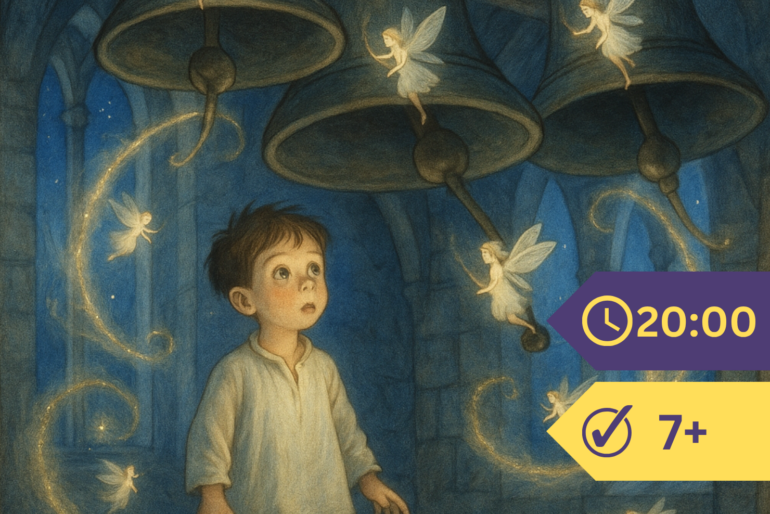
There hung the four great bells, but nobody was pulling their heavy ropes. On each iron tongue perched a fairy; on the chains that suspended them clustered others, all keeping time by swaying their bodies to and fro, just grazing either side, bringing forth a clear, delicate stroke — sweet as laughter, just loud enough for fairy ears.
Through the windows, the crowd of floating fairies could be seen whirling in the moonlight like glittering gossamer. They floated in and out of the tower, they mounted the great bells and sat atop in swarms, they chased and pushed each other, playing all sorts of pranks. Below, others were attacking the owl’s nest — Roger could hear the hoots and grunts and the gleeful laughter of the elves.
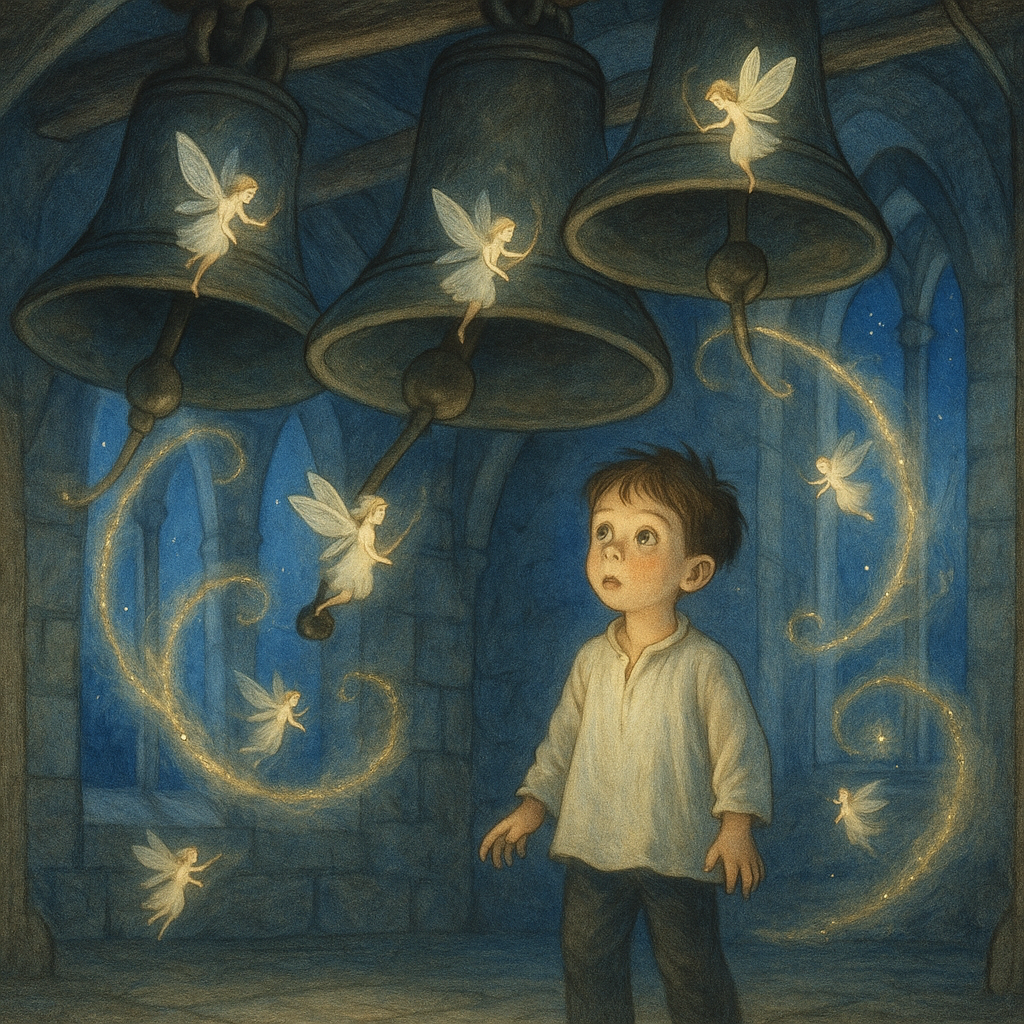
The moon made the tower bright as noon. All the while the elves sang or talked — which, he could not tell — for the words were so blended with laughs and mirthful trills that it was nothing less than music.
To and fro, to and fro, they swayed in unison with the tiny peal they rang. Little quarrels arose. Once Roger watched an elf trying to clamber up the clapper, and whenever he neared the top a mischievous companion pushed him off. The elf pouted, flew away, and returned with a holly leaf. Small as it was, it curled over his head like a huge umbrella. With the spiky point he slyly pricked the elf above, who, taken by surprise, lost his hold and came tumbling down — while the first elf danced for glee and clapped his hands mockingly. Pretty soon, though, all was made up again. They kissed and were friends, and Roger saw them perched opposite each other, swinging back and forth like children on a see-saw.
How long the lovely sight lasted he couldn’t tell. So afraid was he of spoiling the sport that he never stirred a finger — but all at once there came a strain of music in the air, solemn and sweeter than any mortal had ever heard before. In a moment the elves left their play. They clustered like bees at the window and then flew from the tower in one sparkling drift, and were gone, leaving Roger alone with the owls hooting below in the ivy.
And then — which he hadn’t been as long as the fairies were there — he felt afraid, and down he ran over the stone stairs in a fright and entered the church again.
The red glow of the fire was welcome, for he was shivering with cold and excitement. But hardly had he regained his old seat when something marvelous came to pass.
The wide window above the altar swung open, and a train of angels floated slowly through. How he knew them to be angels Roger could not have said — but that they were, he was certain. Christmas angels, with faces of calm and glorious beauty, and robes as white as snow. They hovered over the altar, and a wonderful song rose and filled the church — no bird’s voice was ever half so sweet. The words were few, but again and again they came:
“Glory to God in the highest, on earth peace, good-will to men!”
Roger knew those words — they were the great evergreen motto arching above the chancel — but I think he never forgot the beautiful meaning they seemed to carry as the angels sang them over and over. It was so wondrously sweet that he could not feel afraid. He could only gaze and hold his breath lest he lose a note.
The song rang on, clear and triumphant, as the white-robed choir parted and floated like soft summer clouds through the church, pausing here and there as if in blessing. They touched the leaves of the Christmas greenery as they passed. They lingered over the organ and brushed the keys with their wings. For a long while they clustered above the pews of the poor, as if to leave a fragrance in the air. Then they rested before a tablet put up only a few months before, bearing the name of the rector’s eldest son and the dates of his birth and death. Roger had been told about that brave young man — how he had lost his life diving from his ship to save the drowning child of an emigrant passenger. Now the angel song seemed sweeter than ever, as again and again they chanted, “Good-will to men — good-will to men.”
At last one of the white-winged ones left the rest and hovered awhile above the squire’s pew, near where the little boy was hidden. A prayer-book lay open on the rail, and over it the fair angel bent in benediction. A girl had sat there once — the squire’s only daughter. Roger remembered her well, and the mourning of the whole parish when, barely a year ago, the lovely child had been buried from their sight. Now, as he timidly glanced up into the glorious face above him, it seemed to him to hold the same look — only so ineffably beautiful that he closed his dazzled eyes to shut out the vision and the light shining from the white wings. Only for a moment — then he opened them again as a gentle rustling filled the air, and he saw the bending figure stoop, leave a kiss of blessing on the pages of the open book, and glide away with the others.
Again the group hovered above the altar. Louder and clearer rose the triumphant song — and then, noiseless as a cloud, the snowy train floated to the window. For one moment their figures could be seen against the sky. Then the song died away. They were gone, and Roger saw them no more.
The light of dawn began to creep into the windows. Twittering sounds showed the birds awakening outside, and a pink streak appeared in the sky. Too full of wonder to feel impatient, the boy sat and waited — and by and by a jingling in the lock showed Grandfather at hand. The door opened, and he came in.
You can imagine his surprise when his little grandson flew to meet him with his wonderful story. As for the story, Grandfather laughed it off — sleeping in such a strange place could easily bring about a queer dream, he said. But he took the boy home to the cottage, and Granny, full of wonder and sympathy, quickly prepared a warm breakfast for her darling after his adventure. Even with his mouth full of scalding bread and milk, Roger kept telling of angels and fairies and the owls’ conversation in their nest, until both grandparents began to think him quite bewitched.
Perhaps he was — for to this day he has never changed his story. And though the villagers that morning exclaimed that the old church had never looked so beautiful in all its Christmas finery, and though the organ sent forth a rarer, sweeter music than any fingers had ever drawn from it before, still nobody believed a word of it. And though the poor mother, kneeling in her lonely pew and missing her darling from beside her, felt a strange peace and patience enter her heart, and came away calmed and blessed — still no one listened to the story. “Roger had dreamed it all,” they said.
And perhaps he had. Only the owls knew.