John Day loved the winters he spent in the beautiful home of his friend, Paul Lester. He was such a hardworking, clever pupil that he soon became known as one of the brightest boys in the school where Mr. Lester had kindly placed him alongside his own son — and the fisherman’s little lad had every reason to be proud of himself.
But when spring came each year, John was always ready to go home to the little cottage by the sea, pull on his fishing clothes, and head out on the water with his father. And he stored up so many wonderful stories of the city that his mother and little sister began to dream of seeing it too.
I’m happy to say the Lesters made that dream come true. One beautiful autumn they brought John’s little sister to stay with them — right through until after Christmas.
The Lesters had never had a daughter of their own, so they took great joy in fixing up a room for her, with a doll’s house and everything else to delight a small girl’s heart. Mrs. Lester’s friends, after being shown the pretty room, would smile and say, “Isn’t that just like the Lesters? Always trying to make someone happy.” It was an enviable reputation — and a well-deserved one.
Their home, in one of the loveliest suburbs of New York, was almost perfect: wide lawns, bright flower beds, clumps of shrubbery, and best of all, many grand old trees, especially beautiful now in their autumn colours.
To the little girl the family fondly called “Sea Bird,” the falling of the leaves was a joy that never grew old. One morning she was sweeping the bright leaves into little heaps for Jake the gardener to cart away — but she did it with a sigh, for it seemed such a pity to dump these pretty scarlet and gold and brown treasures somewhere out of sight.
The wind was in high spirits that day, and so was Jet, the little black kitten who was her constant companion. Jet was quite certain the leaves were whirling about just for her, and pranced and pounced in wild efforts to catch them. As Sea Bird swept, she sang:
The wind one morning sprang up from sleep,
Saying, “Now for a frolic, now for a leap!
Now for a madcap galloping chase,
I’ll make a commotion in every place!”
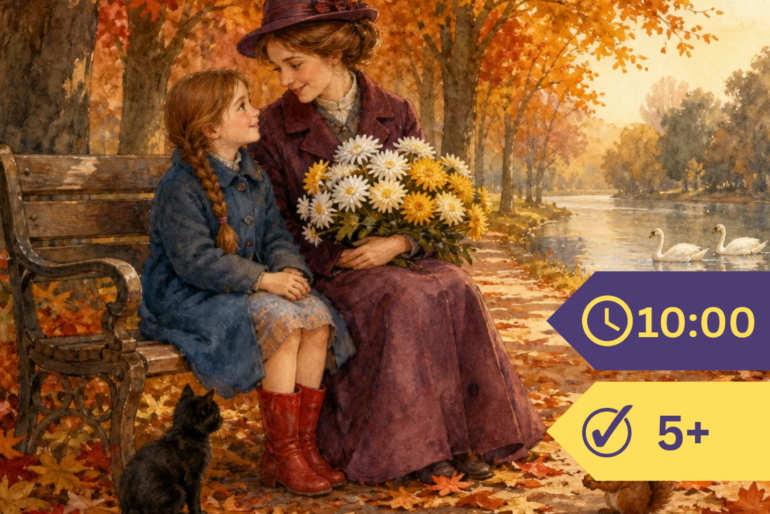
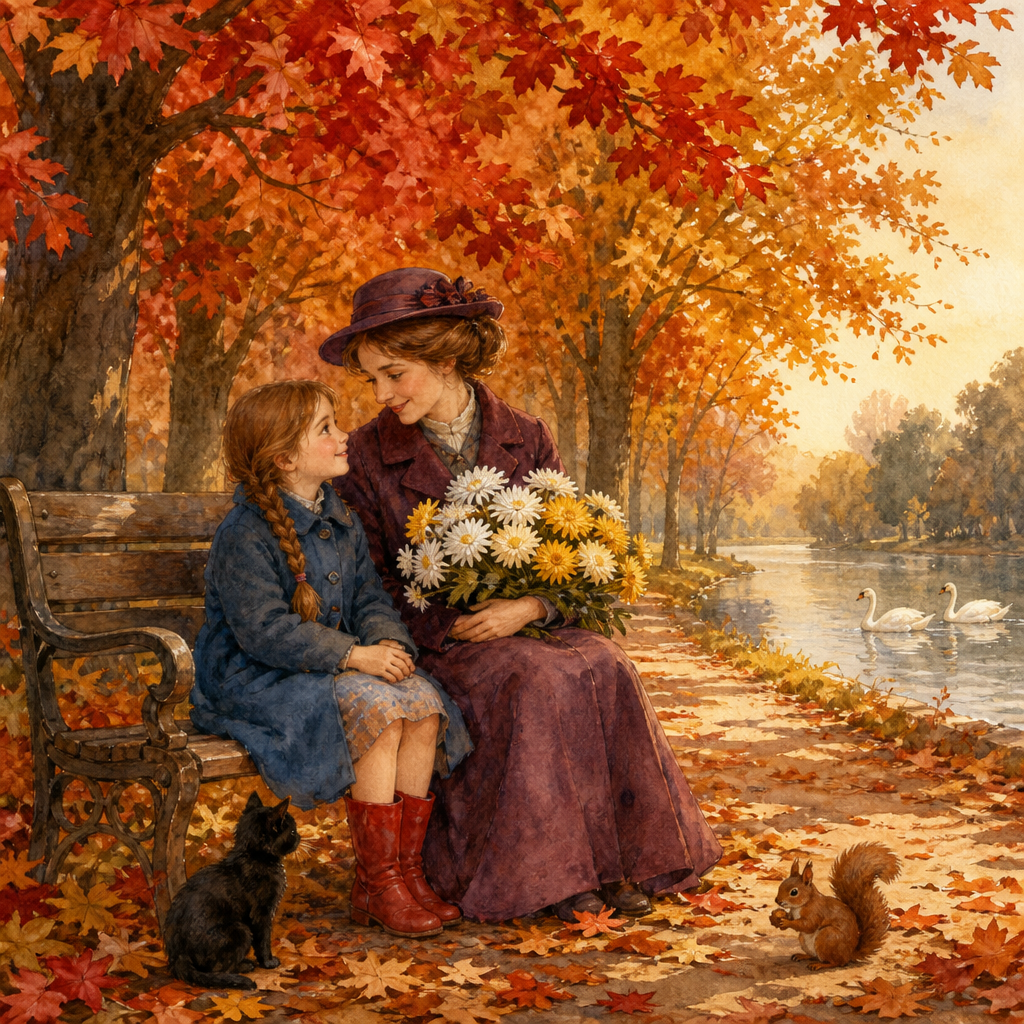
A footstep made her look up. Down the long avenue of golden trees came Mrs. Lester, her arms full of chrysanthemums — her favourite flower. Sea Bird dropped the broom and ran to meet her.
“Oh, the dear things!” she cried, burying her face in the blossoms.
“Paul picked them for you,” Mrs. Lester said, as they sat down together on a garden bench and admired the flowers one by one. “You know, little Sea Bird, in Japan they hold whole festivals just for these flowers. Imagine — red, white, and yellow chrysanthemums arranged so cleverly that whole hillsides seem made of them, with waterfalls of blossoms tumbling down, and figures of horses and riders all shaped from flowers. Wouldn’t that be a glorious thing to see?”
“It would!” said Sea Bird, her eyes wide.
“But come now, dearie — I want you to get ready. We’re going for a drive to the Park.”
“Oh, the beautiful Park! May I bring some nuts for the squirrels, like last time?” And she danced off in delight.
For a little girl who had known only the sights and sounds of the sea, you can imagine what a whole new world this was. Of everything the Lesters had shown her, nothing pleased her so much as Central Park.
She had loved the sea birds over the ocean since she was tiny — “her ocean and her birds,” she called them — so she was fascinated by all the new feathered creatures she found in the Park. And the “little folk in fur,” especially the squirrels, were something else entirely.
Because no one hurt them, the graceful little animals came right up to anyone offering nuts. But whenever a shyer one snatched its prize and darted up a tree, leaping recklessly from branch to branch, Sea Bird almost held her breath, sure it would fall.
“They’re not afraid of falling,” Mrs. Lester reassured her. “A squirrel can spread itself out almost like a little parachute to soften a drop. The flying squirrel is the real champion — it opens out the loose skin along its sides, leaps into the air, and glides from the top of one tree clear down to the foot of the next, as lightly as a bird. The others know the trick too; their ‘coats’ just aren’t as wide.”
“What lovely long tails they have!” said Sea Bird.
“Yes — the tail helps them glide, and it also makes a cosy cloak they wrap around themselves when they sleep.”
“And where do they live?”
“A squirrel builds a leafy little nest high in the top of some fine old tree — but he keeps a second home in a hollow trunk too, and moves the family there when it’s time, or when there’s any danger.”
Just then Sea Bird pointed. “Look at that bird with the pretty red head! How fast he runs around the trunk, and never slips!”
“That’s a woodpecker,” said Mrs. Lester. “He has stiff tail feathers and sharp claws that hold him steady against the bark. He carves a perfectly round hole in the trunk with his sharp beak and builds his nest inside. In fact, sometimes flying squirrels move into a woodpecker’s abandoned hole — a ready-made home, all thanks to the woodpecker’s hard work!”
“That wasn’t very fair of them,” said Sea Bird.
“Well — the birds had usually moved on before the squirrels moved in,” Mrs. Lester smiled. “Now, come and see the swans. I’ve brought crackers. They always expect them, and they come right to shore.”
Beside the pretty little lake they sat and watched the graceful white birds glide toward them.
“They’re beautiful and useful,” said Mrs. Lester. “They clear the weeds from the bottom of the pond and keep the water clean and fresh.”
But the water and the white birds stirred something in Sea Bird — vivid memories of the white-capped waves and white-breasted gulls she’d loved since babyhood. She sighed and nestled closer to Mrs. Lester.
“I don’t think anything in the whole world is prettier than the ocean and the sea birds,” she said, a little tremor in her voice.
“And that is just right, dear child,” Mrs. Lester said gently, drawing her close. “Always be loyal to home and to your first friends. We’ll go back now, and you can write to your mother and father and tell them all about the wonderful things you’ve seen here in big New York — but that their little Sea Bird loves her own home best of all.”