His name was Bruno, and he lived a long, long way from here, on the Roman Campagna. His house was a pointed hut thatched with straw. Behind it lay the fold where the sheep lived, and beyond that, for miles and miles, there was no other living thing for a little boy to see. No one to play with, nothing to do but tend the sheep and milk the goats — and wish, oh, so hard, that he might walk that long Appian Way to the gate of St. Sebastian and on into Rome.
Piccola had told him about Rome. Piccola’s father bought wool and sold it to the traders in the city. Twice a year, at shearing time, Piccola and her father came out to the Campagna. While the fathers haggled over the price of wool, Piccola and Bruno sat under an olive tree, their hands clasped tight, and Piccola told him everything.
“You should see it at the Christmas festa,” she said once, her eyes shining. “Every shop blazes with lights in the evening, and flower carts stand at every corner. There’s a manger and the Christ Child in the chapel — and there’s a box that talks, Bruno, in a shop on the Corso.”
“I don’t believe you,” Bruno said. “How could a box talk? What makes it talk?”
But this Piccola couldn’t tell him. “It talks — that’s all I know,” she said, “and it sings.” She might have said more, but her father came, and she had to say goodbye. In a moment Bruno could see nothing of Piccola but the flash of her scarlet-and-green skirt and the blue cornflower she wore in her black braids. Then even those vanished in a cloud of dust behind the yellow cart wheels, and Piccola was gone — to Rome, where a box could talk and sing.
Long, sweet, all-alike days followed for Bruno and the sheep. The wheat grew yellow and heavy, and Bruno watched the harvesters. The olives ripened, then the grapes, then the figs. The sun set earlier, the nights grew sharp with frost, and Bruno and his father pulled warm skin cloaks over their blue smocks.
“It is nearly the Christmas festa,” Bruno said one day. “I have never been to Rome. Will you take me, Father? I want to hear the talking box on the Corso — it both speaks and sings.”
“No.” His father was quick with his answer, as hard men often are after many lonely years. “The ewe lambs are ailing, and I cannot leave them. Besides, there are no singing boxes in Rome.”
So Bruno kept following the old sheep and the lambs to their grassy hill, and driving them home at dusk, until at last it was Christmas Eve. He locked the gate of the fold and turned toward the hut. His father would be dozing inside, perhaps. Cold dusk had crept over the great Campagna, and one star shone out in the purple sky — hanging there, pointing toward Rome.
As Bruno looked up at it, he heard the faraway sound of bells. They might be the bells of Rome. Oh, beautiful Rome, with its bright streets and flower carts and that magic box that could sing and turn loneliness into music!
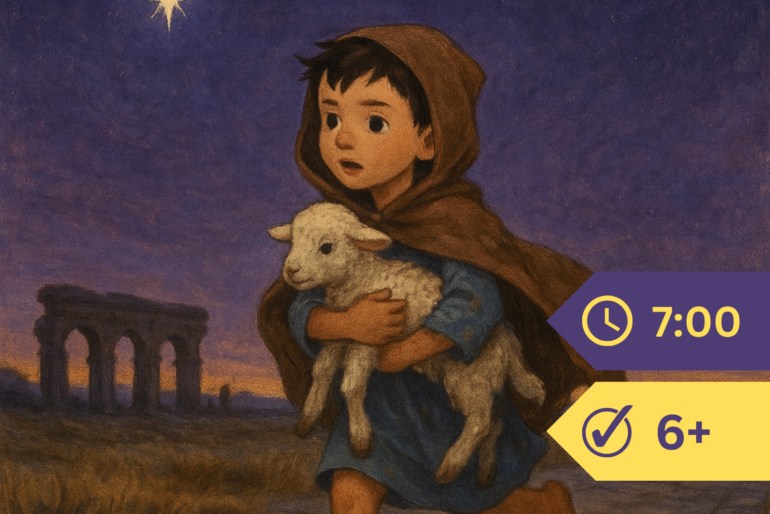
Bruno pulled the hood of his cloak over his head. His bare feet flew over the dry grass and wheat stubble. He found the old Appian Road and ran along it in the path of starlight. He was running away. He was going to Rome.
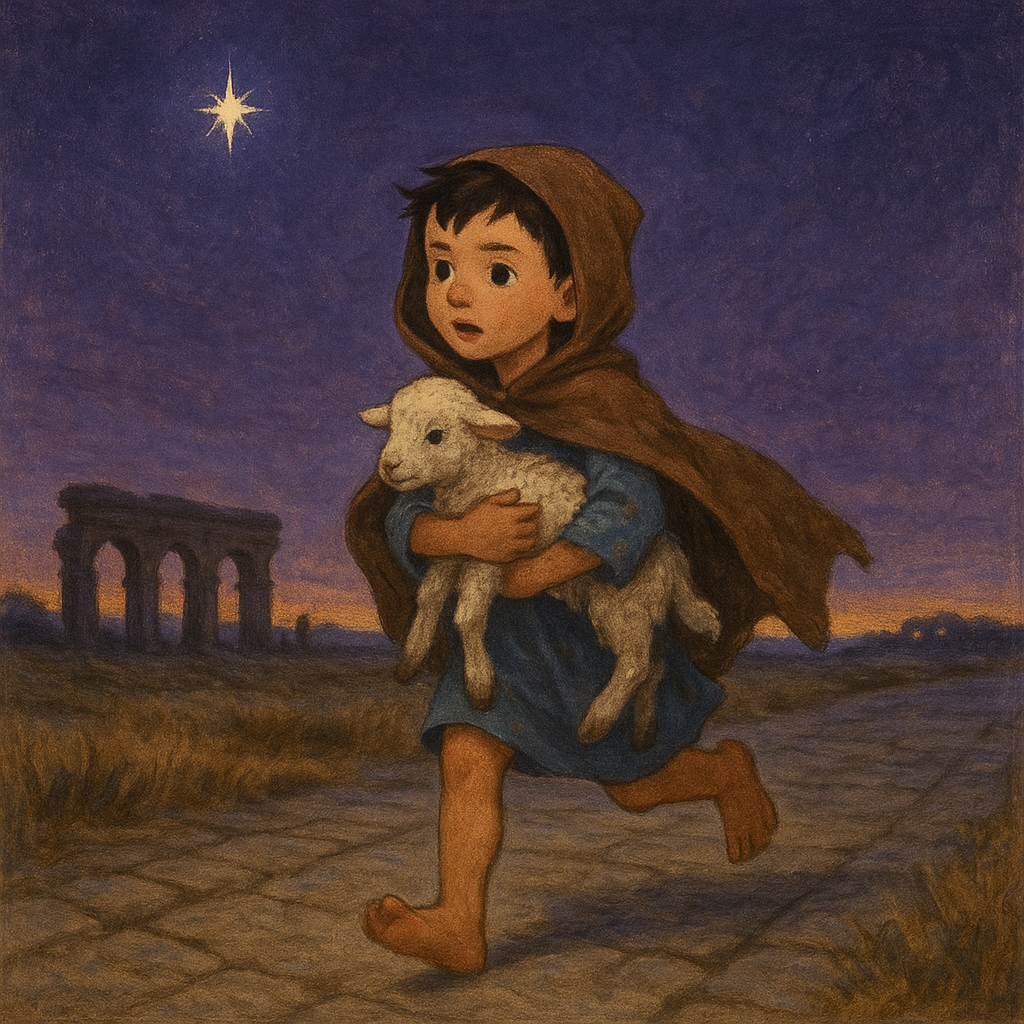
He had gone so far and so fast, and the Christmas bells were ringing so loudly in his ears, that at first he didn’t hear it — the bleating of a foolish little ewe lamb. Then it came again, and Bruno stopped.
The lamb lay under a clump of dried stalks, its fleece torn by thistles, its eyes dull with fear. It had lost its mother.
“Stupid! Why did you run away?” Bruno stamped his little brown foot. “I can’t take you home — I’m going to Rome for Christmas, do you hear? I won’t take you home—”
But even as he said it, he stooped down, lifted the trembling creature into his arms, and turned back toward the fold.
Now the star path was at Bruno’s back. Ahead lay black shadows. A biting wind whirled small stones that stung his face and made mocking sounds as it swept through the ruined arches of an old aqueduct. He lost the road. Stiff thorns cut his slim ankles. The lamb grew heavier with every step. He would not cry — no Roman lad cries, his father had always told him — but he could not find his way.
At last the little shepherd boy sank to the ground. He could hear the Christmas bells; or no — it was a clear, sweet voice, drifting from a polished wooden box, that sang him gently to sleep.
When he opened his heavy eyelids, Piccola’s dancing eyes met his. She looked like a little Christmas sprite in her warm crimson hood and cloak. Bruno himself lay in his father’s arms, and Piccola’s father was lifting the strayed lamb into the yellow cart, a lantern swinging in one hand.
“We were coming back from Albano with wool,” Piccola explained, “and I begged Father to stop for you, Bruno, to bring you back to Rome for Christmas! We couldn’t find you anywhere. Your father came with us to search — and the lamb’s bleating led us to you.”
“My brave little Roman lad.” It was Bruno’s father who spoke, stroking his son’s head with long, thin fingers. “We’ll take the lamb home first and find you some warm milk. Then you may go to Rome for the festa with the little signorina.”
“And we’re going to buy the box that talks,” Piccola added happily.
“And sings!” Bruno smiled, and looked up toward the Christmas star and the gate of St. Sebastian.