In the middle of a sandy desert somewhere in Asia, travellers are refreshed by the sight of a high mountain covered with beautiful trees, among which waterfalls glitter in the sun. In that clear, still air you can even hear the birds singing and smell the flowers. The mountain is plainly inhabited, because here and there a white tent shows among the trees, but none of the kings or princes who pass it on the road to Babylon or Baalbek ever ride into its forests, or if they do, they never come back. The mountain’s reputation is so evil that fathers on their deathbeds beg their sons never to try to uncover its secrets. Yet every year a few young men announce that they will visit it, and, as I said, they are never seen again.
Once a powerful king ruled a country on the far side of the desert, and on his deathbed he gave this usual advice to his seven sons. He was hardly dead before the eldest, who inherited the throne, announced that he would hunt in the enchanted mountain. The old men shook their heads and tried to talk him out of his mad plan, but it was no use. He went, and he did not return, and in due course the throne passed to his next brother.
The same thing happened to five more brothers. When the youngest became king and announced that he too would hunt in the mountain, a loud lament went up in the city.
“Who will rule us when you’re dead? And dead you will be,” the people cried. “Stay with us and we’ll make you happy.” For a while he listened, and the land grew rich and peaceful under his rule. But after some years the restless fit seized him again, and this time he would hear nothing. He would hunt in that forest. He called his friends and attendants and set out one morning across the desert.
They were riding through a rocky valley when a deer sprang up in front of them and bounded away. The king gave chase, followed by his men, but the animal ran so fast they couldn’t catch it, and at last it vanished into the depths of the forest.
The young man reined in for the first time and looked around. He had left his companions far behind. Glancing back, he saw them entering some tents scattered among the trees. As for himself, the fresh coolness of the woods appealed to him more than any food, however delicious, and for hours he strolled wherever his fancy led.
By and by it began to get dark, and he thought it was time for them all to start for the palace. Leaving the forest with a sigh, he made his way down to the tents. To his horror, he found his men lying about, some dead, some dying. The dying could no longer speak, but they didn’t need to. It was clear as day that the wine they’d drunk had been poisoned.
“I’m too late to help you, my poor friends,” he said, looking at them sadly. “But at least I can avenge you! Whoever set this trap will surely come back to see how it worked. I’ll hide somewhere and find out who they are.”
Near where he stood he noticed a large walnut tree and climbed it. Night fell, and nothing disturbed the stillness. But at the first light of dawn, he heard the sound of galloping hooves.
Pushing the branches aside, he saw a rider approaching on a white horse. At the tents the rider dismounted and carefully examined the bodies. One by one, he dragged them to a nearby ravine and threw them into a lake at the bottom. While he did this, servants who had followed him led away the dead men’s horses, and the others were told to let loose the deer used as a decoy and to see that the tables in the tents were laid again with food and wine.
When he’d done, the rider strolled through the forest, and was very surprised to come upon a beautiful horse hidden in the depths of a thicket.
“There was a horse for every dead man,” he said to himself. “Then whose is this?”
“Mine!” answered a voice from a walnut tree nearby. “Who are you, to lure men into your power and then poison them? You’ll do it no longer. Go back to your house, wherever it is, and we’ll fight in front of it!”
The rider was speechless with anger. After a great effort he replied:
“I accept your challenge. Mount and follow me. I am Zoulvisia.” And springing onto his horse, he was out of sight so quickly that the king had time to notice only that a light seemed to flow from rider and steed, and that the hair under the helmet was like liquid gold.
Clearly the rider was a woman. But who could she be? Was she queen of all queens? Or chief of a band of robbers? She was neither: only a beautiful girl.
Lost in thought, the king stood under the walnut tree long after horse and rider had vanished. Then he started, remembering that he must find the way to his enemy’s house, though he had no idea where it was. He took the path the rider had come by and walked for many hours until he came to three huts side by side, and in each lived an old fairy with her sons.
By now the king was so tired and hungry he could hardly speak, but after he’d drunk some milk and rested a little, he could answer the questions they asked him eagerly.
“I’m going to look for Zoulvisia,” he said. “She has killed my brothers and many of my people, and I mean to avenge them.”
He’d only spoken to the people of one house, but from all three came a murmur.
“What a pity we didn’t know! She passed our door twice today, and we might have held her prisoner.”
But though their words were brave, their hearts were not, because the very thought of Zoulvisia made them tremble.
“Forget Zoulvisia and stay with us,” they all said, holding out their hands. “You’ll be our big brother and we’ll be your little brothers.” But the king wouldn’t.
He took a pair of scissors, a razor and a mirror from his pocket and gave one to each of the old fairies.
“I can’t give up my revenge, but I accept your friendship, and I leave you these three tokens. If blood appears on any of them, you’ll know my life is in danger, and in memory of our oath of brotherhood, come to my aid.”
“We will,” they said. The king mounted his horse and set off down the road they showed him.
By moonlight he soon saw a splendid palace, but though he rode twice around it, he couldn’t find a door. He was wondering what to do when he heard loud snoring that seemed to come from his feet. Looking down, he saw an old man lying at the bottom of a deep pit outside the walls, with a lantern beside him.
“Maybe he can give me some advice,” thought the king, and with some difficulty he scrambled into the pit and laid a hand on the sleeper’s shoulder.
“Are you a bird or a snake, that you can get in here?” said the old man, waking with a start. The king answered that he was only a man, and that he was looking for Zoulvisia.
“Zoulvisia? The world’s curse?” said the old man, grinding his teeth. “Out of all the thousands she has killed, I’m the only one to escape, though why she spared me just to condemn me to this living death, I can’t guess.”
“Help me if you can,” said the king, and he told the old man his story, which the old man heard closely.
“Then listen to my advice,” he said. “Every day at sunrise, Zoulvisia puts on her jacket of pearls and climbs the steps of her crystal watchtower. From there she can see all over her lands and spot anyone, man or demon, who enters. If she sees even one, she gives such terrible cries that all who hear them die of fright. So hide in a cave near the foot of the tower and plant a forked stick in front of it. When she has given her third cry, go out boldly and look up at the tower. Go without fear, because you will have broken her power.”
The king did just as the old man said, word for word. When he stepped out of the cave, their eyes met.
“You’ve conquered me,” said Zoulvisia, “and you deserve to be my husband, because you’re the first man who hasn’t died at the sound of my voice!” She let down her golden hair and drew him up to the top of the tower as if on a rope. Then she led him into the great hall and presented him to her household.
“Ask me for anything you like and I’ll grant it,” she whispered with a smile as they sat together on a mossy bank by the stream. The king begged her to set free the old man to whom he owed his life and send him back to his own country.
“I’ve finished with hunting and riding about my lands,” said Zoulvisia on their wedding day. “From now on the job of providing for us all is yours.” She told her attendants to bring the horse of fire.
“This is your master now, my steed of flame,” she said. “You’ll serve him as you served me.” She kissed the horse between the eyes and placed the bridle in her husband’s hand.
The horse looked at the young man for a moment and then bowed its head. The king patted its neck and smoothed its tail, and they felt like old friends. Then he mounted to do Zoulvisia’s bidding. Before he left she gave him a case of pearls holding one of her hairs, and he tucked it into the breast of his coat.
He rode for some time without seeing any game for dinner. Suddenly a fine stag started up almost under his feet and he gave chase. On they raced, but the stag twisted and turned so that the king had no chance to shoot until they reached a broad river and the animal jumped in and swam across. The king fitted a bolt to his crossbow and aimed, and though he managed to wound the stag, it made its way to the far bank. In his excitement he never noticed that the case of pearls had fallen into the water.
The stream, though deep, was fast, and the box was swept along for miles and miles until it washed ashore in quite another country. A water-carrier from the palace there picked it up and showed it to the king. The workmanship was so curious and the pearls so rare that the king couldn’t bear to part with it. He paid the man well and sent him away. Then he summoned his chamberlain and told him to find out its history in three days, or lose his post.
The answer, which puzzled all the magicians and wise men, came from an old woman who arrived at the palace and told the chamberlain that, for two handfuls of gold, she would reveal the mystery.
The chamberlain gladly paid. In return she told him that the case and the hair belonged to Zoulvisia.
“Bring her here, old woman, and you’ll have gold enough to stand in,” said the chamberlain. The old woman said she’d see what she could do.
She went back to her hut in the middle of the forest and stood in the doorway, whistling softly. Soon the dead leaves on the ground began to move and rustle, and a long train of serpents came out from beneath them. They wriggled to the feet of the witch, who stooped to pat their heads and gave each one milk in a red earthenware basin. When they’d all finished, she whistled again and told two or three to coil around her arms and neck, then turned one into a cane and another into a whip. Then she took a stick, turned it into a raft on the riverbank, sat down comfortably and pushed off into the middle of the stream.
All that day she floated, and all the night, and toward sunset the next evening she found herself close to Zoulvisia’s garden, just as the king, on the horse of flame, was returning from hunting.
“Who are you?” he said in surprise, since old women travelling on rafts were not common in that country. “Who are you, and why have you come?”
“I’m a poor pilgrim, my son,” she said. “I missed the caravan and wandered for many days through the desert without food until I reached the river. There I found this little raft, and I trusted myself to it, not knowing whether I’d live or die. But since you’ve found me, please give me some bread, and let me sleep tonight by the dog who guards your door.”
This piteous tale touched the young man’s heart. He promised to bring her food and that she should spend the night in his palace.
“But get up behind me, good woman,” he said, “because you’ve walked far and it’s still a long way to the palace.” He bent down to help her, but the horse swerved to one side.
It happened twice and three times, and the old witch guessed why, though the king did not.
“I’m afraid of falling off,” she said. “But since you’re kind enough to pity my troubles, ride slowly, and lame as I am, I think I can keep up.”
At the door he told the witch to rest while he fetched what she needed. But Zoulvisia grew pale when she heard whom he’d brought. She begged him to feed the old woman and send her away, because she would cause trouble.
The king laughed at her fears. “To hear you talk, anyone would think she was a witch! And if she were, what harm could she do us?” And he called the maidens to carry her food and let her sleep in their room.
The old woman was very cunning, and she kept the maidens awake half the night with all kinds of strange stories. Next morning, while they were dressing their mistress, one of them burst out laughing, and the others joined her.
“What’s the matter with you?” Zoulvisia asked. The girl said she’d been thinking of a funny adventure the newcomer had told them the evening before.
“And oh, madam!” she cried. “She may be a witch, as they say, but I’m sure she’d never cast a spell to harm a fly! And her tales would pass many a dull hour for you when my lord is away!”
So, in an unlucky hour, Zoulvisia agreed to have the old woman brought to her, and from then on the two were hardly ever apart.
One day the witch began to talk about the young king and to declare that, in all the lands she’d visited, she’d seen none like him.
“It was so clever of him to guess your secret and win your heart,” she said. “And of course he told you his in return?”
“No, I don’t think he has one,” said Zoulvisia.
“No secrets?” cried the old woman scornfully. “Nonsense! Every man has a secret, and he always tells it to the woman he loves. If he hasn’t told you, it’s because he doesn’t love you!”
These words troubled Zoulvisia greatly, though she wouldn’t admit it to the witch. But the next time she was alone with her husband, she began to coax him to tell her where his strength lay. For a long while he put her off with kisses, but when she wouldn’t be refused, he answered:
“It’s my sabre that gives me strength. It lies by my side day and night. But now that I’ve told you, swear on this ring, which I’ll give you in exchange for yours, that you’ll tell no one.” Zoulvisia swore. And at once she hurried to betray the great secret to the old woman.
Four nights later, when everyone was asleep, the witch crept softly into the king’s room and took the sabre from his side as he lay sleeping. Then she opened the lattice, flew out onto the terrace and dropped the sword into the river.
Next morning everyone was surprised that the king did not rise early and go hunting, as usual. The attendants listened at the keyhole and heard heavy breathing, but none dared go in until Zoulvisia pushed past them. What a sight met their eyes! The king lay nearly lifeless, with foam on his lips and his eyes already closed. They wept and called to him, but no answer came.
Suddenly a shriek came from those at the back, and in strode the witch with serpents around her neck, arms and hair. At a sign from her they flung themselves hissing at the maidens, whose flesh was pierced by their poisonous fangs. Then, turning to Zoulvisia, she said:
“I’ll give you a choice: come with me, or the serpents will kill you too.” As the terrified girl stared at her, unable to say a word, she seized her by the arm and led her to the raft hidden among the reeds. When they were both aboard, she took the oars, and they floated down the river to the neighbouring country, where she handed Zoulvisia over to the king, who locked her in his palace.
Now, ever since the young king had stopped at the three huts on his way through the forest, not a morning had gone by without the sons of the three fairies checking the scissors, the razor and the mirror he’d left them. Until now the surface of all three had been bright and clear, but this particular morning, when they took them out as usual, drops of blood stood on the razor and the scissors, and the little mirror was clouded.
“Something terrible must have happened to our little brother,” they whispered, awestruck. “We must hurry to rescue him before it’s too late.” They put on their magic slippers and set off for the palace.
The servants greeted them eagerly, ready to tell all they knew, which wasn’t much: only that the sabre had vanished and no one knew where. The newcomers spent the whole day searching for it without success, and when night came they were tired and hungry. But how were they to get food? The king hadn’t hunted that day, and there was nothing to eat. The little men were in despair when a moonbeam lit up the river under the walls.
“How stupid! Of course there are fish to catch!” they cried, and running down to the bank they soon landed some fine fish and cooked them on the spot. They felt better then, and began to look around.
Further out, in the middle of the stream, there was a strange splashing, and soon the body of a huge fish rose, twisting and turning as if in pain. All the brothers’ eyes were fixed on the spot when the fish leapt into the air, and a bright gleam flashed through the night. “The sabre!” they shouted, and plunged into the stream and, with a sharp tug, pulled out the sword, while the fish lay on the water exhausted by its struggles. They swam back to land with the sabre, carefully dried it in their coats and carried it to the palace and laid it on the king’s pillow. At once the colour came back into his waxen face and his hollow cheeks filled out. The king sat up, opened his eyes and said:
“Where is Zoulvisia?”
“That’s what we don’t know,” said the little men. “But now that you’re saved, you’ll soon find out.” And they told him what had happened since Zoulvisia betrayed his secret to the witch.
“Take me to my horse,” was all he said. But when he went into the stable, he nearly wept at the sight of his favourite horse, which was in almost as sad a state as his master had been. The horse turned its head languidly as the door swung open, but when it saw the king it rose and rubbed its head against him.
“Oh, my poor horse! How much cleverer you were than I! If I’d acted like you, I would never have lost Zoulvisia. But we’ll look for her together, you and I.”
For a long time the king and his horse followed the stream, but nowhere could he learn anything of Zoulvisia. At last, one evening, they both stopped to rest beside a cottage not far from a great city. The king was lying stretched on the grass, lazily watching his horse crop the short turf, when an old woman came out with a wooden bowl of fresh milk and offered it to him.
He drank eagerly, because he was very thirsty, and then put down the bowl and began to talk to the woman, who was delighted to have someone listen to her chatter.
“You’re lucky to have come this way just now,” she said, “because in five days the king holds his wedding banquet. But the bride isn’t willing, for all her blue eyes and golden hair. She won’t even leave her room, and says she’d rather stay a prisoner than become his wife. Yet he’s a handsome man and a proper husband for her, more than she could have hoped for, having come no one knows where, and bought from a witch…”
The king started. Had he found her at last? His heart beat so hard he thought it would choke him. But he gasped out:
“Is her name Zoulvisia?”
“Yes, so she says, though the old witch… But what’s wrong with you?” she broke off as the young man leapt to his feet and seized her wrists.
“Listen,” he said. “Can you keep a secret?”
“Yes, if I’m paid for it.”
“You’ll be paid, never fear, as much as your heart desires. Here’s a handful of gold, and you’ll have as much again if you do what I say.” The old woman nodded.
“Then go and buy a dress like those ladies wear at court, and manage to get into the palace, into Zoulvisia’s presence. Show her this ring, and after that she’ll tell you what to do.”
The old woman set off. She put on a gown of yellow silk and wrapped a veil closely round her head, and in this dress she walked boldly up the palace steps behind some merchants the king had sent for to bring presents for Zoulvisia.
At first the bride wouldn’t speak to any of them. But when she saw the ring, she grew meek as a lamb. She thanked the merchants for their trouble and sent them away and stayed alone with her visitor.
“Grandmother,” she asked as soon as the door was safely shut, “where is the owner of this ring?”
“In my cottage,” said the old woman, “waiting for your orders.”
“Tell him to stay there three days. Then go to the king of this country and say that you’ve succeeded in bringing me to reason. He’ll leave me alone and stop watching me. On the third day I’ll be walking in the garden near the river, and your guest will find me there. The rest is my own business.”
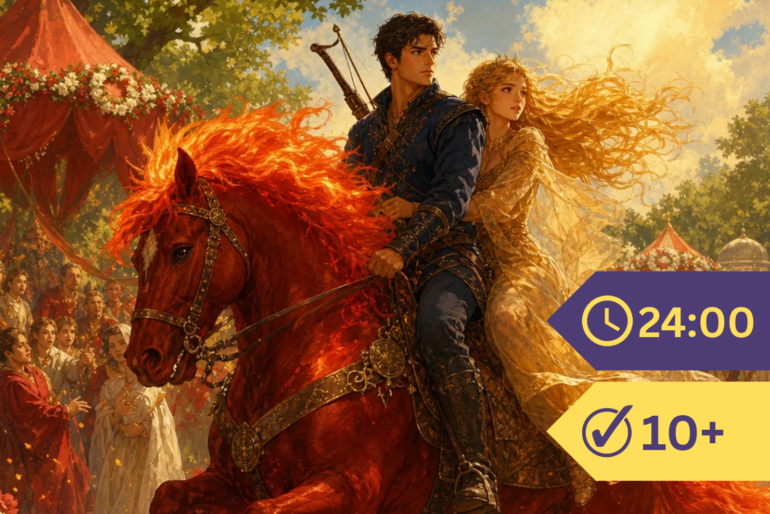
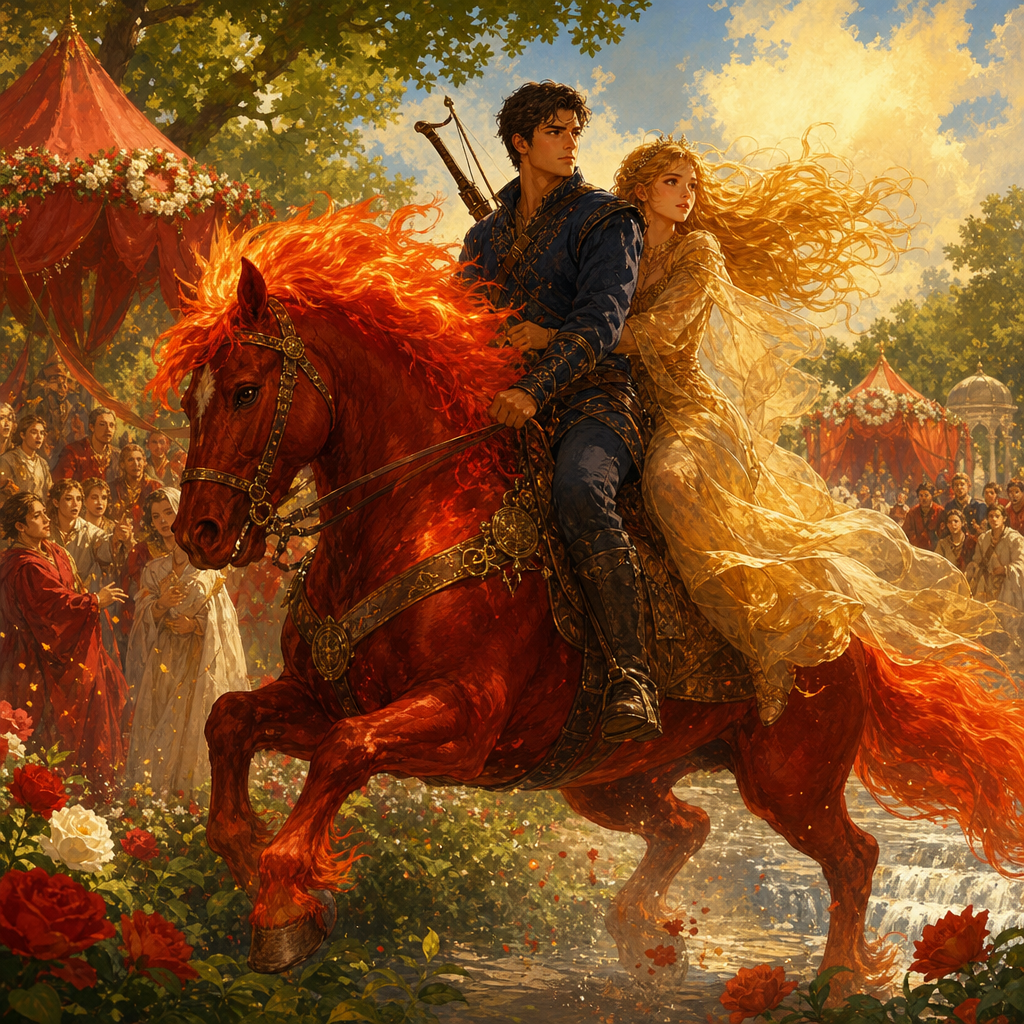
The third morning dawned, and with the first rays of the sun, the palace began to bustle, because that evening the king was to marry Zoulvisia. Tents of fine scarlet cloth were being put up, decked with wreaths of sweet-smelling white flowers, and the banquet was laid inside. When all was ready, a procession was formed to fetch the bride, who had been walking in the palace gardens since daybreak, and crowds lined the way to see her pass. A glimpse of her dress of golden gauze could be seen as she passed from one flowery thicket to another. Then suddenly the crowd swayed and shrank back as a thunderbolt seemed to flash out of the sky to the spot where Zoulvisia was standing. It was no thunderbolt, only the horse of fire! When the people looked again, it was bounding away with two riders on its back.
Zoulvisia and her husband both learned how to keep happiness once they had it, and that’s a lesson many men and women never learn at all. It is also a lesson nobody can teach, which every boy and girl must learn for themselves.