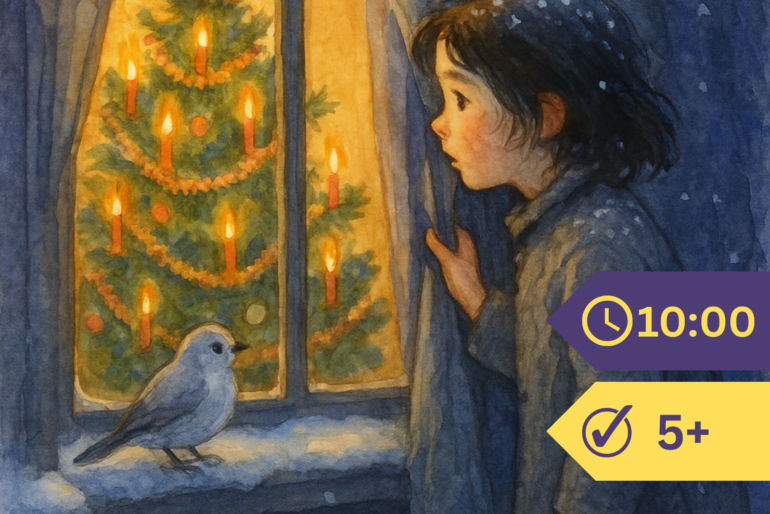
“Well, Brother Evergreen, another Christmas is coming,” said the young fir tree one bright, cold morning. “All over the country, people are out with their saws among our cousins. I love our home here in the forest, and I don’t much like the thought of being cut down so early in my life. I’ve even been trying to grow a little crooked these past months — the little bird told me they only choose the perfect ones. How do you feel about it?”
“I love the open air too,” said his brother. “But it will be a happy thought, when our time comes, that we made so many children glad. I only wish we could visit the homes of the poor as well as the rich. That little girl who comes to gather firewood knelt among us today and wished that one of us might be her Christmas tree.”
A small snow-bird fluttered down from the tall oak and chirped, “I’m glad you like making children happy — so do I. Christmas is made for them. I happen to know exactly where you’re going, dear Evergreen. It’s the same house your brother went to last year.”
And the little bird, who loved to perch on windowsills and listen, told them the whole story.
At the Goodrich house, four children — Rae, Mary, little Patty, and John Paul — had been begging for a Christmas tree, the way their cousins had one the year before. Their parents loved the old tradition of hanging stockings, but this year they decided to surprise the children with a tree as well.
The trouble was keeping the secret. “Oh, Mamma, are you really giving us a tree?” cried Rae, popping out from behind the curtains where she’d been listening. Her mother laughed. “Little pitchers have big ears!” And Rae dashed off to the nursery, singing, “We’re going to have a Christmas tree — a Christmas tree!” while Mary, Patty, and John Paul all chorused, “Are we? Are we? Are we?”
On Christmas morning the little bird was woken at dawn by the greatest shouting it had ever heard. Peeping through the nursery window, it saw all four children on the floor, emptying their stockings and cheering for Santa at every gift.
The tree itself was kept hidden in the parlour until the cousins arrived — which was more than the children’s curiosity could bear. Rae peeped through the keyhole. Mary peeped through the crack in the door. Patty tried to drag a chair as big as herself over to the transom. John Paul just sat on the floor in his paper hat, holding up his arms to be lifted to the keyhole. But their mother had thought of everything: a handkerchief over the keyhole, a chair against the door, paper tacked over the transom.
When at last the children were let in, the tree hardly knew itself. Its green forest coat was almost hidden under garlands of tinsel and gifts. On the very top branch, two twin dolls held out their arms to little Patty. A big doll with eyes that opened and shut nearly leaped into Rae’s arms. A tiny brown-haired doll reached for Mary. And a horn and a mouth-organ set John Paul’s eyes twinkling.
There were gifts for everyone — but the one they’d remember longest was a soft cloth book for Mary, every page covered in pictures pasted by hand by their dear grandmother.
At the foot of the tree stood a small, restless bundle labelled “For John Paul.” Can you guess what it was? A white puppy with silky black ears, who wriggled with joy the moment John Paul untied his blue ribbon and set him loose. “He’s the beautifullest thing I ever saw,” John Paul declared — so they named him Bonito, which means beautiful.
That evening, when the coloured candles were lit and friends came to see the tree, Bonito found his own idea of fun: nipping at the children’s heels as they danced, and, when he tired of that, chewing a corner of the rug. “Never mind,” the grown-ups laughed. “This is the children’s day. Christmas comes but once a year.”
Late that night, when the candles were out and the children were fast asleep with dolls in their arms, the little bird flew down the chimney and perched where the twin dolls had been.
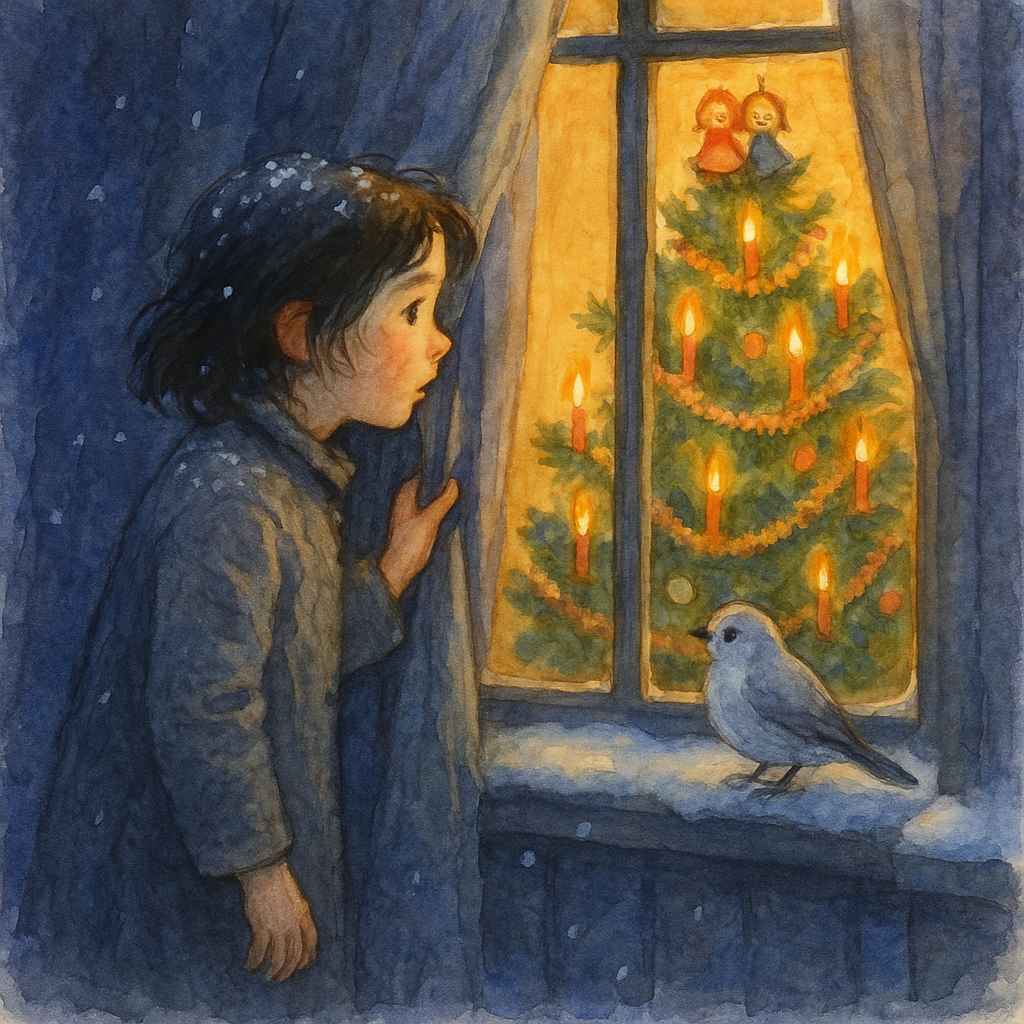
“Kind, patient tree,” it said, “you gave those children so much joy tonight — but you don’t know who else was watching. Little Margaretta, the girl who gathers firewood, crept up onto the veranda and found a gap in the curtains. And I heard her whisper to you: Oh, dear tree, I missed you from the forest today, but I’m so glad you’re warm and beautifully dressed. Your brother, who chose to grow crooked rather than give himself to others, was blown down by the wind today, and I’m afraid he’ll never stand again. I wish I could have you after the children are done. I’d keep you safe through the cold, and in spring I’d carry you home to the woods before the flowers woke to find you gone.“
“Then,” the bird went on, “she heard a footstep and ran — straight into the arms of a police officer making his rounds. But he caught her gently and asked where she lived. Later I saw him talking with the Goodriches’ housekeeper at the back door, asking her to let him know when the children had finished with the tree — for he meant to carry it to Margaretta himself.”
“Except the puppy,” the bird added. “I predict trouble there. I’ve seen families who thought they owned a puppy, only to find the puppy owned them — their shoes, their laundry, everything. Have a care, tree, or he’ll have you limb from limb.”
The tree gave a shiver.
Sure enough, all that week the household chased after Bonito’s mischief. And on the morning before New Year’s, when everyone was busy preparing for the children’s party, a pitiful cry came from the nursery. Mamma ran, Rae ran, Mary ran, John Paul ran, the housekeeper ran, and the little bird simply flew.
There was little Patty, trying to rescue her twin dolls — and there was Bonito, who had seized the hem of her nightgown and would not let go, growling and sliding along the floor behind her. What could poor Patty do but wail?
“I told you so,” said the bird to the tree.
New Year’s Day dawned bright and snowy. Margaretta went into the woods to gather her bundle of firewood, snowflakes dotting her all over. On the way home, the little bird hopped from branch to branch ahead of her, so excited it could hardly keep still, and flew on to reach the cottage first — just in time to see the tree being lifted down from a wagon at her humble door.
Margaretta’s grandmother was bedridden, and she called the girl her “Sunbeam,” though others only knew her as the firewood girl. When Margaretta stepped inside and saw the tree standing in the middle of the room, still hung with its tinsel garlands, she could scarcely believe it.
“Who brought it, Grannie?” she cried.
“Santa, of course — he was a little late reaching us, but here it is. Go and look.”
And she did. There was a warm cloak, a hood, a dress, mittens, and shoes for her; a soft, warm blanket for Grannie; a beautiful doll on the top branch; and at the foot — instead of a fidgety puppy — a basket full of good things to eat.
It had all come about, the bird explained, because the housekeeper had told Mrs. Goodrich the girl’s story, just as the kind officer had told it to her. And when the four children heard it, they were glad to help trim the tree all over again — for they had been taught to pass on a joy that had been given to them. The officer borrowed a wagon and carried the tree across town himself.
I can’t tell you everything Margaretta said and did, but she threw her arms around the tree and hugged it tight, and the little bird danced back and forth along the windowsill until Grannie laughed. “I do believe that bird is out of his senses.”
“No, Grannie — he’s just full of gladness, the same as we are. I think he wants to come in.”
She opened the window, and he flew straight to the top of the tree and sang as he had never sung before.
“He must think it’s summer,” laughed Margaretta.
“He feels the summer in our hearts,” said Grannie.
By the middle of February, Margaretta had an idea. “Grannie, they say the birds will start to nest soon. I’m sure my beautiful tree is longing to be out among them. I asked the kind officer, and he says he’ll bring the wagon and take me and the tree out to the woods, and help me plant it again.”
Grannie smiled and said she would be glad, if only it would grow.
And so the little tree went back to its woodland home, looking as fresh and green as if it had never left — for the girl had watered it faithfully. It could not truly grow again, of course; the axe had taken its roots. But it made Margaretta happy to believe she had made the tree happy by carrying it home.
And the little bird? He brought his own small wife to those branches, and there the two of them made their nest — and lived happily among the thick green boughs.