They say there was once a father and a widow woman — not married to each other, but living nearby. He had lost his wife; she had lost her husband. Each had a little daughter. The father sent his girl, Maria, to the widow’s house every morning to be taught and looked after — and every evening the widow sent a message back with her: “Why doesn’t your father marry me? Then we’d all live together, and Maria would have no more of this weary walk.”
The father did not see it that way. But the widow sent her message day after day until at last she wore him down. Before the wedding, she swore a solemn promise: Maria would always be treated as tenderly as her own daughter.
That promise did not outlast the year.
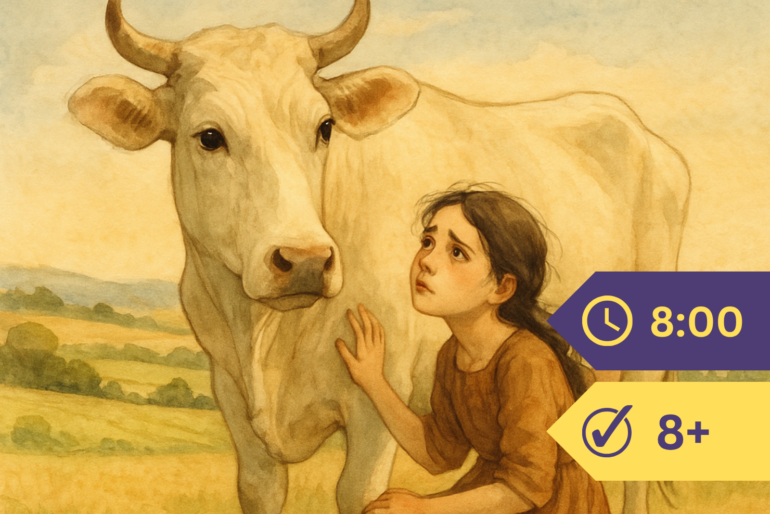
The stepmother soon showed her true colours. She heaped Maria with work and harsh words, and finally sent her out to the Campagna — the open farmland outside the city — to tend the family cow. That way Maria would be out of her father’s sight, and he would grow to forget her. Maria had to keep the stall clean with fresh straw every day, watch that the cow grazed only on the right strip of land, and cut armfuls of grass to bring indoors. It was a great deal of work for a young girl. But Maria had a kind heart, and she grew fond of the cow, and found her company a comfort.
When the stepmother saw that Maria was cheerful even so, it annoyed her greatly. One morning she handed the girl a great heap of raw hemp to spin. It was useless for Maria to explain she had never been taught.
“If you don’t bring it home spun tonight,” the stepmother said, “you will be finely punished.” Maria knew exactly what that meant.
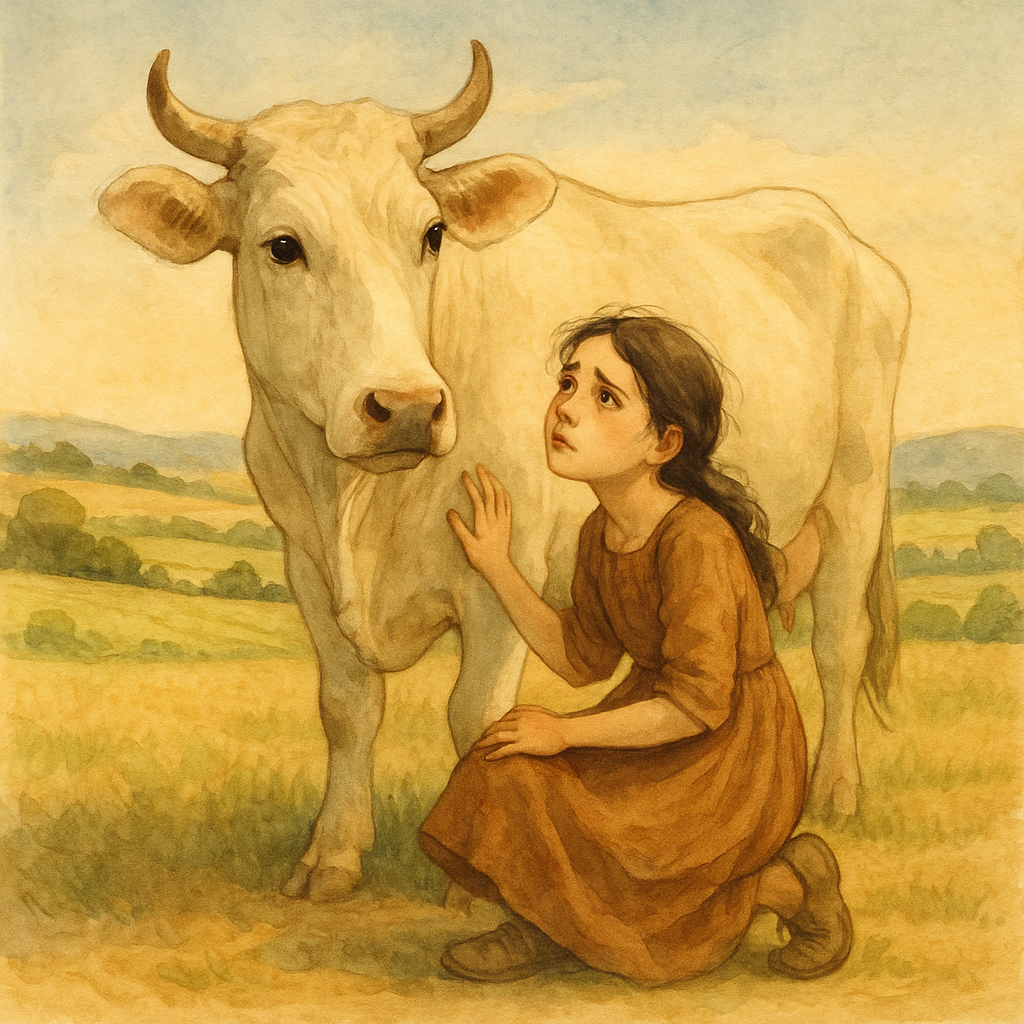
Out in the Campagna that day, her heart was heavy. As she laid down fresh straw in the stall she stroked the cow and said to her — for she had no one else to speak to — “Vaccarella, Vaccarella, what shall I do? I have all this hemp to spin and I never learned spinning. If I don’t get through it somehow, I’ll be badly beaten tonight. Dear little cow, tell me what to do.”
Now Vaccarella was an enchanted cow. When she heard Maria’s distress, she turned and said, clearly and firmly:
Toss it up onto my horns,
Then go and cut the grass!
Maria did as she was told. She went out and cut a fine basketful of grass — and when she came back, all the hemp was beautifully spun.
The stepmother was astonished. She had given Maria enough to keep an ordinary person busy for a week. The next day she handed her a bundle of fine thread to weave into cloth. Maria had never been near a loom. But again she went to her dear little cow, and again Vaccarella gave the same reply:
Toss it up onto my horns,
Then go and cut the grass!
And when Maria came back, the cloth was woven. The stepmother was now truly alarmed. Someone must be helping her. She was determined to find out who.
The next day she gave Maria a shirt to sew, then hid herself in a corner of the cow-house to watch.
She heard Maria whisper her worry to Vaccarella. She heard the cow’s reply. And then she saw — what Maria never saw — that as soon as the girl had gone out, the cow took the shape of a woman, sat down, and stitched and stitched until the shirt was finished. Before Maria returned, the woman became a cow again.
The stepmother could not bear it. She went home and told Maria the cow was to be slaughtered.
Maria was heartbroken, but she knew protest was useless. She ran to Vaccarella to warn her and urged her to escape while there was time.
“There is no need to escape,” said Vaccarella. “Killing will not hurt me. Dry your tears. Only, after they have killed me, reach under my heart — you will find a golden ball. Take it and keep it safe. Whenever you grow weary of your present life, hold the ball and say: Golden ball, golden ball, dress me in gold and bring me a love — and you will see what happens.”
She had no time to say more. The stepmother arrived with a man, and it was done.
Under Vaccarella’s heart, Maria found the golden ball. She tucked it away carefully and waited.
Not long after, a novena began — nine days of church services before a great festival. However cruel she was in private, the stepmother dared not keep Maria from attending. The neighbours would have cried shame on her.
So Maria went to church with the rest of the town. When she had made her way through the crowd to a little distance from her stepmother, she took out the golden ball and whispered: Golden ball, golden ball, dress me in gold and bring me a love.
The ball opened gently and wrapped around her, and she stepped out radiant with beautiful clothing, glowing like a princess. The congregation parted to let her through.
The king’s son was there. He could not take his eyes off her. As soon as the prayers were done, he sent his men to bring her to him. But before they could reach her, Maria had breathed the words again and tucked the gown back into the ball. In her plain working dress, she slipped through the crowd unseen.
At home, the stepmother talked of nothing but the mysterious radiant girl who had appeared in the church — never suspecting it was Maria. Maria sat quietly and said nothing.
So it went each day of the novena. Though Maria was well pleased with the look of the husband her dear little cow seemed to have chosen for her, she did not wish to be too easy a prize. Each day she slipped the gown back into the ball before the prince’s men could catch up.
On the last day, the prince feared he might never see her again. He told his men to be quicker than they had ever been. They came so close that in the rush Maria dropped a slipper. The men snatched it up eagerly, paying no attention to the plainly-dressed girl who tried to claim it — never imagining she could be the shining woman they were looking for.
The novena ended. Maria went back to her endless work. But the stepmother’s hatred had grown past all reason, and now she meant to be rid of her altogether.
Down in the storeroom stood a great barrel that had gone mouldy from neglect. “Get inside and scrub it well before we heat the water,” the stepmother told Maria.
Maria climbed in. The stepmother went to boil the water.
At that very moment, the prince’s men were going from house to house through the town with the slipper: whoever it fit would be the prince’s bride. It fit no one — the slipper was under a spell.
As it happened, the stepmother’s own daughter had slipped down to help Maria without her mother knowing. When Maria climbed out of the barrel to rest, the daughter climbed in to take a turn. Just then the king’s officer reached that door, opened it, and saw a girl standing there. He tried the slipper on the foot of the girl outside — and it fit Maria perfectly. Before anyone had even noticed his arrival, he had helped her into the waiting carriage and driven away.
Soon after, the stepmother returned with her servants, each carrying a can of scalding water. They poured them all into the barrel.
When the house was quiet, the stepmother went to the barrel to see what she had done. The shock of what she found instead of Maria was more than words can say.
Desperate to hide it, she dressed her daughter in dry clothes and propped her at the top of the stairs to wait for her husband. When he came home with his load of firewood and called and called — and got no answer — he flung a log of wood toward the stairs in frustration. The body tumbled down.
But the husband was not deceived. He could see at once that no fall had done this. He went upstairs and asked, “Where is Maria?”
“Nobody knows,” the stepmother said. “She has disappeared.”
He searched the house and found no trace of her. “This is no place for me to stay,” he said to himself. “One child driven away, and one dead. Who knows what comes next?”
The next morning he took the little daughter born of his marriage to Maria’s stepmother, and left for good. That woman lost her husband and all her children in a single day, as she deserved.
And just as the father and his little daughter were setting out, a gilded coach rolled past. Inside sat Maria, with the prince her husband. Her father’s heart was glad. Her stepmother watched, and her heart turned to ash. Maria rode on and did not look back.