Once upon a time there was an old king who was so ill that he knew he would not get well. “Send for Trusty John,” he said. Trusty John was his favorite servant, and he had earned his name by serving the king faithfully all his life.
When John came to the bedside, the king said, “Dear John, I can face my end without fear, except for one worry: my son. He is young, and he doesn’t yet know the world. Promise me you will teach him everything he needs to know and look after him like a father.”
“I will never leave him,” said John. “I will serve him faithfully, even if it costs me everything.”
“Then I can die in peace,” said the king. “After I am gone, show him the whole castle, every room and every treasure. But do not open the last door at the end of the long passage. The portrait of the Princess of the Golden Roof hangs there. If he sees it he will fall hopelessly in love, and for her sake he will run into terrible danger. Keep him from it.”
John gave his word, and the old king laid his head on the pillow and died.
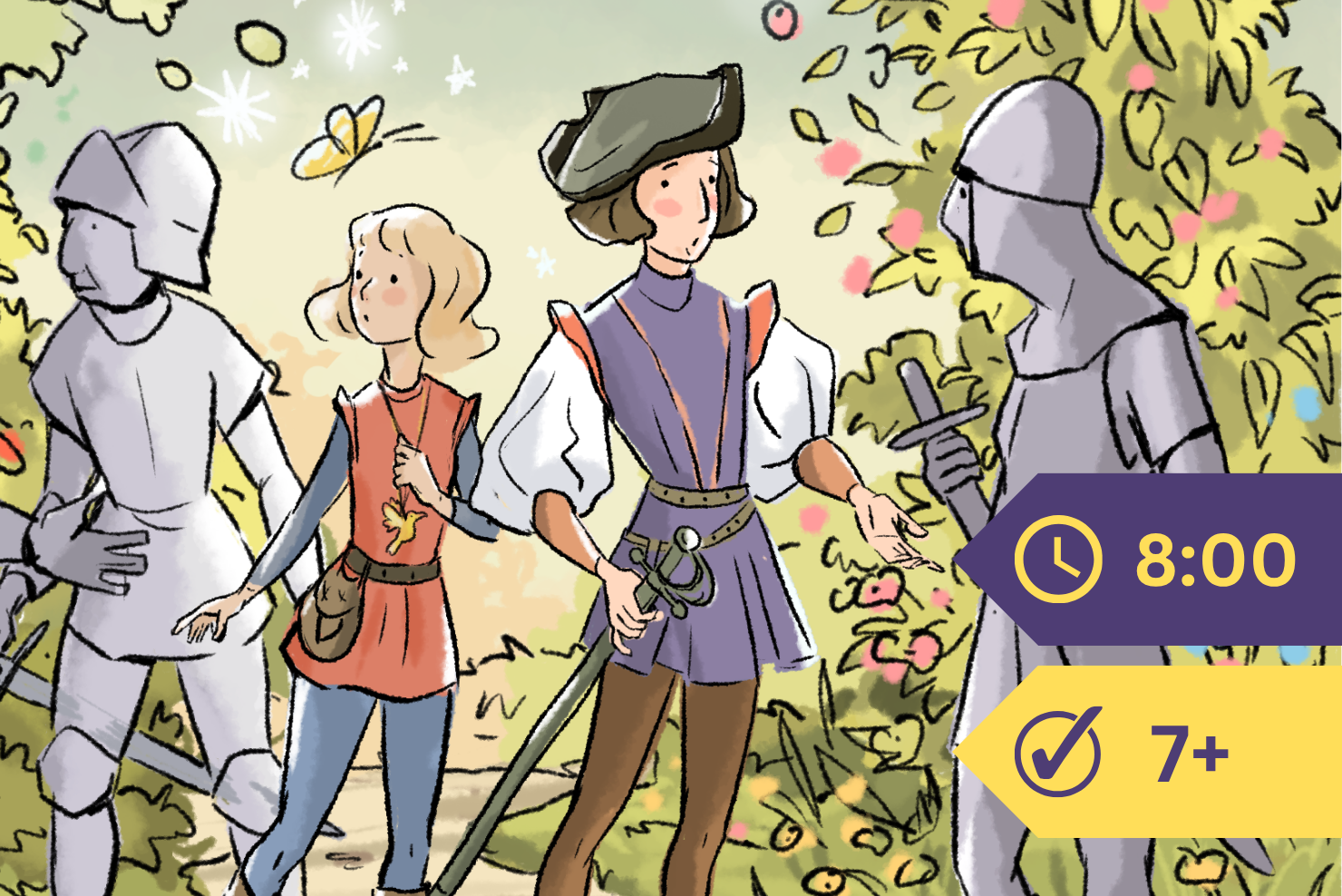
When the mourning was over, John said to the young king, “It is time you saw your inheritance.” He led him through the great halls and treasure rooms, but he walked past the last door without a glance.
“Why don’t you open that one?” the young king asked.
“Something is inside that would trouble you,” said John.
“I’ve seen the whole castle and I mean to see the rest. I won’t move from this spot until you open it!” He pushed at the door, and John, who could see the king would not give way, took out the key with a heavy heart.
He stepped inside first and tried to hide the portrait, but it was no use. The young king stood on tiptoe and looked over his shoulder. There she was, painted in gold and jewels, so lifelike that she seemed to breathe. He gasped, and then he fainted dead away.
John carried him to bed and thought, The thing his father feared has come. When the king woke, his first words were, “Who is she?”
“The Princess of the Golden Roof.”
“If every leaf on every tree could speak, they couldn’t say how much I love her,” said the king. “I cannot live without her. Trusty John, you must help me.”
John thought for a long time, because the princess was said to be nearly impossible to reach. At last he said, “Everything in her house is made of gold: her chairs, her cups, her bowls. You have a great store of gold. Have your goldsmiths make beautiful things from it, vases and birds and wonderful beasts, and we will take them to her.”
For weeks the goldsmiths worked day and night. When a ship was loaded with their work, John and the king disguised themselves as merchants and sailed across the sea to the Princess’s town.
John made the king wait on board. “I may bring her back with me,” he said, “so have everything ready.” He filled his apron with golden trinkets and walked to the palace. In the courtyard a girl was drawing water in golden pails. She looked up and asked who he was.
“A merchant,” he said, and showed her what he carried.
“Oh, how lovely!” she cried. “The Princess must see these. She adores gold.” She took him by the hand and led him inside, for she was the Princess’s maid.
The Princess was delighted. “I’ll buy everything you have!”
“This is nothing,” said John. “My master’s ship is full of far finer things, and there are far too many to carry up here.”
Her curiosity got the better of her. “Then I’ll come to your ship myself.”
On board, the king saw that she was even lovelier than her portrait. He led her below to show her the birds and beasts and goblets of gold. Meanwhile John told the steersman to set sail, and the ship slipped out to sea. The Princess was so absorbed that hours passed before she noticed. When she came on deck, the land was gone.
“I’ve been tricked!” she cried.
The king took her hand. “I am no merchant. I am a king, as high-born as you. I did this because I love you so much. I will turn the ship around this minute if you ask me to.” But by then she had spent hours with him, and she had come to like him. She smiled and said she would stay.
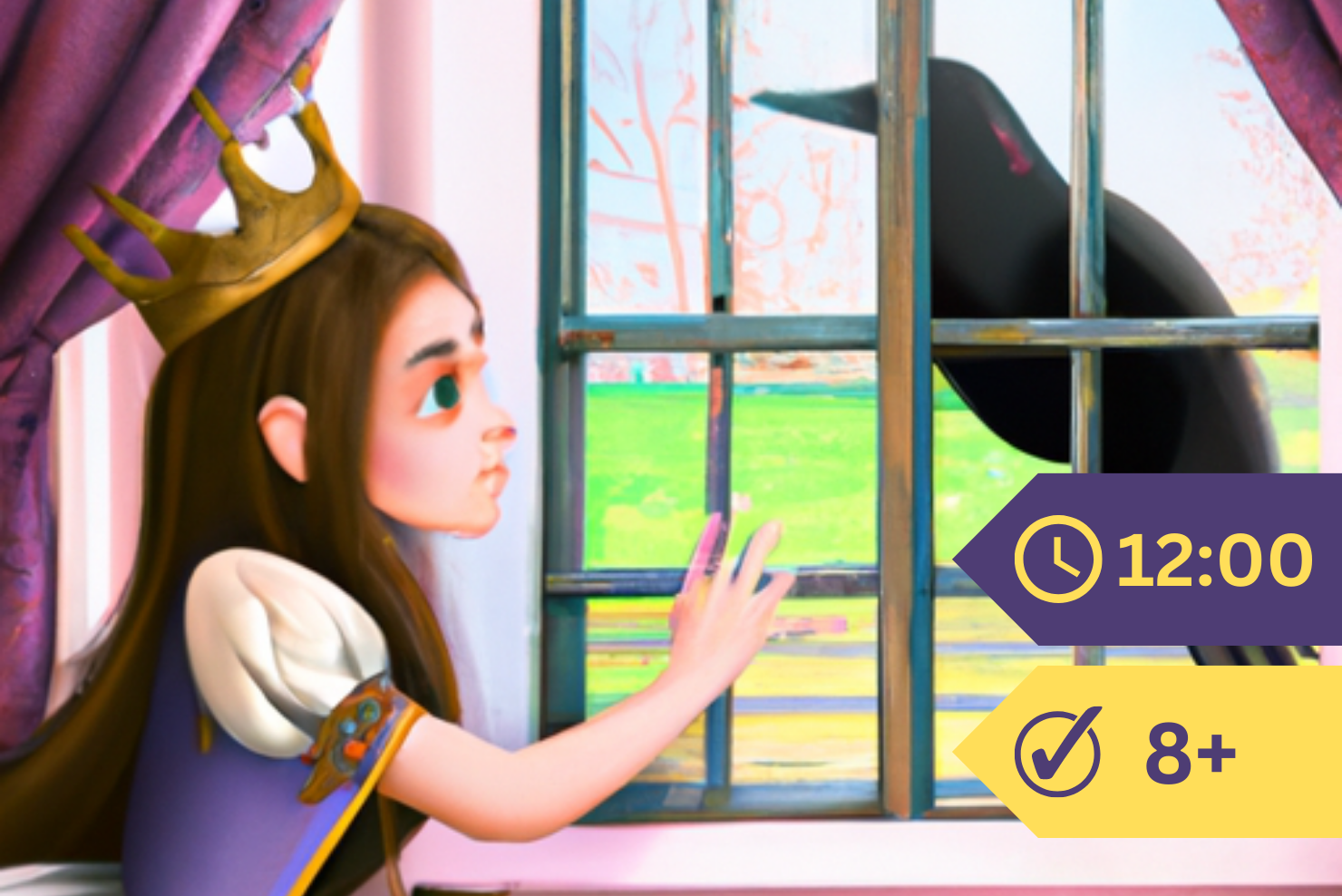
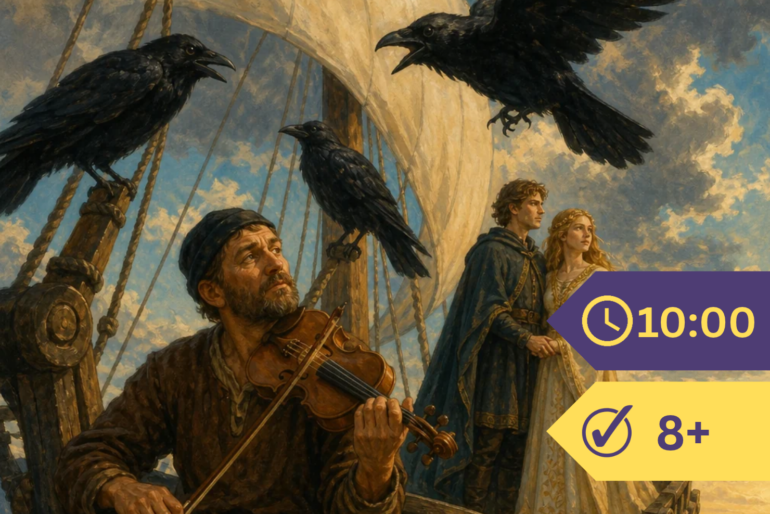
One day on the voyage, John sat at the front of the ship playing his fiddle when three ravens flew overhead. He understood their language, so he stopped to listen.

“There goes the Princess of the Golden Roof,” said the first.
“He hasn’t got her home yet,” said the second.
“When they land, a chestnut horse will race up to greet them,” the first went on. “If the king mounts it, it will carry him off into the sky and he’ll never be seen again.”
“Can he be saved?”
“If someone else gets there first and fires the pistol in the saddle holster, the spell breaks. But whoever tells him about it will be turned to stone from his feet to his knees.”
“I know more,” said the second. “In the palace a wedding shirt will be waiting, shining like silver and gold. It is really made of sulfur and tar, and if the king puts it on it will burn him. Someone who picks it up with gloved hands and throws it in the fire can save him. But anyone who tells him will be turned to stone from the knees to the heart.”
“I know more still,” said the third. “At the wedding dance the young queen will turn pale and fall as if dead. Unless someone lifts her up and draws three drops of blood from her right side and spits them out, she will die. And whoever tells will be turned to stone from head to toe.”
The ravens flew away. John had heard every word. If he stayed silent, his master was doomed. If he spoke, he would be turned to stone. “I will stand by my master,” he said at last, “whatever it costs me.”
When they landed, a splendid chestnut horse came galloping up. “What a fine animal!” said the king. “It shall carry me to my palace!” But John was quicker. He leaped into the saddle, pulled the pistol from the holster, and fired. The horse screamed, wheeled, and bolted away over the hills, and it was never seen again.
The king’s other servants had never liked John. “What a way to treat the king’s horse!” they grumbled.
“Let him be,” said the king. “He is my trusty John. He must have a reason.”
In the palace hall stood a cupboard, and in it lay a wedding shirt that looked as if it were woven from gold and silver. The king reached for it, but John pushed him aside, snatched it up in his gloved hands, and threw it into the fire. The servants muttered again. “Let him be,” said the king. “He is my trusty John.”
At the wedding dance John watched the bride’s face carefully. Suddenly she went deadly pale and dropped to the floor. John was beside her at once. He carried her to a quiet room, drew three drops of blood from her right side, and spat them out. She took a breath and opened her eyes.
But the king had seen only that his servant had carried off his bride and hurt her, and he was furious. “Throw him in prison!”
The next morning John was condemned to death. On the gallows he said, “Every condemned man may speak once. May I?”
“You may,” said the king.
“I have always been faithful to you,” John said, and he told the whole story: the ravens, the horse, the shirt, the dance. “I did it all to save you.”
“Oh, John! Forgive me! Take him down!” cried the king. But as he spoke the last word, John fell lifeless to the ground, and where he lay there was only a stone.
The king and queen were heartbroken. The king had the stone statue carried to his bedroom, and every day he sat beside it and wept. “If only I could bring you back, my trusty John.”
Years passed. The queen had twin sons, and one day while she was at church the king sat with the two little boys playing at his feet. He gazed at the statue and sighed, “If only I could bring you back, my trusty John!”
To his astonishment the stone spoke. “You can, if you are willing to give up what you love most.”
“Anything,” said the king. “My crown, my kingdom, my life.”
“Your two sons,” said the stone.
The king went cold. He looked at his boys, laughing on the floor. But he thought of John, who had been silent when speaking would have saved him, and who had turned to stone for him. He rose with shaking hands, covered his face, and said, “If that is the price, I will pay it.”
At that moment the stone began to crack. It softened and warmed, and John stood before him, alive and smiling. “My lord, I would never take your sons,” he said. “I only needed to know you valued loyalty as I did. You have repaid me a hundred times.”
The king wept for joy and threw his arms around John. When the queen came home, they told her everything. She hugged her sons and said, “We could never repay him enough.” And the king, the queen, the twin boys, and Trusty John lived together happily for the rest of their days.