A princess, so lovely and kind that everyone adored her, disappeared one day. The whole kingdom was searched without a trace. The king, in despair, announced that whoever brought her back could marry her. The young men tried, and returned empty-handed.
Not far from the palace lived an old man with three sons. The two eldest did as they pleased; the youngest always gave way. One day the eldest announced that he was tired of the quiet life and wanted to see the world. His parents packed food and new boots, and he set off merrily.
He sat down on a hillside to eat his dinner. A poorly dressed old man came by and asked for a bite. “I’ve barely enough for myself,” said the young man. “If you want food, earn it.” On the next hill, a still poorer old man begged; he got hard words too. In a clearing at evening, birds flocked around his head for crumbs, and he threw stones at them.
He found a cave under a rock and lay down. At midnight he was woken by a monstrous ogress. He begged her not to harm him. “You may stay if you do any work I set tomorrow,” she said, and he agreed and went to sleep.
In the morning she told him to sweep the dust from the cave floor before evening. But the dust wouldn’t move. By night he had given up and sat sulking. She took one look at the floor. And that was the last his family ever saw of him.
The second brother followed, just as selfish, just as unkind to the beggars and the birds, and met the same fate.
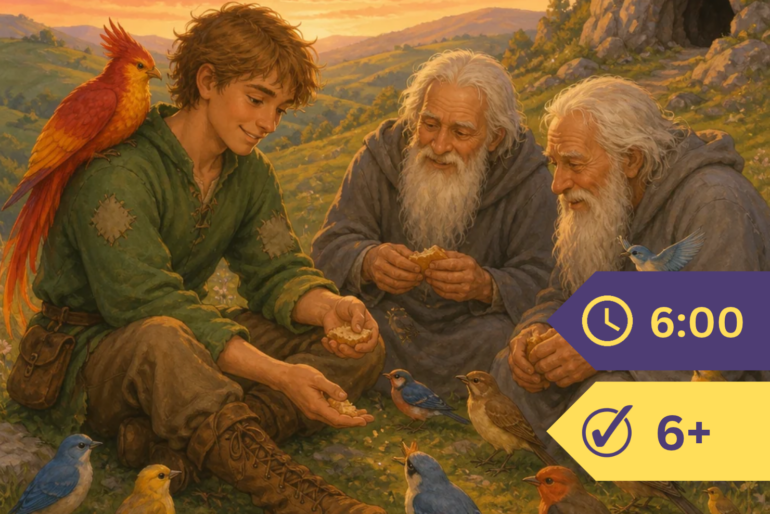
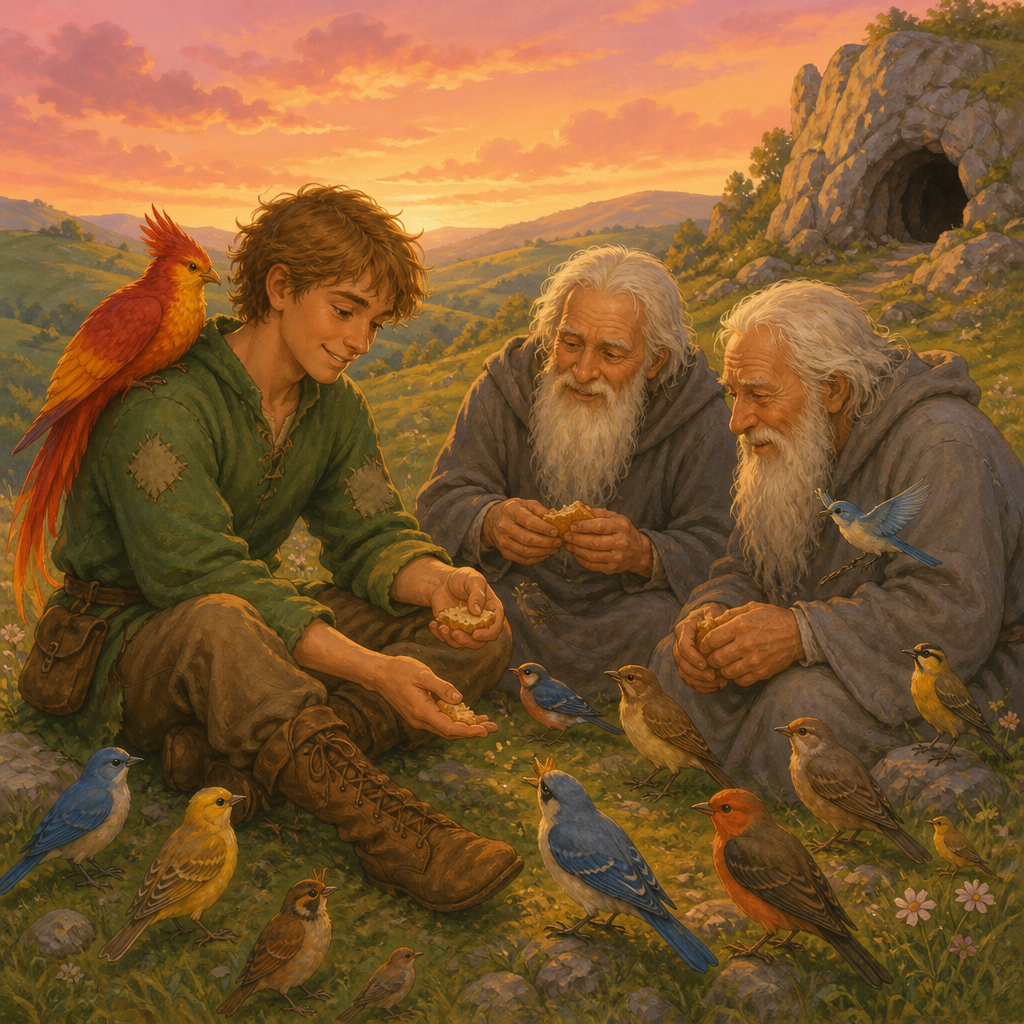
Then it was the youngest’s turn. His parents hardly seemed to notice him go; they gave him boots and bread and sent him on his way. He followed the road his brothers had taken. On the hill, he shared his food gladly with the old beggar, and treated him like an old friend. When the old man stood to go, he said, “If you’re ever in trouble, call me. My name is Tritill.” On the second hill the second old man was also fed, and said, “Call me. My name is Litill.” In the clearing, the young man crumbled bread for the birds, and the biggest and brightest said, “If you need us, say ‘My birds, come to me!'”
At dusk he came to the cave, and saw scraps of his brothers’ clothes. He shivered, but stayed. The ogress came in and gave him the same bargain. On the first day he took the spade and found the dust would not move, until the spade stuck fast in the floor. “Tritill, Tritill, help me!” Tritill was beside him at once. “Spade and shovel, do your duty!” they said, and the two danced about the cave and the floor was spotless in minutes.
“You didn’t do that alone,” said the ogress. “But the floor’s clean, so I’ll spare your head.”
Next day she told him to take every feather out of her pillows, dry them in the sun, and bring them all back by night. He spread them out in the sun, thinking how lucky there was no wind. A gust sprang up and swirled them into the air. “Tritill, Litill, my birds, come!” They all came. The birds brought back every feather, and Tritill and Litill stuffed them back into the pillows. They kept one feather out. “If she says one is missing, push it up her nose,” they said.
When the ogress came home she flopped on the bed, and the whole cave shook. The pillows were plump. She counted the feathers one by one. “If one’s missing, I’ll have your head.” The young man pulled the feather from his pocket and poked it up her nose. “If you want your feather, here it is.”
“You didn’t do that alone,” said the ogress calmly. “I’ll let it pass this time.”
On the third morning she told him to slay one of her fifty oxen, but only the one she meant. “Cook its heart and make drinking cups from its horns. Guess right, and tomorrow you go free and may choose three things from my house. Guess wrong, and you’ll lose your head.”
He called Tritill and Litill. They drove in the biggest ox he’d ever seen; Tritill killed it, Litill took out the heart, and together they turned the horns into cups. As they worked, he told them about the ogress’s promise. “Ask for the chest at the foot of her bed,” they said. “Ask for whatever lies on top of the bed. And ask for whatever lies beneath the wall of the cave.”
When the ogress came back, she found the heart cooked and the cups ready. “You didn’t do this alone,” she said, “but I’ll keep my word.” She woke him at dawn and told him to choose three things.
“The chest at the foot of your bed. Whatever lies on top of the bed. And whatever is under the side of the cave.”
“You didn’t choose those by yourself,” she said, “but what I promised, I’ll give.” On top of the bed lay the lost princess. The chest was full of gold and jewels. Under the cave wall was a great ship that sailed by itself, on land as well as water. “You’re the luckiest man alive,” said the ogress.
He heaved the chest aboard, and the princess walked beside him. He took the helm, and the ship carried them home. The king nearly fainted from joy, and when he’d recovered he asked to hear everything. “You found her, and you shall marry her,” he said. And so it was done.