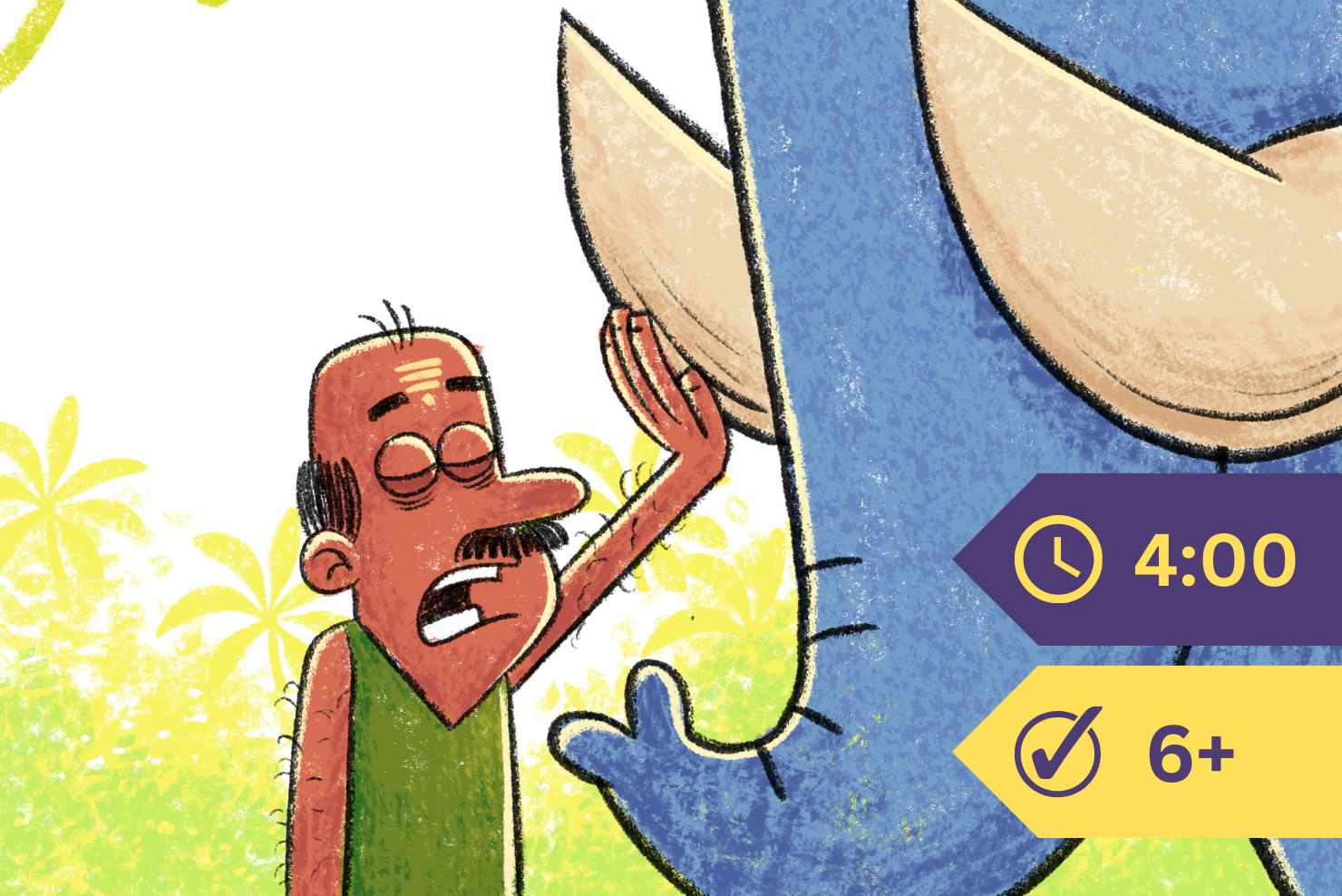
Long ago there was a king so mighty that whenever he sneezed, every person in the country had to say, “To your good health!”
Every person but one. The shepherd with the staring eyes would not say it.
When the king heard, he was furious, and sent for the shepherd. The shepherd walked into the great hall and stood before the throne, and he was not the least bit afraid.
“Say it at once,” ordered the king. “‘To my good health!'”
“To my good health,” said the shepherd.
“Mine, you rascal! Mine!”
“Mine, Your Majesty. Of course.”
“No — my health! My own!” The king thumped his chest.
“Well, yes,” said the shepherd, and tapped his own chest gently. “My own, certainly.”
The king was shaking with rage. The Lord Chamberlain leaned in and whispered, “Just say ‘To your health, Your Majesty,’ or you’ll lose your head!”
“I won’t say it,” said the shepherd, “until I’m married to the princess.”
The princess was sitting on a little throne beside her father, as lovely as a golden dove, and when she heard this she couldn’t help laughing. She had refused a good many princes. She rather liked the look of this young shepherd with his staring eyes.
Her father was not amused. “Throw him in the bear pit!”
The guards shoved the shepherd in with a white bear that hadn’t eaten for two days. The bear charged — and then it saw his eyes. It shrank into a corner and stayed there, sucking its own paws from sheer nervousness. The shepherd knew that if he looked away for even a moment, the bear would be on him. So he stared all night long, and to keep himself awake he made up songs.
In the morning the Lord Chamberlain came to collect the bones and found a cheerful, rested shepherd instead.
“Well?” said the king. “You’ve had a close look at danger. Will you say it now?”
“I’m not afraid of ten bears. I’ll say it when I marry the princess.”
“Then try the wild boars!”
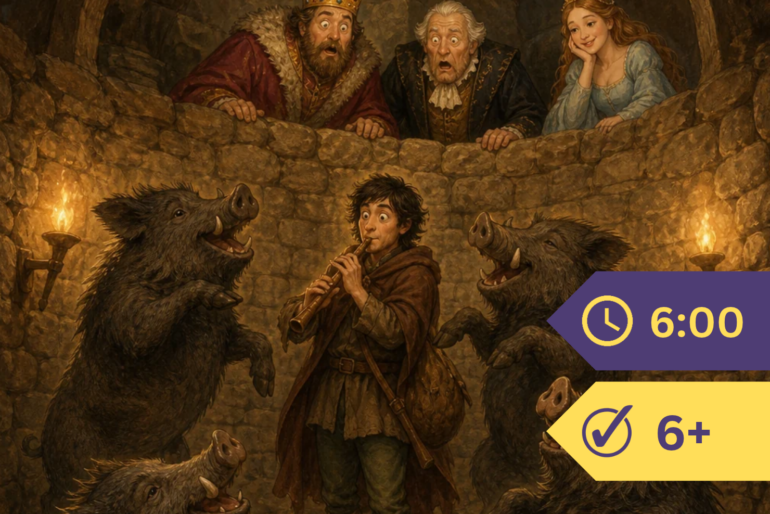
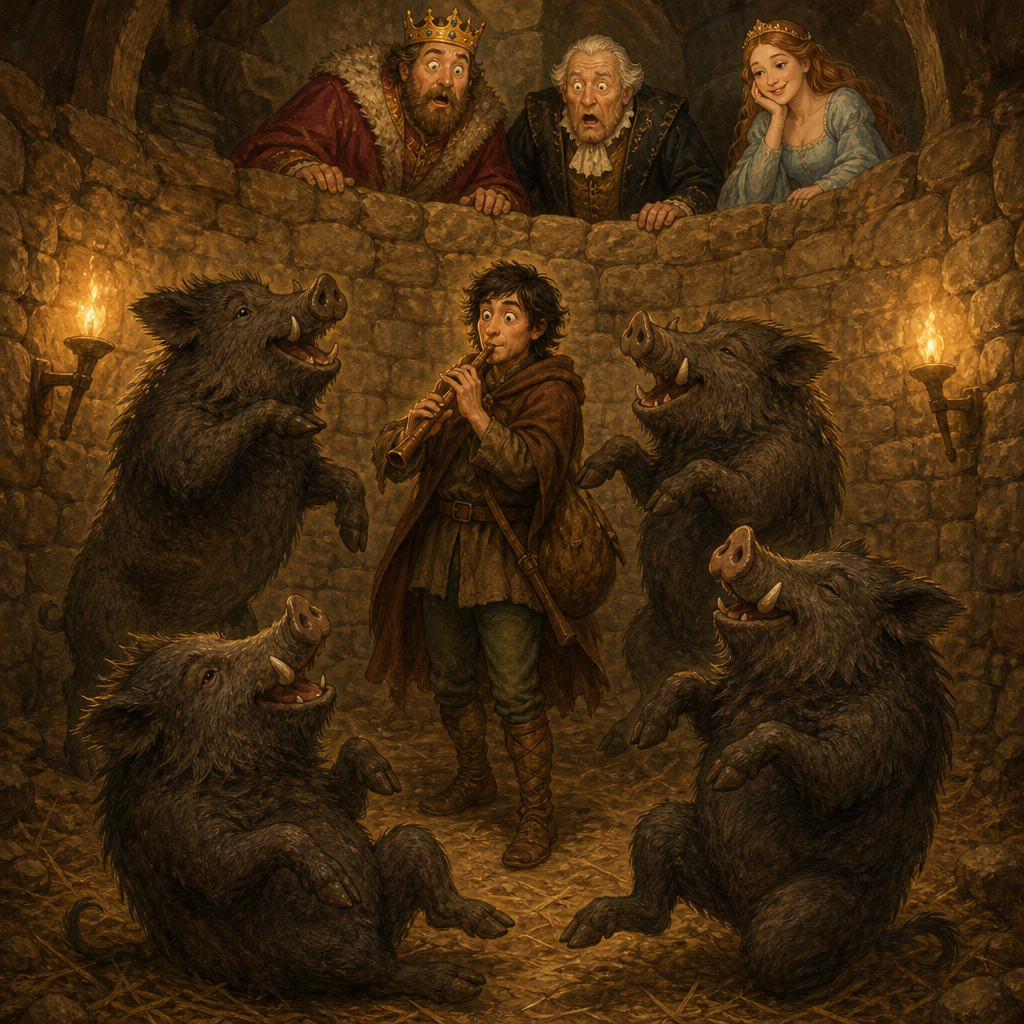
The boars hadn’t been fed in a week. The moment the shepherd was thrown in, they charged — but he pulled a little flute from his sleeve and began to play a merry tune. The boars skidded to a stop. Then, to everyone’s astonishment, they rose on their hind legs and danced. The shepherd nearly burst trying not to laugh, but he dared not stop playing. He made the tune faster and faster, and the boars spun and tumbled until they all fell in a heap, too dizzy to stand. Only then did he laugh, long and loud, and he was still laughing when the Lord Chamberlain arrived.
“A hundred bears couldn’t make me say it,” he told the king. “I’ll say it when I marry the princess.”
“Then the Vault of Scythes!”
This was the worst place in the palace: a dark dungeon with a deep well in the middle, ringed with razor-sharp blades. The shepherd asked the guards to leave him alone for a moment to think over the king’s offer. When they stepped out he stood his long stick against the wall, hung his cloak over it, set his hat on top, and stuffed his knapsack inside the cloak so it looked like a man. Then he called, “I’ve decided, and my answer’s the same!” The guards rushed in, saw a figure by the well, and shoved it in. They heard the scythes clang, watched the light at the bottom flicker, and went off satisfied. The shepherd was crouching in a dark corner, laughing quietly into his sleeve.
The next morning, when the Lord Chamberlain carried his lamp down to look, he nearly fell over backwards.
The king was beyond fury. “A hundred deaths, and still you’re here! Will you say ‘To your good health’?”
“I won’t say it until the princess is my wife.”
At last the king grew thoughtful. Perhaps there was a cheaper way. He had the royal coach brought round, made the shepherd sit beside him, and ordered the driver to the silver wood.
“See this silver wood? It’s yours if you’ll say, ‘To your good health.'”
The shepherd’s mouth went dry, but he said, “Not until I marry the princess.”
On they drove to a castle made entirely of gold. “The wood and the castle, if you’ll say it.”
The shepherd gaped. “Not until I marry the princess.”
On they drove to a lake of diamonds so bright the shepherd had to squeeze his staring eyes shut. “The wood, the castle, and the lake! All yours — only say it!”
“No, no. Not until the princess is my wife.”
The king saw that he was beaten. “Fine,” he sighed. “Marry my daughter. But then you really must say it.”
“Of course I will,” said the shepherd. “Why wouldn’t I? It stands to reason.”
There was a wedding such as nobody had ever seen. Everyone feasted and danced, even the sick were fed, and newborn babies were given presents. At the great banquet, the groomsman carried in a boar’s head on an enormous dish and set it before the king to carve — and the smell was so rich, and so peppery, that the king began to sneeze, and sneeze, and sneeze.
“To your very good health!” cried the shepherd, before anyone else could.
The king was so delighted that he forgot to be sorry about the whole business.
When the old king died, the shepherd became king in his place. He was a fine ruler, and he never made anyone wish him well against their will. But everyone did, because they loved him.