A father had two sons. The elder was clever and sensible and always knew what he was about. The younger was slow, and couldn’t seem to learn or understand anything. People who met him would shake their heads and say, “What a burden he’ll be to his father!”
Whenever there was a job to be done, the elder son had to do it. But if something was needed late, or in the night, and the way led through the churchyard or some other gloomy place, he would say, “Oh no, Father, nothing will make me go there. It gives me the shivers!” He was afraid.
In the evenings, when everyone sat around the fire telling stories that made your skin crawl, the listeners would sometimes say, “Oh, it gives me the shivers!” The younger son sat in his corner, heard them, and couldn’t make out what they meant.
“They’re always saying it gives them the shivers,” he thought. “It doesn’t give me the shivers. It must be an art I know nothing about.”
One day his father said to him, “You there in the corner. You’re growing big and strong, and it’s time you learned to earn your bread. Look how hard your brother works. All the money I’ve spent on your schooling is wasted.”
“Father,” he said, “I’d be glad to learn. In fact, if it could be arranged, I’d like to learn to shiver. I don’t understand it at all yet.”
His brother laughed. “Good heavens, what a simpleton,” he thought. “He’ll never amount to anything.”
His father sighed. “You’ll learn to shiver soon enough. But it won’t put bread on your table.”
Soon afterward the sexton came to visit, and the father poured out his troubles. “My youngest knows nothing and learns nothing. When I asked how he meant to make a living, he asked to be taught to shiver!”
“If that’s all he wants,” said the sexton, “send him to me. I’ll teach him.”
The father was pleased. It will do the boy good, he thought. So the sexton took the youth home with him and gave him the job of ringing the church bell.
A few nights later the sexton woke him at midnight and told him to climb the tower and ring the bell. I’ll teach you to shiver, he thought. He crept up ahead of the boy and hid himself in a white sheet at the top of the stairs.
When the youth reached the belfry and turned to grab the bell rope, he saw a white figure standing in the doorway. “Who’s there?” he called. No answer. The figure didn’t stir.
“Answer me, or go away,” said the youth. “You’ve no business here at this hour.”
The sexton stood stiff as a post, hoping the boy would take him for a ghost.
“What do you want here?” the youth called a second time. “Speak, if you’re honest, or I’ll send you down the stairs.”
Still nothing. The sexton thought, He can’t mean it, and stood like stone.
The youth shouted a third time, and when that had no effect either, he ran at the figure and pushed it down the stairs. It tumbled ten steps and lay in a heap in the corner. The youth rang the bell, went home to bed without a word, and fell asleep.
The sexton’s wife waited a long while for her husband. At last, worried, she woke the youth. “Do you know where my husband is? He went up the tower ahead of you.”
“No,” said the youth, “but somebody was standing at the top of the stairs, and wouldn’t answer me or go away. I took him for a prowler and pushed him down. You’d better go and see if it was your husband. I’d be sorry if it was.”
She ran to the tower and found her husband groaning in the corner with a broken leg. She got him home, then hurried to the youth’s father. “Your son has caused a terrible accident! He threw my husband down the stairs and broke his leg. Get that good-for-nothing out of our house!”
The father was horrified. He rushed to his son and scolded him. “What kind of wicked prank is this? Some mischief must have put it into your head!”
“Father, listen,” said the youth. “I’m completely innocent. He stood there in the dark like someone up to no good. I didn’t know who it was, and I warned him three times to speak or leave.”
“You’ll bring me nothing but trouble,” the father groaned. “Get out of my sight.”
“Gladly, Father. Just let me wait till daylight. Then I’ll go off and learn to shiver, and that way I’ll have a skill to live by.”
“Learn what you like,” said his father. “It’s all the same to me. Here are fifty dollars. Go out into the world with them, and don’t tell a soul where you come from or who your father is, because I’m ashamed of you.”
“Yes, Father. If that’s all you ask, I can easily remember it.”
At daybreak the youth put the fifty dollars in his pocket and set out along the high road, muttering to himself, “If only I could shiver! If only I could shiver!”
A man came along who overheard him. When they came in sight of the gallows, the man said, “See that tree? Seven men were hanged there, and they’re learning to fly. Sit under it till nightfall and you’ll soon learn to shiver.”
“If that’s all it takes,” said the youth, “it’s easily done. And if I learn to shiver that quickly, you can have my fifty dollars. Come back tomorrow morning.”
So the youth sat down under the gallows tree and waited for evening. He was cold, so he lit a fire. By midnight the wind was so bitter that even the fire couldn’t warm him. The wind swung the hanged men against each other, back and forth, and he thought, If I’m freezing down here by the fire, how those poor fellows must be shaking up there!
He had a tender heart. He set up a ladder, climbed up, untied all seven, and brought them down. He stoked the fire and sat them in a circle to warm themselves. But they sat there without moving, and their clothes caught fire.
“Careful,” he said, “or I’ll hang you back up.”
The dead men said nothing and let their rags burn. This annoyed him. “If you won’t look after yourselves, I can’t help you, and I’m not going to burn with you.” He hung them back up in a row, sat down by his fire, and went to sleep.
In the morning the man came, hoping for the fifty dollars. “Well, now you know what it is to shiver.”
“No,” said the youth. “How would I? Those fellows never said a word, and they were so foolish they let the few old rags they had on go up in flames.”
The man saw he wasn’t getting his money that day. He went away muttering, “I’ve never met anyone like him in all my life.”
The youth walked on, murmuring again, “If only I could shiver!” A carter walking behind him heard.
“Who are you?”
“I don’t know.”
“Where do you come from?”
“I don’t know.”
“Who’s your father?”
“I’m not allowed to say.”
“And what’s that you keep muttering?”
“Oh,” said the youth, “I’d give anything to shiver, but nobody can teach me how.”
“Nonsense,” said the carter. “Come along with me and we’ll see to that.”
That evening they reached an inn. As he walked into the room, the youth said it again, quite loudly: “If only I could shiver!”
The innkeeper laughed. “If that’s what you’re after, you’ll have your chance here.”
“Hush,” said the innkeeper’s wife. “Plenty of curious people have paid with their lives. It would be a shame if those bright eyes never saw daylight again.”
But the youth said, “However hard it is, I mean to learn it. That’s why I set out.”
He gave the innkeeper no peace until he told him: not far away stood a haunted castle where anyone could learn to shiver, if he kept watch there for three nights. The King had promised his daughter in marriage to whoever dared, and she was the loveliest maiden under the sun. There was also great treasure hidden in the castle, guarded by evil spirits, which would be freed if the castle were. It was enough to make a poor man rich. Many men had gone in, but none had ever come out.
The next morning the youth went to the King. “With your permission, I’d like to keep watch in the castle for three nights.”
The King liked the look of him. “You may bring three things with you, as long as none of them is alive.”
“Then I ask for a fire, a turning lathe, and a carving bench with its knife.”
The King had everything carried into the castle. When night fell, the youth lit a bright fire in one of the rooms, set the carving bench beside it, and sat down on the lathe. “If only I could shiver,” he said. “But I don’t suppose I’ll learn it here either.”
Near midnight, as he bent to blow up the fire, he heard a wail from a corner. “Miaow! We’re so cold!”
“You silly things,” he cried, “why are you howling? If you’re cold, come sit by the fire.”
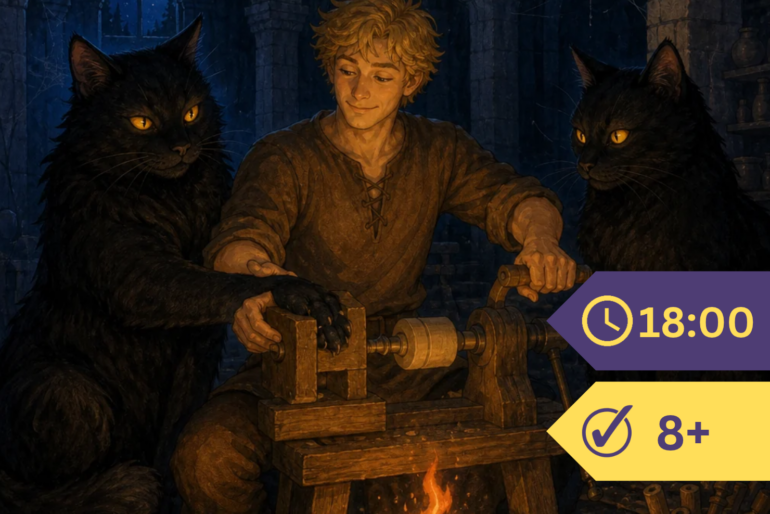
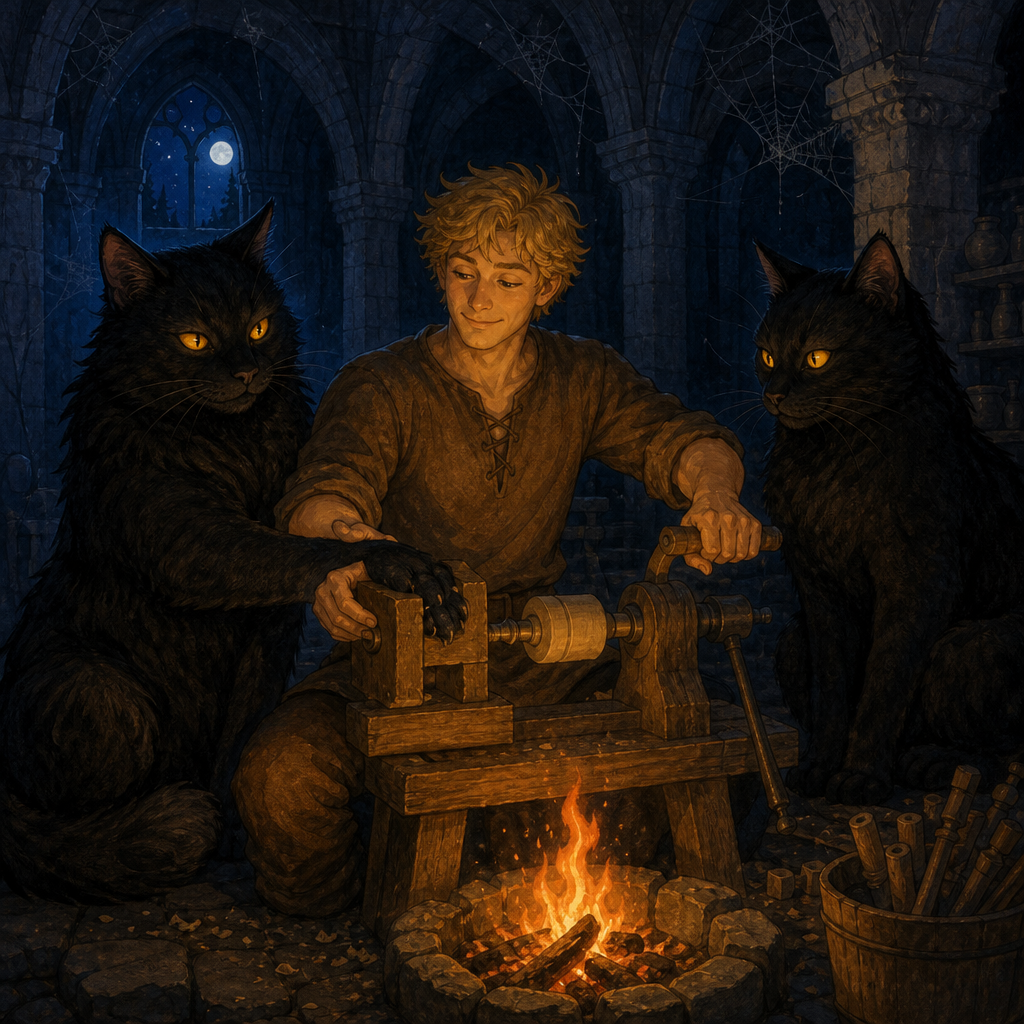
Two huge black cats leapt out and sat on either side of him, glaring with fiery eyes. After a while, when they had warmed up, they said, “Friend, shall we play a little game of cards?”
“Why not? But let me see your paws first.”
They stretched out their claws.
“My, what long nails,” he said. “Wait, I’ll trim them for you.” He grabbed them by the scruff, set them on the carving bench, and clamped their paws in the vise. “Now that I’ve seen your paws, I’ve lost all desire to play cards with you.” The cats yowled and wrenched free, and fled out of the castle and into the pond.
He had just settled down again when black cats and black dogs with glowing chains came pouring out of every nook and corner, more than he could count. They shrieked horribly, trampled his fire, scattered it, and tried to put it out. He watched calmly for a while, but when it got to be too much, he grabbed his carving knife and shouted, “Be off, you rabble!” and swung at them. Some ran away, and the rest he chased out the door and down to the pond.
He came back, blew the sparks into a flame again, and warmed himself. His eyes grew heavy. In the corner he saw a big bed. “Just what I need,” he said, and lay down. But as soon as he tried to close his eyes, the bed began to move by itself and ran all around the castle.
“Excellent,” he said. “A little faster, please.”
The bed raced along as if pulled by six horses, over thresholds and up and down stairs. Then, with a crash, it flipped upside down and landed on top of him like a mountain. He tossed off the blankets and pillows, climbed out, and said, “Anyone who fancies a ride is welcome to it.” He lay down by his fire and slept till morning.
The King came and found him lying on the floor. Thinking the ghosts had finished him, he sighed, “What a pity. And such a fine young man.”
The youth heard, sat up, and said, “It hasn’t come to that yet.”
The King was astonished and delighted, and asked how it had gone. “Very well,” said the youth. “One night is over, and I’ll get through the other two as well.”
The innkeeper’s eyes went wide when he saw him. “I never expected to see you again. Have you learned to shiver?”
“No,” said the youth. “It’s hopeless. If only someone could tell me how!”
The second night he went up to the castle again, sat by the fire, and began his old refrain: “If only I could shiver!”
Toward midnight a noise broke out, first soft, then louder. There was a moment of silence, and then, with a loud shriek, half a man tumbled down the chimney and landed in front of him.
“Hey, up there!” he shouted. “You’ll need to send the other half. This isn’t enough!”
The racket began again, with howling and yelling, and the other half dropped down. “Wait a moment,” said the youth. “I’ll stir up the fire for you.”
When he looked back, the two halves had joined together, and a hideous man was sitting in his seat.
“Now, now,” said the youth, “that wasn’t part of the bargain. That’s my seat.” The man tried to push him off, but the youth wouldn’t have it. He shoved the man out and sat back down.
More men dropped down the chimney, one after another. They fetched nine skeleton legs and two skulls, set them up, and began a game of ninepins. The youth wanted to join in.
“Mind if I play?”
“Not if you’ve got money.”
“Plenty,” he said, “but your balls aren’t round enough.” He took the skulls, put them on his lathe, and turned them till they were perfectly round. “There. They’ll roll better now. Houp-la! Let the fun begin!”
He played along and lost some of his money. At the stroke of twelve, everything vanished. He lay down and slept peacefully.
In the morning the King came for news. “How did you fare?”
“I played ninepins and lost a few coins.”
“And you didn’t shiver?”
“No such luck. I had a lovely time. Oh, if only I knew what it was to shiver!”
On the third night he sat down on his bench and said, very gloomily, “If only I could shiver.”
Late in the night six tall men came in carrying a coffin.
“Ha!” he cried. “That must be my little cousin, who died just a few days ago.” He beckoned. “Come, little cousin, come!”
They set the coffin on the floor. He went over and lifted the lid. A dead man lay inside. He touched the man’s face. It was cold as ice.
“Wait,” he said, “I’ll warm you up.” He went to the fire, warmed his hands, and laid them on the dead man’s face. It stayed cold. He lifted the man out, sat by the fire with him on his knee, and rubbed his arms to get the blood moving. That did nothing, either. Then he remembered that two people lying in bed warm each other. So he put the dead man into the bed, covered him up, and lay down beside him. After a while the corpse grew warm and began to stir.
“There now, little cousin,” said the youth. “What would have become of you if I hadn’t warmed you up?”
The dead man sat up and cried, “Now I will strangle you!”
“What! Is that the thanks I get? Back into your coffin with you!” He picked him up, dropped him in, and shut the lid. The six men came and carried him away.
“I simply can’t shiver,” the youth said. “I’ll never learn it here, not in a lifetime.”
Then a man walked in, enormous and terrifying to look at, though old, with a long white beard. “Wretched creature,” he roared, “now you’ll learn what it is to shiver, for you are going to die!”
“Not so fast,” said the youth. “If I’m to die, you’ll have to catch me first.”
“I’ll catch you soon enough.”
“Gently now. Don’t boast. I’m as strong as you are, and probably stronger.”
“We’ll see,” said the old man. “If you’re stronger, I’ll let you go. Come, let’s try it.”
He led the youth through dark passages to a forge. Taking up an axe, he drove one of the anvils into the ground with a single blow.
“I can do better than that,” said the youth, and went to the other anvil. The old man leaned in close to watch, his white beard hanging down. The youth swung the axe, split the anvil in two, and caught the old man’s beard in the crack.
“Now I’ve got you,” he said. “This time it’s you who must be afraid.”
The old man begged him to let go and promised him great riches. The youth pulled out the axe and freed him. The old man led him back to the castle and showed him three chests of gold in the cellar. “One is for the poor, one is for the King, and one is yours.”
Just then twelve o’clock struck, and the old man vanished, leaving the youth alone in the dark. “I’ll find my way out,” he said, and groped along until he reached his room again. He fell asleep by the fire.
The King came the next morning. “Surely you’ve learned to shiver now.”
“No,” said the youth. “What can it be? My dead cousin came, and a bearded man showed me heaps of gold downstairs, but nobody’s told me what shivering is.”
“You have lifted the curse from the castle,” said the King, “and you shall marry my daughter.”
“That’s all very nice,” said the youth, “but I still don’t know what it is to shiver.”
The gold was brought up and the wedding was held. The young king loved his wife dearly and was very happy, but he kept saying, “If only I could shiver! If only I could shiver!” At last it wore her out.
Her maid said, “Leave it to me. We’ll make him shiver.” She went to the stream that ran through the garden and had a bucket filled with little fish. That night, while the young king slept, his wife pulled off the covers and poured the bucket of wriggling fish over him.
He woke up with a yell. “Oh, how I shiver! How I shiver, dear wife! Now I know what shivering is!”