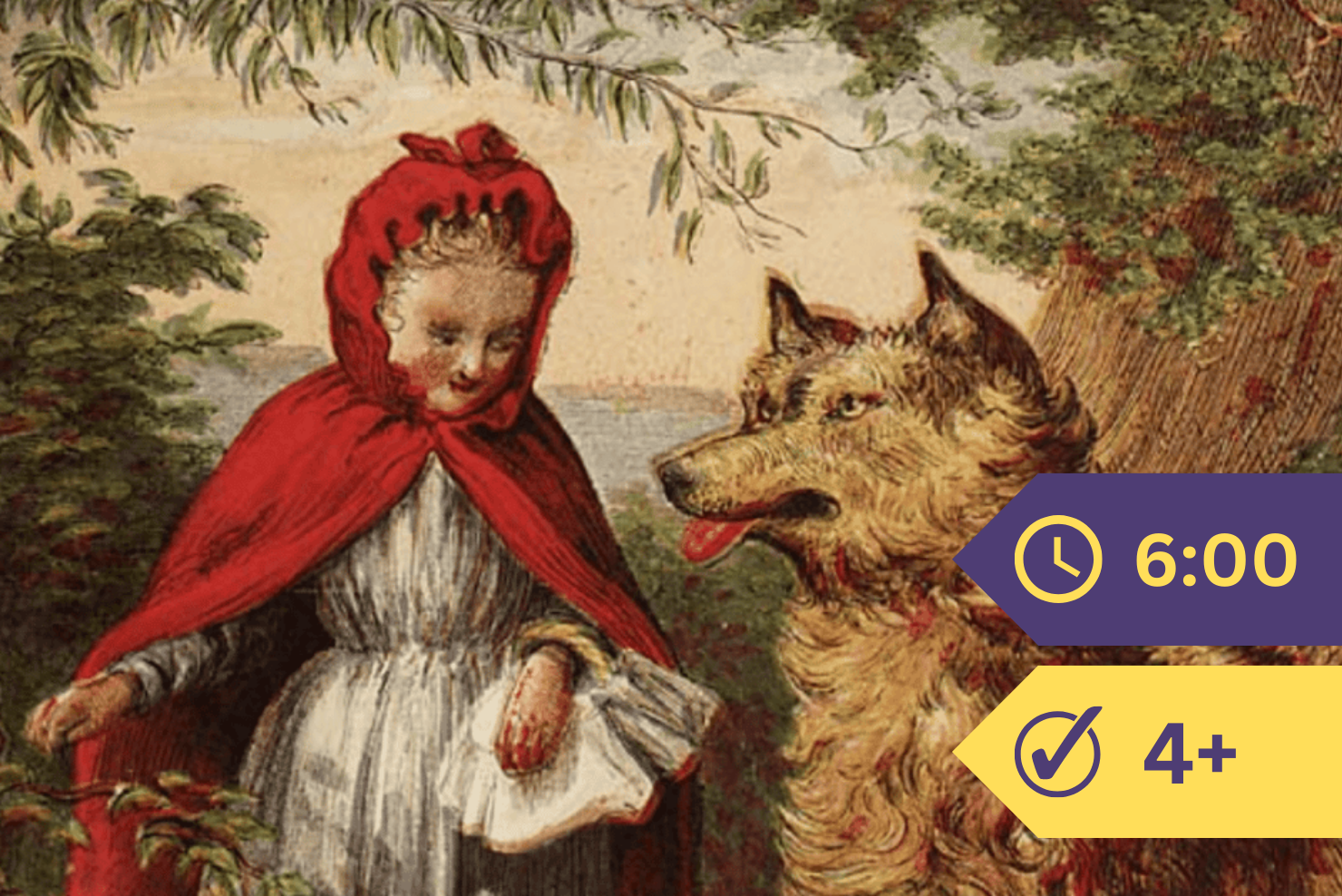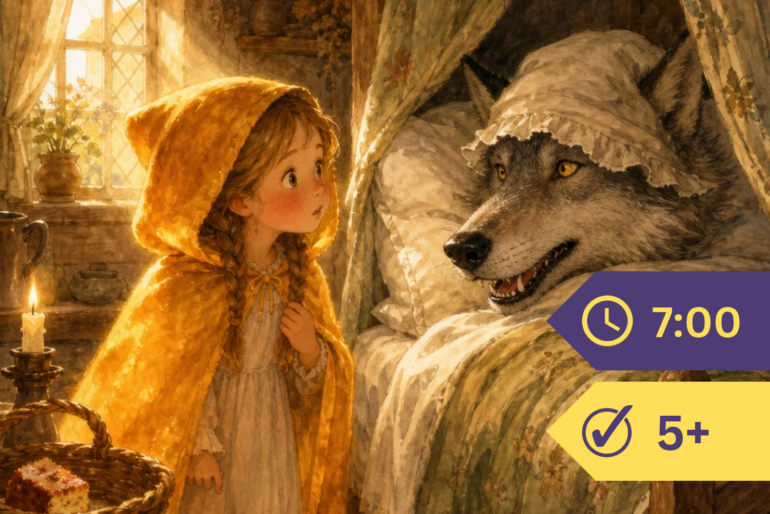
You know the tale of poor Little Red Riding Hood, whom the wolf tricked and swallowed, along with her cake, her little pot of butter, and her grandmother. Well, the true story happened quite differently. First of all, the little girl was called Little Golden-Hood, and still is. Second, it wasn’t she or her good grandmother who was caught in the end, but the wicked wolf.
Listen.
The story begins a bit like the other one. There was once a little peasant girl, as pretty as a star in its season. Her real name was Blanchette, but everyone called her Little Golden-Hood because of her wonderful little cloak with a hood, the colour of gold and fire, which she always wore. Her grandmother had given it to her. The old woman was so old she’d lost count of her years, and she said the hood would bring good luck, because it was made from a ray of sunshine. Since the grandmother was thought to be something of a witch, everyone supposed the little hood was a bit bewitched too.
And so it was, as you’ll see.
One day Blanchette’s mother said, “Let’s see, my little Golden-Hood, whether you can find your own way now. Take this good piece of cake to your grandmother for her Sunday treat tomorrow. Ask how she is and come straight back. Don’t stop to chat with people you don’t know. Understood?”
“Quite understood,” said Blanchette cheerfully, and off she went with the cake, very proud of her errand.
But Grandmother lived in another village, and there was a big wood to cross first. At a bend in the road under the trees, a voice said, “Who goes there?”
“Friend Wolf.”
He had seen the child set out alone, and the scoundrel was waiting to eat her. Then he spotted some woodcutters who might see him, and changed his mind. Instead of leaping at her, he came bounding up like a friendly dog.
“Why, it’s my nice Little Golden-Hood!” he said. And Blanchette stopped to talk to the wolf, whom she didn’t know at all.
“You know me, then! What’s your name?”
“Friend Wolf. And where are you going, my pretty, with your little basket?”
“To my grandmother’s, with a nice piece of cake for her Sunday treat.”
“And where does she live?”
“On the other side of the wood, in the first house in the village, next to the windmill.”
“Ah, yes, I know it,” said the wolf. “That’s just where I’m going. I’ll get there before you, no doubt, with your little legs, and I’ll tell her you’re coming. Then she’ll wait for you.”
And the wolf cut through the wood and in five minutes was at Grandmother’s door.
He knocked: toc, toc. No answer. He knocked harder. Nobody. Then he stood up on his hind legs, put his front paws on the latch, and the door swung open.
Not a soul. The old woman had risen early to sell herbs in town, and left in such a hurry that she hadn’t made her bed, and her big nightcap lay on the pillow.
“Good,” thought the wolf. “I know what to do.”
He shut the door, pulled the nightcap down to his eyes, stretched out in the bed, and drew the curtains.
Meanwhile Blanchette went along the path as little girls do, picking Easter daisies, watching birds build their nests, and chasing butterflies in the sun.
At last she reached the door. Knock, knock.
“Who’s there?” said the wolf, softening his rough voice as best he could.
“It’s me, Granny, your Little Golden-Hood. I’ve brought you a big piece of cake for your Sunday treat.”
“Press the latch, then push, and the door will open.”
“Why, you’ve got a cold, Granny,” said Blanchette, coming in.
“Ahem, a little, a little,” said the wolf, pretending to cough. “Shut the door well, little lamb. Put your basket on the table, then take off your dress and come lie down beside me. You can rest a little.”
Blanchette undressed, but, look: she kept her little hood on her head. When she saw how Granny looked in bed, she was very surprised.
“Oh, how like friend Wolf you look, Grandmother!”
“That’s the nightcap, child.”
“Oh, what hairy arms you have, Grandmother!”
“All the better to hug you, child.”
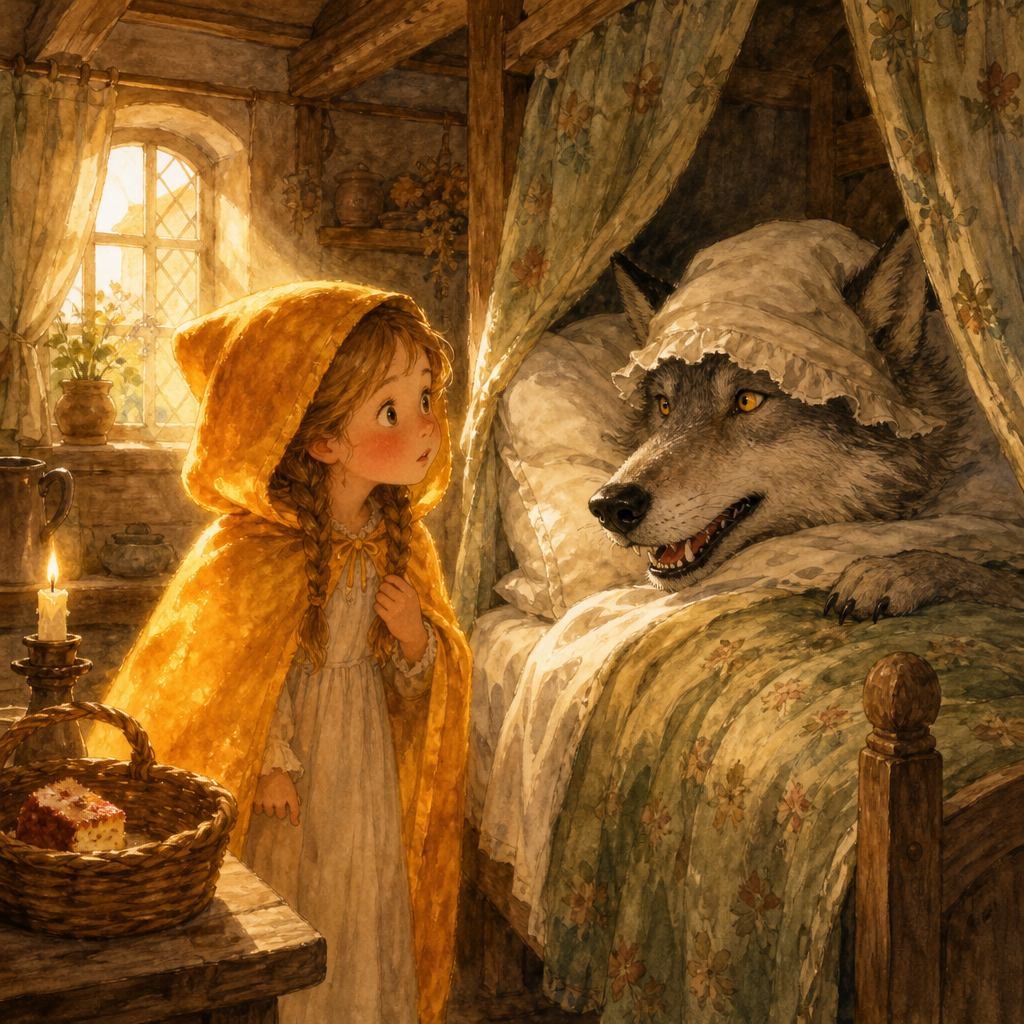
“Oh, what a big tongue you have, Grandmother!”
“All the better to answer you, child.”
“Oh, what a mouthful of big white teeth you have, Grandmother!”
“All the better for crunching little children!” And the wolf opened his jaws wide to swallow Blanchette.
But she ducked her head and cried, “Mamma! Mamma!” and the wolf only caught her little hood.
At once, oh dear, oh dear, he jumped back, howling and shaking his jaw as if he had swallowed red-hot coals. The little fire-coloured hood had burned his tongue all the way down his throat. It was one of those magic caps that people had in the old stories, for making oneself invisible or safe from harm.
So there was the wolf with a scorched throat, leaping off the bed and looking for the door, howling as if every dog in the country were after him.
Just then Grandmother came back from town with her long empty sack over her shoulder.
“Ah, you rascal!” she cried. “Wait!” Quickly she held open the sack across the doorway, and the frantic wolf sprang in headfirst. It was he who was caught now, swallowed like a letter in a mailbox.
The brave old woman tied the sack shut, ran to the well, and tipped him in, and that was the end of him.
“Scoundrel! You thought you’d gobble up my little grandchild! Well, you won’t trouble anyone again.” And she hurried to dress Blanchette, who was still trembling in the bed.
“Without my little hood,” she said, “where would you be, darling?” To bring back the colour to the child’s face, she gave her a good piece of cake and a sip of sweet drink, and led her home by the hand.
And who scolded her when she heard what had happened? Her mother.
But Blanchette promised again and again never to stop and listen to a wolf, and in the end her mother forgave her.
And Blanchette, Little Golden-Hood, kept her word. In fine weather you can still see her in the fields in her pretty hood the colour of sunshine.
But to see her, you must rise early.