A king and queen had two children, Sigurd and Lineik, famous for their wisdom and beauty. They were a year apart, and so close they did everything together. When the queen fell ill, she asked the king for two promises. “If you marry again, don’t choose a woman from a small state or a faraway island, who knows nothing of the world and will be vain about her grandeur. Choose a princess from a great kingdom, used to courts. And always watch over our children.”
When she died, the king was so grief-stricken that the kingdom went unattended. His Prime Minister said, “You must marry again, sir. The people need a queen.” The king entrusted him with the search. “Only not from a small town or a remote island.”
The ship sailed, but a thick fog came down for a month. When it lifted, a cliff stood in front of them, and behind it a sheltered bay. The minister rowed ashore and heard a harp. A woman of marvellous beauty sat on a low stool, playing, with a girl beside her singing.
“I’m in the same state as your master,” she said. “My husband, a great king, was killed by sea-robbers, and I escaped here with my daughter.” The daughter murmured, “Are you telling the truth?” The woman pinched her sharply when the minister wasn’t looking. “Remember your promise.” Her name, she said, was Blauvor, and her daughter’s Laufer.
Blauvor was so learned that the minister thought: what a wife for the king! She protested that she was unworthy, which only made him more eager, and finally she agreed to come. When the fog lifted they saw that the island was bare and barren, but nobody was looking back.
The king took one look at the two beautiful women in gold and silver and forgot his grief. He forgot his children too. They were left alone in their own house. After the wedding, the king did nothing without his new wife’s advice. But he noticed that his courtiers had a habit of vanishing, one after another, without a trace. And he noticed that his children stayed away from their stepmother.
One day the queen announced that the king should tour the kingdom and see that his governors weren’t cheating him. “I’ll rule as carefully as you.” He had no wish to go. But his will was weaker than hers, and he got ready. The night before leaving, he visited the children.
“If I should not come back,” he told them, “it may not be safe for you here. Go east to a high mountain and cross it. Then follow a little bay until you come to two trees, one red and one green, in a thicket you’d never see unless you looked. Hide in them and you’ll be safe from all enemies.”
The king sailed. For a few days the wind was fair, and then a storm of thunder and lightning blew up, and the ship was driven onto rocks, and no one survived. That very night Sigurd dreamed that his father stood dripping at his bedside, took the crown from his head, and laid it at his son’s feet. He woke Lineik, and they agreed their father was dead. They took their jewels and a few clothes and left.
They had reached the mountain when Sigurd looked back and saw their stepmother following, her face uglier than that of any witch. Between them lay a thick wood. Sigurd set it ablaze, and they hurried on to the grove with the red and green trees, jumped into the trunks, and felt safe at last.
At that time, a king reigned in Greece with a son and daughter, the most beautiful and accomplished in the land. The prince had heard of Princess Lineik’s beauty and decided to ask for her hand. Blauvor, who had foreseen it by her dark arts, dressed her own daughter Laufer in a splendid gown and met him herself.
“The Princess Lineik?” he asked. Blauvor brought forward Laufer, pale-faced and heavy-eyed. The prince was disappointed. “She never recovered from the loss of her father and mother,” said Blauvor quickly. “That shows a good heart,” thought the prince, and agreed to the betrothal. He insisted on taking only Laufer back to his country.
On the voyage, fog came down again, and the ship drifted into a strange bay. The prince went ashore and noticed two beautiful trees, unlike any in Greece, and had them cut down and carried aboard.
At the palace, Laufer was taken to the women’s rooms to wait for the wedding. The prince had the trees brought into his own chamber. Next morning he gave her silk and told her to weave three robes, one red, one green, one blue, in that order, before the wedding, the green most splendid of all, “for I’ll wear it at our marriage.”
Laufer sat staring. She couldn’t weave. She burst into tears, and Sigurd, inside his tree, heard her. “Lineik, Laufer is crying. Help her.”
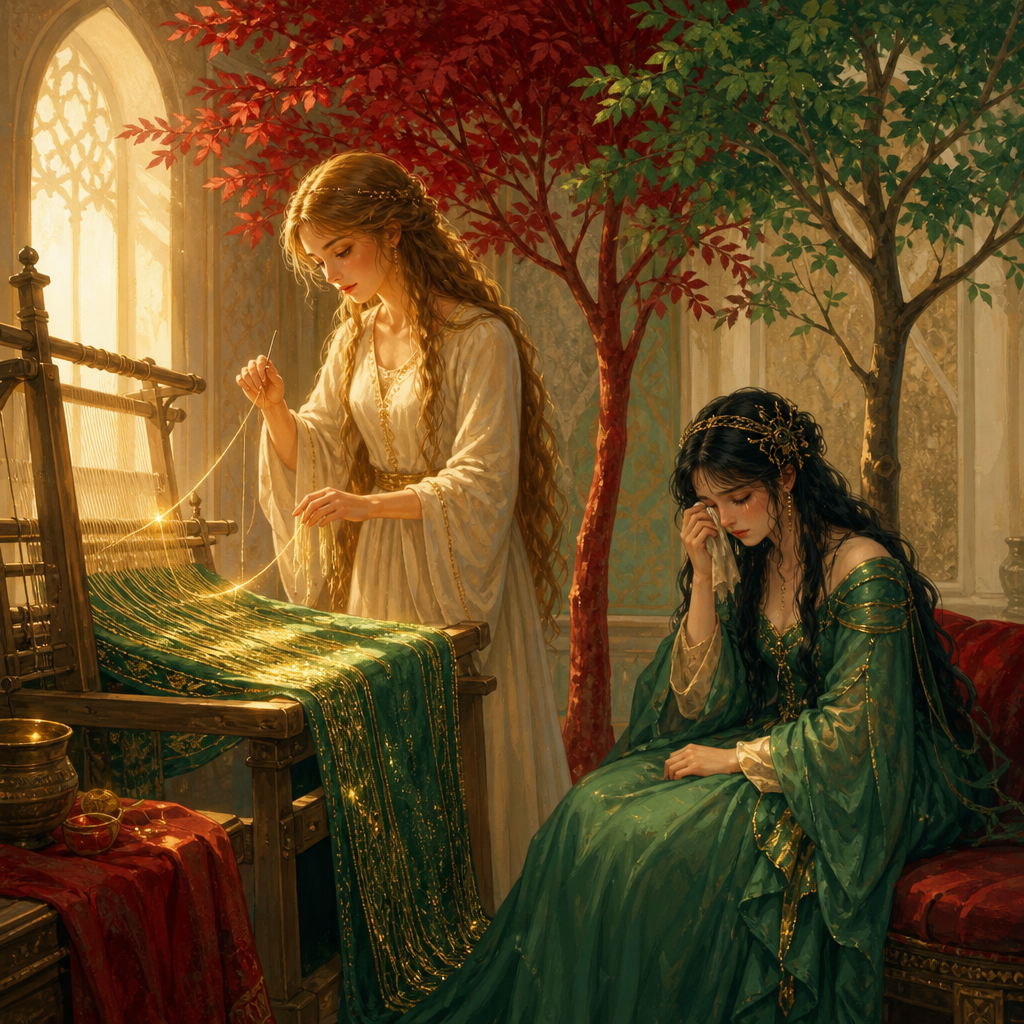
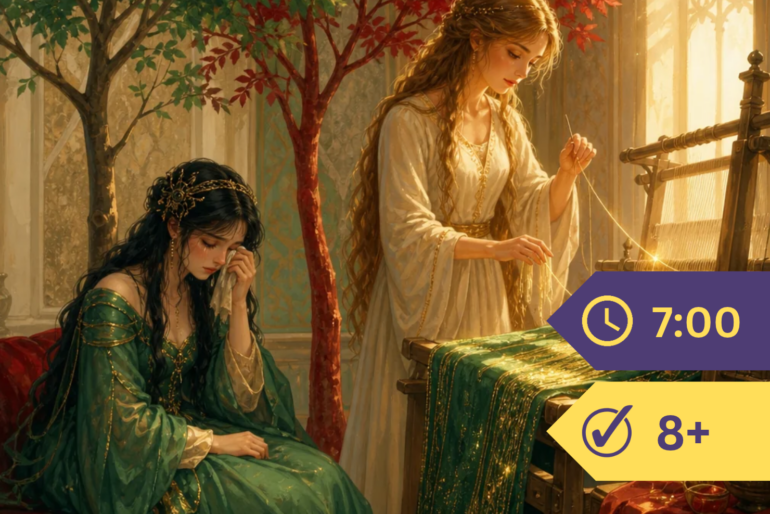
“She and her mother drove us out of our home,” said Lineik. But she wasn’t really unforgiving. She slipped out of her tree, took the silk, and wove so fast and so well that the blue robe was finished and embroidered before the prince returned. “The most beautiful work I’ve ever seen. The red will be even better,” he said. The second robe, red and gold, was just as splendid. For the third, he gave her three days. This time Laufer thought Lineik might not help; but Sigurd begged, and Lineik caught the sun’s rays and the moon’s beams on the point of her needle and wove them into the green silk, in a pattern no one had ever seen.
On the third morning, just as she was putting in the last stitch, the prince came in. Lineik jumped up to dash back to her tree, but the silk tangled around her and she would have fallen if he hadn’t caught her. “I’ve suspected for some time that something was wrong. Who are you?”
She told him. He turned on Laufer, and Laufer fell at his feet. “It was my mother. The only lie of my own was about the robes.” Just then, Sigurd came in. He pleaded with the Greek prince to forgive her, and the prince agreed on condition that Lineik would marry him. “Not while my stepmother is free,” said Lineik. Laufer told them the truth: Blauvor was no queen but an ogress and a witch, who had taken Laufer from a neighbouring palace as a baby. She’d caused the wreck that drowned the old king. It was she who had been making the courtiers disappear.
The two princes raised an army and marched on Blauvor’s city. They came so fast she was taken by surprise, and with most of her strong men gone or fled, she was captured. She was driven out of the land and never seen again.
Lineik married the Prince of Greece, and Sigurd married the Greek princess, in a double wedding. Laufer stayed on as Lineik’s friend and sister, and in time she married a great nobleman. They all lived happily till the end.