Labakan was a young tailor in Alexandria, and a good one when he felt like it. He could stitch as if his needle were red-hot, and then, an hour later, sit staring into space with such a lofty look that his fellow workers would say, “Labakan has his aristocratic face on again.”
On Fridays he put on his best robe and went to the mosque, and if anyone greeted him on the way home he gave a gracious little wave. When his master teased, “Really, Labakan, you look like a prince,” he was delighted. “You noticed it too?” he’d say. His master put up with this because Labakan was an honest worker, whatever his airs.
One day the sultan’s brother passed through town and sent a state robe to be altered. The master gave it to Labakan, his best hand. That evening, after everyone had gone home, Labakan stood alone in the shop and gazed at the rich cloth and the gold embroidery. He couldn’t resist. He slipped it on, and it fit as if it had been made for him.
“Am I not as good a prince as any?” he said, strutting up and down. “Hasn’t my master said I was born for it?”
By the end of that evening he had decided that he must be the son of some unknown king, and that it was time to go and find his proper rank. He gathered his savings and, in the dark, walked out of the city gates wearing the robe.
People stared at the prince on foot. He explained mysteriously that he had his reasons. But walking looked silly, so he bought a quiet old horse named Murva, cheaply.
On the road a young rider overtook him and asked to join him. He was cheerful and open, and his name was Omar. He told Labakan an odd story. He had been raised by Elfi Bey, the Pasha of Cairo, who on his deathbed had said Omar wasn’t his nephew but the son of a great king, who had sent him away at birth because astrologers warned of danger and had vowed not to see him until he turned twenty-two. Omar was to go to a tall pillar four days east of Alexandria, hand a dagger to the men waiting there, and say, “Here am I whom you seek.” If they answered, “Praised be the Prophet who has preserved you,” he was to follow them to his father.
Labakan listened with growing envy. Omar was handsome and well-mannered, and yet here was a prince walking the road, while Labakan, who had the looks for it, had no kingdom. That night he couldn’t sleep. Before dawn, he drew the dagger from the sleeping Omar’s belt. He held it for a moment, ashamed of the thought that crossed his mind, and put it away in his own belt instead. Then he saddled Omar’s swift horse and rode off.
Two days later he saw the pillar on a hill in the middle of a plain. Below it a splendid camp had been pitched. Labakan, heart pounding, waited until the appointed morning, then climbed the hill with the dagger.
At the foot of the pillar stood six men around a tall old man in cloth of gold, with a jewelled white turban. Labakan bowed and held out the dagger. “Here am I whom you seek.”
“Praised be the Prophet who has preserved you!” The old man’s eyes filled with tears. “Come, my son Omar!”
For a moment Labakan was truly moved, and truly ashamed. Then he looked up and saw a horseman crossing the plain at a gallop on a tired old horse that he knew very well. It was Murva, and it was Omar.
Having begun a lie, Labakan stuck with it. When Omar leaped from the saddle and cried, “Don’t be fooled! I am Omar!” Labakan said sadly, “Father, he’s a half-mad tailor’s apprentice from Alexandria named Labakan, poor fellow.” Omar lunged for him in a fury and was held back by the guards. That made him look wilder than ever. “Poor lad,” said the old king, who was the Sultan Sached. “Tie him to a camel, and perhaps we can find him help.”
They rode to the capital, past decorated villages and cheering crowds, with Omar bound behind them. The queen sat waiting in the great hall, under a crimson canopy, with a peacock-feather fan waving over her. When the king led in the tailor, she sprang up. “That is not my son!”
At that moment Omar burst in, broke away from his guards, and threw himself at her feet. “Kill me here, but I can’t bear this shame!” The queen cried, “This is my son. I’ve never seen him, but my heart knows him!”
The king would not listen. “Women’s dreams prove nothing. The one who brought the dagger is my son.” He had Omar dragged away. The queen was shut up with her grief — until an old lady at court pointed out that the impostor had called Omar “Labakan the tailor.” What if the false prince had simply used the tailor’s name for the real one? She whispered a plan.
The queen went to the king. “Let me test them,” she said. “Not riding, not fencing. Anyone can learn those. Let each of them make a kaftan and a pair of trousers.”
The king laughed. “My son, competing with a tailor?” But she held him to his promise, and in the end he asked his son to humour his mother. Labakan chuckled to himself. “If that’s all she wants…”
Each young man was shut in a room with cloth, scissors, needles, and thread. On the third day they brought their work. Labakan spread out a flawless kaftan. “A masterpiece, Father. The court tailor couldn’t do better.” The queen smiled and turned to Omar.
He flung the cloth and scissors on the floor. “I was taught to ride, to draw a sword, to throw a lance sixty paces. Sewing was never beneath me because it was never anywhere near me!”
“True son of your father,” the queen sighed. “My lord, do you see now? That kaftan is lovely. I’d like to know who taught that young man to make it.”
The king sat silent. “It still isn’t proof,” he said at last. “But I know another way.” He rode alone into a forest, to a clearing ringed with cedars, and called out to the kind fairy who had helped his ancestors. One of the cedars opened, and a veiled woman in white stepped out.
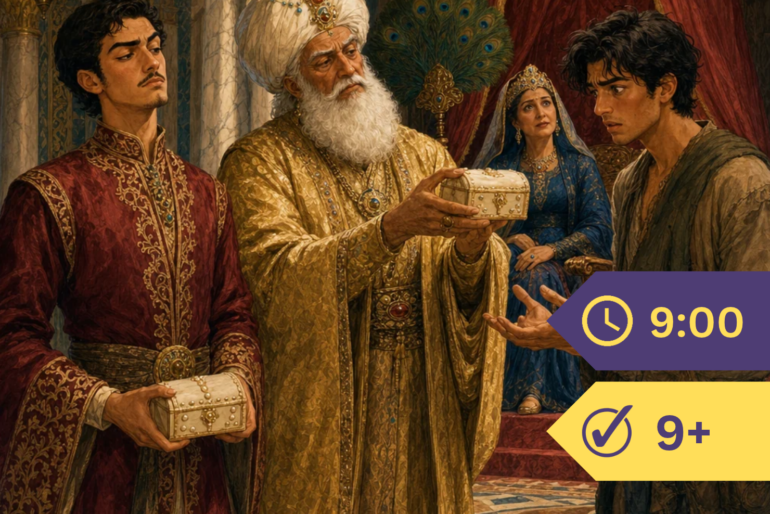
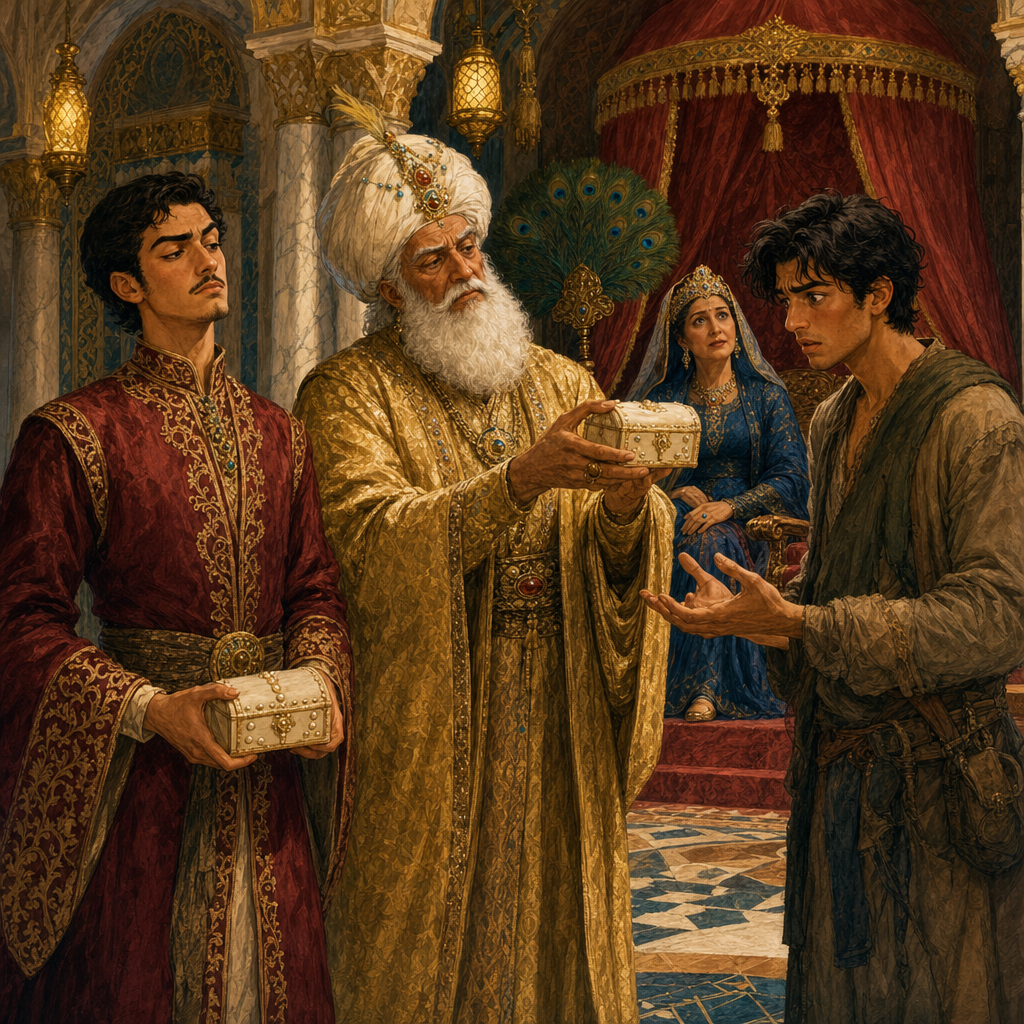
“I know your errand,” said Adolzaide. She handed him two small ivory boxes studded with gold and pearls. One was marked “Honour and Glory,” the other “Wealth and Happiness.” “Let the two young men choose. The true prince will not choose wrong.”
Back at court, Labakan was called first. He thought for a moment. “What’s better than being your son? What’s richer than your love? I choose ‘Wealth and Happiness.'” The king bade him sit down.
Omar came in, pale. He read both mottoes. “The last few days have shown me how uncertain happiness is and how quickly riches vanish. Even if it costs me a crown, I choose ‘Honour and Glory.'”
The boxes were opened. In Omar’s lay a tiny gold crown and sceptre on a velvet cushion. In Labakan’s lay a large needle and a spool of thread.
The king lifted the crown. It grew and grew until it was full-size, and he set it on Omar’s head and kissed his forehead. Then he turned to the tailor. “You’ve earned no mercy. But on this day, I’ll give you your life. I advise you to leave my country quickly.”
Labakan sank before Omar. “Can you forgive me?”
“Go in peace,” said Omar, and lifted him up.
In the middle of the cheering, Labakan slipped away with his little box. He saddled old Murva and rode back to Alexandria. At his old master’s shop he offered to pay three times the price of the robe, but the master and the apprentices set on him and pitched him into the street. He limped to an inn, ached all night, and decided to give up being great and live as an honest workman.
In the morning he sold the ivory box to a jeweller, bought a little house, and hung out a sign: LABAKAN, TAILOR. He sat down to mend his own torn clothes with the needle from the box. When he looked up from some errand, the needle was stitching by itself, in tiny stitches finer than he had ever made, and the thread never ran out.
Soon the whole town came to him. He cut the cloth, made the first stitch, and left the rest to the needle. People wondered how one man could finish so much work, and why he worked behind closed doors. And so the box’s promise, “Wealth and Happiness,” came true. Whenever he heard of Prince Omar’s heroic deeds, Labakan reflected, “Better a tailor. ‘Honour and Glory’ are rather dangerous things.”