In sapphire, emerald, amethyst,
Sparkles the sea by the morning kissed;
And the mist from the far-off valleys lie
Gleaming like pearl in the tender sky;
Soft shapes of cloud that melt and drift,
With tints of opal that glow and shift.
— Celia Thaxter
One bright day, a little Sunbeam slid down his long golden ladder and slipped, unnoticed, in among the leaves of a great tree.
Sunbeams are really tiny Sun-fairies, you see. They run down to earth on golden ladders, which look to people like rays of sunlight. Whenever a cloud drifts near, they scramble up their ladders and pull them in after them. Every morning the mighty fairy who rules the Sun tells his tiny servants where to shine, and every evening he counts them as they come home, to be sure none are missing.
Not many people know it, but the Sun and the Moon are enemies, and that is why they never shine at the same time. The fairy of the Moon is a lady, and all her beams are tiny ladies too, who come down on the loveliest little ladders, thin as threads of silver. No one remembers why the Sun and Moon quarrelled. They were once the best of friends. Now they are bitter enemies, and Sunbeams and Moonbeams are forbidden to play together.
On this particular day the little Sunbeam settled near a Bullfinch’s nest and watched the Bullfinch and her mate.
“Why shouldn’t I have a friend of my own?” he thought. He was the prettiest fellow you can imagine, with bright golden hair. He sat leaning on his tiny ladder, listening to the birds chatter.
“I’m going to stay awake tonight and see her for myself,” said a young Bullfinch.
“Nonsense,” said his mother. “You will do no such thing.”
“But the Nightingale says she’s the loveliest creature ever,” said a Wren, peeking out of her nest in the hedge nearby.
“The Nightingale!” scoffed the old Bullfinch. “Everyone knows he’s been moonstruck for years. Who believes a word he says?”
“I’d still like to see her,” said the Wren.
“I have seen her, and the Nightingale is right,” said a Wood-dove, in her soft, cooing voice. “I was awake last night. She is lovelier than anything that has ever come here.”
“Who are you talking about?” asked the Sunbeam, darting over to the Bullfinch’s nest. The birds all fell silent at the sight of him. At last the Bullfinch said, “Only a Moonbeam, Your Highness. Nobody you’d care to hear about.” She remembered the quarrel between the Sun and the Moon, and thought it wiser to say very little.
“What is she like?” asked the Sunbeam. “I’ve never seen a Moonbeam.”
“She is as beautiful as an angel,” said the Wood-dove. “But you should ask the Nightingale. He knows her best. He sings to her every night.”
“Where is the Nightingale?”
“Resting,” said the Wren. “He won’t say a word until later, when the sun starts to set.”
“When all decent birds are going to bed,” grumbled the Bullfinch.
“Then I will wait,” said the Sunbeam.
So he shone about the tree all day long. As the sun sank, his ladder sank with it, because it was fastened to the Sun at the other end. If he let the Sun disappear before he’d climbed back up and drawn the ladder in, it would snap against the ground. Then the poor Sunbeam could never get home. He would wander the earth growing paler and paler, until at last he faded away.
But well before the sun was gone, while it still glowed in a great bed of red and gold, the Nightingale woke and began to sing, loud and clear.
“Oh, there you are at last!” said the Sunbeam. “I’ve waited all day. Tell me quickly about this Moonbeam everyone is whispering about.”
“What shall I tell you?” sang the Nightingale. “She is lovelier than the rose. Her hair is silver, and the light in her eyes is far sweeter than yours. But why do you want to know? You belong to the Sun. You’re supposed to hate Moonbeams.”
“I don’t hate them,” said the Sunbeam. “Please, dear Nightingale, show her to me some night.”
“I can’t do that, because she doesn’t come out until long after sunset,” said the Nightingale. “But wait a few days. When the Moon is full, she’ll rise a little before the sun goes down. If you hide beneath a leaf, you can see her. But you must promise never to shine on her. You could hurt her, or break her ladder.”
“I promise,” said the Sunbeam. And every evening he came back to the same tree to talk with the Nightingale about the Moonbeam, until the Bullfinch was quite cross.
At last the Moon was almost full. “Tonight I shall see her,” the Sunbeam told himself, and he hid in the oak leaves, trembling with excitement.
“She’s coming!” whispered the Nightingale.
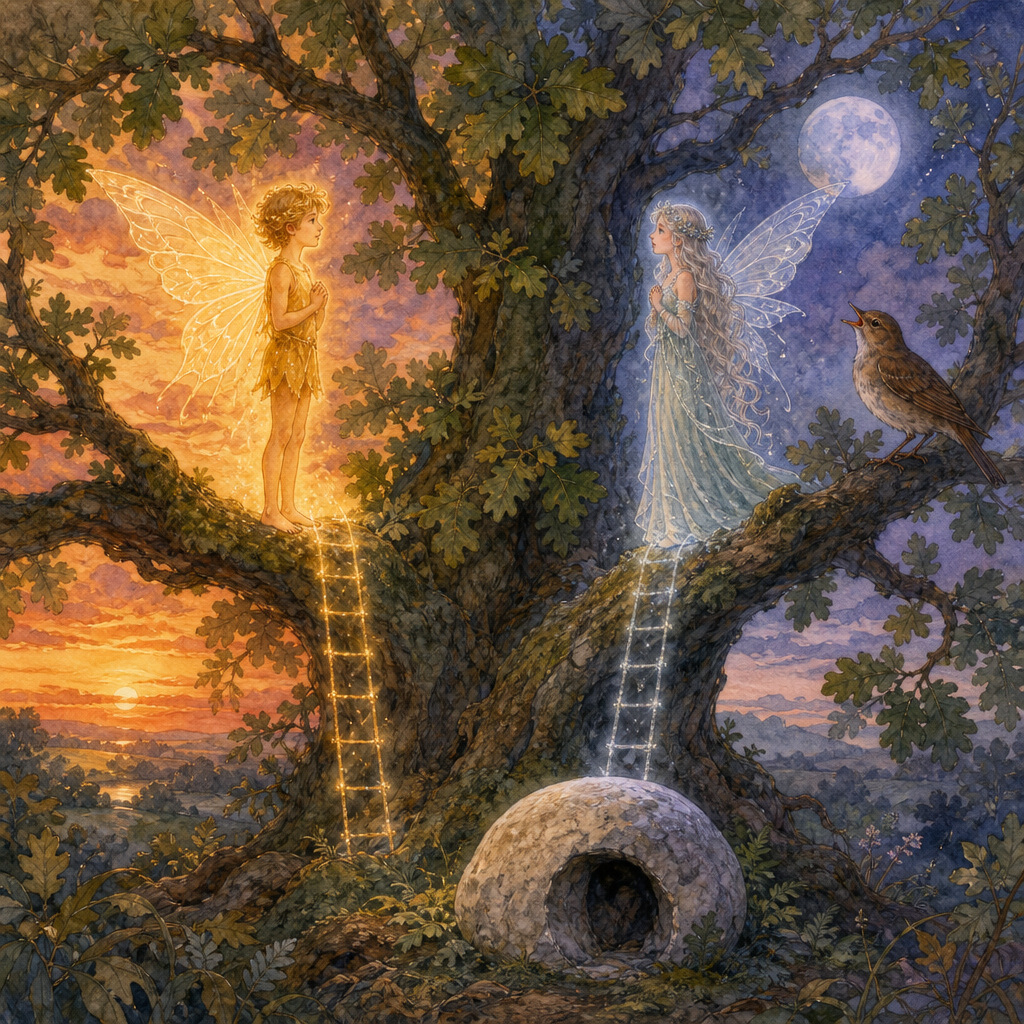
The Sunbeam peeped out. A tiny silver ladder, fine as thread, was set among the leaves near the Nightingale’s nest, and down it came the Moonbeam.
She was not at all what he had imagined, and yet he agreed with the Nightingale: she was the loveliest thing he had ever seen. She was all silver and pale sea-green, with hair and eyes that shone like stars. Sunbeams look bright and warm, but she looked cool as the sea, and she glittered like a diamond. He stared, unable to say a single word, until suddenly he noticed his ladder bending. The sun was sinking! He only just had time to scramble up and pull the ladder in after him.
The Moonbeam saw only a flash of light vanishing. She never saw him.
“Who were you talking to, dear Nightingale?” she asked, putting her white arms around his neck and resting her head against his breast.
“A Sunbeam,” said the Nightingale. “And oh, how beautiful he is! I was telling him about you. He longs to see you.”
“I’ve never seen a Sunbeam,” said the Moonbeam wistfully. “I should so like to.” She stayed close beside the Nightingale all night, her head on his breast, while he sang to her about the Sunbeam. His song was so loud and clear that it woke the Bullfinch, who flew into a rage and threatened to report him to the Owl. The Owl was the chief judge of the wood, and he ate any little bird who misbehaved.
But the Nightingale did not stop, and the Moonbeam listened until tears rose in her eyes and her lips trembled.
“Tonight, then, I’ll see him,” she whispered, kissing the Nightingale goodbye.
“And tonight he’ll see you,” said the Nightingale, settling down among the leaves.
The next day was cloudy and the Sun stayed hidden. But toward evening the clouds drifted away, and the Sun came out. The Nightingale had barely noticed the light when the Sunbeam’s ladder appeared beside his nest, and in an instant the Sunbeam was there too.
“Dear, dear Nightingale, you were right,” he said. “She is lovelier than the dawn. I’ve thought of nothing else all night and all day. Will she come again? I’ll wait and see.”
“She will come, and you may speak to her,” said the Nightingale. “But you must not touch her.” Then they were quiet, and waited.
Beneath the oak lay a large white Stone, a plain white Stone, neither beautiful nor useful. It lay just where it had fallen, and it was bitterly sad that it had no purpose in life. It never spoke to the birds, who hardly knew it could. But sometimes, when the Nightingale rested against it, or the moonlight fell on it, it felt it might crack with sorrow at being so dull and useless. It had watched the Sunbeams and Moonbeams come down on their ladders. It had wondered why none of the birds except the Nightingale thought the Moonbeam beautiful. That evening, as the Sunbeam sat waiting, the Stone watched him closely. When the Moonbeam set down her little ladder and slid into the leaves, it heard every word.
At first the Moonbeam didn’t see him. She went straight to the Nightingale and kissed him as usual. “Have you seen him again?” she asked.
At that, the Sunbeam darted out from the green leaves and stood before her.
For a few moments she said nothing. Then she began to shiver and sob and shrank closer to the Nightingale. Whenever the Sunbeam stepped toward her, she climbed up her ladder, farther and farther away.
“Don’t be frightened, dearest Moonbeam,” he begged. “I would never hurt you. You are so lovely, and I love you so much.”
The Moonbeam turned away, weeping.
“I don’t want you to leave,” she said, “but if you touch me, I will die. It would have been better for you never to have seen me. Now I can’t go back and be happy in the Moon, because I’ll be thinking of you always.”
“I don’t care what happens to me, now that I’ve seen you,” said the Sunbeam sadly. “And look, I am lost anyway. The sun is nearly gone, and I won’t be going home. I’ll stay with you.”
“Go, while there’s still time!” cried the Moonbeam. But even as she spoke, the Sun slipped below the horizon, and the Sunbeam’s golden ladder snapped. Both halves fell to the earth and melted away.
“There,” said the Sunbeam. “I can’t go back, and I don’t wish to. I’ll stay with you until the end.”
“No, no!” cried the Moonbeam. “I’ve killed you! What have I done? And look, clouds are coming near the Moon. If one crosses my ladder, it will break.” But she couldn’t make herself leave. She leaned across the leaves and looked into his eyes.
The Nightingale saw it, though: a tiny white cloud, no bigger than a tuft of wool, drifting close to the Moon. It was small, but strong enough to break her ladder.
“Go! Go now! Your ladder will break!” he sang. But she didn’t hear him. She only sat gazing at the Sunbeam. For a moment the moonlight dimmed as the little cloud passed. Then the silver ladder fell to earth, broken in two, and shrank away. The Moonbeam never even looked.
“It doesn’t matter,” she said. “I could never have gone back and left you here, now that I’ve seen you.”
So all night the two of them sat together in the oak, and the Nightingale sang to them, and the other birds grumbled that he was keeping them awake. They were very happy, though the Sunbeam knew he was growing paler by the minute, for no Sunbeam can live a whole day away from the Sun.
When dawn began to show, the Moonbeam shivered.
“The strong Sun would kill me,” she said. “But I fear something worse. Look how heavy the clouds are. It’s going to rain, and rain would kill us both at once. Where can we find shelter?”
The Sunbeam looked up and saw that she was right.
“Come,” he said. “We must go.” They wandered off into the forest, searching for somewhere to hide, but every moment they grew weaker.
After they’d gone, the Stone spoke up to the Nightingale.
“Why did they leave? I love hearing them talk, and they’re so pretty. They’ll never find shelter out there. Look, in my side there’s a big hollow, dark and dry, where no rain can reach. Fly after them and tell them to come back. I’ll keep them safe.”
The Nightingale spread his wings and flew, singing as he went:
“Come back, come back! The Stone will shelter you! Come back before the rain falls!”
They had wandered into an open field. When the Moonbeam heard the song, she lifted her head.
“That’s the Nightingale. He’s calling us.”
“Follow me!” sang the bird. “Back to the Stone, quickly!”
But the Moonbeam only staggered and fell. “I’m so weak and pale,” she said. “I can’t move.”
So the Nightingale flew down to the ground. “Climb on my back,” he said, “and I’ll carry you both.” They climbed up, and he flew them back to the great Stone beneath the oak.
“Go in,” he said, and they slipped through the hollow and nestled together in the dark.
Then the rain began. It rained all day long, and the Nightingale sat in his nest, half asleep. When the Moon rose that night, the clouds had cleared, and the air filled once more with tiny silver ladders as the Moonbeams came down. The Nightingale searched for his own Moonbeam, but she was not among them. He knew she could never shine on him again, and he sang a sorrowful song. Then he flew down to the Stone and sang at the mouth of the hollow, but no one answered. He looked inside. There was no sign of either of them, only one small spot of shining light where they had rested. And so the Nightingale knew they had faded away.
“They couldn’t live apart from the Sun and the Moon,” he said. “Still, I wish I’d never told the Sunbeam how beautiful she was. Then she’d be here now.”
When the Bullfinch heard the news, she was delighted. “Well, at least we’ll hear no more about the Moonbeam,” she said. “I was sick of her.”
“How much they must have loved each other,” said the Dove. “I’m glad, at least, that they died together.” And she cooed sadly.
But through the Stone where the two had sheltered, bright rays of light shot up, silver and gold. They coloured it all over with every colour of the rainbow, and when the sun or the moon touched it, it blazed. The Stone, which had been the dullest thing in the whole forest, became the most beautiful.
People found it and named it the Opal. But the Nightingale knew the truth: it was the Sunbeam and the Moonbeam who had filled the Stone with their mingled colours and light. He has never forgotten them. Every night he sings their story, and that is why his song is so sad.