Once upon a time an old woman lived in a small cottage at the edge of the forest. Behind it was a garden where every kind of vegetable grew, and beyond that a field with two or three cows in it, so her neighbours thought her quite rich and envied her.
As long as she was strong enough to work in her garden all day, she was never lonely. But after a bad illness left her weaker than before, she began to think it would be nice to have someone to talk to now and then. About that time she heard that a shepherd and his wife on the far side of the plain had died, leaving a little boy alone in the world.
“That will do nicely,” she said, and sent a man to bring him, meaning to adopt him as her own.
The boy was about twelve, and he should have thought himself very lucky, because his new mother was as kind to him as his old one had been. But he made friends with some rude, rough boys whose tricks made them a terror to the neighbourhood, and the poor old woman never stopped regretting her lost peace.
Things went on like this for years, until the boy became a man.
“Perhaps if he were married, he’d settle down,” she thought. She asked among the neighbours which girls were old enough to choose from and found one who was good and hardworking as well as pretty. The young man raised no objections, and the wedding took place right away. The bride and groom moved into the cottage with the old woman. But the husband didn’t change at all. He was out all day amusing himself with his old friends, and if his wife said a word when he came home, he shouted at her and shoved her aside. When a baby was born the following year, he frightened it too with his noise and temper.
At last the old woman’s patience ran out. She could see it was no use hoping the lazy, idle creature would mend his ways, and one day she said:
“Are you going to go on like this forever? You’re not a boy any more, and it’s time you stopped behaving like one. Shake off your bad habits, work for your wife and child, and above all, stop bullying them. If not, I’ll turn you into a donkey. Heavy loads will be piled on your back, people will ride you, thistles will be your food, and you’ll find out for yourself how it feels to be driven.”
If she expected that to do any good, she was wrong. The young man only got angry and said rudely, “Bah! Hold your tongue, or I’ll do the same to you.”
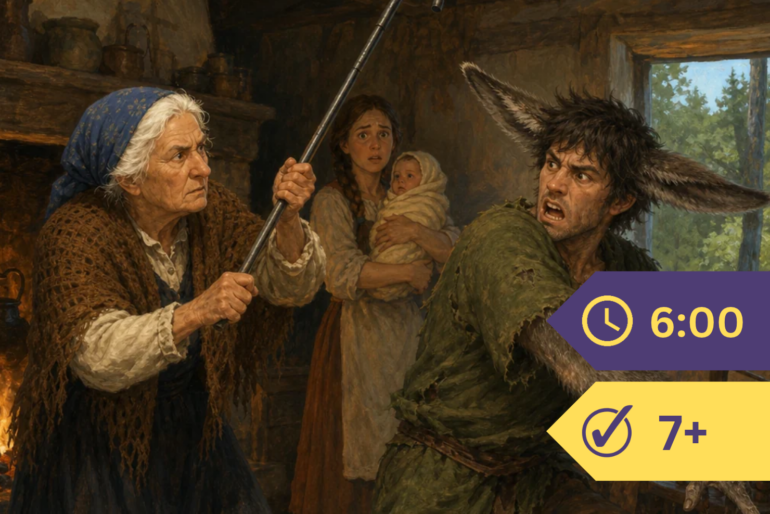
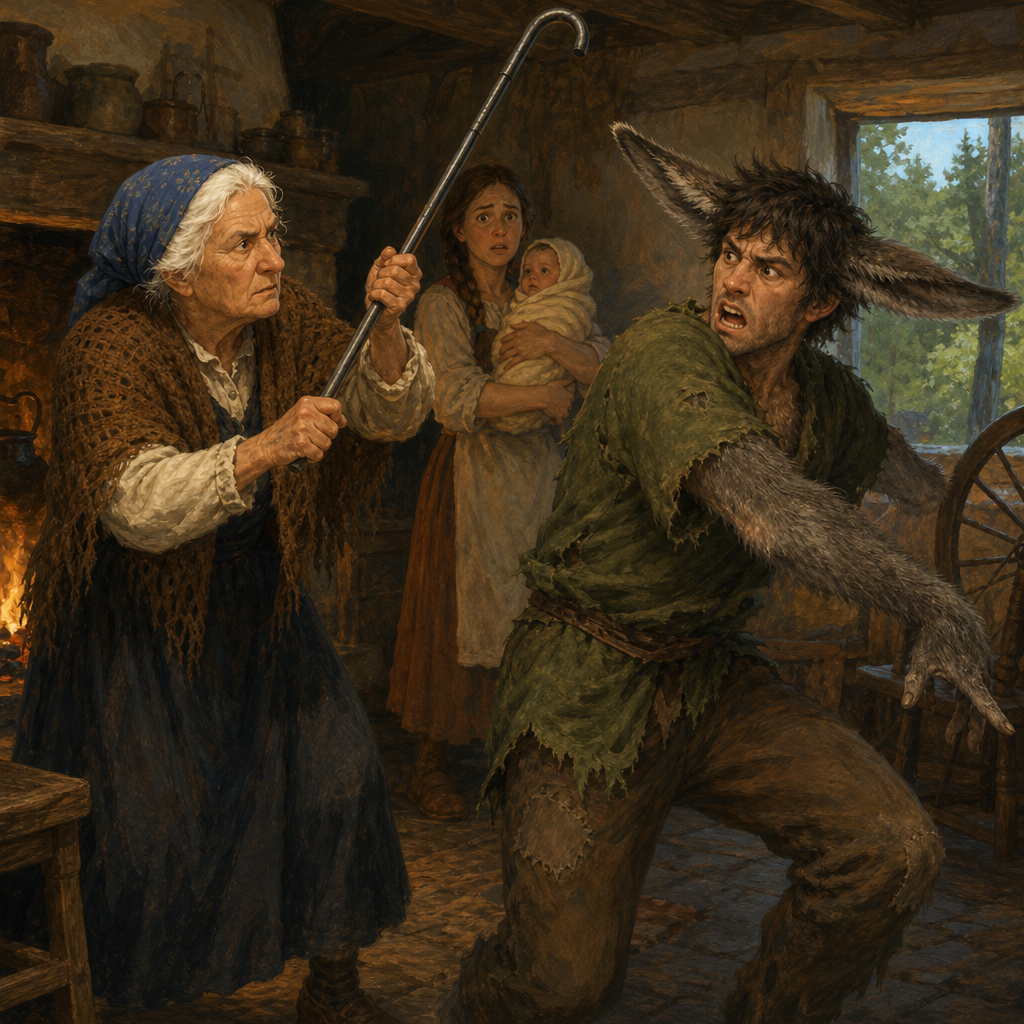
“Will you?” she said grimly. Quick as lightning, she picked up a steel cane that stood in the corner and laid it across his shoulders. In an instant his ears grew long and his face longer, his arms became legs, and his body was covered with coarse grey hair. He was a donkey, and an ugly one at that!
“Get out of my house,” said the old woman. He shambled off.
He stood in the path outside, not knowing what to do, when a man passed by. “Ho! You’re exactly what I was looking for! You don’t seem to have a master, so come with me. I’ll find some work for you.” And he led him off by the ear.
For seven years the donkey lived a hard life, just as the old woman had said. But instead of realising that he’d brought it all on himself, and being sorry, he grew harder and more bitter. At the end of seven years his donkey skin wore out and he was a man again. One day he came back to the cottage.
His wife opened the door at his knock, dropped the latch, ran inside and cried, “Grandmother, Grandmother! Your son has come back!”
“I thought he would,” said the old woman, going on with her spinning. “Well, we did very well without him. But I suppose he’d better come in.”
He came in. And, as the old woman had expected, he behaved worse than before. For some weeks she let him do as he liked. Then at last she said:
“So experience has taught you nothing. Well, very few people have the sense to learn from it. But take care, or I’ll turn you into a wolf, to be chased by dogs and men.”
“You talk too much,” was all he said. “I’ll break your head!”
If he had looked at her face he might have taken warning, but he was busy making a pipe and paid no attention. The next moment the steel cane had touched his shoulders and a big grey wolf bounded out the door.
How the dogs barked! How the neighbours shouted as they ran after him!
For seven years he lived like a hunted animal, cold and nearly always hungry, never daring to sleep soundly. At the end of that time his wolf skin wore out too, and he turned up again at the cottage door. But the second seven years had taught him no more than the first. He was worse than before, and one day he behaved so roughly toward his wife and son that they screamed for the old woman to come.
She came, and brought the steel cane with her. In a second the bully vanished, and a big black crow flew around the room, crying, “Gour! Gour!”
The window was open and he shot through it. He found the friends who had led him astray and somehow made them understand what had happened.
“We’ll get even,” they said, and picked up a rope, and set off to take revenge on the old woman.
But she was ready for them. One stroke of her cane and they were all changed into a flock of black crows, and this time their feathers have lasted ever since.