Far away, beyond countries and seas and rivers, there stood a splendid city where King Archidej ruled. He was rich and handsome, his army obeyed his slightest wish, and his twelve councillors had long beards and always told him the truth. He had everything except a bride to his taste.
One day a ship came into harbour and its merchants came to the palace. “You’ve travelled far,” said the king. “Have you ever heard of a princess as clever and handsome as I am?”
The eldest merchant thought. “On the Island of Busan there’s a princess named Helena, so lovely she could hardly be plainer than you, Your Majesty, and so clever that the wisest greybeard can’t guess her riddles. But she’s no bride for you. It’s ten years’ sail, and by the time your envoy came back, twenty years would have passed. Wouldn’t she be old?”
The king thanked them, gave them free trade, and went off in a gloom. To clear his head he rode out hunting. At a green hedge he stopped. Beyond it lay a field of golden maize rolling like a sea. “Whoever planted this must be a fine farmer,” he said. “Find out who owns it.”
His men found a tidy farmhouse where seven peasants in red shirts sat eating rye bread and drinking water. They were so alike that they were hard to tell apart. “It’s our field,” they said. “We’re King Archidej’s labourers.”
The king had them brought to him. “We are seven brothers, and every one of us is named Simon,” said the eldest. “Our father taught us to be loyal, to farm, and to be kind to our neighbours. He also gave each of us a trade.”
“Let me hear them,” said the king.
“I can build a white pillar so tall it reaches above the clouds,” said the first Simon.
“I can climb it,” said the second, “and from the top see everything happening in the world.”
“I can build a simple little ship,” said the third, “that goes in a day where others take a year, and in a week where others take ten.”
“If we’re chased,” said the fourth, “I can grab the prow and sink the ship to the bottom of the sea, then draw it up again when the danger is gone.”
“I can make a crossbow,” said the fifth, “that hits whatever the eye sees.”
“And I can catch whatever’s been shot, faster than any dog,” said the sixth, “from a river bottom or a forest at midnight.”
The king laughed with delight. Then he remembered. “And you, Simon the seventh? You’ve said nothing.”
“I don’t have a trade, Your Majesty,” said the seventh Simon. “Not a real one. And it’s one no king likes to see. Promise me first that you won’t have me killed.”
“I give you my word.”
“I can steal,” said Simon the seventh. “And I can hide whatever I’ve stolen. There’s no vault, however enchanted its lock, that I can’t empty. But I never steal. If I wanted to, I could rob your treasury, bribe your judges, and build a marble palace with the change. You asked me my trade, and I’ve told you. You gave your word.”
The king fumed. But he’d given his word. “Take him to the dungeon on bread and water. You six, come with me.”
The first Simon built his pillar. The second climbed it and told wonders: a king marching to battle, a feast somewhere else, a famine somewhere else. The third built his ship in three stretches of his arms; its rigging was wire, and musicians played it with fiddle bows. The fourth Simon dived it beneath the sea and brought it up with a giant fish in his other hand for the royal table. The fifth shot an eagle from the sky, and the sixth caught it in a dish before it hit the ground.
“Excellent,” said the king. “Now, Simon the second. Climb the pillar and look at the Island of Busan.”
Simon came down. “Its king is mighty, proud, and harsh. He says no prince on earth is good enough for his daughter, and if anyone asks, he’ll make war and burn the kingdom. His army is large.”
The king’s council said nothing and tried to hide behind each other. At last the court fool pushed forward. “What’s everyone so glum about? The ship gets there in a week. Send the seventh Simon. He’ll steal the maiden before her father notices, and the king of Busan can spend ten years bringing his army over.”
The king said, “That’s the best advice I’ve had all year.” The seventh Simon was fetched out of the dungeon, pale and hungry. The king told him that stealing for his king and country was no wrong, though stealing for himself was.
“The princess? Easy,” said Simon. “Load my brother’s ship with brocades, carpets, and jewels. Send the four middle brothers with me, and keep the other two as hostages.”
The ship was loaded in no time. A week later they were at the Island of Busan. The tower watchman called, “Who are you?” “Merchants from the good King Archidej’s land,” said Simon. “We have wares for the king and the princess.”
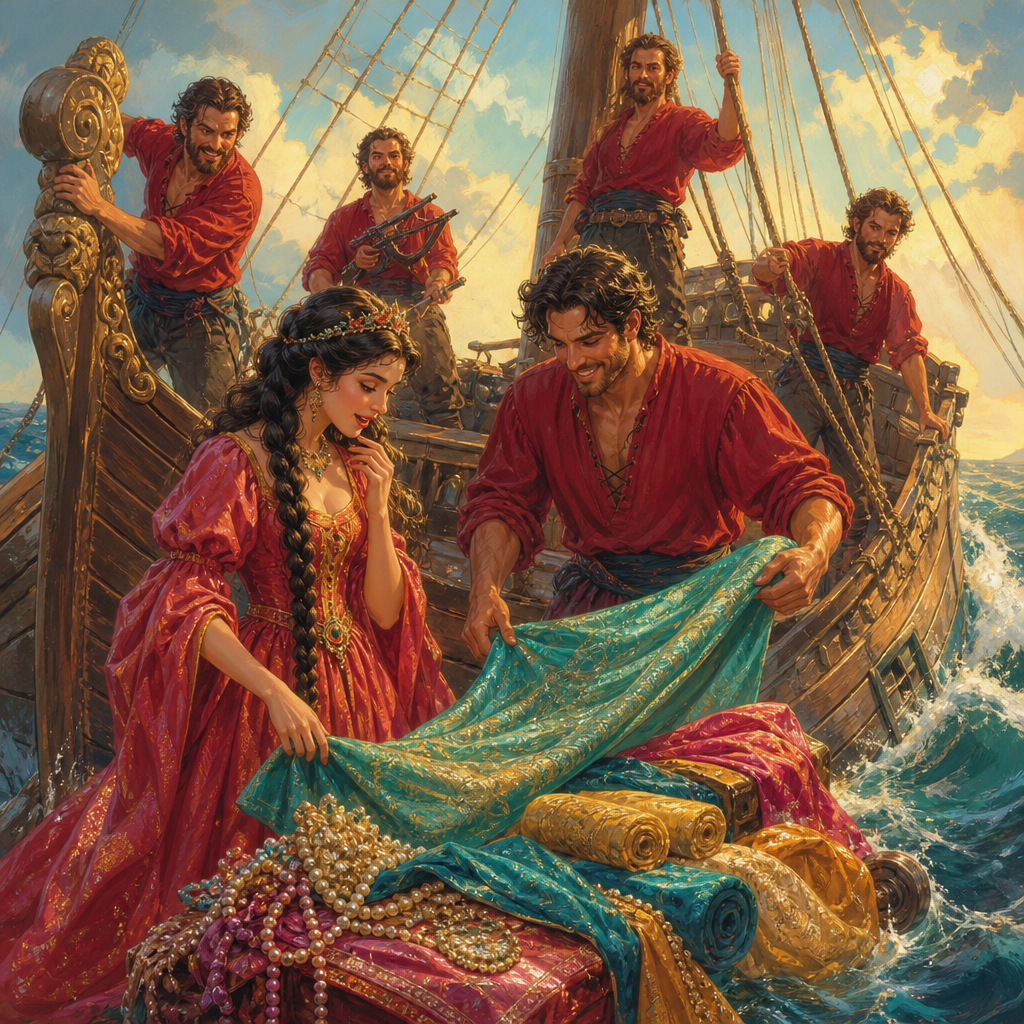
The princess sat in a rose-red room. The brothers spread their velvets and pearls, and the waiting-women gasped. Simon bowed. “Fairest princess, these are nothing compared with what we have on our ship. If you’d honour us with a visit, you could choose what you like.”
Princess Helena asked her father. He frowned and rubbed his ear, and in the end sent her in his own yacht, with a hundred knights and a thousand soldiers to guard her. Led by the brothers, she crossed a crystal plank to the wonder-ship. Simon the seventh unrolled his silks and told a story for every piece, and she forgot everything else. She never noticed that the fourth Simon had taken hold of the prow, and that the ship had vanished from the surface and was racing under the waves.
The yacht’s crew shouted, the knights froze, and the soldiers stood speechless. There was nothing for it but to sail home with the news. The King of Busan wept and raged. “Light of my eyes! I’m punished for my pride. Lock up every one of them until I decide what to do!”
Under the sea, the ship raced on. When the island was far behind, Simon the fourth brought it back up. Helena looked around. “Nurse, we’ve been staring at these treasures too long. Father will worry.” Then she stepped on deck. No yacht. No island.
She wrung her hands. Then, being a sorceress, she changed into a white swan and flew away. The fifth Simon shot the swan; the sixth caught it before it could fall; and it turned into a silver fish. Simon the sixth caught the fish, and it turned into a black mouse that ran across the deck for a hole. Simon pounced faster than any cat, and the mouse became the beautiful Helena again, standing there out of breath.
King Archidej was sitting at his window one morning, sad and not eating. Is that a white gull flying toward the shore? No, a sail. The wonder-ship, flags flying, wire rigging singing with fiddlers. The crystal plank went down, and Helena stepped onto the quay, shining like the sun.
He hurried to meet her, took her hand, and said, “Madam, I’d heard of your beauty, but not that it would be like this. I won’t keep you against your will. If you wish, the wonder-ship will take you home to your father. But if you’ll stay, then rule over me and my country as queen.”
Helena considered him, and listened, and in time agreed. The wedding was announced. The brothers Simon sailed again to Busan with a letter from Helena inviting her father. They arrived just as his guards, the knights and soldiers, were about to be punished. “Stop!” cried the seventh Simon. “A letter from Princess Helena!” The king of Busan read it over and over, set his men free, sent his blessing, and would not come to the wedding himself.
When the ship returned, King Archidej summoned the seven Simons. “Name your reward. Be nobles? Governors of cities?”
“We’re plain folk,” said the eldest. “We have our fields. If you’d like to reward us, free our land from taxes, and forgive our brother. He isn’t the first thief, and he won’t be the last.”
The king agreed. He gave each brother a goblet of wine and invited them all to the wedding feast, and what a feast it was.