Once there were two widows who lived on a small patch of ground rented from a farmer. One had two sons, the other had one. When the time came for the mother of two to send her boys out into the world to seek their fortunes, she told her eldest to take a can to the well and fetch water, so she could bake him a cake for the journey. The more water he brought, the bigger the cake would be.
The lad filled the can at the well, but the can was broken, and most of the water had trickled out before he got home. So the cake was very small. His mother asked whether he would take half of it with her blessing, or the whole of it with her curse. The young man thought he might have a long way to travel and no idea where his next meal would come from. He chose the whole cake, curse and all, and that is what he got.
Before he left, he gave his brother a knife to keep. “Look at it every morning,” he said. “As long as it stays bright, you’ll know I’m well. If it goes dull and rusty, you’ll know something has happened to me.”
He walked all that day and the next, and on the third afternoon he came upon a shepherd with a flock of sheep. “Whose sheep are these?” he asked. The shepherd answered:
“The Red Etin of Ireland
Once lived in Bellygan,
And stole King Malcolm’s daughter,
The King of fair Scotland.
He beats her, he binds her,
He lays her on a band;
And every day he dings her
With a bright silver wand.
Like Julian the Roman
He’s one that fears no man.
It’s said there’s one predestinate
To be his mortal foe;
But that man is yet unborn
And long may it be so.”
Glosses: Etin — giant; dings — beats; predestinate — fated.
Farther on he met an old man with white hair herding pigs. “Whose pigs are these?” The old man gave the very same answer. Farther still, an even older man was herding goats, and the goats belonged to the Red Etin too. This last herder added a warning: beware the next beasts you meet, for they are unlike any you have seen.
He was right. Soon the young man saw a crowd of dreadful creatures, each with two heads and four horns on every head. He ran from them as fast as he could, and was glad to reach a castle on a hillock with its door standing wide open. Inside, an old woman sat by the kitchen fire. He asked if he could stay the night.
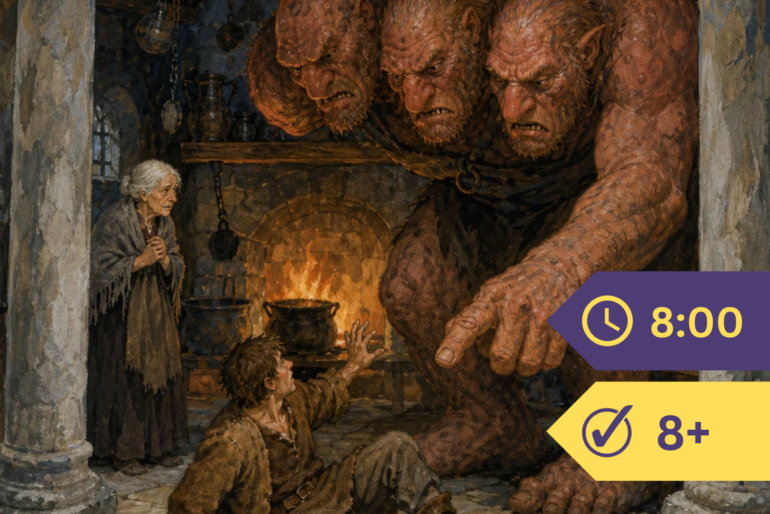
She said he could, but it was a dangerous place. The castle belonged to the Red Etin, a terrible three-headed monster who spared no man he could catch. But the young man was more afraid of the beasts outside, so he begged her to hide him and say nothing. If he could just get through the night, he thought, he might slip away in the morning.
He had not been hidden long when the Etin came stamping in, sniffing, and crying out:
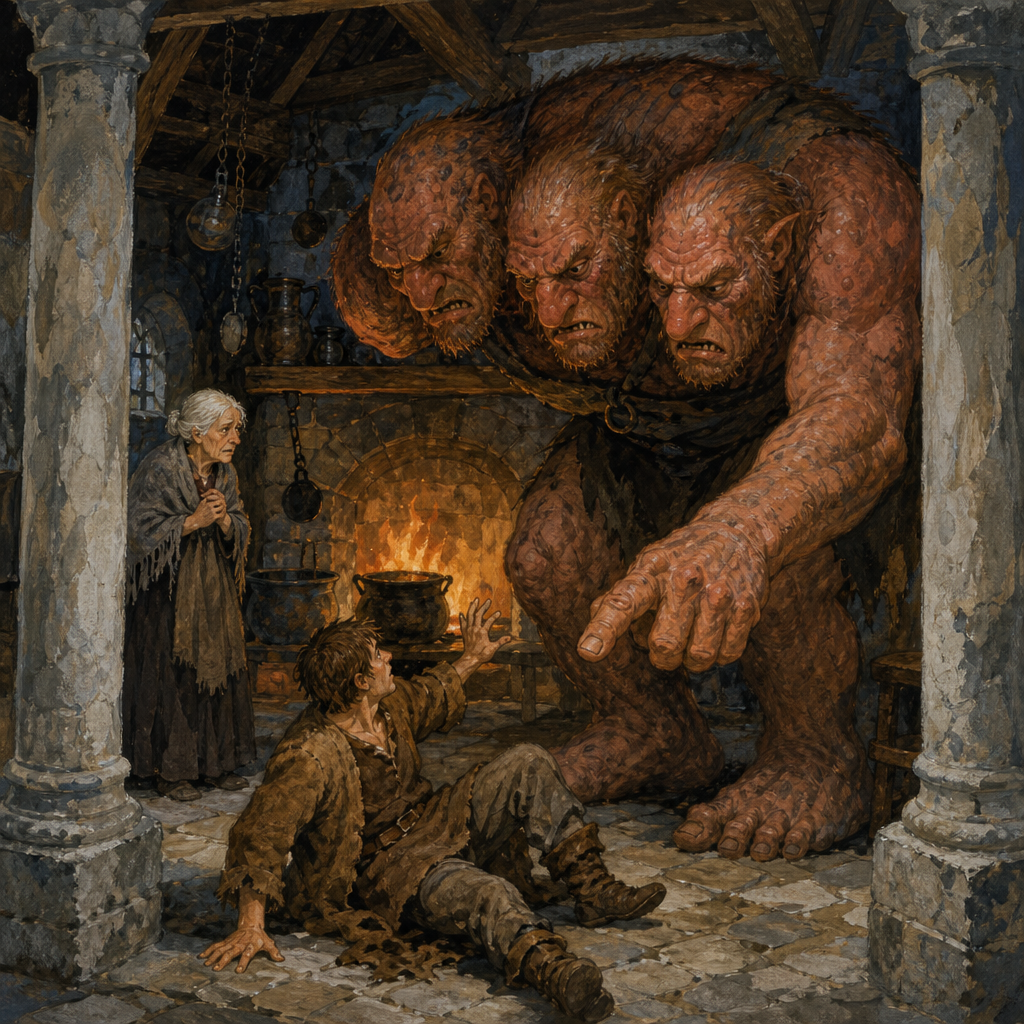
“Snouk but and snouk ben,
I find the smell of an earthly man;
Be he living, or be he dead,
His heart this night shall kitchen my bread.”
Glosses: snouk — sniff; but and ben — outer room and inner room, i.e. all through the house; kitchen — season, flavour.
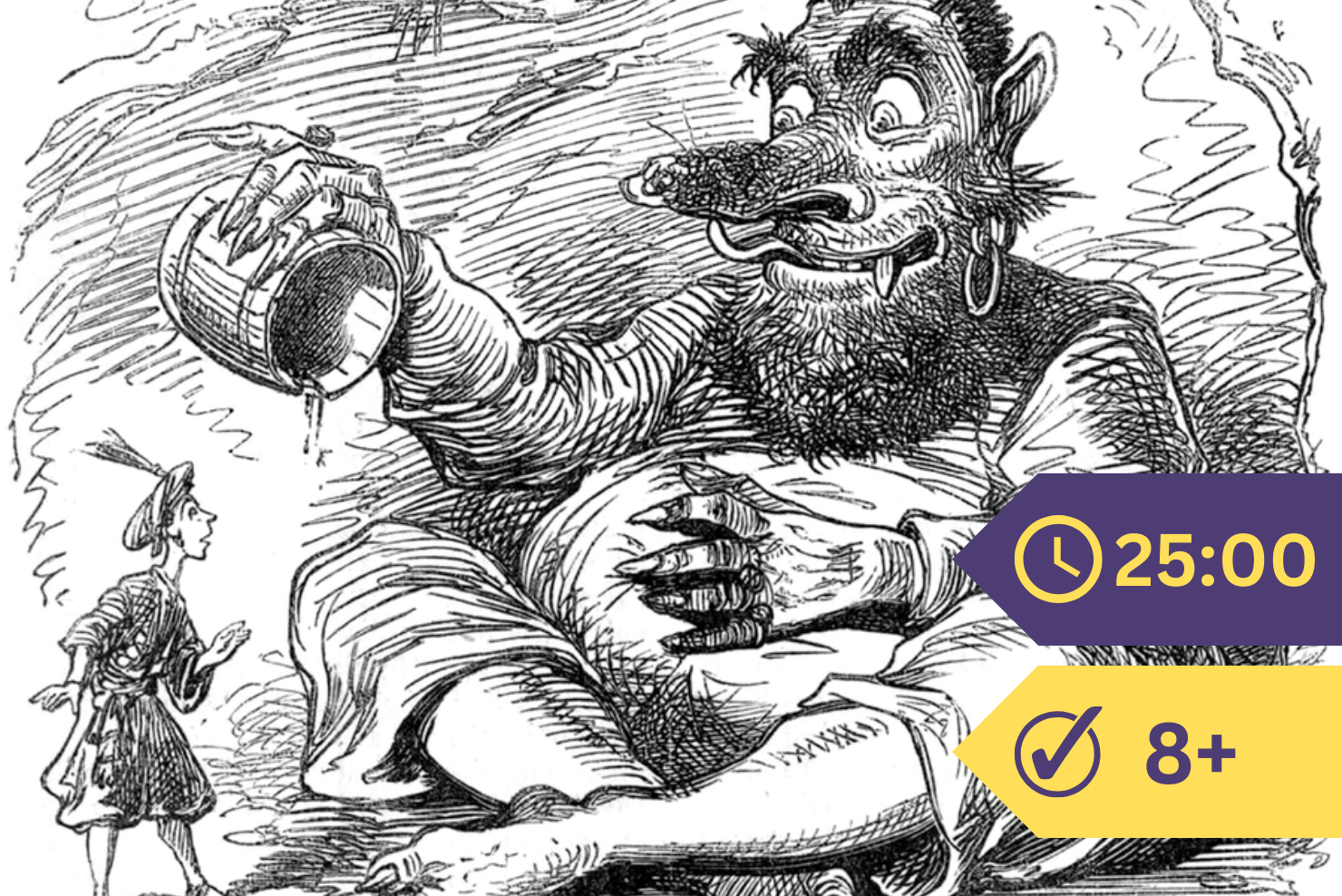
The monster found him at once and dragged him out. “Answer me three questions,” said the Etin, “and I’ll spare your life. Was Ireland or Scotland inhabited first? Was man made for woman, or woman for man? Were men or beasts made first?”
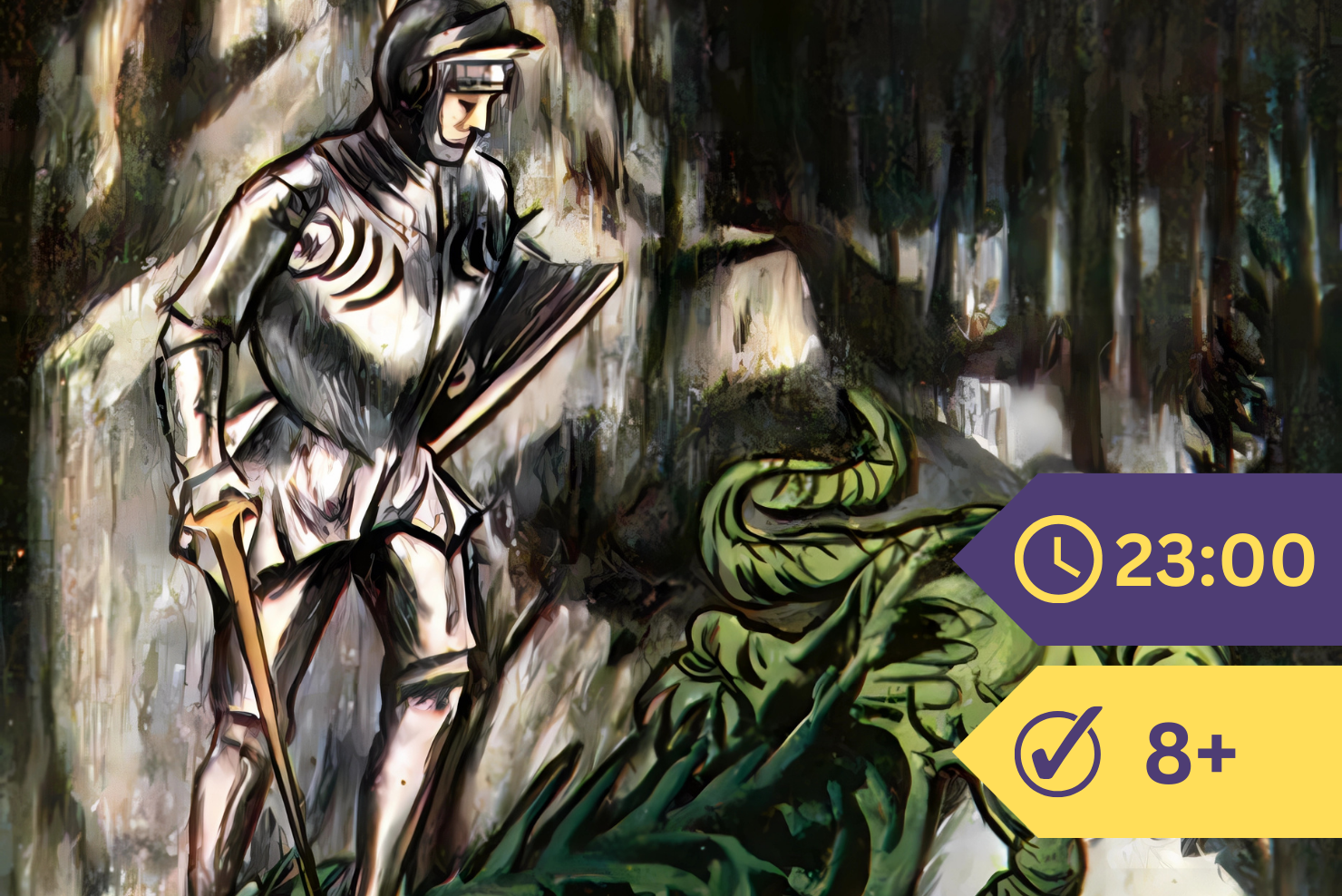
The young man could not answer a single one. The Etin struck him on the head with a mace and turned him into a pillar of stone.
The next morning, the younger brother took out the knife and found it brown with rust. He told his mother it was time for him to go too. She sent him to the well with the same broken can, and the same thing happened: little water, small cake, the whole cake chosen over the half and the blessing. Everything that had happened to his brother happened to him.
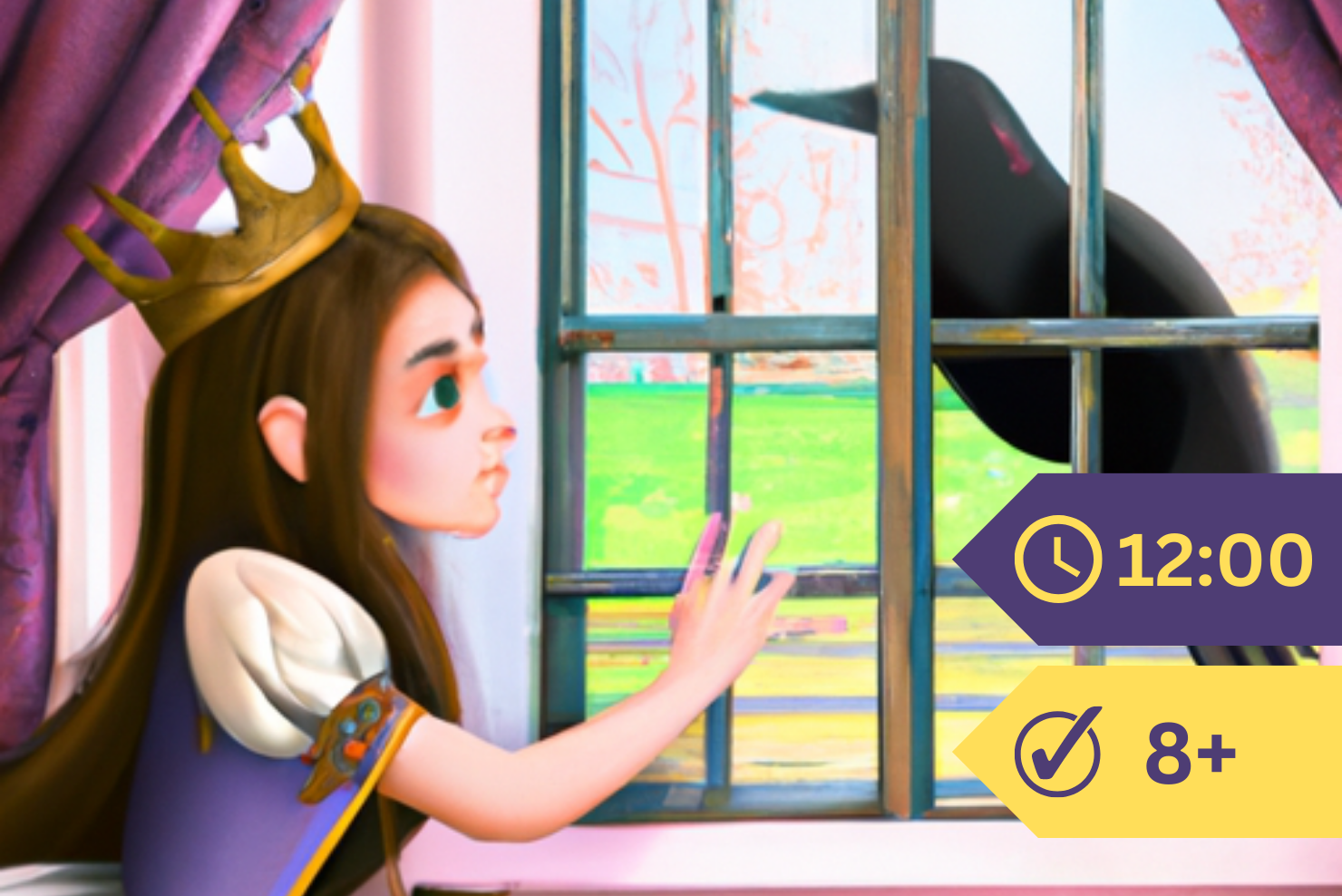
Now the other widow and her son heard all this from a fairy, and her son decided he would go too, and try to rescue his two friends. His mother gave him a can and sent him to the well. On the way home, a raven flew over his head and croaked at him to look, and he saw that the water was running out. He was a sensible young man. He stopped, took some clay, and patched the holes, and so he carried home enough water for a big cake. When his mother offered him the half with her blessing or the whole with her curse, he took the half with her blessing. Even so, his half was bigger than the whole cakes the others had carried away.
He set off, and after a long way he met an old woman who asked him for a bit of his bannock. He gladly gave her a piece, and in return she gave him a magic wand. “Use it rightly,” she said, “and it may serve you well.” She was a fairy, and she told him a great deal about what lay ahead and what he should do. Then she vanished in an instant.
He walked on until he came to the old man minding the sheep. “Whose sheep are these?” he asked, and the answer came, a little different this time:
“The Red Etin of Ireland
Once lived in Bellygan,
And stole King Malcolm’s daughter,
The King of fair Scotland.
He beats her, he binds her,
He lays her on a band;
And every day he dings her
With a bright silver wand.
Like Julian the Roman,
He’s one that fears no man,
But now I fear his end is near,
And destiny at hand;
And you’re to be, I plainly see,
The heir of all his land.”
He asked the swineherd and the goatherd too, and each gave the same answer.
When he reached the terrible two-headed beasts, he did not stop or run. He walked straight through them. One came at him roaring, jaws wide, and he touched it with his wand and it dropped dead at his feet.
At the castle the old woman warned him about the Etin and about the two brothers who had gone before him, but he was not afraid. The monster came in, sniffing:
“Snouk but and snouk ben,
I find the smell of an earthly man;
Be he living, or be he dead,
His heart shall be kitchen to my bread.”
He spotted the young man quickly and ordered him out onto the floor, then asked his three questions. But the fairy had told the young man everything, and he answered every one. The Etin knew then that his power was gone. The young man took up the monster’s own axe and cut off his three heads.
He asked the old woman to show him where the King’s daughter was kept. She led him upstairs and opened a great many doors, and out of each came a beautiful lady the Etin had locked away. One of them was the King’s daughter. Then she took him down to a low room, where two stone pillars stood. He had only to touch them with his wand, and his two friends sprang back to life.
The whole company, overjoyed to be free, agreed that they owed it all to the sensible young man. The next day they set out together for the King’s court, and a gallant sight they made. The King gave his daughter in marriage to the young man who had rescued her, and found a noble’s daughter for each of the other young men. And they all lived happily for the rest of their days.