I.
Pacorrito Migajas was quite a character. He stood a trifle over two feet from the ground and had just turned seven. His skin was tanned by sun and wind, and his wizened face suggested a dwarf rather than a child. His eyes, fringed with long lashes like black wires, were full of vitality and bright with mischief. His mouth was remarkable in its ugliness, and his ears — strangely like a faun’s — seemed to have been attached to his face rather than to have grown there. He wore a shirt of every possible shade of grime, and a pair of patchwork trousers held up by a single suspender. In winter he wore a coat inherited from his grandfather, the sleeves cut off at the elbow, which Pacorrito considered a fine fit as overcoats go. A rag that aspired to be a muffler was wound like a snake round his neck, and on his head sat a cap he’d picked up at the Rastro flea market. He had little use for shoes, which he regarded as a hindrance, and even less for stockings, which he found disagreeably rough.
Pacorrito’s family background could not have been more distinguished. His father, accused of trying to enter a house through the drain, had gone to Ceuta for a change of climate and died there. His mother, a great lady who for many years kept a chestnut stand in the Cava de San Miguel, had also somehow fallen into the hands of the authorities, and after considerable dealings with judges and notaries, had repaired to the Alcalá jail. Pacorrito had one sister, but she had deserted her post at the tobacco factory and flown to Seville in pursuit of an artillery officer. She has not returned to this day.
Migajas was therefore alone in the world, with no protection but God’s, and no guide but his own will.
II.
The reader need not imagine that Pacorrito was in the least daunted by his solitude — not he. In his brief life he had had occasion to study the ways of the world and had learned a thing or two about its fraud and vanity. He gathered his energy and faced the situation like a hero. He was on excellent terms with many people his own age and kind, and even with grown men who seemed inclined to protect him, so by sheer force of character he got the better of his circumstances.
He sold matches, newspapers, and lottery tickets — three branches of trade which, if intelligently pursued, can certainly yield honest gain. And so it happened that Pacorrito was never short of a penny to help a friend in need or treat an acquaintance of the fairer sex.
He was spared all domestic worries, all household cares. His palaces were the Prado in summer and the archways of the Casa Panadería in winter. By nature he was frugal and wisely indifferent to the pomps of the world. He slept wherever he found himself and ate whatever he came across, just as the birds do, suffering no anxiety on that score — he had a deep, instinctive faith in that mysterious Providence which deserts no one, great or small.
You might conclude from all this that Migajas was happy. It seems natural enough. He had no family, true, but he had the precious gift of freedom. His needs were few, his earnings were sufficient, and he owed no one anything. His sleep was disturbed by neither care nor ambition. Poor but content; his body threadbare, his spirit rich in peace.
And yet, for all that, young Pacorrito was unhappy. Why? Because he was in love — head over heels in love, as they say.
Yes — this very Pacorrito, so small, so plain, so poor, and so alone, had fallen in love. Such is the inexorable law of life, which permits no creature, whatever his condition, to escape the despotic yoke of love. Our hero loved with a pure mind but a passionate heart. He had days of sweet, dreaming idealism like Petrarch’s, and then again days when an ardent fire set the blood boiling like the very devil in his veins. And who, pray, had inspired this terrible passion? No less a person than a great lady who wore silk and velvet gowns, beautiful furs, and gold eyeglasses — a great lady with flaxen ringlets falling on her alabaster neck, who had been known to sit at the piano for three days in succession.
III.
Who was this celestial beauty, and how came Migajas to know her? This is how it happened.
Our hero’s commercial operations extended over a great stretch of one of the streets opening onto the Puerta del Sol — a busy thoroughfare lined with beautiful shops whose windows blazed at night with all the marvels of industry. One of these shops, kept by a German, was always full of exquisite novelties and trifles. It was the great bazaar of childhood, both young and old. During Carnival it hung with grotesque masks; at Holy Week it was filled with figures of saints and pious images. At Christmas and New Year’s it became all Bethlehem mangers and Christmas trees laden with magnificent toys and gifts.
Pacorrito’s mad passion began the Christmas the German filled his window with the most enchanting collection of richly dressed ladies that Parisian fancy could conceive. Nearly all of them stood two feet tall. Their faces were of the finest wax, and the crimson of fresh roses could not rival the glow of their perfect cheeks. Their still blue-glass eyes shone with a splendor surpassing the human pupil. Their softly crimped hair might with greater justice be compared to sunrays than the hair of most real ladies; and the strawberries of April, the cherries of May, and the coral from the deep sea were ugly things set beside their lips. Their manners and deportment were impeccable — they never stirred from wherever they were placed. They merely creaked the wooden joints of their knees and shoulders and elbows when the German sat them at the piano or made them raise their eyeglasses to look out at the street. Otherwise they were no trouble at all, and no one had ever heard one of them say, “This month is mine.”
There was one among them — what a woman! She was the tallest, the most graceful, the most beautiful, the most charming, the most elegant — in a word, the greatest lady of them all. She was without doubt a person of the highest degree, judging by her grave and grand manner and the faintly regal air that sat so naturally upon her.
“Grand woman! She is the paragon!” thought Pacorrito the first time he saw her, and for a full hour he stood before the window, rooted to the pavement.
IV.
Pacorrito had entered that state of emotional fever peculiar to heroes of romance. His brain boiled; writhing serpents coiled around his heart; his mind was a volcano. Many a night had found him in a melancholy ecstasy before the window, oblivious to everything, even his business. It ought to be said at once that our good Migajas met with no rebuff — his mad passion was, to some degree, returned. Who can measure the intensity of a heart of tow and sawdust? The world is full of mysteries. Science is vain and will never penetrate the depths of things. Who will draw the line defining the exact sphere of the inanimate? Where does the inanimate begin? Down with the pedant who stands before a stone and says, “Thou hast no soul.” God alone knows the true dimensions of the invisible limbo wherein rests all that which does not love.
Pacorrito was quite certain he had stirred his lady’s pulse. She gazed at him and, without moving a muscle, opening her mouth, or winking an eye, spoke soulful things to him — now sweet as hope, now sad with the presentiment of tragic events. This naturally fanned the flame in his heart, and his daring imagination conceived bold plans of conquest, and even of matrimony.
One night the faithful lover arrived punctually at his post. The lady was seated at the piano, her hands hovering over the keys, her divine face turned toward the street. The ragamuffin and she exchanged glances — and what passion, what idealism, in that look! Sighs and tender thoughts were following one another when an event occurred that clipped the thread of their sweet communion and shattered the happiness of both at a single blow. It was one of those sudden catastrophes that inflict a mortal wound.
A hand from somewhere inside the shop was thrust into the window, caught the lady by the belt, and vanished with her into the interior. Pacorrito’s amazement gave way to a misery so intense he could hardly stand. To see the object of his love vanish as though swallowed by the grave, to be unable to rescue her or follow her — even to the ends of the earth — this was a blow beyond human endurance.
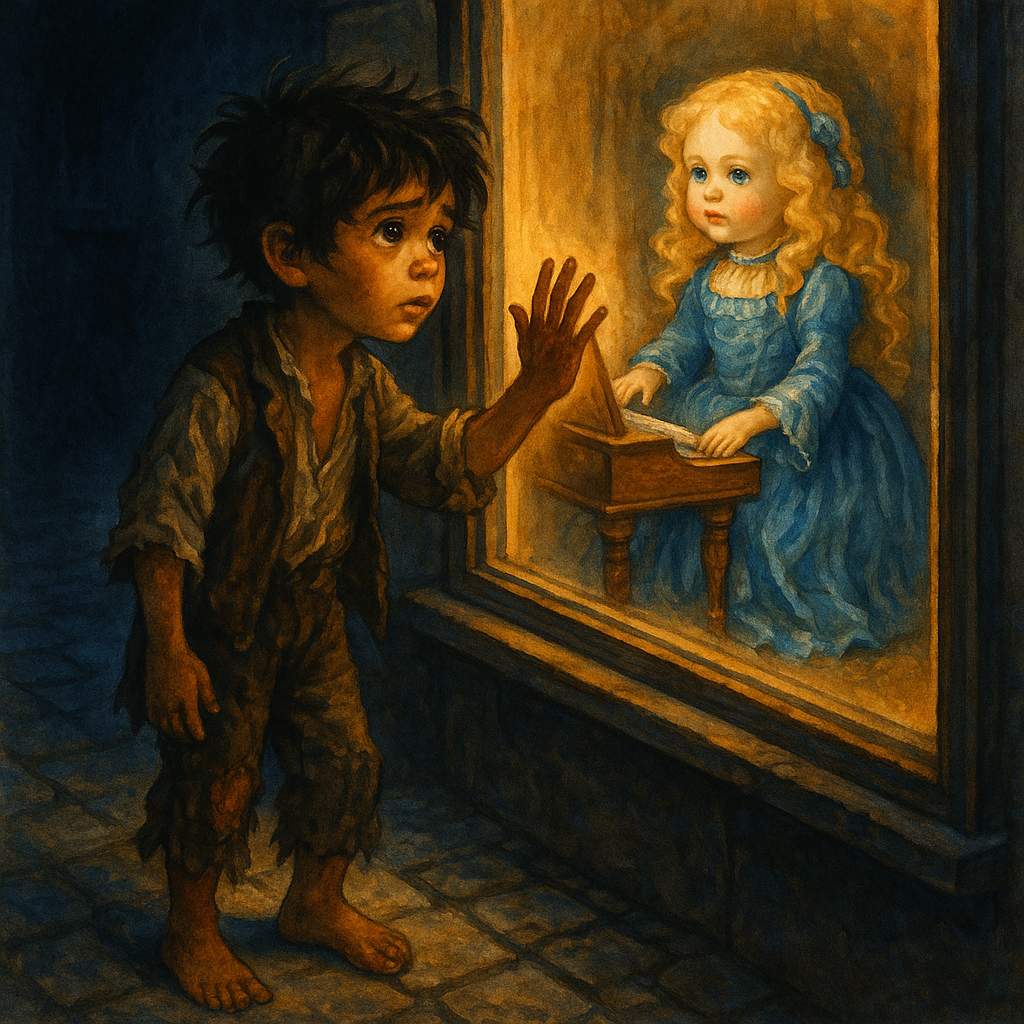
“They have sold her!” he muttered hoarsely. He called on God and the Devil in his despair, and as he thrashed about he dropped his matches, his lottery tickets, and his newspapers. Worldly interests — you are not worth a sigh!
V.
After a time, when the worst of the storm had passed, he glanced into the shop and saw two or three grown persons and several little girls talking with the German. One of the little girls held in her arms the lady of his thoughts. He felt like rushing upon them, but restrained himself — his appearance was not in his favor, and there was every chance of his being soundly beaten and handed to the police. He stood rooted to the threshold, meditating upon the horrors of the trade in living creatures, upon this wicked institution in which a few dollars decided the fate of honest souls, exposing them to the savage destructiveness of ill-bred children.
Those who had purchased the lady left the shop and entered a luxurious carriage. And how they laughed, the wretches! Even the youngest child took the liberty of pulling the unfortunate doll by the arms, though he already had the greatest quantity of toys any child could want. The grown-ups, too, seemed entirely satisfied with their new acquisition.
While the footman stood by for orders, Pacorrito — a person of heroic and daring resolutions — conceived the idea of swinging up behind the carriage. This he accomplished with the agility peculiar to a ragamuffin who wishes to cross the city for free.
Craning his neck to the right, he could see the doll’s rigid arm sticking out of the carriage window. That stiff arm and its little pink fist spoke forcibly to his imagination, calling to him through the rumble of the wheels:
“Save me, save me, my Pacorrito!”
VI.
Under the archway of the great dwelling where the carriage stopped, Pacorrito’s illusions met a prompt end. A servant informed him that if he soiled the flagstones with his muddy feet, he would have his backbone broken. Migajas retreated before this overwhelming argument, but from that instant his heart was filled with a burning thirst for justice. His fiery nature impelled him forward into the unknown, into the arms of his fate.
His soul was well fitted for noisy and dramatic adventures, so what did he do but make a pact with the men who removed the rubbish from the house where his beloved was enslaved? By this means — not altogether poetical, but revealing a shrewdness of heart as big as the top of a pine tree — he found his way into the palace. How his heart throbbed as he climbed the stairs and entered the kitchen! The thought of being near her confused him so that more than once his basket slipped from his hands, spilling its contents down the steps. But nowhere could he see his lady-love. He often heard the shrieks of children at play, but nothing more.
The servants, because he was so small and so plain, played many tricks on him. One alone, more compassionate than the rest, gave him sweets. One cold morning the cook — through pity or sheer mischief — gave him a draught of wine that was as biting and fiery as the devil himself. The ragamuffin felt a warm current run through his whole body while hot vapors rose to his head. His legs trembled; his arms went limp with a strange giddiness. A stream of laughter bubbled up from his heart and out through his lips, and Pacorrito held on to the wall with both hands to keep from falling. A vigorous kick from the cook somewhat settled his merriment, and he left the kitchen.
His head was spinning. He had no idea where his feet were taking him. He ran along staggering and laughing, first over cold tiles, then over smooth floorboards, then over soft warm carpets. Suddenly he caught sight of something on the floor. He froze — and then uttered a cry and fell to his knees.
There, stretched out before him like a figure at rest, with a crack across her alabaster brow, a broken arm, and disheveled locks, was the lady of his thoughts.
For a moment he could not speak. His voice was stopped in his throat. He pressed the cold body to his heart and covered it with burning kisses. The lady’s eyes were open and gazed with melancholy tenderness at her faithful lover — for she lived, in spite of her wounds. Pacorrito knew it by the singular light of her calm blue eyes, which sent out little flames of love and gratitude.
“Señora, tell me who reduced you to this sad condition!” he exclaimed. His grief was quickly followed by a burst of rage, and he thought of the great revenge he would take upon those responsible. Just then he heard footsteps approaching. He tucked the lady under his arm and ran.
He went down the stairs, crossed the courtyard, and burst into the street. He could scarcely be said to be running — he was flying, like a bird that has snatched a grain of corn, heard a shot, and finding itself unharmed, determines to put the greatest possible distance between itself and the gun. He ran past one, two, three, ten streets, until he felt he was safe, and then stopped to rest, laying the object of his passionate devotion across his knees.
VII.
Night came upon him, and he welcomed the soft shadows that hid his daring deed and sheltered their love. He examined her carefully and concluded that the wounds were not serious, though the crack in her brow was wide enough to reveal her interior — what would have been her brain, had she had one — and the sawdust of her heart was pouring out in copious streams through the rents in her chest. Her gown was in shreds and part of her hair had been lost in the hasty flight.
His soul overflowed with sorrow when he realized he had no money to meet the situation. As he had abandoned his business entirely, his pockets were naturally empty, and a beloved woman in poor health is a source of unlimited expense. Migajas laid his hand sadly upon that part of his rags where he had habitually kept his coin, but nothing was there.
“At this critical moment,” thought he, “when I need a house, a bed, doctors and surgeons, an abundance of food, a warm fire, and a dressmaker, I have nothing — nothing!”
But as he was very tired, he laid his head upon his idol’s body and fell asleep like an angel.
Then a great miracle took place. The lady began to revive, and finally rose to her feet, showing Pacorrito a smiling face. The crack had vanished from her noble brow; her graceful form was without a rent; her gown was neat and whole. On her curled and perfumed hair she wore a coquettish hat trimmed with tiny flowers. In short, she stood before him in all her beauty, just as he had known her in the shop window.
Migajas was dazzled, stupefied, speechless. He fell to his knees and worshipped her as one worships a divinity. She took the ragamuffin by the hand and, in a voice clear and pure and sweeter than a nightingale’s, said to him:
“Pacorrito, follow me! I want to show you my gratitude and tell you of the love with which you have inspired me. You have been loyal, constant, generous, heroic — you rescued me from the power of those who tormented me. You deserve my heart and my hand. Come, follow me! Do not think yourself inferior to me because you are in rags.”
Migajas looked at the lady’s elegant attire and said sadly, “My lady, where can I go dressed like this?”
The lady did not answer. She simply led Pacorrito by the hand into a mysterious region of shadows.
VIII.
The ragamuffin soon found himself in a grand parlor, brilliantly lit and filled with beautiful objects. As the first bewilderment passed, he made out a thousand different figures and statuettes, like those that had peopled the shop where he first saw his beloved. What surprised him most was to see all the elegant ladies who had occupied the shop window with his princess come forth to meet them. His lady accepted their homage with grave and ceremonious courtesy. She seemed to belong to a higher order than they. Her queenly manner, her proud though not haughty bearing, suggested dominion. She immediately presented Pacorrito — and he grew redder than a poppy when the princess, taking his hand, announced:
“Allow me to present to you Señor Don Pacorrito de las Migajas, who will honor us with his presence tonight.”
His heart sank as he compared the luxury surrounding him with his own poverty — his rags, his bare feet, his torn trousers held up by a single suspender, his coat sleeves cut off at the elbow.
“I can divine your thoughts,” the princess said quietly. “Your dress is not the most appropriate for a celebration like this. You are, frankly, not presentable.”
“Señora, that wretched tailor of mine,” stammered Migajas, “has broken his word, and —”
“Never mind; we will dress you here,” said the noble lady.
The valets in this strange mansion were tiny, comical monkeys. Small parrots acted as pages, and a great number of paper birds fluttered about. They immediately set to work improving Pacorrito’s unfortunate appearance. They slipped his feet into a pair of tiny gilded matchboxes that made the most stylish boots; they cut a cravat from half a little red paper lantern, and turned a wicker flower-pot into a sort of pastoral hat, trimmed elaborately with flowers. As Pacorrito had never been decorated, they took a metal plate from an elegant kepi and hung it round his neck as a medal, added a round matchbox to serve as a watch, and hung from his buttonhole the cut-glass stopper of a perfume bottle. The paper birds conceived the happy idea of tucking an ivory paper-knife into his belt to serve as a sword. Thanks to these and many other inventions for concealing his rags, our friend looked so transformed that no one would have recognized him. When he caught sight of himself in the mirror-lid of a sewing box, he swelled with pride. He was radiant.
IX.
The ball now began. A company of canaries sang waltzes and habaneras from their cages. The cornets and clarinets played their keys all by themselves; the violins plucked their own strings; the trumpets blew into one another. Migajas thought the music entrancing. Needless to say, the princess danced with him. The other ladies found partners among the army officers and sovereigns who had left their horses outside. Among these were Prince Bismarck, the Emperor of Germany, and Napoleon. Migajas was beside himself with pride. It would be impossible to describe the emotions of his soul as he swept through dizzy waltzes with his beloved in his arms. Her soft breathing and an occasional stray golden curl caressed his cheek, tickling him gently and producing a strange intoxication. A loving glance or a small sigh of weariness now and then put a climax to his rapture.
Suddenly the monkeys appeared and announced supper. This caused great commotion. Migajas rejoiced heartily, for without any prejudice to the spiritual character of his love, the poor little fellow was very hungry.
The dining hall was superb and the table exquisite. The china was of the very finest made for dolls, and a multitude of tiny bouquets showed their colors and scattered fragrance from egg-stands and thimbles. Pacorrito sat at the princess’s right.
The dishes were delicious, though everything was raw or, at best, cold. Migajas was quite pleased at first, but soon had enough. The menu consisted of: bits of sponge cake; turkeys no bigger than sparrows, which could be swallowed at a mouthful; giltheads no larger than almonds; a generous supply of hemp-seed; a pâté of birdseed à la Canaria; breadcrumbs à la perdigona; a fricassée of pheasants’ eyes with a sauce of wild mulberries; a salad of moss; delicate sweetmeats; and every variety of fruit harvested by the parrots from the tapestries on the walls, the melons being as small as grapes and the grapes as small as lentils.
During supper the company chattered without pause — all but Migajas, who sat silently, confused among so many gold-braided and uniformed generals. He was also amazed to find such liveliness in these great men who had stood stiff and dumb in the shop window as though carved from clay.
Prince Bismarck in particular never stopped talking. He said the wildest things imaginable, pounded the table with his fist, and threw breadballs at the princess. He flung his arms about in the most marvelous fashion, as though a string were attached to their hinges and someone under the table had hold of it.
“What fun I am having!” said the chancellor. “My dear princess, when a man spends his life adorning a mantelpiece in the cheerful company of a clock, a bronze figure, and a pot of begonias, he really needs recreation — and at a festival like this he lays in a supply of mirth for the whole year.”
“Ah, a thousand times happy, those whose only duty is to adorn mantelpieces!” said the lady, in melancholy tones. “It may be dull, but you do not at least suffer as we do — we whose lives are a prolonged martyrdom. You cannot imagine, Prince Bismarck, what we endure when one child pulls our right arm, another our left; when one cracks our head, another tears us apart or leaves us to soak in water, or rips us open to find out what’s inside us!”
“I can imagine it,” said the chancellor, opening his arms wide and clapping them together several times.
“How dreadful!” said Espartero and two of the emperors at once.
“I was the least unfortunate of all,” said the lady, “for I found a friend and protector in the valorous and faithful Migajas, who managed to save me from that barbarous treatment.”
Pacorrito blushed to the very roots of his hair.
“Valorous and faithful!” repeated all the dolls, in an admiring chorus.
“And therefore tonight, when our Creator-Genius permits us to come together for this great celebration, I have chosen to honor him by bringing him here and offering him my hand — as a sign of alliance and friendship between the lineage of dolls and that of kind-hearted, compassionate children.”
X.
At this, Prince Bismarck looked at Pacorrito with an expression of such malice and sarcasm that our hero was filled with indignation. The wretched chancellor immediately aimed a breadball at Migajas and fired it so accurately that the bridegroom came near being blinded. But Migajas, a model of prudence and self-possession, controlled himself and said nothing. The princess threw him a glance of love and gratitude.
“What fun I am having!” repeated the chancellor, clapping his wooden hands. “Before we must return to our places beside the clock and endure its endless tick-tock, let us drink deeply of pleasure! If Señor Pacorrito would favor us by calling the daily newspaper, we might have a laugh.”
“Señor de Migajas,” said the princess quietly, “did not come here to make us laugh. But there is no reason why we should not enjoy hearing him call out the paper — or even the matches — if he is willing.”
The ragamuffin could find no words. He was bitterly stung by the suggestion, which he took as a slight against his dignity.
“Let him dance!” shouted the chancellor, impudently. “Let him dance on the table! And if he refuses, I move that we strip him of the fine clothes we put on him and leave him as ragged and barefooted as he was when he arrived.”
Migajas felt all the blood rush to his heart. He was blind with rage.
“Do not be cruel, dear prince,” said the princess, smiling. “Leave him to me. I will take it upon myself to calm our good Migajas.”
A loud burst of laughter greeted this reply, and all the dolls and the most celebrated generals and emperors of the world simultaneously began pounding one another’s heads like Punch and Judy puppets.
“Make him dance! Make him call the matches!” they clamored.
Migajas felt faint. His sense of dignity was so powerfully developed that he would have died rather than submit to such degradation. He was about to reply when the malignant chancellor, pulling a long thin straw from a work-basket and wetting the end of it, drove it into Pacorrito’s ear with such a quick movement that the latter did not realize what had happened until he felt the painful shock of it.
Blind with rage, he reached to his belt and drew the paper-knife. The ladies shrieked and the princess fainted; but the enraged Migajas, far from being calmed, was growing more furious by the second, and rushed upon his insolent adversary, dealing blows right and left. The air was filled with yells and imprecations. The parrots croaked, and even the paper birds ruffled their paper tails in sign of panic.
Nobody was laughing at the daring Migajas now.
A few moments later the chancellor could be seen going about gathering up his arms and legs — a strange predicament — while all the emperors found themselves noseless. Gradually, however, with a good deal of glue and considerable innate skill, they mended one another — a rare advantage of puppet surgery. The princess, having recovered from her swoon via smelling-salts administered by her pages in a filbert shell, called the ragamuffin aside and led him to her private apartments, where she spoke as follows:
XI.
“Most illustrious Migajas, what you have just done has only increased my love for you, for you have proven your indomitable valor by your easy triumph over this swarm of scoffing puppets — the most despicable class of beings on earth. The tender feelings that bind me to you move me to propose that you become my husband without further delay.”
Pacorrito fell to his knees.
“As soon as we are married, the emperors and chancellors will all venerate you as they do me, for I must tell you that I am queen of this division of the world. My titles are not usurped — they are transmitted by the divine law of puppets, established by the Supreme Genius who created us and governs us.”
“My lady,” Migajas said, or tried to say, “my happiness is so great I cannot express it.”
“Very well,” said the lady with great majesty. “Since you are willing to become my husband, and consequently prince and lord of this puppet kingdom, I must inform you that in order to do so you will have to renounce your human nature.”
“I do not quite follow your Majesty’s meaning,” said the ragamuffin.
“You belong to the human race. I do not. Our natures being different, we cannot be united. There is only one way. Give up your humanity. It is the easiest thing in the world, believe me — you need only will it. Now answer me: Pacorrito, son of man, will you be a puppet?”
The peculiar nature of this request set the ragamuffin to thinking for a few seconds.
“And what does it consist in, this being a puppet?”
“You will be like me. Our nature is perhaps nearer to perfection than yours. We are, to all appearances, devoid of life — but we live, believe me. To the imperfect senses of man we seem to lack movement, words, affection — but this is far from the truth. You have had an opportunity of judging how we move, how we speak, and how we feel. Our fate, for the present at least, is not a very happy one. We are the toys of your children, and of your men too — but as compensation for this disadvantage, we are eternal.”
“Eternal!”
“Yes; we live forever. When your wicked children break us, we rise with a new life out of our destruction and are born again, describing a mysterious and everlasting circle from the shop to the children, from them to the factory, and thence to the shop again through all the ages.”
“Through all the ages everlasting!” repeated Migajas, absorbed.
“It is not always pleasant — but, on the other hand, we do not know death. And our Creator-Genius permits us to meet at certain great festivals to celebrate the glory of our race, as we have done tonight. We cannot elude the laws of our being — it is not given us to enter the realm of humanity, though men can easily enter ours, and in fact have very often been known to become puppets.”
“A most extraordinary thing!” exclaimed Pacorrito.
“You know the requirements. I have nothing more to say. Our law is very simple. Now, meditate upon it, and answer: Will you be a doll?”
The princess’s attitude was that of a priestess of antiquity. Pacorrito was captivated.
“I want to be a doll,” declared the ragamuffin, resolutely.
The princess proceeded to trace mysterious characters in the air and utter great words that Pacorrito had never heard before — neither Latin, nor Chinese, nor Chaldean. He concluded they were Tyrolese. When this was accomplished, the lady threw her arms about Migajas, saying:
“Now you are my husband. I have the power of marrying, and also of receiving new members into our Great Law. My darling little prince, may you be blessed through time everlasting!”
And the whole court of figures entered the room singing, “Through time everlasting!” to the accompaniment of canaries and nightingales.
XII.
They all promenaded through the parlors in couples. Migajas gave his arm to his royal consort.
“What a pity,” said she, “that our hours of pleasure should be so brief! Soon we shall have to return to our places.”
His Serene Highness Migajas had, from the moment of his transformation, begun to experience the strangest sensations. The strangest of all was that he had completely lost his sense of taste and any notion of hunger. All he had eaten lay within him as though his stomach had been a basket of cardboard food — without substance, weight, taste, or nourishment. Moreover, he was no longer master of his own movements and was compelled to keep a mechanical rhythm when he walked, which was very difficult to manage. He felt himself growing hard, as though he were being turned to bone, or wood, or clay. He struck himself, and — behold! — his body rang like porcelain. His clothes, too, had grown hard and were in every respect indistinguishable from his body.
When he found himself alone with his little wife and clasped her to his bosom, he felt no warmth — nothing but the harsh shock of two hard, cold bodies. He kissed her cheek; it was frozen. In vain did his spirit call upon nature. Nature within him had become what it is in a piece of pottery. He felt his heart ticking like the mechanism of a clock. His thoughts alone survived; everything else was unfeeling matter.
The princess seemed entirely happy. “What is the matter, my love?” she said, noticing Pacorrito’s expression of distress.
“I am weary, my dear — unspeakably weary,” said the lover.
“You will grow accustomed to it. Oh, happy hours! If this lasted much longer, we could not bear it!”
“Does your Highness call this happiness?” observed Migajas. “What coldness, what emptiness, what rigidity!”
“The memory of human things still lingers in your soul, and you are still a slave to your depraved human senses. Pacorrito, I must implore you to control these feelings, or you will be the ruin and demoralization of every living doll.”
“Life! Life! Blood! Warmth!” cried Migajas in despair, gesturing like a madman. “What is happening to me?”
The princess clasped him to her bosom and, kissing him with her red waxen lips, exclaimed:
“You are mine — forever, forever, through time everlasting!”
Just then they heard a great commotion and the sound of many voices crying:
“It is time! It is time!”
The clock struck twelve, and all had vanished — princess, palace, dolls, and emperors. Pacorrito was left alone.
XIII.
He was left alone in the most complete darkness. He tried to scream, but he was voiceless. He made frantic attempts to move, but he could not. He had turned to stone.
He waited in anguish. Day dawned at last. Pacorrito had resumed his old appearance — but strangely, he was all one color and apparently all one substance: his hands, his arms, his rags, his hair, and even the newspapers he held in his hand.
“There is no doubt about it,” said he; “I have turned into a statue.”
Before him was a great sheet of plate-glass, with letters on it running backward. Around him stood a multitude of statuettes and ornaments.
“Horror! I must be in the shop window!”
A clerk took him carefully in his hands, dusted him off, and set him back in his place.
His Serene Highness looked down at the pedestal on which he stood and saw a card with the figures $12.00 upon it.
“Good heavens! I am worth a fortune! That, at least, partially consoles one.”
And the people paused on the other side of the plate-glass to admire the remarkable little clay figure representing a ragamuffin selling matches and newspapers. Everyone praised the artist, and laughed at the droll expression and comical figure of the great Migajas — while he, in the innermost recesses of his clay, repeated in anguish:
“A puppet! A puppet! Forever! Through time everlasting!”