There was once a rich merchant who had three daughters. Two of them loved dancing and theatres and balls, but the youngest was a homebody who scarcely strayed beyond the garden.
When the father set off abroad to buy merchandise, he asked each daughter what she would like him to bring home. The two eldest asked for fine dresses and jewels, but the youngest asked only for a pot of rue.
“That’s an odd fancy,” said her father, “but an easy one to grant. You shall certainly have it.”
“Not so easy as you think,” she replied. “Now that you have promised it, mind you bring it — for you’ll find you cannot get home again unless you do.”
Her father smiled and thought no more of it. He travelled to a far country, bought his merchandise, packed the fine clothes and jewels for his two eldest daughters, and set off for home — having quite forgotten the pot of rue.
They were barely a day’s journey out to sea when the ship stopped dead. No sail could fill, no oar could move it. The captain paced the deck.
“Someone on board has an unfulfilled promise on him,” he declared, and called upon whoever it was to come forward — for the lives of all on board should not be risked by one man’s broken word.
The merchant stepped forward. It was true, he admitted: he had forgotten something he had promised his youngest daughter. But it was such a small thing, he could hardly believe it was the cause.
As no one else had anything to confess, the captain judged the merchant to blame. He was a good trading partner and a loyal customer, so instead of throwing him overboard, the captain agreed to turn the ship around.
“And what is it you must bring your daughter?” he asked.
“Nothing but a pot of rue.”
The captain stared. “A pot of rue! That is no easy matter at all. In this whole country, only the king has a plant of it — and he has decreed that anyone who dares ask for even a single leaf shall be put to death instantly.”
“That is grim news,” said the merchant. “Still — I made a promise, and I must keep it. If I lose my life in the trying, I might have had a worse death.”
So he went ashore and walked straight to the king’s palace. There he knelt before the throne.
“Your Majesty,” he said, “I come not out of boldness or disrespect. A promise was laid on me before I knew of your decree. I am bound to ask — not for a single leaf, which I know is forbidden — but for the whole plant.”
The king looked at him steadily. “To whom did you make this promise?”
“Only to my youngest daughter, sire. But having made it, I will not back away, even at the cost of my life.”
Then the king smiled. “Because you kept faith with your word, and had the courage to come before me rather than break your promise — I give you the whole plant, freely. My decree said death to anyone who asked for a single leaf. But you asked for the whole plant, and that is a different thing entirely — a boldness worthy of reward.”
He handed the pot of rue to the merchant, and added: “Tell your daughter she must burn one leaf every night.”
The merchant went home and gave out all his gifts. The two eldest daughters admired their fine dresses and jewels, and were delighted. The youngest was no less pleased with her simple pot of rue.
That evening, the father and two eldest daughters went off to a ball as usual. The youngest stayed home, as she always did, and burned a leaf of rue as the king had told her. Now, the king had three handsome sons. The moment the leaf caught fire, the eldest son appeared before her. He sat beside her and talked so warmly and kindly that the evening passed like a dream.
She burned a leaf every night, and every night the prince came.
After a while, the other merchants began to notice that only two daughters ever came to the balls. “Why does the youngest never come?” they asked. Not knowing what to say, the merchant answered vaguely that only two of his daughters were old enough. But the merchants pressed him: “Bring the youngest — let her come.”
So the next evening, the father brought the youngest to the ball, and the two elder daughters were left at home.
The youngest had never left her room for long, so her sisters had never found a chance to harm her. But now, with her safely away for the evening, they slipped into her apartment and set fire to it. The whole room burned. The garden burned. The pot of rue burned.
If the prince had come quickly when a single leaf was lit, you can imagine the speed at which he came when the entire plant went up. He came with such force that he crashed through the blazing beams of the apartment and through the shattered glass, and by the time he dragged himself home, he was terribly bruised and cut all over.
The youngest daughter came home from the ball to find her room reduced to ash, the garden scorched, the pot of rue gone. She looked at the ruin and said quietly, “I will not stay here any longer.” She put on men’s clothes, tucked a brace of pistols into her belt, and walked out into the night.
On and on she walked, until darkness came and she could go no further. She lay down to sleep beneath a tree.
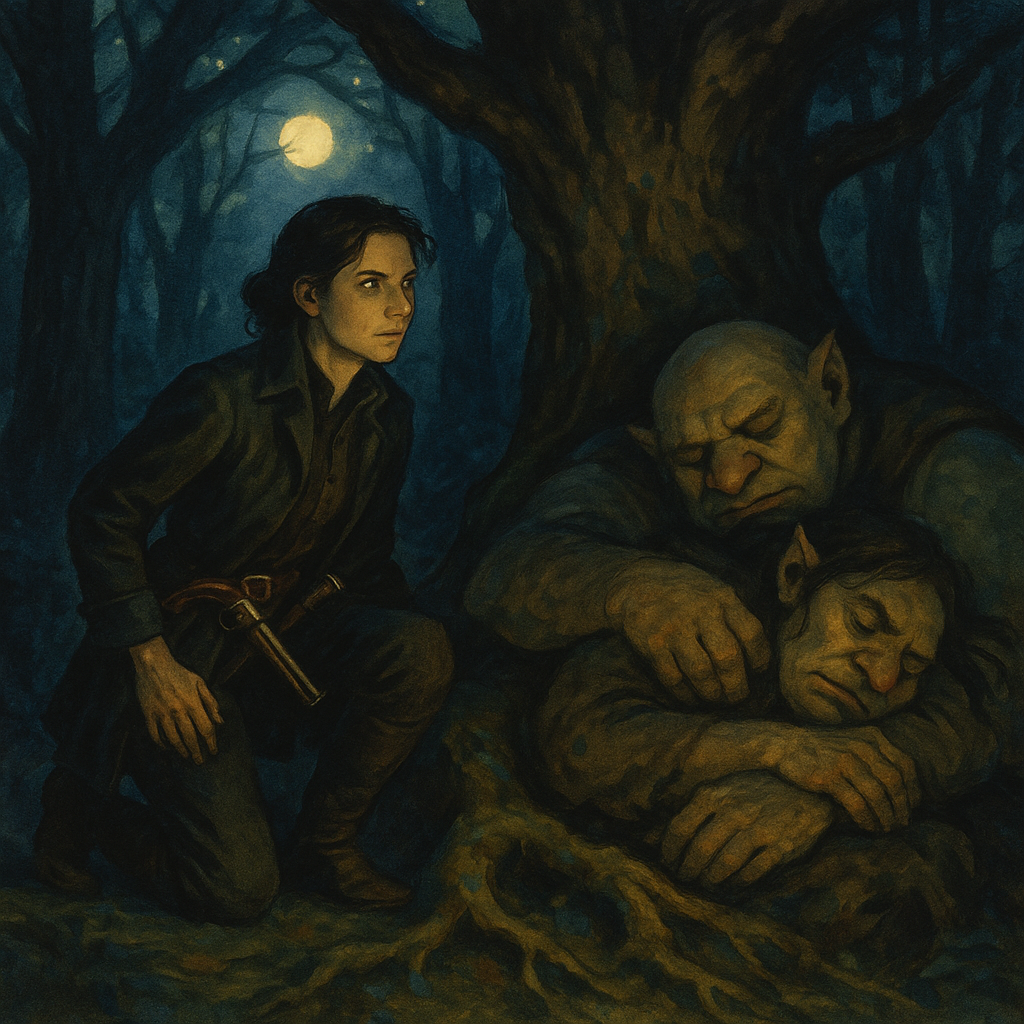
In the middle of the night, an ogre and an ogress came and lay down beneath the same tree to rest. She kept still and listened.
“Our king’s eldest son is gravely ill,” the ogre said to the ogress. “He fell through a window and was cut by the glass and bruised all over. What is to be done for him?”
The ogress sighed. “It is well that no one knows the answer — but I will tell you. To heal those wounds, they would have to kill us both, and take the fat from around our hearts, and make it into an ointment, and spread it over his wounds.”
The merchant’s daughter lay very still until the ogre and ogress were fast asleep. Then she drew both pistols and shot them dead together. With her knife she cut out the fat from around their hearts, and set off again toward the king’s city.
At the palace gate, the guards turned her away. Too many great surgeons had already tried and failed — there was no entrance for a travelling quack. She refused to leave. When the guards tried to drive her off, she fought back so fiercely that they were forced to call out the whole guard, and the noise of the struggle reached the king himself.
“There is a wandering surgeon at the gate, Sire,” they told him, “claiming he can heal the prince.”
“All the learned doctors have failed,” said the king. “Let the stranger try.”
She was brought to the prince’s room. She asked for what she needed to prepare the ointment, for linen bandages, and to be left undisturbed for a week. When the week was over, the prince was completely healed.
She dressed herself carefully — still in her travelling clothes, for she had no others — and stood before him.
“Do you not know me?” she asked.
He looked at her closely. The dust of the road had hidden her face when she arrived, but now he saw her clearly. “Yes,” he said. “The girl with the pot of rue.”
He told his father he meant to marry her.
The king was skeptical. “The prince is well in body,” he said to his advisors, “but perhaps the illness has affected his mind, if he wishes to marry his surgeon. Still — there’s no use arguing with a young man in this state. We will humour him. Have the surgeon dress up as a princess and let them go through a ceremony. He’ll soon come to his senses.”
When the ladies of the court came to dress the supposed surgeon in bridal robes, they saw at once, from the way the dress became her, that she was no surgeon at all — she was a woman, and a beautiful one, and the prince was perfectly sane.
The prince silenced their exclamations. “Say nothing,” he told them quietly. “If my father realises this is a true marriage and not a game, he may refuse, since she is not a princess. But I know she is meant for me — my mother told me, before she died, that I would know my bride by a pot of rue. And she has proved herself more than worthy by giving herself to heal me. Let the wedding go forward, exactly as my father planned.”
So the marriage was celebrated. When the king discovered afterward that the surgeon was a real woman and a real wife, he saw that the thing was done and could not be undone. He said nothing more about it.
And so the merchant’s daughter became a prince’s wife.