
Once there was a merchant so wealthy that his three daughters had never wanted for anything. So when he was setting out for a distant market — one famous for silks, jewels, and wares the like of which they had never seen — he asked each daughter what she would like him to bring back.
When he described the shawls he expected to find, shot through with brilliant colours and gold thread, the eldest daughter asked for one at once. When he mentioned coverlets made from bird plumage, shimmering like a rainbow, the second daughter begged him to bring her one too.
But the youngest daughter — known for her quiet, stay-at-home ways and her distaste for anything showy — wanted none of it. Not the shawls, not the coverlets, not the sparkling rubies or the rarest pearls he offered her. She had just one request: a pot of marjoram. The herb was impossible to find where they lived, and she needed it for the kitchen.
The merchant set off and chose the finest shawls and coverlets for his two eldest daughters, selecting each one with care. But the homely pot of marjoram slipped his mind entirely. He was nearly home before he remembered it at all.
He was within a day’s journey of his house when a strange-looking man stepped out to meet him on the road one evening.
“Would you like to buy a pot of marjoram?” the stranger asked.
The words brought his youngest daughter rushing back to mind. “A pot of marjoram! Just what I need — here, take something extra for it,” the merchant said, and called to his attendant to load the pot onto one of the pack mules.
But the stranger held the pot back and laughed.
“I thought you were a man of business,” he said, “and knew that a man has the right to set his own price on his own goods.”
The merchant laughed too, thinking the comparison absurd. “When a trader travels a thousand miles through a thousand dangers to bring back rare goods that no one at home has ever heard of — then, yes, he alone can set the price. But a pot of marjoram? Everyone knows what that costs.”
“Perhaps not,” the stranger replied, pulling his cloak tightly around the pot. “At any rate, you clearly don’t.” And he stepped away as though the matter were settled.
The merchant’s vexation was real. He could not go home without that pot of marjoram, and he was far too close to home to find another. So he swallowed his pride and drew his horse nearer.
“You’ve made me curious, friend. Name your price.”
“Three hundred thousand scudi,” said the stranger — who was, in truth, a magician. “And if you knew its powers, you’d know it comes cheap at that.”
He turned as if to leave, perfectly indifferent.
The merchant stood puzzling. He must have the pot; the stranger clearly would not budge a single coin; and any attempt to haggle would only have made the whole affair more ridiculous. So the merchant assumed his most dignified air, as though the sum were nothing to him, called to his steward to count out the money, and rode on.
At home, his two eldest daughters exclaimed over their shawls and bird-plumage coverlets. The youngest received her modest-looking gift with such a glow of surprise and admiration that her father imagined, with quiet satisfaction, that she was not entirely ignorant of what it had cost him.
Life settled back into its usual rhythm. The elder sisters returned to their round of parties and pleasures. The youngest went quietly back to her household duties — though if she had any pastime now, it was tending her pot of marjoram with devoted care.
But in time, through the servants’ gossip, the sisters learned the truth: their younger sister’s humble little request had cost their father a fabulous fortune. Their jealousy curdled into fury. They resolved to punish her by destroying the pot.
Getting at it was not easy. She was always home, and she guarded it constantly. So the sisters went to their father and told him it was unhealthy for a young girl to shut herself up so completely. Whatever her own inclinations, they insisted, she ought to see the world. Their father found the argument convincing, and that very evening he called his youngest daughter to him and told her, firmly, that she was to accompany him to a social engagement.
She could not refuse. But she left her pot of marjoram with a heavy heart, as though some dark premonition had settled over her.
The moment she was gone, her sisters went up to her room, seized the pot, and hurled it out of the window. It smashed on the road below, and within minutes it had been trampled to dust and scattered.
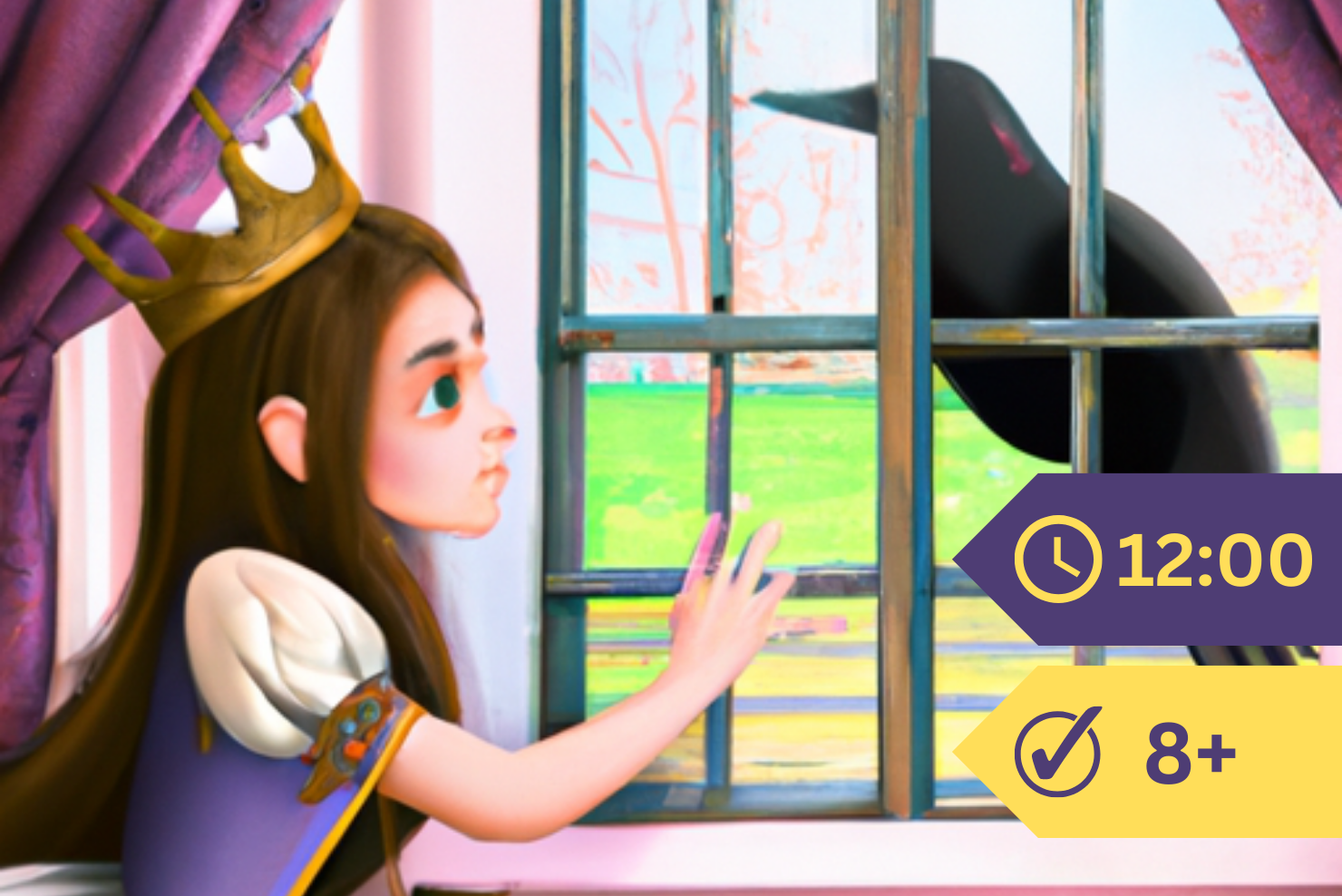
When the youngest daughter came home and saw what had been done, her grief was overwhelming. That night, when the whole house was asleep, she made up her mind: she would not spend another hour under the same roof as the sisters who had treated her so cruelly. She slipped away into the darkness, wandering wherever her feet took her, not caring where she went.
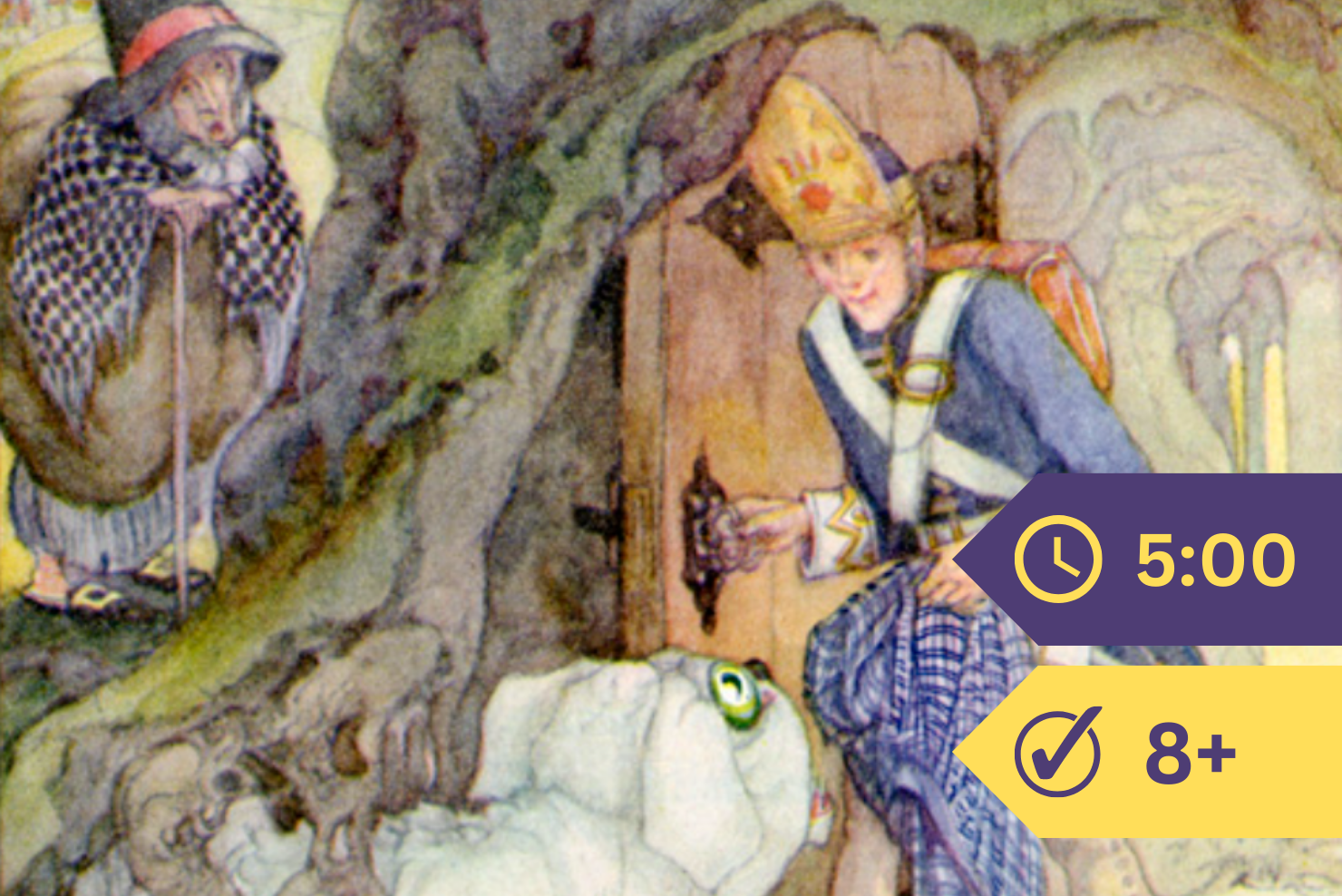
On and on through the night she walked. When dawn broke, she found herself on a vast plain where many roads met. She hesitated, not knowing which to take — and then a figure appeared before her, as if from nowhere. The last time she had looked up, not a soul was in sight; now a woman stood there who had the look of an enchantress about her, though she was plainly dressed.
“Where are you going so early, my dear, and why are you weeping?” the woman asked, in a voice so gentle it could have drawn an answer from anyone.
It was not an easy question, since the girl had no idea where she was going. So she answered the second part first and poured out everything — her sisters’ cruelty, the loss of the pot, the long night of wandering.
“It is not so very terrible,” the fairy replied when she had finished. “You have been trying to be a sensible girl, and now you must be brave as well. There is always a bright side, even when you cannot see it — and your loss will not harm you in the end. But you will need courage and steadiness for what lies ahead. And since it would not do for a young woman to go about the world alone, I shall give you a suit of man’s clothing — it will keep you safer.”
So saying, she produced a complete set of travelling clothes, though she had carried nothing. In the belt were weapons and a number of other things the girl did not recognise, but the fairy assured her she would need every one of them in time. Then she pointed out which road to take, urged her to keep her spirits up, and vanished almost before the girl could thank her.
The moment the fairy disappeared, the whole landscape changed. Where there had been a vast flat plain, great mountains now rose on either side, and a dense forest spread out straight ahead along the path. The girl’s heart sank — but she remembered the fairy’s words and walked steadily forward. Although their conversation had seemed to last only a few minutes, the sun was already high in the sky. She was glad of the cool shade when she reached the first trees, and glad too to hear a small brook trickling nearby. She sat and rested and ate the provisions the fairy had thoughtfully packed for her.
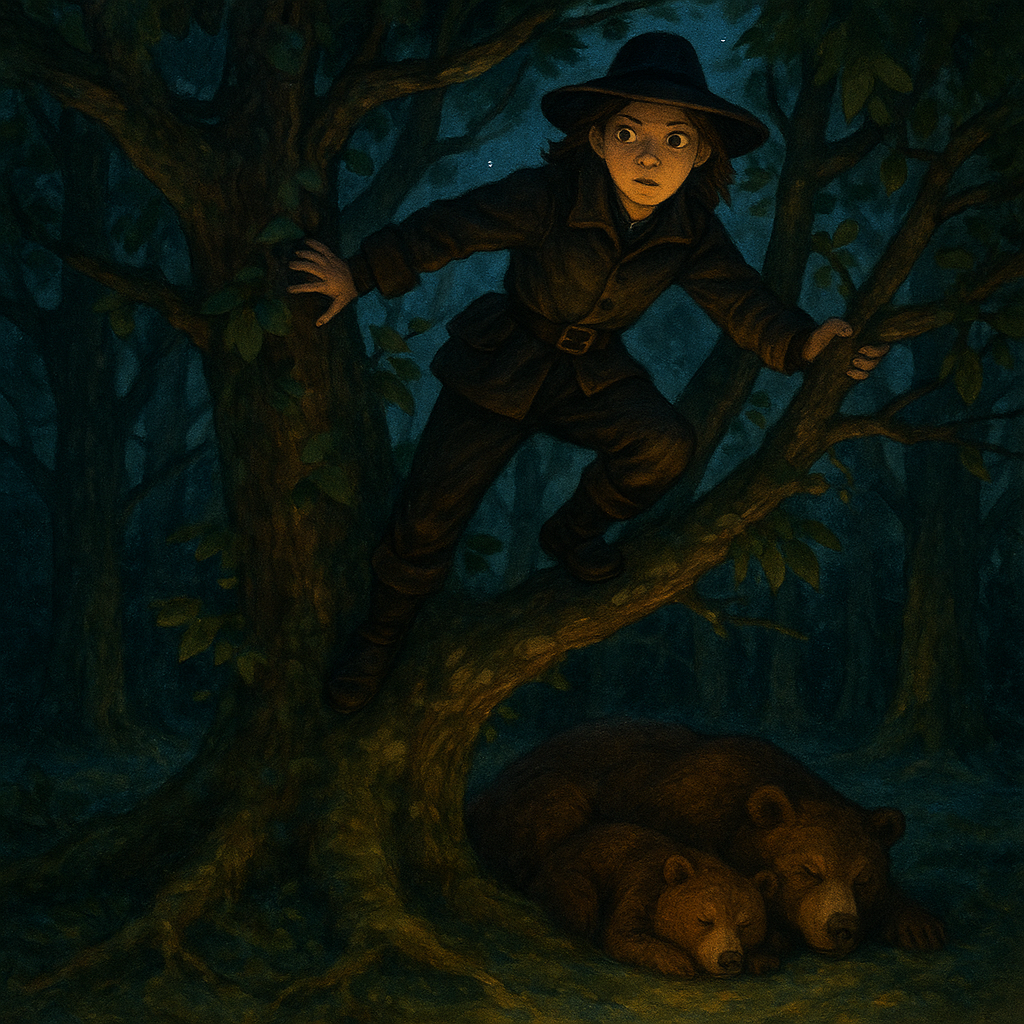
When the afternoon cooled, she rose and walked on until dark, then climbed high into the branches of a great spreading tree — to be out of reach of any wild creatures that might roam the forest — and settled herself to sleep.
In the middle of the night she was woken by a deep, terrible growling below her. Peering down, she made out two enormous bears stretched beneath the very tree she had chosen — and she realised, with a start, that she understood every word they said, as clearly as if they were speaking aloud. She recognised this at once as another gift from the good fairy.
“Where in the world have you been all this time?” growled the she-bear. “You are away constantly now. I’ve been hunting through the whole forest for you.”
“What a waste of effort,” grumbled the he-bear. “I was nowhere near the forest.”
“Then where were you?” she growled, with a tone that made clear she intended to know everything.
“Since you must know — I went twenty miles along the river, then over the rocky mountains and round the edge of the forest, all the way to the kingdom of Persia. And a great wailing is going up from Persia, because last night the king fell from his high tower and broke every bone in his body. The glass shattered with him and has entered his wounds. All of Persia is mourning.”
“Then let them find another king,” growled the she-bear.
“It is not so simple. There was no king in all the world as handsome as the king of Persia. But that is not the worst — the worst concerns us directly.”
“How can it concern us?” she retorted.
“It concerns us very closely — if anyone knew of us, we should both be killed. For the only cure for the king’s wounds is this: that we two should be slain, our fat melted together and made into an ointment with honey and wax, that ointment spread over the king’s body, with warm baths, three days in a row. The king has sent a proclamation to every land inviting any physician who can heal him to come. If any of them consults his books and discovers our remedy, we are finished.”
“Nonsense,” the she-bear grumbled. “Come to sleep. Who in the world is going to find us here in the middle of this forest?”
“Not very likely at all,” the he-bear agreed.
And on that comfortable thought, both bears fell fast asleep.
The girl listened to their snoring with a pounding heart. She could understand the snoring as clearly as the growling.
I’m sound asleep, snored the she-bear.
I’m so tired I never want to wake again, snored the he-bear.
Then you won’t, the girl said to herself, as she quietly climbed down from the tree.
Just think of that old king of Persia wanting our fat — he can wish for it forever, snored the she-bear.
It would be a fine thing to give the king back his health and his looks — but one’s own life is too high a price for the honour, snored the he-bear.
“You shall have that honour nonetheless,” the girl whispered — and drawing the two sharp blades the fairy had fastened in her belt, she stood firm and plunged one swift into the throat of each bear. A rush of blood, and both great bodies rolled over without so much as a sound. She had been quick and steady.
At first light she steeled herself and set to work, cutting up the carcasses and extracting the fat. She lit a fire, melted the fat down, and made it into an ointment with the honey and wax the fairy had provided. Then she set off in the direction the bear had described, and after much toil and weariness she arrived at last in the kingdom of Persia.
Confident in her remedy, she went directly to the palace gate and presented herself as a healer who could cure the king.
“I may not have the great reputation some who answered your king’s call can claim,” she said. “But I am so certain of my treatment that I offer my own life as surety. If I fail, do with me as you will.”
“You need fear nothing,” the chamberlain replied. “You are the only one who has come. Every physician in the world read the proclamation, declared the king past saving, and refused to make the attempt. Walk in.”
Wan and wasted as he was, the girl saw at once, when she was shown into the king’s presence, that the bears had not exaggerated his looks. More than ever, she wanted to succeed.
The king submitted willingly to her treatment: three days of the ointment and the warm baths, as the bear had said. At the end of it he was entirely healed — sound in body and restored to all his former appearance.
If the king’s looks had made an impression on the girl, she had not gone unnoticed by him either. On the fourth day, when she came to take her leave, he told her at once that he could not let her go. She must stay and serve as his court physician.
The flush of joy she could not hide at this proposal was enough to confirm a suspicion the king had already been nursing — that his supposed physician was no physician at all, but a young woman who might be worthy to be his queen.
For the moment he said nothing more, and simply gave her fine apartments in the palace, her own staff, and a generous allowance. The days passed; they were often in each other’s company; and each grew fonder of the other.
Then one day the king sent for his chamberlain and gave a curious instruction: the court physician was to appear before him dressed in a queen’s robes, with ladies-in-waiting and pages of honour in attendance.
The chamberlain, who privately thought the king’s fall had perhaps done something to his head, carried out the command with evident unease. But carried it out he did — and what puzzled him further was that the physician did not share his reluctance in the slightest. Instead, the king’s instruction was received with a look of plain joy.
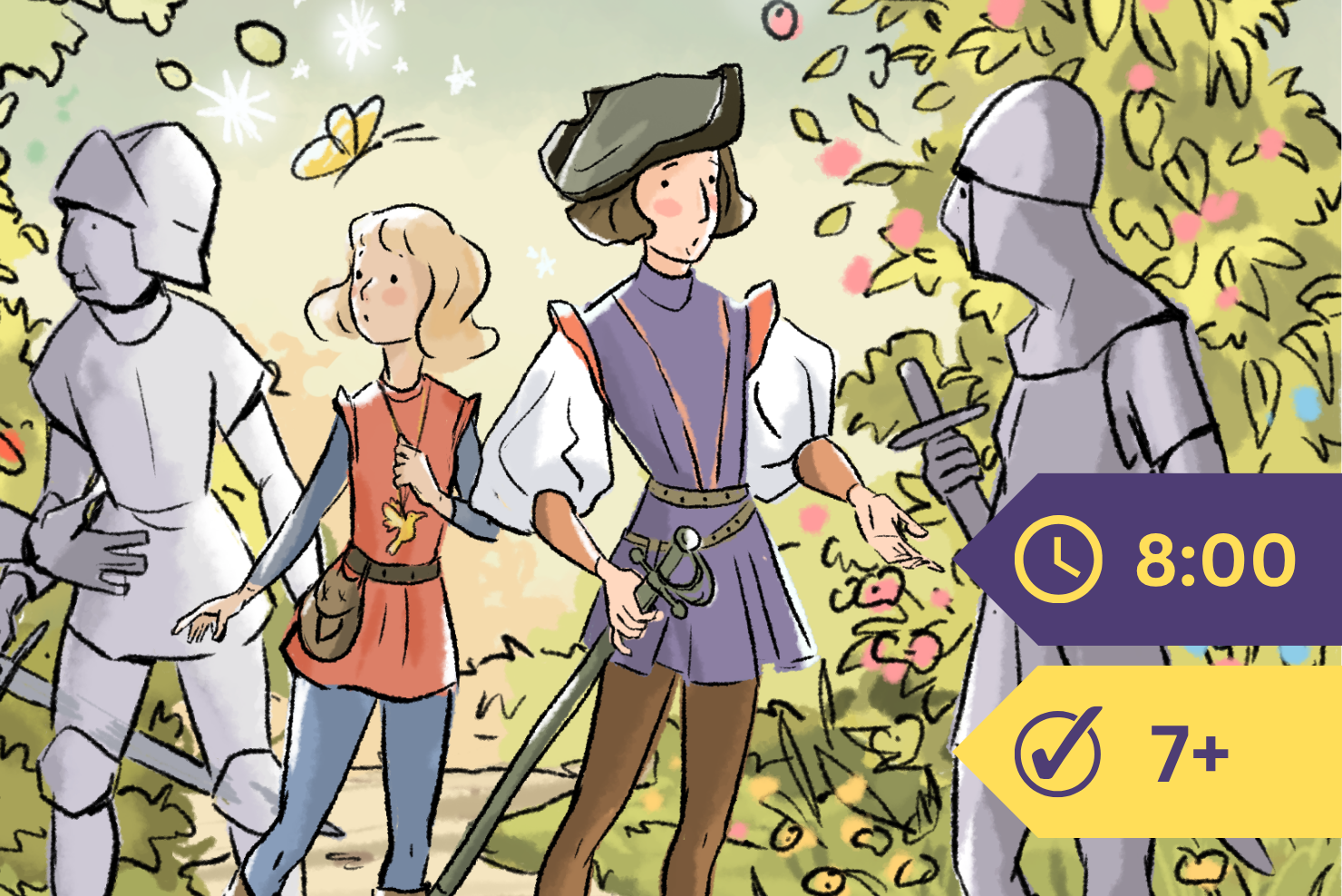
The king had also called all the great nobles and officers of the court, and all his guards, to attend in full ceremonial dress. Before entering the hall, however, he went alone to his private study and summoned the girl there. They stood facing each other — each in their proper dress, each seeing the other more clearly than ever before. The king did not take long to draw from her the confession that the robes she wore were those of her own sex, and that she was as willing as he was to be bound to him forever. He led her into the great hall and presented her to his people as their queen.
As for her two sisters — he sent for them, and justice was done.
The woman who first told this story added that her own mother had always ended it in a particular way, with a small rhyme:
“Never was there such a feast as for the wedding of the king of Persia. The confetti were as big as eggs — and I was given five of them.”
“Oh, Mama,” her daughter used to say, “why didn’t you save them for me?”
“Listen and I’ll tell you what I did with them:”
One I gave to the cock, who carried me on his back,
And one to the hen, who showed me the way.
One to the pig, who pointed out the door.
One I ate myself,
And one I put by —
and no doubt it’s still there.
She would point as she spoke to an old glass cabinet in the corner, and the little girl would go and rummage through it, always certain the sweet was hidden somewhere — until one day, finally convinced it didn’t exist, she got very angry and threw a key at the cabinet and broke the glass. And her mother never told her that story again.