We are altogether wrong if we imagine that flowers can do nothing but bud and bloom and smell and fade. That opinion has merely been forced upon us by our own vanity, which would have us believe that everything in nature exists only for our sakes. Because we can perceive only the outer life of flowers, we suppose they have no inner life at all. But that is not the case.
Not only has every flower a character of its own — one modest, another vain and proud, a third cheerful and brilliant, a fourth dull and sullen — but every one of them has its own wishes, joys, loves, and sorrows. All of them share one sentiment in particular: not a mere attachment to the soil, but a deep devotion to the very spot on which they have grown, so that they cannot exist anywhere else. In modern times this feeling has often been wanting among mankind.
Flowers also have an organ of communication, and those who understand their language could tell many a pretty tale. A man who could pass many a night listening upon the enamelled field and watching all the motley images that passed before him would have, probably, a very fine poetical dream.
Now, the narrator of this tale was lying one balmy moonlit night on the flowery carpet of the wood, listening — or, as some will rather believe, dreaming — when all at once he heard a thousand little voices rising from the flowers. Some kindly fairy, to whom he had unconsciously done some good turn, had lent him his hearing for the night.
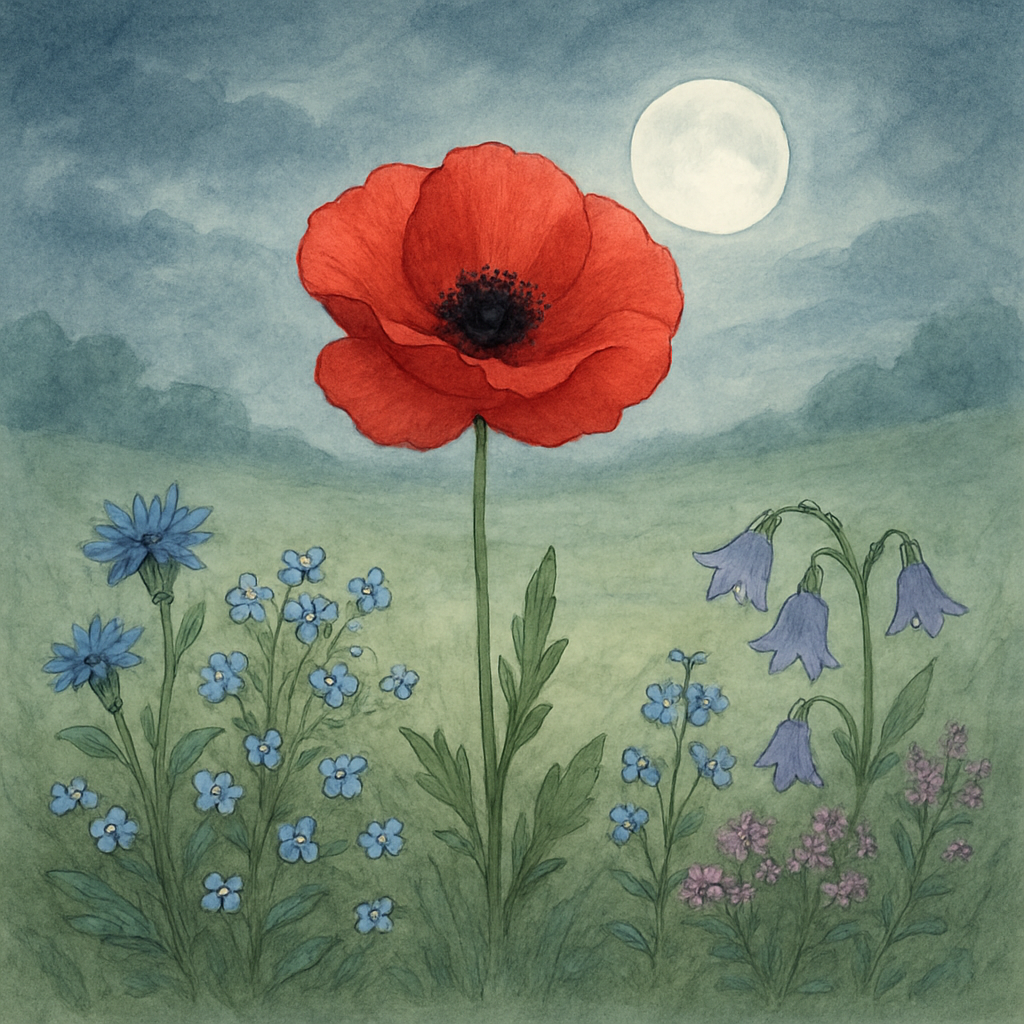
The common cornflower chattered away, while at a short distance the red mossflowers were tittering together, apparently about something droll. The bellflower was silent but constantly gave assent to what her neighbours said by nodding her head backwards and forwards. The quaking-grass kept shaking its head, quite unable to believe whatever it heard. Whether they had perceived the listener — or whether, according to the old proverb, they wished to punish him for his intrusion — their conversation turned chiefly on the injustice and unkindness of man towards them.
“Alas!” said a knot of thyme-blossoms in a mournful tone, “look where the clumsy foot of man has again crushed our dear brothers and sisters.”
“They do not care for us,” said a catchfly, lifting itself straight on its slender stem. “If they would only destroy us for being mischievous, like the hemlock, it would not be so bad. But nothing is harder to bear than their contempt. They do not even think us worth the trouble of keeping their feet from our heads.”
“According to your remark, then,” interposed a forget-me-not, “we ought to consider mankind as most unjust towards us. And yet — are we not their loveliest ornament when they hold their festivities? Do they not always use us as messengers of their holiest feelings — of their love?”
“Those times have long gone by,” grumbled the sorrel. “Does not man, in the height of his presumption, dare to meddle with his Creator’s handiwork, and endeavour to imitate — nay, to surpass — us with wretched things made of painted paper? Which, now, are the fairest ornaments: ourselves or those paltry copies? And as for messengers of love, they only use us in that capacity when they can get nothing better. Besides, the language of flowers has long gone out of fashion. They call it sentimentality and laugh at it.”
“I could endure all that,” interposed the lily, “for how can man appreciate feelings he does not know? He ought not to deny the existence of those feelings which are brought plainly before his eyes. When night has passed and we look around us in the morning light, we are sure to miss one of our playmates who bowed her head in the evening twilight, or was despoiled by the sharp night breeze. We mourn over her, and tears tremble in our eyes. Man sees these tears — but without troubling himself to understand them, he denies that the drops are a sign of our mourning feelings, and says it is nothing but the dew which the morning mists have scattered over us.”
This proof of human injustice must have been very convincing, since for the moment none of them had anything to say. A group had then formed around a brilliant Poppy that stood close by in full bloom. For some time it had been remarked that all the flowers in her neighbourhood laid their heads together and took no part in the conversation. When the pause occurred, the cowslip, shaking her bells, cried out: “Silence, sisters! The Poppy has something to tell us.”
“Silence, silence! A story from the Poppy!” was the general cry, and all of them listened attentively. Even the reed-grass had finished its long poem.
The Poppy now raised herself on her slender stalk, looked around her, and then rocked slowly backwards and forwards. I expected that she would have let her audience entreat her for a long time — would have feigned hoarseness and uttered a world of excuses. But things of this sort could not have been in fashion among the flowers, for she began her story at once, without any ado.
“You wish to hear me, then,” she said. “Well, I must tell you that, according to the traditions which have been handed down from generation to generation in my family, we poppies owe our existence to a very singular event.
“Of course you do not believe that when the world was first created, we flowers were scattered all at once over the earth. No — one came after another, and things went on then much as they go on in spring-time now.
“And what goes on in spring?” interposed the cornflower.
“You had better ask that of the daisy,” replied the Poppy. “She is an early flower and they do not interrupt me any more.”
The daisy, who had generally been lightly esteemed — nay, looked upon as somewhat of a simpleton — while her cousin the pansy stood in higher repute on account of her superior education, was both gratified and confused at being allowed to speak. Her small white leaves became suffused with a delicate red, such as may often have been observed in that little flower. She raised her head gratefully to her lofty patroness and proceeded without waiting for further entreaty:
“How we offended the Winter, and made him so hard with us poor flowers, I cannot say. Opinions are divided on the subject. Only this much is certain: he cannot bear us, and will not rest until he has swept us all from the surface of the earth. His reign does not last forever, and after him comes our best friend — the Spring. Good Spring, however, looks very grieved when, on his departure, he specially confides to the care of Summer not one of us is left, and he is forced to wrap his head in a long grey veil, because there are no flowers or leaves to twine into a wreath. He then passes his soft warm hand gently over the earth, beckons and calls his darlings — not one of whom will yet put out his head, so much have they been frightened by the rough Winter.”
“Nor is this fear altogether groundless,” continued the Poppy, resuming her story, “for instances have been known when Winter, after his departure, has returned and destroyed the flowers. Some flowers, indeed — those with remarkably kindly hearts — do not allow the Spring to wait long, but come out as soon as they can. Such is the case with the good violet. But when she looks round and finds the earth so bare and so few of her sisters awake, her courage fails her and she again hides her head under the green leaves. Men call this modesty, but it is much more fear. And then there awakens in the violet a strong desire for her companions, which she expresses by the sweetest fragrance. Poor violet! Her desire remains unsatisfied, and when the others come she has already completed the measure of her days.
“Now, you see what happens in spring,” resumed the Poppy. “And so it was in the time of the creation — one flower came after another. At the time to which my traditions extend, most of them had already assembled and the earth was truly beautiful, for joy and concord prevailed everywhere. Men and animals dwelt together in peace, and there was nothing but rejoicing from morning till evening. There was only one single being in the wide world that did not share the general joy and wandered mournfully over the young earth — that being was Night.
“You will ask why she was so sad. Recollect: she was alone in the world, while everything else had a companion. Is there any happiness when we cannot share it? Besides, she became more and more sensible of a fact which she would willingly have concealed from herself: that she was the only one whom the others would not approach in love. For although she lighted her own little lamps, she could not help hiding the beauties of the earth from man and brute. This alienated the affections of all. They did not, indeed, complain to her face — but the rejoicings with which the morning sun was greeted showed plainly enough how little the Night was esteemed. This naturally grieved her, for she was good and kind, and she wrapped her head in her thickest veil to shed her bitter tears.
“We compassionate flowers were touched by her sorrows and, although we could not alleviate her pain, we sought to cheer her to the best of our ability. But we had nothing to offer save colours and fragrance, and in colours the Night has never taken much pleasure. We therefore stored up for her our sweetest scents. Some of us, for instance the evening violet, gave no smell in the daytime, so that they might reserve all their fragrance for the night. This custom, as you know, has been preserved ever since. Still, all this was insufficient to console the mourner, and she flung herself in grief before the throne of the Creator.
“‘Almighty Father,’ she began, ‘Thou seest how everything is happy in Thy creation. I alone roam joyless, lonely, and unloved on the earth, and there is no single being to whom I can communicate my grief. Day flies before me, though I hasten after him with ardent longing. Likewise every creature turns away from me. Therefore, Thou Almighty Father, take pity on my grief and grant me a companion.’
“Then the Creator heard with pity the prayer of the Night, and fashioning Sleep, gave him to her for a companion. It is not known that the Creator made Sleep out of kindness — that Sleep alone is beloved and confers happiness — but that is the only joy and consolation the Night received. Sleep took her friend into his arms, and from that day everything changed for her. Not only had she ceased to be alone, but the hearts of all yearned towards her, for Sleep, the beloved of all mortals, came with her whenever she chased Day from the earth. Soon other kindly creatures were found in her train — Dreams, the children of Night and Sleep. These passed over the earth with their parents and soon formed a friendship with man, who was then a child in heart.
“But alas! A change now arose. Passions awoke in man, and his soul became darker and darker. Evil communication corrupts children, and thus some of the Dreams, through their intercourse with man, became frivolous, deceitful, and cruel. Sleep observed this change in her children and wished to banish the erring ones from her train. When the rest came to her and said, ‘Let our brothers still be with us — they are not so bad as they seem — and we promise to use our best efforts to repair the mischief they have done!’ the Father granted the wish of his good children. And thus even the bad Dreams were allowed to remain in her train — but these, as experience shows, have mostly been the associates of bad men.
“As for mankind, they became worse and worse. One beautiful night a man was lying on the fragrant grass, and Sleep and Night approached him, but Sin prevented them from using their power. A frightful thought arose in the man’s soul — the thought of murdering his brother. In vain did Sleep shake down upon him her soothing drops from her magic wand. In vain did the Dreams sport around him with motley forms — he always shrank back from their gentle influence. Then Sleep called her children around her.
“‘Let us fly,’ she said. ‘This man is unworthy of our gifts.’ And they fled.
“At a distance, Sleep took her wand — half angered that it had showed its power so ill — and fixed it in the ground. The Dreams hovered over it, scattering their light, airy images, those they would so willingly have bestowed upon man. Night, observing this, breathed life into the wand, so that it struck root into the earth. It throve and still preserved the virtue which had invited Sleep, while the gifts of the Dreams became delicate, trembling leaves.
“This was the origin of us poppies.”
The story was ended, and the flowers on all sides bowed their thanks to the narrator. Then morning dawned, and when it was bright day, the leaves of a centifolia rose — which had been scattered by the wind during the night — came fluttering along, stopping by every flower as they passed to pay her a sad farewell. And tears trembled in them all.