High in the mountains of Japan, an old man lived in a little house he was very proud of. He loved the white straw mats and the papered walls, which slid back in warm weather so the smell of the trees could drift in.
One day he was admiring the mountain across the valley when he heard a rumbling behind him. In the corner sat a rusty old iron kettle he’d never seen before. He turned it over and found it was sound, so he cleaned it up and carried it to the kitchen.
“What luck,” he said. “My old kettle is leaking at the bottom. A spare will be handy.”
He took the old kettle off the fire, filled the new one with water, and set it down.
As the water warmed, something very strange happened. The handle stretched into a head. The spout curled into a tail. Four furry paws sprouted from the sides. And suddenly there was no kettle on the fire at all — only a tanuki, which hopped down and began bounding around the room like a kitten, running up the walls and across the ceiling while the old man wailed that he would ruin his beautiful room.
His neighbour came running, and between them they caught the creature and shut it in a wooden chest. Exhausted, they sat down on the mats and agreed to sell the thing. A child was sent to fetch a tradesman named Jimmu.
When Jimmu arrived and the chest was opened, there was no tanuki inside. There was only the old iron kettle. The old man was happy to let it go for a fair price, and Jimmu carried it away.
On the way home, the kettle grew heavier and heavier, until Jimmu was glad to set it down in a corner and forget it. But in the middle of the night, a noise woke him. He peeked out of bed — nothing but the kettle. He fell asleep again, and was woken again. This time he lit the lamp and saw a tanuki chasing its own tail. When it tired of that, it trotted out onto the balcony and turned somersaults, just for the joy of it. Jimmu watched, bewildered, and by morning the tanuki had vanished and the old kettle sat quietly in its corner.
He told his neighbour, who did not seem very surprised. “I’ve heard of a kettle like that, when I was young,” the neighbour said. “Take it on the road and show it off, and you’ll get rich. But ask the tanuki’s permission first.”
Jimmu followed this advice exactly. The tanuki agreed, a little booth was built, and a notice was hung outside: Come and see the most wonderful transformation in the world!
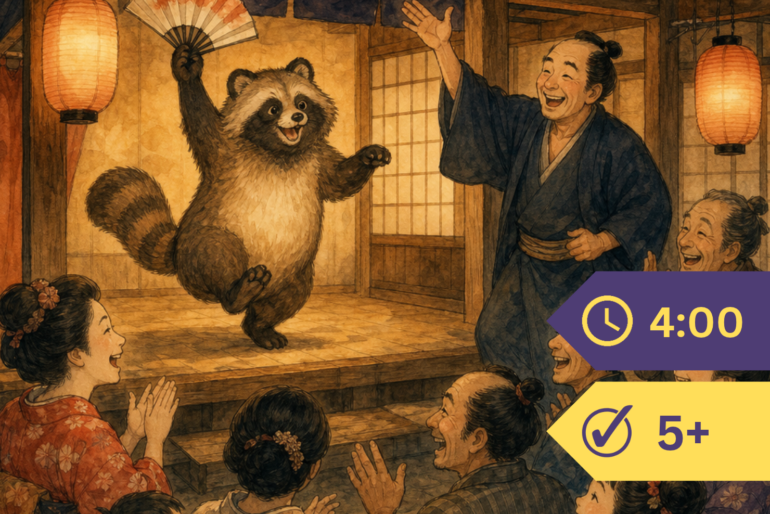
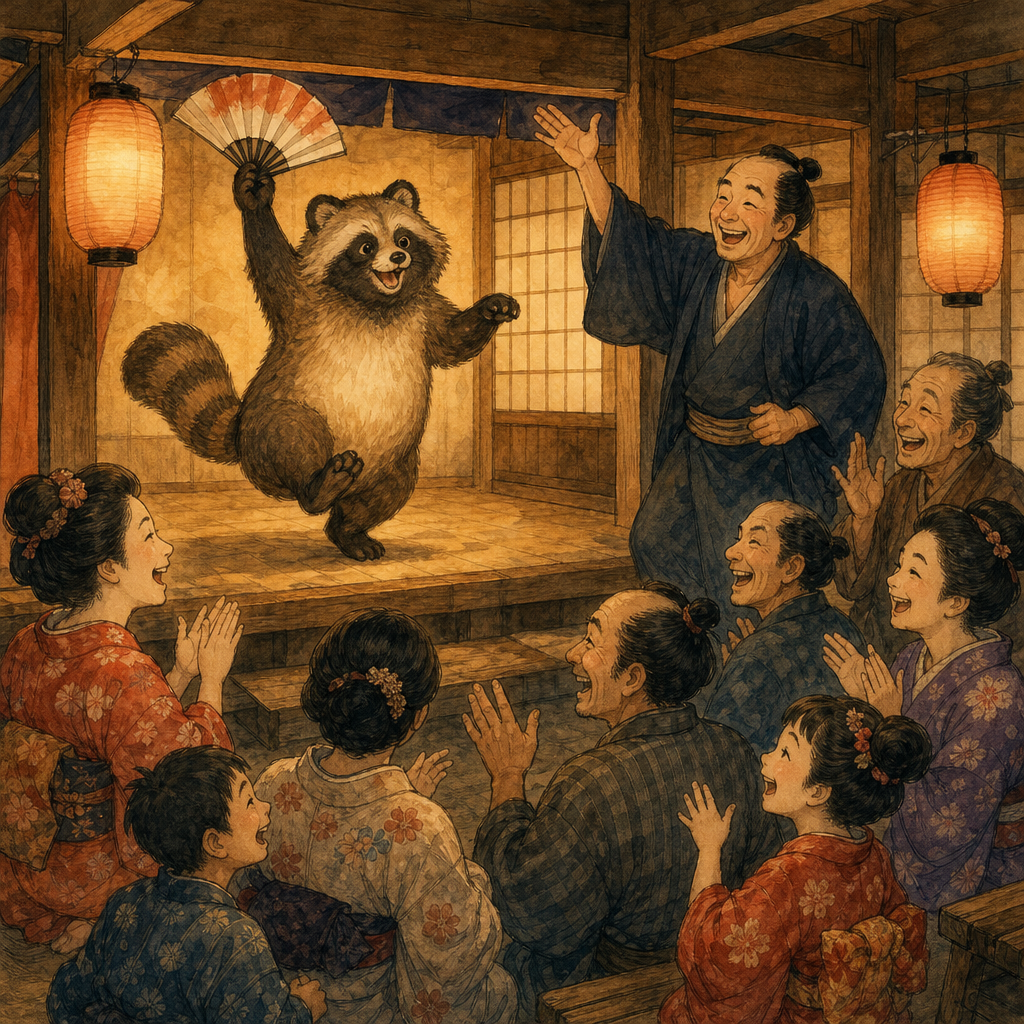
People poured in. The kettle was passed from hand to hand; they turned it over and peered inside. Then Jimmu took it back, set it on the stage, and told it to change. The handle became a head, the spout a tail, and four paws appeared. “Dance!” said Jimmu, and the tanuki danced. He danced the fan dance, then the shadow dance, then the umbrella dance, and soon the whole audience was dancing with him, unable to stand still. He might have danced forever if Jimmu hadn’t called a halt.
Day after day the booth was packed, and Jimmu grew rich. But it bothered him. He was an honest man, and he felt he owed something to the one who’d sold him the kettle. So one morning he put a hundred gold pieces inside it and carried it back.
“I have no right to keep this any longer,” he said, “so I’ve brought it back. Inside you’ll find a hundred gold pieces, the price of its hire.”
The old man thanked him and said few people would have been so honest. The kettle brought good fortune to them both, and they lived to a great old age, respected by everyone.