Once, back when wishes still came true, a king’s son was enchanted by an old witch and forced to sit inside a large iron stove in the middle of a forest. He stayed there for many years, and nobody could free him.
One day a king’s daughter wandered into the forest. She was lost and could not find her way back to her father’s kingdom. For nine days she went round and round, until she came to the iron stove. A voice from inside asked, “Where do you come from, and where are you going?”
“I’ve lost the way to my father’s kingdom,” she said, “and I’ll never get home.”
“I’ll help you get home, and quickly,” said the voice from the stove, “if you promise to do something for me. I am a greater prince than you are a princess, and I will marry you.”
She was frightened. What can a girl do with an iron stove? she thought. But she wanted so badly to go home that she promised.
“Come back with a knife,” said the voice, “and scrape a hole in the iron.”
He gave her a guide who walked beside her without a word and brought her home in two hours. The old King wept for joy and kissed his daughter. But she was troubled. “Father, I’d never have come home out of that wild forest if I hadn’t met an iron stove, and I had to promise to go back and free him and marry him.”
The old King was terrified. She was his only daughter. They talked it over and decided that the miller’s daughter, who was very beautiful, should go in her place. They took her to the forest, gave her a knife, and told her to scrape at the iron stove.
She scraped for twenty-four hours and did not leave a mark. When day broke, the voice inside said, “It seems to be day outside.”
“I think so too,” she said. “I can hear my father’s mill rattling.”
“So you’re the miller’s daughter. Go away at once and send me the King’s daughter.”
She went home and told the old King that the thing in the stove would not have her. The King was frightened, and his daughter wept. But they also had a swineherd’s daughter, even more beautiful than the miller’s, and they paid her a gold piece to go in the Princess’s place. She scraped for twenty-four hours too, and made no mark at all.
When day broke the voice said, “It seems to be daylight outside.”
“I think so too,” she said. “I can hear my father blowing his horn.”
“So you’re the swineherd’s daughter! Go away at once and send me the King’s daughter. Tell her what I say will come to pass: if she does not come, everything in the kingdom will fall into ruin, and not one stone will be left standing on another.”
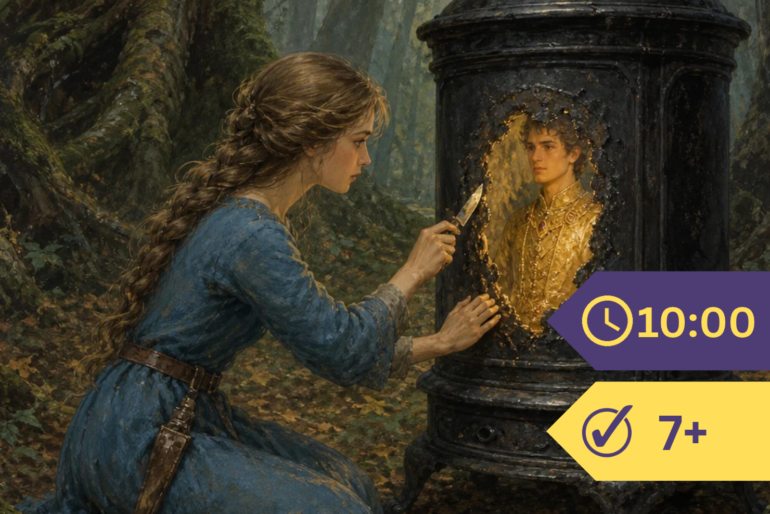
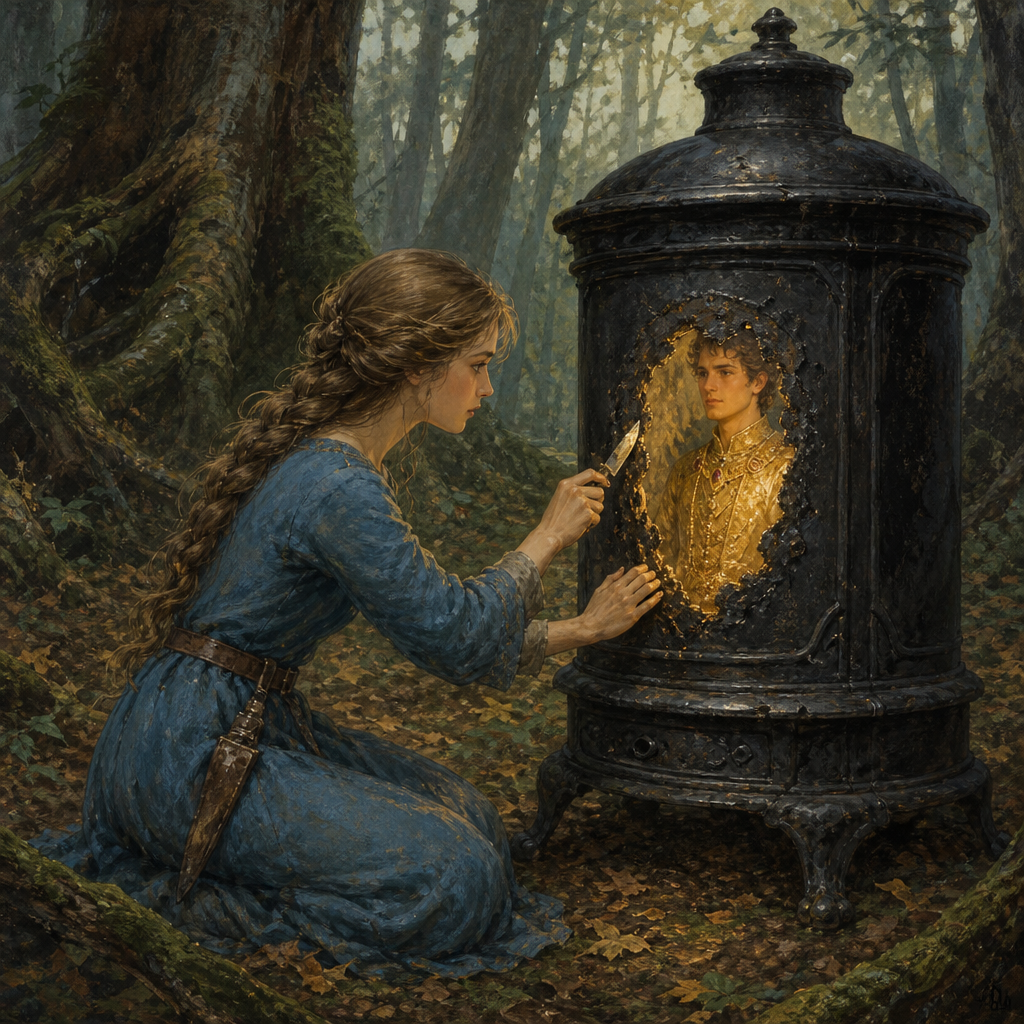
When the Princess heard this she cried. But it was no use. She had given her word. She said goodbye to her father, put a knife in her belt, and went back to the iron stove in the forest. As soon as she began to scrape, the iron gave way. In two hours she had made a little hole. She peeped in and saw a beautiful young man, shining with gold and jewels. She fell in love with him on the spot. She scraped harder, until the hole was big enough for him to climb out.
“You are mine and I am yours!” he said. “You’ve set me free!”
He wanted to take her straight to his kingdom, but she begged him to let her see her father once more. He agreed, but he said, “You may say no more than three words to your father. Then come straight back.”
She went home, but alas! She said more than three words. At once the iron stove vanished, flying away over a mountain of glass and swords. The Prince was free, but gone.
She said goodbye to her father, took a little money, and went back into the great forest to look for the stove. She could not find it. She searched for nine days until her hunger was unbearable. When evening came she climbed a little tree, hoping the night would never fall, for she was afraid of wild animals.
At midnight she saw a faint light far away. If I could only reach that, she thought. She climbed down and followed it. She came to a tiny old house with grass growing all around it and a little heap of firewood in front. Where have I come to? she thought, and peered in through the window. She saw nothing but toads, big and small, and a table laid with roast meat and wine, with dishes and cups of silver.
She took her courage in both hands and knocked. A fat toad called:
Little green toad with leg like a crook, Open wide the door and look Who it was the latch that shook.
A little toad came and let her in. They all welcomed her and sat her down and asked where she had come from and what she wanted. She told them everything: how she had spoken more than three words, how the stove had vanished with the Prince, and how she was determined to wander over mountain and valley until she found him again.
The old toad said:
Little green toad whose leg doth twist, Go to the corner of which you wist, And bring to me the large old chest.
The little toad brought out a big chest. They gave her food and drink and led her to a beautiful bed of silk, where she slept soundly. In the morning the old toad took three things from the chest for her to carry. She would need them: she had to cross a high glass mountain, three cutting swords and a great lake before she found her love again. The toad gave her three large needles, a plough-wheel and three nuts, and told her to take great care of them.
She set out. At the glass mountain, which was impossibly slippery, she stuck the three needles behind her feet and then in front of them, and so climbed over. On the far side she put them away carefully. At the three cutting swords, she climbed onto the plough-wheel and rolled across them. At last she crossed the great lake and reached a beautiful castle.
She went in and asked for work as a servant. She knew that the Prince she had freed was in this castle. She was taken on as a kitchen maid for tiny wages. The Prince was about to marry another princess. He thought she was long dead.
That evening, when her work was done, she felt in her pocket and found the three nuts. She cracked one, meaning to eat the kernel. Inside was a beautiful royal dress! When the bride heard of it, she came and begged for the dress and wanted to buy it. “It is not a dress for a servant,” she said.
The kitchen maid would not sell. “Only if I may sleep outside the Prince’s door tonight.”
The bride agreed, because the dress was so lovely. That evening she said to the Prince, “That silly maid wants to sleep by your door.”
“If you don’t mind, I don’t,” he said. But the bride gave him a glass of wine mixed with a sleeping potion. They went to his room, and he slept so deeply that nothing could wake him. All night the maid wept and said, “I freed you from the iron stove in the wild forest. I searched for you. I crossed a glass mountain, three sharp swords and a great lake to find you, and will you not hear me?” The servants outside heard her crying all night, and told their master in the morning.
The next evening, when her work was done, she cracked the second nut. Inside was an even more beautiful dress. The bride wanted that one too. Again the maid asked only to sleep by the Prince’s door. Again the bride gave him a sleeping draught, and again he heard nothing, though the maid cried the whole night: “I freed you in the forest and from the iron stove. I crossed a glass mountain, three sharp swords and a great lake to find you, and still you will not hear me!” The servants outside told their master once more.
On the third evening she cracked the last nut, and inside was a dress of pure gold, finer than the others. The bride wanted it. The maid asked for the same bargain, a third night by the Prince’s door. But this time the Prince was careful not to drink the sleeping draught. When the maid began to weep and say, “Dearest, I freed you in the wild forest, and from the iron stove,” he sat bolt upright. “You are right!” he said. “You are mine and I am yours!”
Though it was still night, he got into a carriage with her. They took away the false bride’s clothes so she could not follow. When they came to the great lake, they rowed across. At the three swords, they rode over on the plough-wheel. At the glass mountain, they stuck the needles in. At last they reached the tiny old house, and the moment they stepped inside, it turned into a great castle. The toads had all been under a spell. Now they were freed, and they turned into beautiful children of kings, who ran about for joy.
There the Prince and Princess were married, and they stayed in that castle, which was much bigger than her father’s. But since the old King did not like being left alone, they sent for him, and so they had two kingdoms and lived in great wealth.
A mouse has run, My story’s done.