Once upon a time a king in Egypt lost his sight through a bad illness. He was very unhappy, and became more so as the months passed and all the best doctors in the land failed to cure him. The poor man grew so thin from misery that everyone thought he was going to die, and the prince, his only son, thought so too.
So there was great rejoicing across Egypt when a traveller arrived by boat down the Nile. He asked the people why they looked so downcast, then announced that he was physician to the king of a far country and would, if allowed, examine the blind man’s eyes. He was brought at once into the royal presence, and after a few minutes of careful study he said the case, though serious, was not quite hopeless.
“Somewhere in the Great Sea,” he said, “lives a Golden-Headed Fish. If you can catch it and bring it to me, I’ll make an ointment from its blood that will restore your sight. I will wait here a hundred days. If the fish is still uncaught by then, I must go back to my own master.”
The next morning the young prince set out to find the fish, taking with him a hundred men, each with a net. A little fleet of boats was waiting, and they sailed to the middle of the Great Sea. For three months they worked from sunrise to sunset. They caught enormous numbers of fishes, but not one had a golden head.
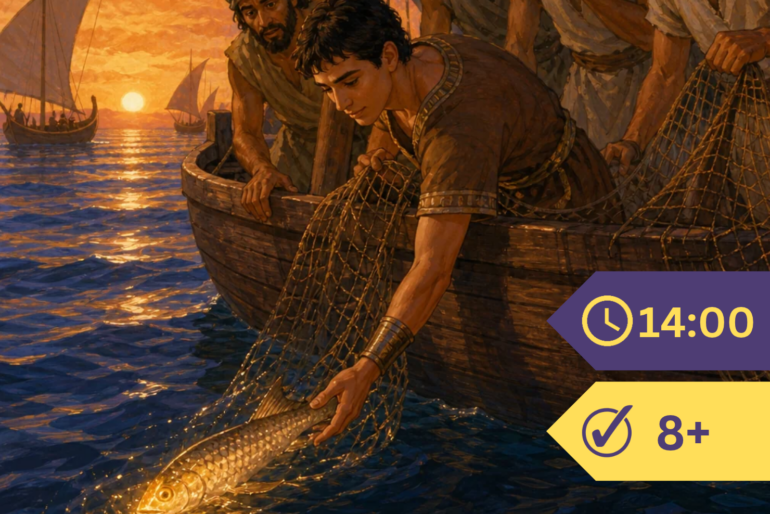
“It’s useless now,” said the prince on the very last night. “Even if we find it this evening, the hundred days will be over in an hour, and long before we could reach the capital, the doctor will be on his way home. Still, I’ll go out once more and cast the net myself.” And he did, and just as the hundred days ended, he drew in the net with the Golden-Headed Fish tangled in its meshes.

“Success has come, but too late, as it often does,” murmured the young man, who had studied in the schools of philosophy. “All the same, put the fish in that vessel of water, and we’ll take it back to show my father that we did what we could.” But when he came close, the fish looked up at him with such pitiful eyes that he couldn’t bring himself to condemn it to death. He knew that, although the doctors of his own country didn’t know the secret of the ointment, they would do everything they could to get something out of the fish’s blood. So he picked up the prize he’d worked so hard for and threw it back into the sea, and began the journey home. When he reached the palace, he found the king in a high fever from disappointment, and the king refused to believe his son’s story.
“Your head shall pay for it! Your head shall pay for it!” the king shouted, and ordered the courtiers to summon the executioner at once.
Of course somebody ran to the queen and told her. She dressed the prince in common clothes, filled his pockets with gold and hurried him on board a ship that was sailing that night for a distant island.
“Your father will be sorry one day, and then he’ll be thankful to know you’re alive,” she said. “But I’ll give you one last piece of advice: never take a servant who wants to be paid every month.”
The prince thought this advice rather odd. If you had to pay the servant anyway, what difference did it make whether it was by the year or by the month? But he had many times proved that his mother was wiser than he, so he promised to obey.
After several weeks at sea he reached the island his mother had named. It was full of hills and woods and flowers, with beautiful white houses in gardens all around.
“What a lovely place to live,” he thought. He wasted no time buying one of the prettiest houses.
Servants came crowding to offer their services, but they all said they must be paid at the end of every month, and the young man, remembering his mother’s words, would have nothing to do with them. At last, one morning, a stranger from the desert came and asked the prince to hire him.
“What wages do you want?” the prince asked, when he had questioned the newcomer and found him suitable.
“I don’t want money,” said the stranger. “At the end of a year, you can see what my services are worth to you and pay me however you like.” The young man was pleased and took him on.
Now, though you wouldn’t have guessed it from the side of the island where the prince had landed, the other half was a complete desert, laid waste by a horrible monster that came up from the sea and devoured all the corn and cattle. The governor had sent soldiers to lie in wait for it, but somehow nobody was ever awake at the moment of the raid. The sleepy soldiers were always severely punished, and it always happened again. At last heralds were sent all over the island offering a great reward to anyone who could kill the monster.
As soon as the servant heard, he went straight to the governor’s palace.
“If my master kills the monster, what reward will you give him?”
“My daughter, and anything else he chooses,” said the governor. But the servant shook his head.
“Give him your daughter and keep your wealth,” he said, “but from now on, let her share in your gains, whatever they are.”
“Agreed,” said the governor, and a deed was drawn up and signed by both.
That night the servant crept down to the shore to watch, but before he went, he rubbed himself all over with an oil that made his skin smart so badly that there was no chance he would fall asleep like the soldiers. Then he hid behind a large rock and waited. After a while a swell seemed to rise on the water, and a few minutes later a hideous monster, part bird, part beast and part serpent, stepped quietly onto the rocks. It crept up toward the fields, but the servant was ready. As it passed, he plunged his dagger into the soft spot behind its ear. The creature staggered, gave a loud cry, and rolled over dead with its feet in the sea.
The servant watched for a while to be certain there was no life left in his enemy, but the huge body lay still. He left his hiding place, cut off the monster’s ears and took them to his master, telling him to show them to the governor and say that he, and no one else, had killed the monster.
“But it was you who killed it, not I,” said the prince.
“Never mind. Do as I say. I have a reason,” said the servant. The young man didn’t like taking credit for something he hadn’t done, but in the end he gave in.
The governor was so delighted that he begged the prince to marry his daughter that very day. But the prince refused, saying all he wanted was a ship to see the world. Of course it was given at once, and when he and his faithful servant boarded, they found the ship heaped with diamonds and precious stones that the grateful governor had secretly put there.
So they sailed and sailed and sailed, and at last they reached the shores of a great kingdom. The prince stayed on board while the servant went into town to find out what sort of place it was. He came back some hours later saying that the king’s daughter was the most beautiful princess in the world and the prince would do well to ask for her hand.
The prince was willing. He took some of the finest necklaces in his hands and rode a splendid horse the servant had bought for him up to the palace, with his faithful attendant close behind.
The strange king happened to be in a good mood and they were admitted at once. The prince laid his gifts on the steps of the throne and begged the king to give him his daughter in marriage.
The king listened in silence and then said after a pause, “Young man, I’ll give you my daughter, if that’s what you want. But first you must know that she has already been married to a hundred and ninety young men, and not one of them lived twelve hours after the wedding. Think, while there’s still time.”
The prince thought, and was so frightened he almost went straight back to his ship. But just as he was about to withdraw his proposal, the servant whispered, “Fear nothing. Take her.”
“My luck must change sometime,” the prince said at last. “And who wouldn’t risk his head for such a peerless princess?”
“As you wish,” said the king. “I’ll give orders for the wedding tonight.”
It was done. After the ceremony the bride and bridegroom went to their own rooms to have supper alone, as was the custom of the country. The moon shone brightly, and the prince walked to the window to look out at the river and the distant hills. His eyes fell on a silk shroud laid on a couch, with his name embroidered across the front in gold thread, which was also the king’s doing.
Horrified, he turned away, and his glance fell on a group of men digging busily under the window. It was a strange hour for anyone to be working, and what was the hole for? It was an odd shape, long and narrow, almost like… Ah, yes, that was it! It was his grave they were digging!
The shock left him speechless, but he stood fascinated, unable to move. At that moment a small black snake darted out of the mouth of the princess, who was sitting at the table, and wriggled quickly toward him. But the servant had been watching for something of the kind, and, seizing the snake with a pair of pincers he held in one hand, he cut off its head with a sharp dagger.
The king could hardly believe his eyes when, early the next morning, his new son-in-law asked to see him.
“What, you?” he cried as the young man came in.
“Yes, I. Why not?” said the bridegroom, who thought it best to pretend to know nothing of what had happened. “You remember I told you my luck would have to change, and so it has. But I came to ask if you’d be so kind as to have the gardeners fill in a big hole just under my window, which spoils the view.”
“Oh, certainly, of course!” stammered the king. “Anything else?”
“No, nothing, thank you.” The prince bowed and withdrew.
From the moment the servant cut off the snake’s head, the spell, or whatever it was, seemed to be lifted from the princess, and she lived very happily with her husband. The days passed quickly, hunting in the forests or sailing on the broad river that flowed past the palace, and at night she would sing to her harp or the prince would tell her tales of his own country.
One evening a man in strange clothes, his face burned dark by the sun, arrived at court. He asked for the bridegroom and fell on his face to announce that he was a messenger from the queen of Egypt, proclaiming him king in place of his father, who had died.
“Her Majesty begs you to set out without delay, and your bride too, because the affairs of the kingdom are somewhat in disorder,” the messenger finished.
The young man hurried to ask for an audience with his father-in-law, who was delighted to learn that his daughter’s husband wasn’t just the governor of a province, as he’d thought, but the king of a powerful country. He ordered a splendid ship to be made ready at once, and a week later he rode down to the harbour to say goodbye to the young couple.
Despite her grief for the dead king, the queen was overjoyed to welcome her son home. She ordered the palace hung with splendid cloth to honour the bride. The people expected great things from their new king, because they had suffered much under the harsh rule of the old one, and every morning crowds came with petitions, hoping he would grant them. He had plenty to keep him busy, but he was very happy, until one night the servant came to him and asked permission to return to his own land.
Dismayed, the young man said, “Leave me? Do you really want to leave me?” Sadly the servant bowed his head.
“No, my master. I could never want to leave you. But I’ve received a summons and I dare not disobey.”
The king was silent, trying to swallow his grief at the thought of losing his faithful servant.
“Well, I mustn’t keep you,” he said at last, his voice unsteady. “That would be a poor way to repay all you’ve done for me. Everything I have is yours. Take what you like, because without you I’d have been dead long ago.”
“And without you, I’d have been dead long ago,” said the servant. “I am the Golden-Headed Fish.”