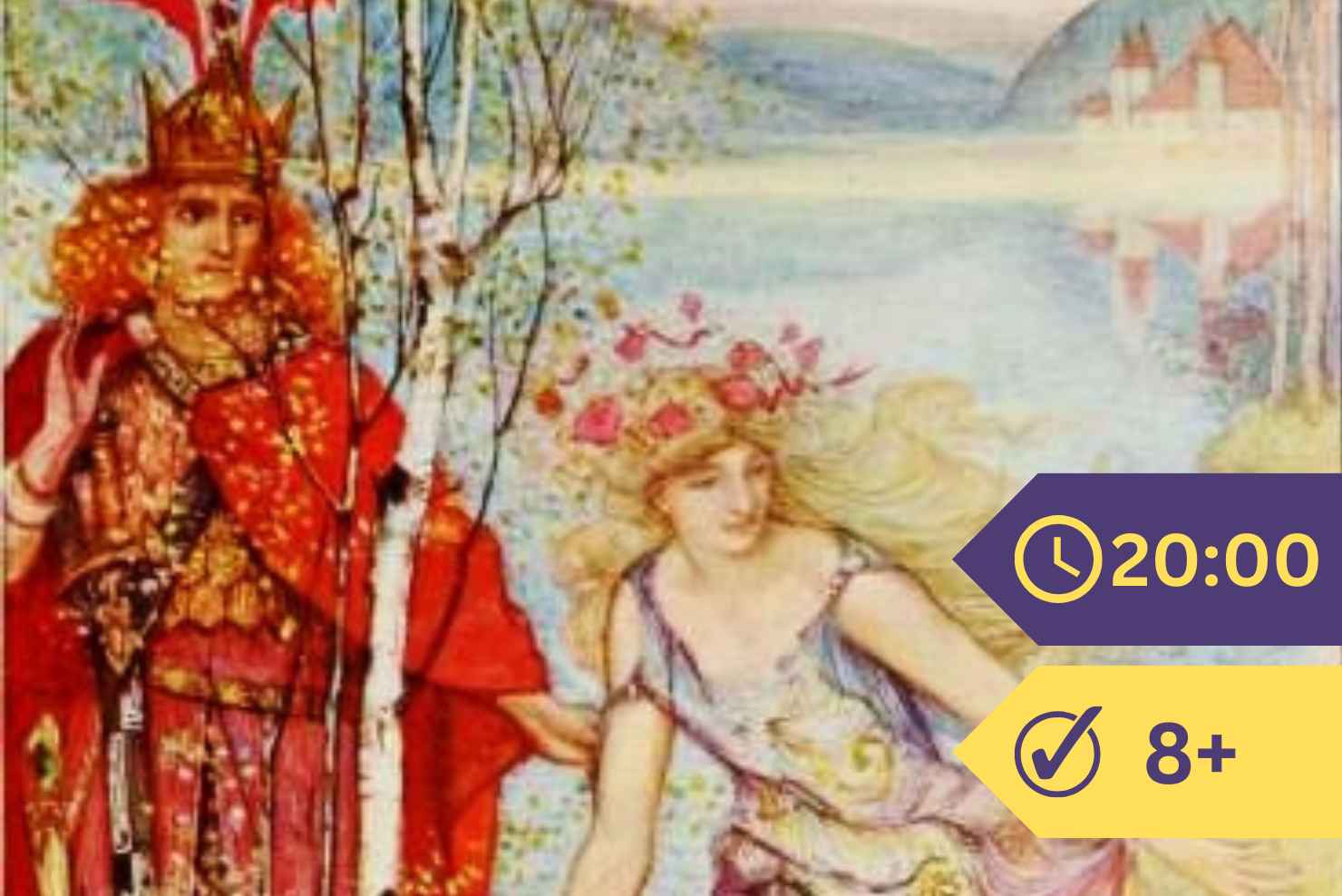
A great king had a wife and a young son he loved dearly. One day he said to the queen, “I feel death near. Promise me you’ll never marry again, and that you’ll devote your life to our son.”
The queen wept and promised. The king died, content. But the queen said to herself, “To promise is one thing, to keep is another,” and before the grave was even filled she had married a noble from abroad, who made himself king instead of the prince. He was cruel; he gave the boy rags and scraps, and would have done worse but for fear of the people.
By the palace ran a brook, but instead of water it flowed with milk, and everyone drew from it. The new king, out of pure spite, forbade it. For a few days no one dared go near. Then the watchmen noticed that every dawn a man with a gold beard came down with a pail, filled it to the brim, and vanished before they could grab him. They told the king.
He watched himself, and saw the same. He ordered a cage built. Watchmen hid behind every bush, but whenever they crept close, the gold-bearded man disappeared. At last an old soldier proposed: leave bread, bacon, and a flask of drugged wine by the brook. It worked. The man ate and drank and fell asleep, and was carried to the palace and locked in a golden cage. The king showed him to every visitor. The gold-bearded man tried to talk, but no one listened, and eventually he fell silent and wept and ate nothing. He was kept alive only because the king feared he’d die and escape his tormentor.
A month later, war called the king away. Before he left he said to his stepson, “I put the prisoner in your care. Make sure he eats and drinks. If he escapes, you’ll pay.”
The boy was glad his stepfather was gone, and he stayed by the cage day and night, even playing his games beside it. One day he was shooting at a target with a silver bow when an arrow fell into the cage.
“Please give me my arrow,” said the prince.
“I’ll give it if you let me out.”
“I can’t. My stepfather will punish me terribly.”
The gold-bearded man handed the arrow through the bars anyway, and then begged so earnestly that the prince’s tender heart gave way. He drew the bolt. “I’ll repay you a thousand times,” said the man, and vanished.
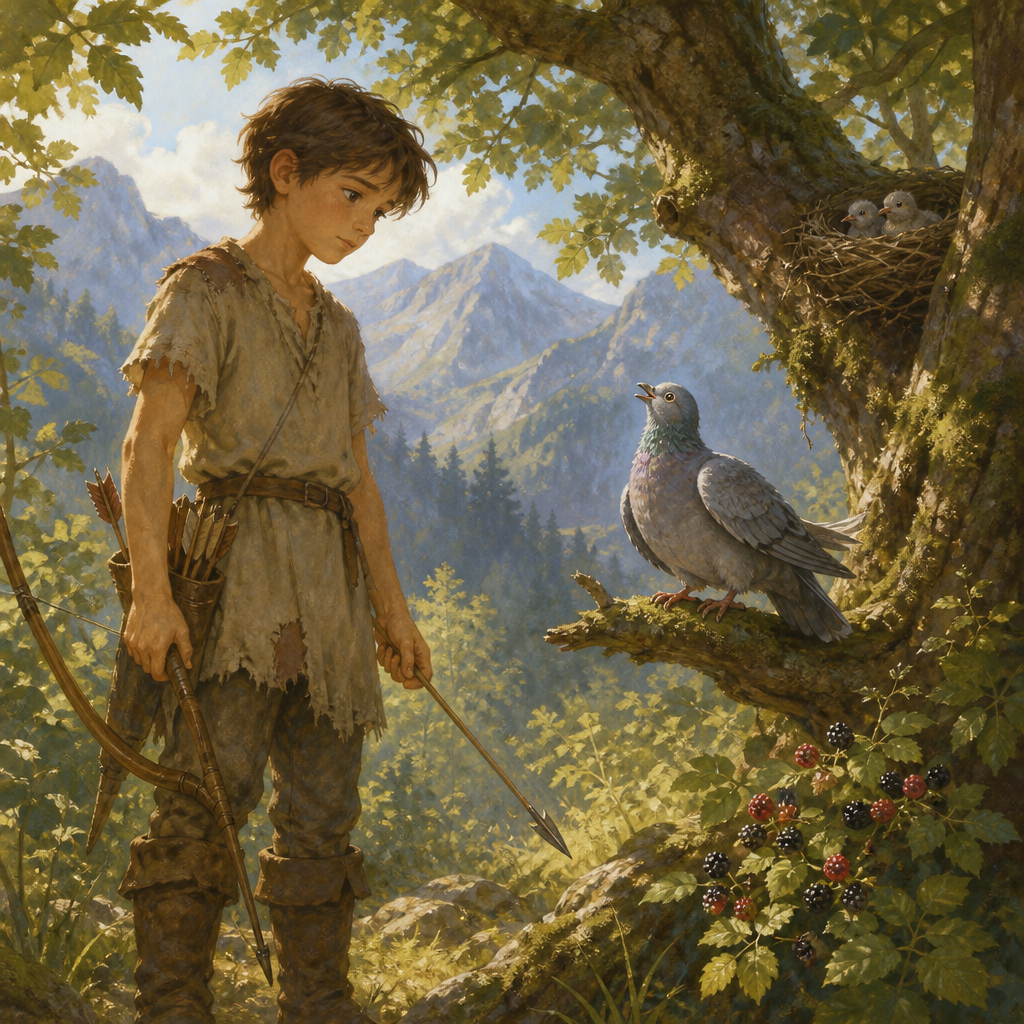
Then the boy panicked. When the king came home, he would be punished for this. So when dusk fell, he slipped out of the palace and walked for days through forests and over mountains, eating berries. One morning he fitted an arrow to his bow to shoot a wood-pigeon. “Please don’t!” the bird cried. “I have two chicks at home who’ll starve.” He put the bow down. “I’ll repay you,” said the pigeon.
“How could you?” said the prince.
“Don’t forget the proverb,” said the pigeon. “‘Mountain and mountain never meet, but one living creature can always come across another.'” The prince laughed and went on.
At a lake he drew his bow on a wild duck; he used to have duck on his birthday. “Please!” cried the duck. “I have two chicks at home.” He spared it. “I’ll repay you,” said the duck, and quoted the same proverb. A little further on a stork stood on one leg; same plea, same mercy, same proverb.
Soon he met two discharged soldiers. “We’re looking for work too. Let’s go together.” They crossed seven kingdoms and came to a palace where the king stood on the steps. “Looking for work? You two can be my coachmen. And you, my boy, I’ll keep near me as a companion.”
The soldiers were furious and plotted. “Your Majesty, that fellow boasts that if he were your steward, he wouldn’t lose a single grain. Set him a test. Mix a sack of wheat and a sack of barley and have him separate them in two hours.”
The king, who was weak, believed them. “If you succeed, you’ll be my steward. If you fail, you will pay.”
The prince swore he’d boasted of nothing, but the king left him alone in a room with the heap of mixed grain. A thousand helpers and a week wouldn’t be enough. He flung himself down in despair. A wood-pigeon flew in the window. “Why do you weep? I’m the king of the wood-pigeons, whose life you spared.” Out she flew and returned with a cloud of pigeons, so thick that the room was dark. In no time the wheat and barley sat in two clean heaps. The king couldn’t find a single wrong grain. “You’re my steward.”
The soldiers tried again. “He boasts he’d never lose so much as a gold pin from your treasury. Throw the princess’s ring in the brook and tell him to find it.”
The king did. The prince hunted along the water’s edge until he sank under a tree and wept. “Don’t be sad,” said a voice. It was the wild duck. “I’m the king of the wild ducks.” A flock of ducks paddled up and down the brook, and long before the king returned from council, the ring lay on the grass. “Keeper of my jewels,” said the king.
The soldiers tried a third time, with the cruelest lie. “He boasts that a child will be born in the palace tonight who speaks every language in the world and plays every instrument.” The king, who had tried magic and failed at it, flew into a rage. “If it doesn’t happen, he’ll pay for it.”
The prince had no magic. He sat in his chamber in despair when something tapped at the window. A stork. “I’m the king of the storks you spared. Don’t worry.” The stork flew off and returned with a baby in swaddling clothes, laid it next to a lute, and the baby began to play so beautifully that the prince forgot his fear. It played a flute, a zither, anything. The prince spoke to it in every language he knew, and it answered him in all of them.
The next morning the king saw it for himself. “If you can summon a child like that, you’re greater than any wizard. You shall marry my daughter.” And since he was a king, he ordered the wedding at once.
After the feast he asked, “By what arts did you do it?”
“I know no arts,” said the prince. “Somehow I’ve always escaped what threatened me.” And he told the king everything: the stepfather, the cage, the pigeon, the duck, the stork, and the soldiers’ envy. The king chased the two soldiers away with whips and warned them never to show their faces in his land again.