“Why did the Fir-tree creak when the daisy said that the Winter was wicked, and could not bear flowers?” asked the linden.
“Because he was angry,” replied the oak. “When he is angry he always creaks. Have you never heard that when the wind comes running through the wood, it cries to the other trees, ‘Bow your heads!’ — but that the Fir-tree says, ‘Stand firm!’ Thus, when the trees of the forest are awed and pay their respects to the wind, the Fir-tree remains quite upright and only turns about creaking, because he is in an ill-humour.”
“But what has that to do with the Winter and the daisy?” said the linden.
“Ask him yourself,” gabbled the poplar. “You will hear what he says — he often gives sharp replies.”
However, the linden was still curious. The Fir-tree stood year after year on the same spot, after all — one does not readily lose a story from the fear of getting a sharp reply. At the same time the linden was prudent, and considered how he might best open the conversation.
“Fir-tree,” said he, “how is it that you always wear the same dress, whether it is winter or summer, warm or cold?”
“Because I am not vain and always seeking for novelties, like you,” answered the Fir-tree.
“He has you there,” said the poplar.
For all that, the Fir-tree was wrong, and the reason he gave was not the true one. The fact was that he could do nothing contrary to his nature. However, human beings are quite as bad and set down whatever lies in their nature as a special virtue. He who has no taste for dress exclaims against the vain; some abuse poetry because they are insensible to its beauties, and these are even worse than the Fir-tree. The linden had a good mind to be offended by the answer and abstain from further conversation, but curiosity prevailed. And this was a very good thing — for in the first place, there is no use in pouting, and in the second, he would never have known the story of Winter, and we should not have known it either. He therefore grumbled a little to himself, and then, turning to his uncivil neighbour, he said:
“At any rate, you can tell us something about Winter, for you know him, and it is said that you like him. We others know nothing about him, for we are asleep when he comes, while you keep awake, and doubtless have a talk with him during the long, long time.”
The Fir-tree kept silent awhile, and all the trees listened, anxious to know what would come of the conversation, though only the willow spoke:
“You have a stout heart, linden-tree; you stick to him.”
At last the Fir-tree replied:
“Leave me alone — and if you want to know anything about Winter, keep awake. Those who desire knowledge should not sleep their time away.”
The conversation would have been brought to an end had not the oak put in a word. The oak stood in very high repute among the trees of the forest, because he was the oldest and strongest, though perhaps he might not have gained respect for the former quality if he had not owned the latter likewise.
“Fir-tree,” said he, “you seem an uncivil fellow. However, you are not so bad, but always keep the rough side outwards. I know you better than the others, for I saw you when you were scarcely a year old, and had only just begun to sprout forth. But why are you so uncouth with your comrades? Did we not all spring from the same soil? Do not our roots embrace below, as our branches embrace above? Do we not all unite in resisting dangers which we could not resist apart? It is not good to stand aloof, especially for such trifles. Because the others adorn themselves with leaves and you with needles, because your bark is perhaps rougher than that of the beech — must you, forsooth, seclude yourself, and assume an unkindly appearance which does not belong to you? No — tell your companions your story. Rejoice with them in good times, just as in bad times you stand by them.”
These were serious words, and the Fir-tree took them to heart, as might have been the case with many others. After reflecting a little while, he proceeded:
“You wish to hear about Winter. So be it then. I know you cannot bear him — but, nevertheless, lay aside all your prejudices against him. Do not fancy that I am partial because he is my friend. I am only just because I know him. But to the facts.
“When the Creator had made the world, and the flowers were springing in the field, and the trees in the forest, he called the Seasons around him and said: ‘Look on my world — how beautiful it is! I give it to you. Share the flowers and trees among you — but love and cherish them.’
“The Seasons were very happy and sported with the children of Nature. This lasted for a short time, but soon a disagreement began to arise. The bold, fickle Spring could not agree with the slow, cautious Winter. The glowing Summer found the Autumn phlegmatic. Autumn reproached Spring with spoiling the flowers — in short, the contest became more and more violent, and the flowers and trees were the chief sufferers. At last Autumn said, ‘This must not go on any longer. We can never agree while we hold things in common — so let us make a division.’
“The hint was taken, and the Seasons divided the earth between them. Winter built a house for himself at each of the poles. Summer moved about the middle of the earth. Spring and Autumn established their domain between them. You will have observed that this division has not been strictly preserved — Winter still resides in his old house and remains there long.
“‘How do you know that?’ asked the linden.
“‘I was told so by my cousin, who once paid him a visit.’
“‘Observe, he is romancing a little,’ whispered the poplar to his neighbour.
“‘How could your cousin visit him?’ asked the linden. ‘Is he not fixed to the ground as we are?’
“It happened thus,” replied the Fir-tree. “‘Some bold adventurous men once came to look for wood so they might build a ship, and my cousin — a tall slender fir — was standing proudly among the other trees of the forest. They had no sooner spied him than they cut him down and made a mast of him. They put him to sea. The mariners hung a huge cloth about my cousin, and said, ‘Hold it fast!’ and on his head they set a coloured streamer which could be seen glistening a long way off. My cousin enjoyed himself during the voyage and did his duty right well — for when the wind came and tried to take the cloth away, he held it fast and would not bend in the least. For this reason the sailors esteemed him more and more, and as they approached the north, they came at last to Winter’s house. Winter came out, quite surprised at the strange visit. It then struck him that wherever he had gone he had seldom received a hearty welcome — so, feeling little disposed to hospitality, he shook his head so as to make the white flakes fly around him. However, when he perceived my cousin, he became civil at once, and they had a pleasant chat. For Winter is always well-disposed towards us Fir-trees. He wished to know how all his brothers were going on. And when the mast told him everything, Winter began to tell stories too — and wonderful stories they were. What you now hear is one of them.
“‘There seemed to be no end to the Winter’s tales, and the old gentleman was so happy in pouring forth the stores of his memory that he would not let the ship go, but kept his arms locked round it. My cousin was delighted beyond expression — but the more he was pleased the worse became the condition of the crew. One morning he heard them consulting together. “Our wood is burned, our stores are consumed,” said the steersman. “And if the ice does not soon melt, we shall all miserably perish. Let us cut down the mast and burn it — it will last us a long while.”
“‘When my cousin heard this, he implored Winter to let the ship go — and Winter complied, to save his favourite, though he would not have done as much for man. He let the ice melt, and the ship returned home happily with her crew.’
“‘That was kind, indeed,’ exclaimed the trees with one voice.
“‘Let me, however, return to my story,’ said the Fir-tree. ‘The earth, as I have said, was divided, and each of the Seasons had a separate domain. Things would, no doubt, have remained in this state had not Spring, with his wonted fickleness, again desired a change. He never could bear to remain in one place. He called the other Seasons together and made the following proposal: “Let us make another division — and as the earth belongs to us all in common, do not let each of us be confined to one portion. Let every one have a fixed period of time during which he alone shall govern the earth.”
“‘Content,’ said Summer, ‘provided I am allowed to retain the girdle.’
“‘And I the pole,’ added Winter.
“‘The thoughtless Spring was perfectly satisfied if he could only attain his end, and Autumn hoped to be compensated in some other way. Thus the bargain was struck.
“‘Spring was just about to commence his reign when cautious Winter said, “But lest one should take to himself all the beauty of the earth, let us divide that too.”
“‘”Good,” said Spring. “I will take the buds.”
“‘”The blossoms belong to me,” said Summer.
“‘”The fruit is mine,” said covetous Autumn. “And the leaves of the trees shall belong to Winter.”
“‘Winter could not object to this arrangement, so the contract was concluded, and Spring began his reign. He kissed the trees and flowers so as to make them put forth buds, and all greeted him with a smile. When the buds burst, a thousand colours were sparkling in leaf and flower. Summer occupied the throne of the earth. But now the arrangement was less strictly observed — for Autumn, who always had an eye to his own advantage, made a separate contract with Summer. Summer was to leave him the flowers in exchange for the fruit. Autumn had the best of this bargain, and when his time came he gathered in the fruit to which he had a perfect right. However, something else occurred by which poor Winter was heavily defrauded.
“‘You will recollect that by the terms of the agreement, Winter was to have the leaves from the trees. Nevertheless, in the glowing season of love — when the leaves hung down together and the flowers coquettishly displayed their thousand bright colours in the grass — something of a flirtation had begun between the same leaves and flowers. As is generally the case, the love-making began with a little teasing. When the sun was about to shine on the flowers with his warm bright rays, the leaves of the trees would interrupt them, and then, before the flowers were aware of it, they would suddenly slip aside so that the little beauties below were dazzled by the sudden blaze of sunlight. Then the flowers would shut their eyes, while the leaves chuckled on the branches above. Again, when a refreshing shower came, the leaves would hoard up the drops, and when the flowers thought it was all over they would let them all fall, so that the flowers were all frightened and shook their little heads. Presently what was at first mere teasing became good service, for the sun grew hotter and hotter, and the poor flowers would all have been scorched if the leaves had not, like so many shields, caught the burning rays. After these serious marks of affection, the old plan of childish teasing would not do, and the leaves sought to be united. But how was the union to be effected when the leaves hung above and the flowers sparkled in the grass below? Love can always find a way. Even flowers and leaves soon found a messenger by whom their sighs and vows could be carried backward and forward — and this was the ivy.
“‘He had sprung from among the flowers below, and now, as a green wreath, wound up the top of the tree. As he kept his leaves close together, forming a ladder of soft vows, he was the most discreet chain of love. Who, on the first glance at the ivy, does not recognise his high mission? With such a messenger the flowers and leaves were perfectly satisfied.
“‘However, Autumn’s reign drew to its close, and he was about to pluck the last flowers of the field. The leaves grew pale and earnestly entreated Autumn to let them descend to their dying mistresses below. He granted their prayer, though in this he exceeded his rights and encroached on those of Winter, to whom the sole governance of the leaves belonged. Autumn shook the trees, and the leaves — now liberated — came fluttering down to the ground.
“‘Now a life of the maddest love began. Autumn, who was greatly pleased, struck up a wild melody, and the leaves flew in a whirling dance round the flowers until these, becoming weak and weary, dropped their heads. When the leaves also, to Autumn’s last noisy tune, laid themselves down for their last repose, Winter came on, and on the fields and woods that received him were bare and lonely. There was nothing green to welcome him except us poor Fir-trees — for the flowers would have nothing to do with our sharp needles. And the ivy moved himself from tree to tree, as if he would conceal the inconstancy of the leaves and give the trees an ornament to compensate for the foliage they had lost.
“‘Winter was touched by the sight. In his rage he struck down the few leaves that, against their will, were still left hanging on the branches, and chased them about over ice and snow. But he said solemnly to the leaves of the ivy: “I will protect you and maintain you in the kindly office you have chosen. Remain as you are, messengers of love, and carry silent greetings from flowers to leaves, from Autumn to Spring, forming a perpetual bridge between the Seasons. Your vocation is to embrace and unite — you are the evergreen memory of fields and forests — you shall hide the severity of Winter.”
“‘Thus said Winter to the ivy, but on us Fir-trees he bestowed his full affection, and prepared for us honours which you other trees do not share.'”
“And what might those be?” asked the other trees, somewhat piqued.
“Winter is the season for good feeling,” continued the Fir-tree, “and he can, therefore, perceive and appreciate that quality in the ivy. This fact is well known to mankind, for at no time do they come together so closely as in Winter. He brings with him the kindly, sacred, and mysterious festival of Christmas — and you see in his train that most friendly of guests, the Christmas-man.
“Men say that the Christmas-man’s love is for parents and friends, but that is not true. When he exerts his magic power, mankind find him irresistible. In the beginning of Winter, the mother is pondering and pondering — but that is only because the Christmas-man keeps whispering into her ear. And whoever goes out to buy anything about Christmas time always comes back with a larger purchase and a shorter purse than he intended. It is not that the pretty things have tempted him, but the Christmas-man — who is ever whispering and persuading, and pulling at the heart, so that the hand opens more and more to improve the Christmas festivity.
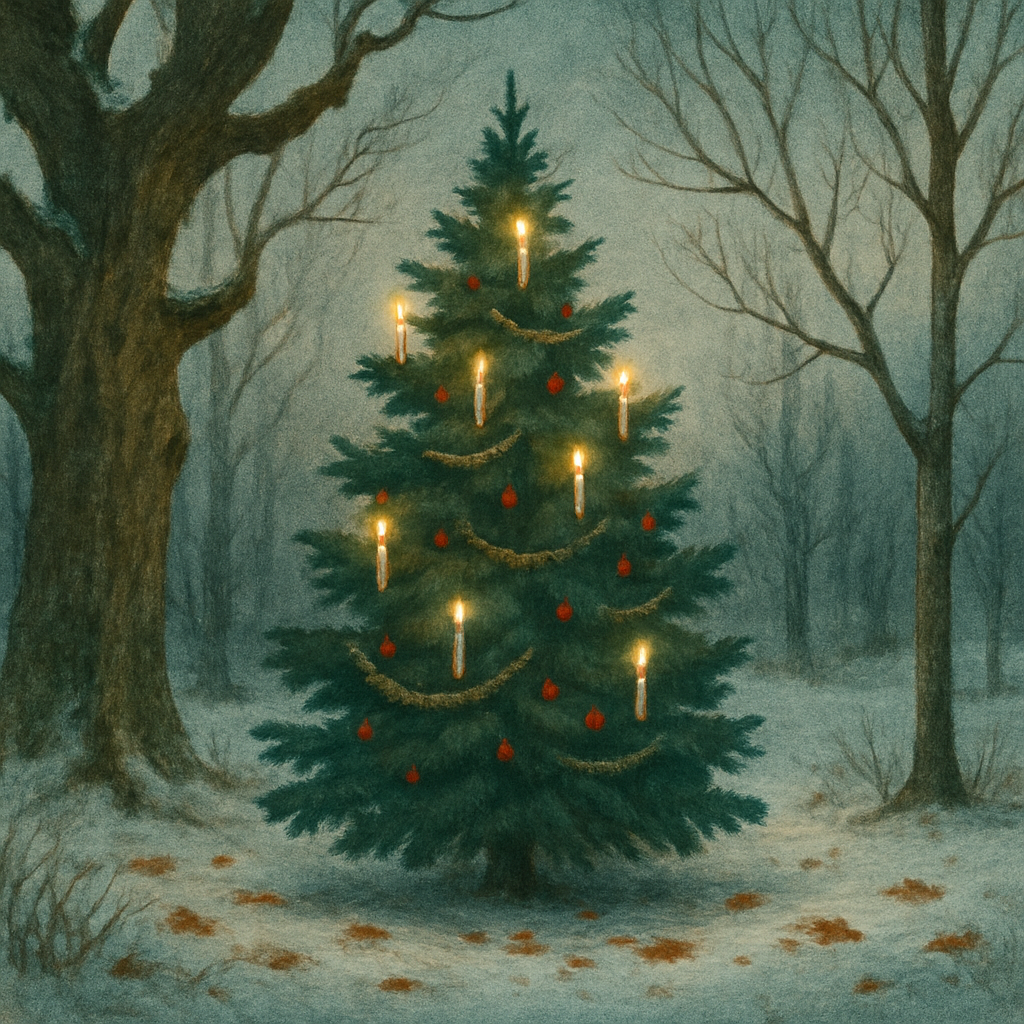
“We Fir-trees know this well, for we are the Christmas-trees, and the good Christmas-man always puts us in the very midst of the rejoicings. Whether they take place in palace or in cottage, we are sure to be there. However poor the parents may be, they always fix a few candles to our green boughs for the sake of the merry children. Gold and silver hang from our summits. We bear glittering fruit, and children clap their hands before us — for however beautiful all the rest may be, the Christmas-tree is, nevertheless, the most beautiful of all, having been endowed by the Christmas-man with his own peculiar magic.
“Perhaps the children are so fond of the Christmas-tree because it is in itself like the mind of a child. All sorts of glittering images are twined about the green boughs of hope, and the tree stands rich and golden, mysterious and inexplicable. But one glittering image falls off after another, the gold proves tinsel, the hopes wither, the riddle is solved with the last spangle that is taken off — and nothing is left but a faded Fir-tree. In the mind of a child one golden dream fades away after another, one riddle is solved after another. And what is life otherwise than as in the mind of a child?”
“But when the spangles have all fallen off, is all your glory over?” asked the aspen-tree.
“Then they put the tree on the hearth,” replied the Fir, “and he hears many a pretty story which the folks tell when they look into the glowing fire. He listens attentively, but when anything drops out that does not please him, he crackles so that the sparks fly out and make the company in the chimney quiet again. Even though the golden apples have all gone, the children give a mournful look from their corner when they see the Christmas-tree burning.”
“So that is the history of Winter and the Fir-tree. Another time I will tell a story which a Christmas-tree overheard in the chimney — for very pretty stories are known by man.”