Centuries before the race of the Nekyes — before the wars of Osiris, Orus, and Typhon, before the wanderings of Isis, before Egypt’s gods were transformed into beetles and serpents and crocodiles and cows — the ancient Spirit-King Tien reigned supreme.
Towards the end of one of his mysterious cycles, on the eve of the birth of Mittoras, he assembled all the great and mighty of the universe around him. Seated on his throne in all the splendour of fairy majesty, he graciously accepted the “happy and many returns of the seasons” from the loyal multitude; then he rose, and addressed his four beautiful daughters, who were seated at his feet.
“My children,” said he, “age has whitened my hair and beard, the cares of government have furrowed my brow, my eyes grow dim, and my head can no longer bear the weight of my four golden crowns. I have resolved to transfer the governance of my four kingdoms to you.”
The four daughters were very different from one another.
Thalatta, the eldest, was invariably dressed in sea-green, interwoven with silver threads, her long flowing tresses crowned with red coral. She loved every kind of motion — the wilder the better, when she was in the mood, though she could just as suddenly become perfectly still and calm, so that people much delighted to join in the dance with her, although they could never entirely depend on her humour. Her greatest enjoyment was dancing; but she was prone to caprice, and would sometimes hurtle about in the wildest excitement and then become utterly tranquil.
Ætheria, the second, was a little whirligig from her very birth, exceedingly inconstant. She carried, according to the saying, smiles and tears in the same bag; for scarcely had she smiled on anyone before her blue loving eyes would cloud, and she would burst into tears. She was equally capricious in her dress — for grand occasions she would be provided with a magnificent blue gown woven of the most delicate material, richly adorned with gems that sparkled brilliantly; yet she would often not wear it at all, and would appear early in the morning array dressed in the most splendid robe, then at midday be wrapped in a homely grey cloak with the hood drawn over her head — and then all of a sudden she would fling aside her veil and grey mantle, and appear in her light blue dress with her face arrayed in smiles.
Fiamma, the third, was still less predictable. Her favourite colour was black — not only was her apparel always black, but her hair and eyes were black as coals. But as coals that revive and glow, so Fiamma’s eyes had the same property, and it was often remarked that they seemed to emit sparks. It was even dangerous to approach too near the train of her robe; for at the slightest motion imparted to it, flames would dart forth, which consumed with fiery tongues whatever came within their reach.
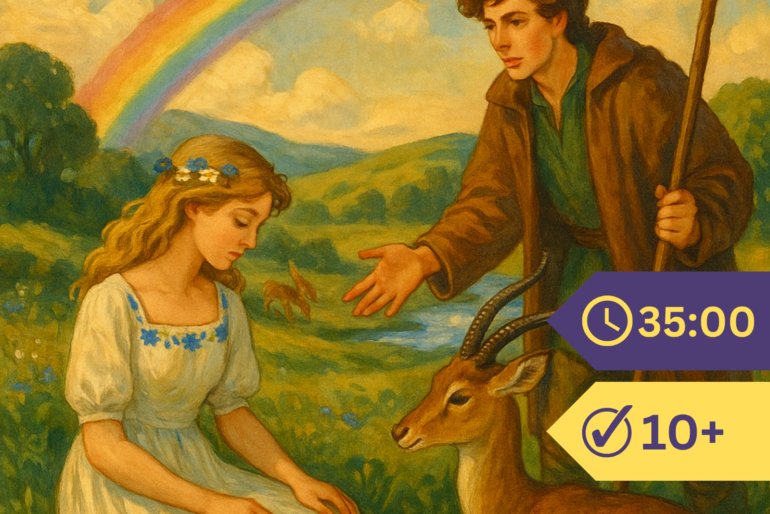
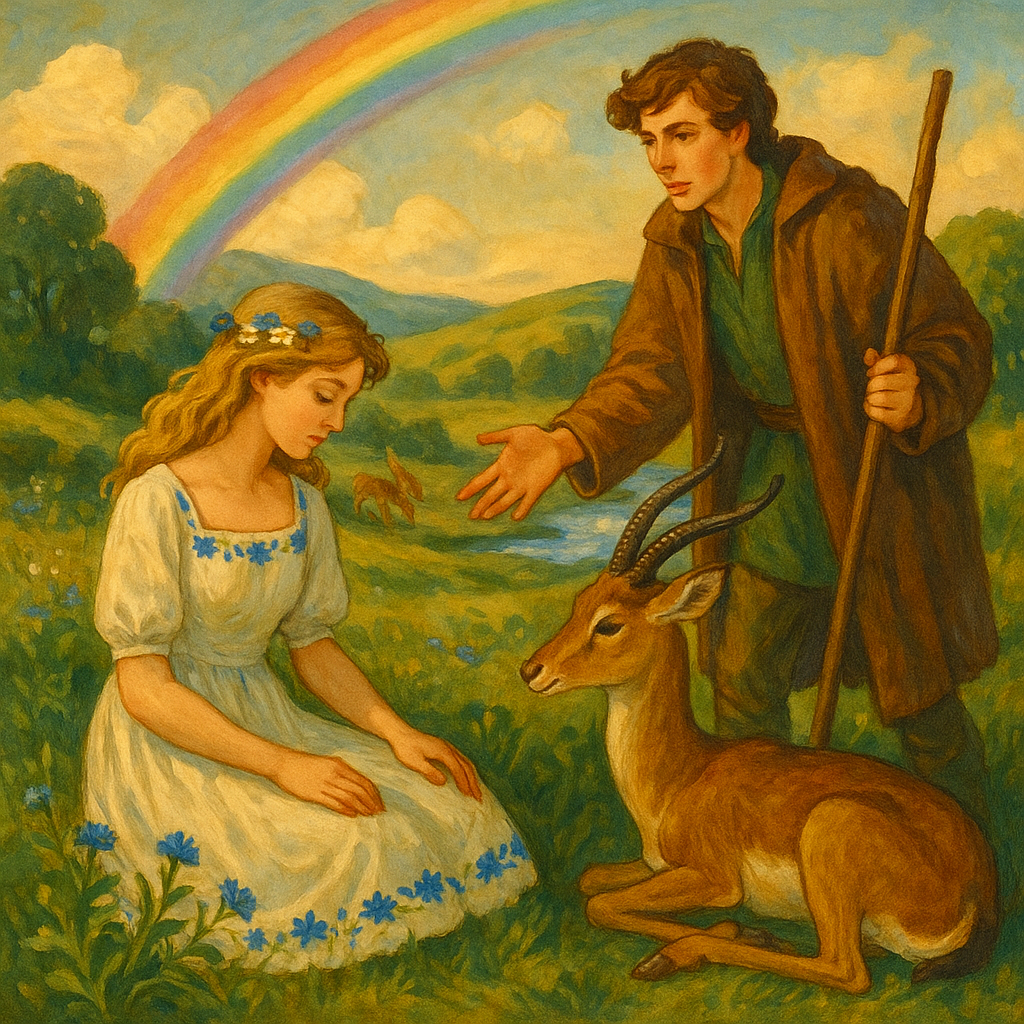
The fourth of the daughters was, on the contrary, a right gentle and modest maiden. Her name was Hertha. To wreathe May flowers in her fair hair, or to trim her little white robe with blue cornflowers, satisfied her ambition. Violets were the flowers she loved best; but these she never plucked, being content to sit beside them with her work.
Such were the four maidens whom the ancient Monarch now summoned to him.
“My daughters,” said he, “your dispositions and habits have not been unobserved by me; and I trust that I may be able to divide my kingdoms amongst you so that each of my beloved children shall be satisfied with her portion. To thee, Ætheria, I commit the empire of the skies, together with the sun, moon, and stars. Henceforth thou shalt dwell alone beneath thy blue pavilion. Be careful in thy dealings with the lightning; and when thou art desirous to take an airing, avoid, as much as possible, making use of the thunder-phaëton, which is somewhat out of repair.”
To Thalatta he confided the dominion of the ocean: “There thou mayst toss to thy heart’s content, and adorn thee at will with pearl and coral.”
“And shall I also have carriages and horses?” inquired Thalatta, with delighted curiosity.
“All, my child,” replied her father. “Thy carriage will be of mother-of-pearl, drawn by eight sea-horses; by thy side dolphins shall disport in the waves, and tritons blow their conches, and thou shalt always be attended by a brilliant escort.”
Who was more delighted than Thalatta? She gracefully gathered up her green garment with her fingertips and made oscillatory movements with her arms and shoulders, as though she were already floating on the waves.
To Fiamma the King confided his subterranean empire, where on a golden altar glows the eternal fire — fire-breathing dragons to draw her golden-wheeled car, and all power over the hidden metals of the earth.
Never before had the dark eyes of Fiamma been seen to flash so joyfully. “My gracious king and sire,” she cried, “you have gratified my most earnest wish. Might it but please you, father, at once to command for me a flash of lightning, whereby I may be transported swift as an arrow to the innermost depth of my fiery empire?”
There followed a certain amount of difficulty about this, as Ætheria had already made off with her father’s bunch of keys and was busily inspecting the arsenal. But Fiamma went in search of her sister, though she was very unwilling to ask the favour.
“But we are quite forgetting our little Hertha,” resumed the father. “Thou also shalt be a Queen.”
Hertha obediently tripped towards the throne, which she ascended step by step, in the manner of a child. Her father stroked her fair smooth locks and said:
“I have only remaining my earthly kingdom, which thou seest lying yonder below. It is so long since I have been there that I cannot very accurately describe to thee what kind of place it is; but thou hast ever been moderate in thy desires, and thou wilt now be satisfied with thy inheritance.”
“Is that my kingdom?” asked the youthful Hertha. “Where I see the gentle lambs and sprightly deer playing by the stream that flows through those flowery meadows? Oh, how delighted I am!”
At that moment a great disturbance was heard in the ante-chamber; the voices of Ætheria and Fiamma were distinctly heard exchanging sharp words. The door was thrown open, and the two sisters were seen struggling over a flash of lightning, of which each grasped one extremity, resolved not to let go.
“The kingdom of fire belongs to me,” cried Fiamma, “and wherever I find flames, they are mine.”
“Were it so,” replied Ætheria, “all the light of my aerial kingdom would not be safe from your clutches — neither sun, moon, nor stars. It is only subterranean, not heavenly, fire that belongs to thee.”
“As long as I do not burn my finger,” cried Fiamma, still more indignantly, “nothing shall withhold me from playing with your stars, and carrying off, if I think proper, a lapful of them.”
So saying, she endeavoured with both hands to break off one of the barbed points from the lightning, which dilated under her fingers and hissing like a serpent scattered burning sparks around. Hertha, in alarm, retired to the furthest corner; but Thalatta, who had already become familiar with the virtues of her element, seized one of the ethereal silver urns and discharged such a flood over the lightning and her two contending sisters that, wrapped in a dense cloud of hissing vapour, they could no longer see out of their eyes. Their father profited by this confusion to restore peace.
“Not an instant longer shall you remain near me,” he said. “For I see before me the rapid destruction of all my four kingdoms if I do not separate you forthwith. My beloved Hertha alone has a gentle nature, and shall be rewarded accordingly.”
“I am now become a poor man,” said the old King to Hertha. “Your ill-conditioned sisters have carried off my keys and my sceptre, and even my eagle has gone to take a flight.”
Hertha looked down with tearful eyes on the lambs as they browsed below; and as the clear drops rolled down her cheeks, and the sun’s rays shone upon them, they formed themselves into a wonderful bright-coloured arch, which extended from her feet down to the green hills below.
“There!” exclaimed her father. “Thou hast constructed for thyself a right beautiful bridge, on which thou canst glide down happily. Take my blessing. My best wishes will always be with thee, even if we should never see each other again.”
At these words Hertha wept still more, which only rendered the rainbow more resplendent. Her especial favourite — a little gazelle — went down on its knees as soon as she appeared, and she soon learned to ride him down the bridge to her kingdom.
Now, at this same period, in the Himalaya Mountains in India, the enchanter Fohi had an only son, whose name was Andrea.
“Andrea,” said Fohi to his son, “thou hast now attained the years of wisdom; wherefore seek thy fortune in foreign parts, and select for thyself a wife. Now it has come to pass that the aged monarch Tien has divided his four empires amongst his four Princesses, his daughters; and I think, verily, that thou wilt not demand in vain the hand of one of these young Queens.”
He gave Andrea a magic mirror: as soon as he pronounced the name of one of the young Sovereigns, her image would appear in it, and he had only to follow that shadow to arrive in her presence. He also gave him a little mantle — useful as a ship on the ocean, wings in the air, and protection through fire and water. But the best gift he could bestow was a saying to engrave indelibly on his memory:
If too high thy hopes aspire, Despised shall be thy low degree; Think not to find by fiercest fire The genial warmth that’s meet for thee. The swelling waves, their boundaries flowing o’er, Lost in the sand, shall fertilize no more, But Earth, content, and looking to her source, A child in seeming, be a god in force.
In addition to all this, his father liberally filled his portmanteau with two plates, two goblets, two dishes, a spoon, a knife and fork — so that he might not be obliged, in obscure inns, to take his meals off inferior table-services. And he gave him, withal, much good advice.
Andrea thanked his father with great tenderness, and they took an affectionate leave.
No sooner had Andrea emerged from the mountains to the open plain than he thought it was high time to consult his magic mirror. He drew it from its case, wiped it very clean with a bandana, so that not the smallest particle of dust remained on it. Remembering his father’s instructions, he breathed a gentle whisper: “Ætheria.”
The mist became a cloud, then the heavens represented in the glass gradually grew clear, and the image of the Queen of the Skies appeared to him — wearing a lustrous crown of stars.
His mantle expanded around him like a balloon, ascending higher and higher after the image, from which he never withdrew his eyes as it floated before him. He had long left the moon far beneath him when he arrived at the gates of the Heavenly Palace, which flew open at his approach. Inside: a temple with twelve columns and seven steps, and beyond that — the fair Ætheria herself, her head reclining on her arms, listlessly hanging by her side, fast asleep on a throne of gold shrouded by an azure veil glittering with actual stars.
The unusual noise awakened her. Andrea courteously begged her forgiveness for having disturbed her, and was about to retire, when Ætheria — who did not appear to be at all startled — beckoned him to approach.
“The Sun-rose of Ispahan informed me this morning of your arrival, and of your intended courtship,” said she. “And if my impatience made the time before you came pass so heavily, do not interpret this as an unfavourable omen.”
“Since my courtship has already been announced to you, fair Ætheria,” said Andrea, with modest dignity, “I am spared the embarrassing task of telling you how happy I should esteem myself to divide with you the cares of government, and share with you the joys of your aerial kingdom.”
“You are vastly obliging,” scornfully replied the haughty Ætheria.
As they were about to seat themselves at table, a service of silver was displayed. Andrea refused to make use of the silver plate — taking from his travelling-case his plate of gold, he flung the silver one out of the window: “As at home I only eat off gold, excuse me if I make use of my own service.”
Ætheria, without appearing the least discomposed, coolly answered, “Pray do as you are accustomed to do.”
When, however, he had placed his two golden plates before him, the Queen opened the window, and — to the no small astonishment of her guest — brought in a few slices of the moon and placed them on the plates. Andrea found them well-flavoured, but when, on rising from the table, he wished to replace his own plates in the case, he found himself entirely unable to lift up the heavy slices, which had besides pressed his plates as flat as a couple of poppy petals. Annoyed at this impertinent jest, he considered it best to be silent, and put up with the loss as well as he could. His hostess also informed him that her chariot was waiting.
“To a pedestrian,” said the Queen, “it cannot but be beneficial to take an agreeable drive; only I must request you not to carry your golden plates — they might prove too heavy for the horses.”
Andrea had scarcely seated himself when the chariot rolled on with a noise like thunder. He made several attempts to make the Queen aware that this drive was altogether unpleasant to him; but she was intent on the splendour and pomp of her empire, and as they drove by the constellations on her right and left, which inclined themselves reverentially before her as she passed, Orion saluted with his flaming sword, the Great Bear reared himself on his hind legs like a poodle, and the Lion crouched down carelessly like a kitten.
“To the Milky Way,” said the Queen, and the horses immediately took a side direction, and the carriage glided gently and softly, without jolting or thunder, along the smoothest way imaginable.
She drew from her finger a gold ring in which was set a planet of considerable value. “Accept this,” she said, “in memory of our excursion.”
Andrea, however, clearly perceived that affixed to the ring was a very fine chain — invisible, but strong — which, had he put the ring on his finger, would have held him forever. Feigning to take all possible pains to draw off a very tight glove, he looked about on all sides for some means of slipping away. At that moment the Queen directed his attention to a passing comet. As it shot by, Andrea boldly grasped it by the tail and was carried out of the chariot as it pursued its course.
“Farewell, beauteous Queen,” he cried. “To catch such birds as I, you must set your snares more cunningly!”
Vainly strove the Queen to urge on her steeds. The wheels turned heavily in the deep ruts of the Milky Way. Andrea, hanging to the fiery tail, soon vanished from her sight.
As soon as Andrea felt certain he was well beyond the power of the ethereal Queen, he spread his mantle, slipped from the comet, and in a few hours’ time found himself again on the spot where he had started that morning. He washed the drowsiness from his eyes in a neighbouring spring, drew forth his mirror, and pronounced the name “Fiamma!”
Lightning seemed at once to flash within the mirror, so dazzling that he only very gradually could accustom his eyes to gaze on the image that appeared therein. He resolutely followed where the form led, and after some days arrived at a mountain from whose summit issued, at intervals, great columns of fire. At its foot lay a dark cavern. He descended unappalled, and at length found himself at the bottom of the steps in a cave more lofty and spacious than he had imagined — where he beheld the Queen of the subterranean empire seated on her throne, wearing on her head a crown of flame.
He bent reverentially before her, delivered a greeting from his father the potent Fohi, and although he did not immediately reveal the especial object of his coming, Fiamma discovered it at once.
Having found the solitude of the subterranean world somewhat tedious, she rejoiced at the thought of an agreeable companion, and requested Andrea to seat himself beside her.
Flaming domestics presented him, in glowing goblets, melted gold — a beverage which the Queen partook of with great relish. Andrea courteously declined. Thereupon music of a very peculiar kind was heard issuing from a side cavern, for the musicians appeared to be neither more nor less than worthy blacksmiths, who struck alternately with their hammers on anvils and bells, calling forth a harmony forcibly reminding Andrea of the thunder from which he had escaped so recently.
Then on a kind of stage — the floor of which was a large metallic mirror — two spirits of flame danced the most graceful minuet, soon interrupted by the appearance of two armed Titans who, in unison with the blows of the hammers, struck their shields with their swords and commenced a fight in good earnest with the two minuet dancers. The flame spirits were cut asunder several times but always rejoined. Metal from the Titans’ armour melted and trickled down in hot drops over their foreheads; their swords, shields, and breastplates flowed to earth like liquefied butter. The Titans — who had at first presented themselves in glittering armour — now appeared burnt out as skeletons, with naked skulls and whitened joints, and retired clattering from the scene.
The flame spirits then danced up to the throne of their sovereign Fiamma, who graciously extended her hand to be kissed. They thought it was requisite to pay their young guest the same respect; and although he declined the compliment in the most courteous manner, they seized his hands, held them fast, and kissed through his gloves so that the fire burned him to the very nails. It was only by waving his mantle that he could at all succeed in keeping off the officious flames.
“It begins to grow cool in the grotto,” said Fiamma; “let us go and see the fireworks.”
The dragon car had been prepared; there was no means of avoiding the entertainment. The tunnel or subterranean passage through which they drove was high and vaulted and illuminated by thousands of gas-flames. It terminated in a spacious hall, where — seated in tiers as in an amphitheatre — was assembled the élite of the subterranean court. The Queen and her guest took the seats of honour; and the bursting of a volcano was the signal for the commencement of the fireworks.
Thunders growled in the abyss, from whence fierce lightnings issued — and Andrea now first perceived that he was in one of those vast chambers, the store-house of the infernal material to which the craters of Amateva, Hecla, and Ætna serve as ventilators.
First of all, a fountain of fire began to play; it rose high in the distance like a crystal column, and in its sparkling crown thousands of golden oranges danced, and were cast forth amongst the spectators. Our friend quickly caught some of them, having been in his boyhood very expert at playing at ball.
Then from the depths of the abyss arose a tree, the stem and branches of which were of gold and whose leaves were the most beautiful precious stones of all colours — emeralds, sapphires, chrysoprase, jacinths. Birds of Paradise sat on the branches, and as they fluttered their wings, the most costly glowing wine streamed up in lofty arches from their beaks. Each of the spectators had come provided with a goblet, and they were so expert at catching the wine-streams that not a drop was wasted. The wine naturally raised the spirits of the company, and when the last entertainment concluded, the game of the air-balloons commenced: two balloons, chained to each other, so that as one went up the other went down — forming a great swing.
“Will you not enter the balloon and try a turn with me?” asked Fiamma.
“I much fear,” replied Andrea, “that I am too heavy, and that you would not be able to raise me again from the depth.”
“Fear it not,” said the Queen. “The reverse is far more likely to occur, for my crown alone outweighs you full ten times!”
This was precisely what Andrea desired. In order to render himself as light as possible, he laid aside his golden apples, retaining only his mirror — whilst the Queen, to ensure what she had said, not only took her crown and sceptre with her, but secretly put a little basket of golden apples into the balloon car. How did Andrea rejoice when he perceived that his balloon immediately ascended! Far up the clear air he floated, and high above he beheld the moon in the azure distance. He at once decided on his plan: spread his mantle, sprang from the car, and escaped happily through the mouth of the crater from the subterranean empire.
The indignant Queen, perceiving the trick that had been played upon her, sent a shower of red-hot stones after the fugitive — but he was already beyond her reach.
To cool himself from this very heating diversion, Andrea bent his course to the sea-shore, where the sea-breezes greatly refreshed and invigorated him.
“I have almost renounced the hope,” he said, as he reposed on a rock washed by the spray of the foaming waves, “of finding a Princess in accordance with my desires.”
The time, however, passed tediously; and after he had arranged his appearance, he fell to polishing his mirror.
“Well,” said he, “there are still two of these fair Princesses remaining, and I will take good care not to invoke either of them. I remember their names perfectly.” Then, as he rubbed the last speck off his mirror: “Yes, perfectly: the one is Thalatta, the other — but what do I behold? Truly, there is the Princess already in the mirror, and she beckons me to follow her!”
He was irresistibly drawn down from the rock into the waters. His silken mantle closed as in a transparent diving-bell, and he found he could see distinctly whatever passed around him. He was very soon followed by a numerous train of lobsters, crabs, and other sportive fish, very desirous to find out what strange guest had come to pay them a visit.
As soon as he reached the submarine plain on which stood the Palace of the Ocean Queen, the warder of the tower blew his horn, and announced that an illustrious Prince with a numerous suite approached. Her Majesty sent four of her porpoises-in-waiting to attend upon him, each of whom wore on his back-fin the golden key of office; they were charged to inquire his commands and to conduct him to her presence.
Arrived within the vaulted crystal grotto — into which no drop of water could penetrate — Andrea stood with astonished gaze before the Queen. Neither the splendour of the aerial throne-chamber nor the wondrous lustre of the subterranean hall had struck him so forcibly as Thalatta’s magic palace. The dome, formed of the purest aqua-marine, was supported by crystal columns, round which were entwined garlands of coral. Between the columns stood ornamental vases formed of shells containing the rarest flowers, which shed around the most delightful fragrance; curiously contrived fountains, whose drops were the finest pearls, played in softened sunlight that penetrated the depths; and in a basin lined with mother-of-pearl, golden fish swam both above and below the surface of the water, singing melodious songs.
“You find me at table,” said the Queen, “and I beg you will do me the favour to join me.”
The attentive porpoises had already taken his hat from him, placed a chair for him, and — whilst on the one side the finest oysters were presented to him — on the other, foaming champagne was poured into an elegantly wreathed drinking-horn. Andrea scarcely believed the evidence of his palate; until, after several repeated experiments, the Queen said to him:
“You are under no mistake; the wine is genuine and good, and was only very lately brought me as a tribute from France. My store-house has abundance of all the treasures of the air, the earth, and the subterranean world. My High Steward understands his duty well; and neither the silver-laden flotillas of America, nor the gold from California, nor the tea and coffee freighted vessels from India and Africa, escape his vigilance. Sometimes he thrusts beneath them a rocky reef, at others he causes them to run ashore on the sand, and whatever goes to the bottom is our prize.”
One of the most unpleasant sensations that Andrea ever remembered was when the Queen presented her arm to him, which — although it was of dazzling whiteness, full and round — felt to him cold and damp, as though he were touching a frog. Never in his life had he so missed his gloves.
When the repast was over, the Queen proposed an airing.
“I should like very much,” said Andrea, “to make a little excursion to the Ganges, as I may, from the mouth of that river, hear perhaps news of my dear father, whose dwelling is situated on its banks.”
“The red mussel-car, today!” said the Queen. “With the bay sea-horses!” A great splashing was heard in the waves. Twelve Tritons blowing their conches rode in advance, and a train of nereids singing in chorus accompanied the chariot.
They had not gone far inland when the sea-dogs in waiting and the dolphin chamberlains began to look somewhat seriously at their fish-tails, ill-calculated for parties of pleasure by land. “We will leave that to our friend,” said Thalatta cheerfully; and a shell boat was immediately prepared for him in order to row up the stream.
The Queen and her suite had, however, thoughtlessly ventured too near the shore, forgetting that the sea breathes twice a day — at that very moment the tide had drawn its deep inspiration which produces the ebb, and the Queen beheld herself and all her suite left upon the sand. In vain did she stimulate the sea-horses with her golden whip; the wheels of the car sank deeper and deeper in the slime. The conches of the advanced guard had become so filled with sand that not a single clear note could be extracted from them.
Andrea found no difficulty in reaching the river by his flat boat and rowed rapidly towards the tall reeds, soon found a convenient spot where he could land. The Sea-Queen in vain made signals to him, moving her green veil and beckoning him to fly to her assistance.
He was lost to her for ever.
When he found himself safely on the river bank, Andrea’s first act was to take out his mirror — and then, with great determination, he threw it backwards over his head into the abyss.
“Three times this treacherous mirror showed me a deceptive image of happiness,” said he. “I will not be a fourth time betrayed by it. I have a pair of good eyes, which are able to show me the right path, and I think I can rely upon my own heart to guide me.”
He cut from a neighbouring tree a stout staff: “Henceforth thou shalt be my guide and companion.”
He wandered for several days by the beautiful banks of the Ganges, where the delicious fruit and milk of the palm-trees supplied him with food, and their broad fan-like branches afforded him shelter. One evening, already feeling very tired, he heard at a distance the tinkling of a little bell, and soon after distinguished a soft, childish voice. He listened, went nearer to the spot, and as he gently put back the bushes with his hand, he saw the most charming child ever beheld by human eyes.
“Come nearer; fear not,” cried the lovely little maiden. “I am bringing you a cup of milk, and a whole lapful of flowers and herbs I have just plucked for you.”
Andrea was beginning to fancy that this friendly invitation was designed for him, when he saw a tame gazelle approach the child. It was the same little gazelle — he was sure of it — that he had seen carrying the child Hertha down from her father’s throne on the rainbow bridge.
The child drew from her little basket some bread, which the gazelle immediately ate from her hand. Then, drawn by the child’s gentleness, the gazelle went down on its knees before her, and she climbed on its back. The child, whose hand he retained in his as he stepped forward to greet her, grew and grew — until she stood before him in the form of a young woman.
“Do you not know me?” she inquired. “I am greatly surprised at that, for I have already long been acquainted with you.”
“Yes, truly,” cried Andrea, with most entire trust, “thou art Hertha, Queen of the empire of Earth, to whom no magic mirror has led my steps, to whom I had no guide but this staff and my own heart.”
“Then you are doubly welcome to me,” said Hertha. “Come with me to my cabin; and although I cannot place a crown and sceptre in your hand, you will yet assuredly find with me calm and quiet enjoyment.”
Touched by so much grace and kindness, Andrea followed the fair Hertha, and rejoiced to think that his father’s saying —
A child in seeming, be a god in force —
was likely to be realized here.
Those were festal days that followed. The governors of the four provinces assembled to swear fealty to the young couple. From the east came Spring, with the winged band of the genii of the flowers. From the south, Summer approached, with his industrious field labourers, who laid garlands formed of ears of corn at the feet of the happy pair. Autumn led up from the west the gay company of the grape-gatherers, who brought not only rich bunches of the sweetest grapes but ornamental pitchers filled to the brim with wine. And from the north came Father Winter with his merry attendants, and gave the young couple the spectacle of a sledge party — when the bells with the shaggy coats of the ice-bears rang, and the cracking of the outriders mounted on reindeer made no trifling noise.
Hertha’s good fortune could not long remain unknown to her other sisters. The babbling springs witnessed the bridal days and gossiped about them to the forest streams, who in their turn related what they had heard to the rivers, who could not avoid rushing on, open-mouthed, with their news, until when they reached the sea the Queen of the Ocean quickly heard whither her fugitive had betaken himself. Ætheria received the news still earlier from some sportive zephyrs who had wandered to earth and were murmuring unobserved amongst the trees.
Ætheria at once commissioned a flash of lightning to inform her sister Fiamma of the marriage of their youngest sister; and requested that she play a few tricks on the young pair who had been so impolite as not to invite their eldest sister either to the bridal eve or the wedding. Thalatta was also persuaded to join in the conspiracy.
We all know well enough how matters go when grand folks begin to tease. Ætheria poured down violent hailstorms and annihilated the fair promise of a rich harvest; in May, she unexpectedly covered the violets and hawthorns — which the spring had enticed forth — with a thick layer of snow, and they were all frozen to death. Fiamma’s tricks were not much gentler: at night, when Andrea and Hertha had retired to repose and were sleeping sweetly, a subterranean clatter was heard, the house rocked, and the earth heaved; sometimes the Queen would shake the very mountains, causing dreadful avalanches that buried fruitful valleys and sent scalding broth through the clefts of the rocks to destroy the most beautiful vineyards. Thalatta willingly lent her aid, and in company with the other sisters sought to torment the faithless Andrea who had left her unassisted on the dry land till the return of the tide — she would beg Ætheria to send her a couple of the most spirited hurricanes, to set the ocean in a fluster and drive the swelling waves over the land, so as to inundate the dwellings scattered on the shore.
All these tricks, vexatious as they were, did not, however, prevent Hertha and her husband — with the aid of industrious assistants — from soon repairing the damage: the reeds were seen growing up again fresh and green; and as soon as the tempests and hailstones had passed away, orange gardens were laid out again on more remote eminences, where the waves of the shores could not reach them. Fiamma might shake the earth as much as she pleased, but she was unable to disturb the happiness of the loving pair.
Even to this very day the hostile sisters cannot forget their ancient grudge.
Hark! do you not hear the whistling of the chill December wind? Do you not see the icy flakes changing the hue of all around? Do you not feel the nipping cold, killing all verdure, and benumbing the weary traveller?
Ah! but Summer must come again. And even now, with its gay festivities — its cheerful blaze — its joyful dance — its holly and its mistletoe, Christmas is here! And as in the times of Tien, on the eve of the birth of Mittoras, all saluted the Spirit-King with “a hail, and happy return of the season,” so we, on the vigil of the greater Nativity, hail you all with — A merry Christmas and a happy New Year!