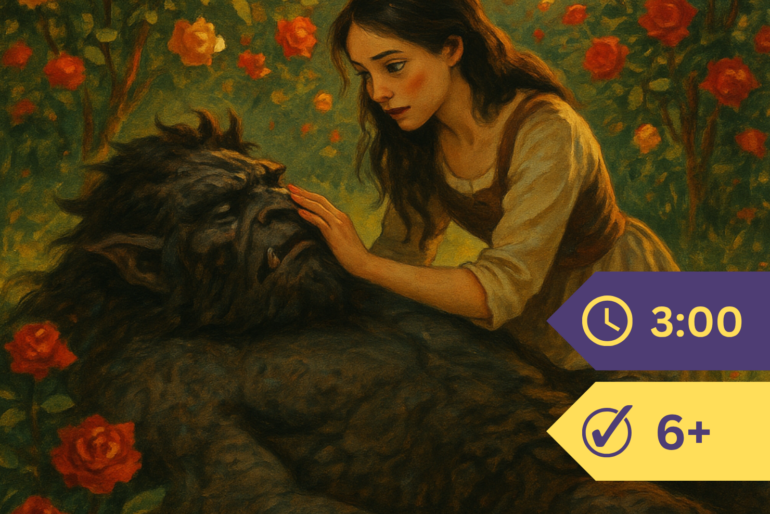
A merchant setting out on his travels asked his daughter what she would like him to bring her. She wanted nothing but a simple rose-tree.
“That’s easily managed,” said the merchant. “But you shall have the finest one I can find.”
In all his travels he found nothing worthy of the promise. One day, walking just outside the walls of his own city, he came upon a garden he’d never noticed before — full and lush, with plants of many years’ growth, though he couldn’t have said when it had appeared. He went in to look for a rose-tree.
In the middle of the garden stood a small house with its door open. Inside was a banquet laid for no visible guest, and a kind voice invited him to sit and help himself. He ate and drank extremely well.
When he was done he went out into the garden. “As the meal was free,” he thought, “I suppose the flowers are too.” He found the finest rose-tree of all: red petals on the outside, pure gold within, and gold-overlaid leaves. He began to pull it up.
Thunder crashed. The air filled with rushing wind and water. A monstrous figure appeared before him.
“You ate my food freely, and now you steal my flowers — which are my very life? You’ll die for this!”
The merchant explained himself as best he could: the hospitality had made him assume the flowers were free too; he’d only taken it for his daughter, who’d asked for nothing else.
“Your daughter?” The monster paused. “I might forgive you — but only if you bring her here to me within three days.”
Three days later the merchant kept his word. The monster received them both warmly and gave them the house to live in. After eight days a voice told the father he must go, and when he hesitated he was quietly shown the gate.
The monster visited the daughter often. He was gentle and kind in every encounter. She began quite to like him.
One day she asked to go home and visit her family. He let her, but begged her to promise on her word to come back in eight days. “If you stay away longer, I’ll die of despair.” He gave her a little mirror to look into, to see how he was.
She went home. The visit stretched on. Eight days passed without her thinking of the mirror. Then one day she came across it by accident and looked in.
The monster lay motionless on the ground, barely breathing.
She ran.
When she reached the garden the monster was just as she’d seen him. At the sight of her he lifted his head. When she knelt beside him he revived by the minute, and before long was well enough to talk.
“You were really this bad just because I stayed away?”
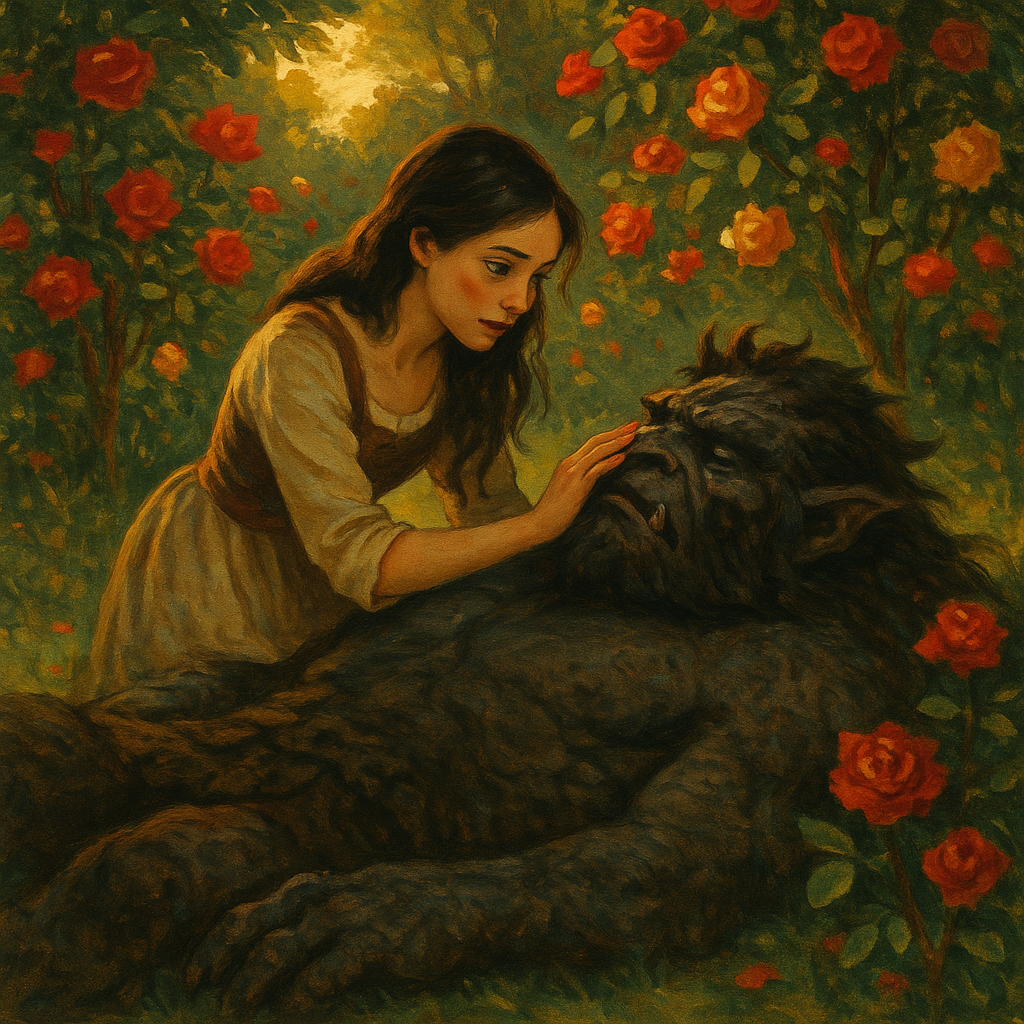
“Not only because you stayed away — it was right for you to see your parents. But I began to think you’d never come back, and if you’d never come back I should have died.”
“And now you’re well again?”
“Yes. Now you’re here I’m quite happy — or would be, if you’d promise never to leave again.”
She looked at him. She saw how much he meant it. And she gave her word.
The moment she spoke, the garden shook. The monster became a handsome prince; the house became a palace; and each rose-tree became a city, spread out across a flourishing kingdom. He had been enchanted by an enemy and could not be freed until a young woman freely chose to love him.