There was once a poor family — a father, a mother, and three daughters — who scraped a living gathering chicory in the fields to sell for salad. One Carnival morning the youngest daughter found a patch where the chicory grew especially fine and tall. She reached for the biggest plant.
It came up by the roots — and with it came all the earth around it, leaving a hole in the ground.
She peered in cautiously. Below was no cave: it was a well-lit room, handsomely furnished, with a meal laid on the table and a broad staircase reaching up to where she stood. All fear left her, and she went down and ate.
When she had finished, invisible hands cleared the table. She explored: several bright apartments, then a long passage with store rooms full of provisions and cloth and household goods of every kind. She was gathering things up to bring home to her mother when she came back to the dining room and found the staircase gone.
She sat down and cried. By suppertime she had composed herself — supper appeared, as mysteriously as dinner had. After that, invisible hands led her to a bedroom, undressed her, and put her to bed. In the morning she was bathed and dressed like a princess.
This went on for months: every luxury without interruption, and not another person in sight. At last the silence wore on her and she could do nothing but weep.
At the sound of her crying a great dark-complexioned king appeared at her door. He was large and unfamiliar-looking, and she was startled. But he spoke gently and asked why she cried when she had everything she could want. She couldn’t quite answer, and he said: “You haven’t seen half this palace yet. Here are the keys to all the rooms you haven’t been in. Go where you like — all of them are yours. Only one room has no key among these. Do not try to enter it.”
The locked rooms occupied her for another three months. Then the silence wore on her again.
This time she knew her answer: “I want to go home. I want to see my family.”
He said he understood. She could go — but she had to promise to come back. “If you stay away too long, I’ll die of waiting.” She promised.
She went home in a fine coach, loaded with gifts. Her family barely knew her. Her sisters were jealous. She gave them money and left quickly.
Three more months, and once more she wept herself into a visit home. Her sisters pressed her about the riches she kept bringing. “What, that pot of gold? That’s nothing. You should see what it’s like down there.” She told them more than she meant to — and they began to plan.
“If you got rid of this king,” they said, “we could all come and live there. He must be some kind of enchanter. Take this stiletto, and when he’s asleep—”
“I couldn’t.”
“You’re selfish. You want to keep it for yourself. Burst open the forbidden door while you’re at it — that’s where the real treasure is.”
They wore her down. She went back resolved.
In the morning she pushed open the forbidden door.
Inside she found a room full of young women weaving shining cloth. “What are you making?” she asked. “Wedding garments for the bride of the Dark King,” they replied.
A little further on: goldsmiths working pearls and diamonds and rubies into ornaments. “For the bride of the Dark King,” they said.
A little further on: a small hunchbacked figure carefully mending a worn and tattered garment, with a heap of old rags beside him. “And what are you making?” “The clothes,” he said, “for the girl who was supposed to be the bride, to go away in.”
She understood then what she’d come to lose. But she went on.
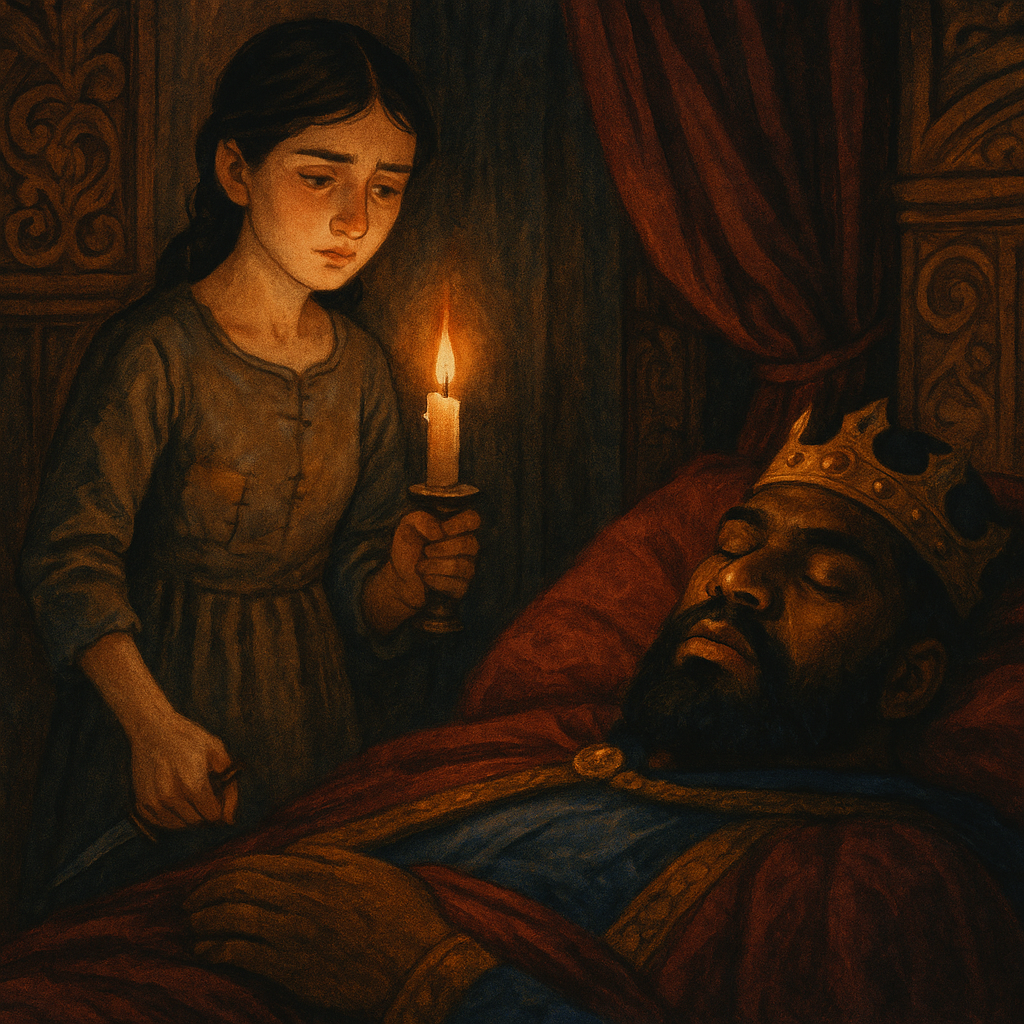
At the end of a passage was a door, and beyond it a room, and in the room the Dark King lay asleep. She took up a taper to see his face. He was dark and unfamiliar-looking, and she thought of what her sisters had said, and she pressed the stiletto into his chest.
As she drove the blade home, her hand trembled and hot wax from the taper fell onto his forehead. He woke.
He looked at the blood on his chest. Then he looked at her.
“Why did you do this?” he said quietly. “I cared for you. I thought you’d come to care for me. But it’s over now. Go back to what you were before.”
He called servants. They dressed her in the rags the hunchback had been mending, took her to the dining room, and opened the ceiling. She found herself standing on the chicory bed in the cold of early morning.
Before they’d led her away she had thought to ask for one thing: men’s clothes, because it was unsafe for a girl to wander the roads alone. They had given her the old patched things.
She walked toward her parents’ cottage. Her parents did not recognise her under the disguise. Her father threatened to drive away this beggar who claimed to be his daughter. She left.
She walked on until she came to a great city and found work in a royal stable. The queen of that palace noticed the fair-faced young groom and brought her to the palace as master of household — a post she filled with grace. She was given fine apartments and fine clothes, and the queen was never easy without her company.
Then the king came home from a long campaign, and the queen decided this was the moment to settle a grievance. She went to her husband with manufactured tears: the master of the palace, she said, had tried to force her to marry him while the king was away.
The king drew his sword. The master of the palace was thrown in prison, and the next morning the scaffold was raised.
There was nothing left to lose. From her pocket the girl drew one of three hairs the Dark King had pressed into her hand as she left: “If you are ever in mortal danger with no one to help — burn these.”
She burned the first hair in the torch flame. A distant sound grew from the horizon: drums, and marching feet. The executioner paused.
She burned the second. A vast army surrounded the palace, pressed up to the scaffold, gathered at the foot of the throne.
She burned the third. The Dark King appeared in the midst of them, armoured and terrible, and said to the king: “Who has condemned my wife to death?”
“Who is your wife?”
He took her hand. “This woman. Touch her who dares.”
The king understood then what the queen had done. He ordered her punished for it, and gave the girl to the Dark King.
Then the Dark King said to her: “I claimed you as my wife to save your life. But whether you become my wife is your choice, not mine. What do you say?”
She looked at him. “You have been nothing but good to me,” she said. “Ungrateful indeed would I be if I said anything but yes.”
The moment she spoke, the earth shook, and she was not standing on a scaffold but before an altar in a great cathedral, surrounded by a flourishing city. Beside her stood the Dark King — but dark no longer, and the enchantment broken at last: a fair maiden had given her free consent to marry him, and so he was free.