I
“Whirr-r-r! Whirr-r-r! Whirr-r-r!” said the wind, and it tore through the streets of the city that Christmas Eve, turning umbrellas inside out, driving the snow in fitful gusts before it, creaking the rusty signs and shutters, and playing every kind of rude prank it could think of.
“How cold your breath is tonight!” said Barbara, with a shiver, as she drew her tattered little shawl more closely around her numbed body.
“Whirr-r-r! Whirr-r-r!” answered the wind. “But why are you out in this storm? You should be at home by the warm fire.”
“I have no home,” said Barbara. She sighed bitterly, and something like a tiny pearl came to the corner of one of her sad blue eyes.
But the wind did not hear her answer, for it had hurried up the street to throw a handful of snow in the face of an old man who was struggling along with a huge basket of good things on each arm.
“Why are you not at the cathedral?” asked a snowflake, as it settled on Barbara’s shoulder. “I heard grand music and saw beautiful lights there as I floated down from the sky a moment ago.”
“What are they doing at the cathedral?” asked Barbara.
“Why, haven’t you heard?” exclaimed the snowflake. “I supposed everybody knew that the prince was coming tomorrow.”
“Surely enough — this is Christmas Eve,” said Barbara, “and the prince will come tomorrow.”
She remembered that her mother had told her about the prince, how beautiful and good and kind and gentle he was, and how he loved the little children. But her mother was dead now, and there was none to tell Barbara of the prince and his coming — none but the little snowflake.
“I should like to see the prince,” said Barbara, “for I have heard he was very beautiful and good.”
“That he is,” said the snowflake. “I have never seen him myself, but I heard the pines and the firs singing about him as I floated over the forest tonight.”
“Whirr-r-r! Whirr-r-r!” cried the wind, returning boisterously. “I’ve been looking for you everywhere, little snowflake! Come with me.”
And without any further ado, the wind seized the snowflake and hurried it along the street, leading it a merry dance through the icy air of the winter night.
Barbara trudged on through the snow and looked in at the bright things in the shop windows. The glitter of the lights and the sparkle of the vast array of Christmas toys quite dazzled her. A strange mingling of admiration, regret, and longing filled the poor little creature’s heart.
Much as I may yearn to have them, it cannot be, she said to herself, yet I may feast my eyes upon them.
“Go away from here!” said a harsh voice. “How can the rich people see my fine things if you stand before the window? Be off with you, miserable child!”
It was the shopkeeper, and he gave Barbara a sharp cuff on the ear that sent her reeling into the deeper snowdrifts of the gutter.
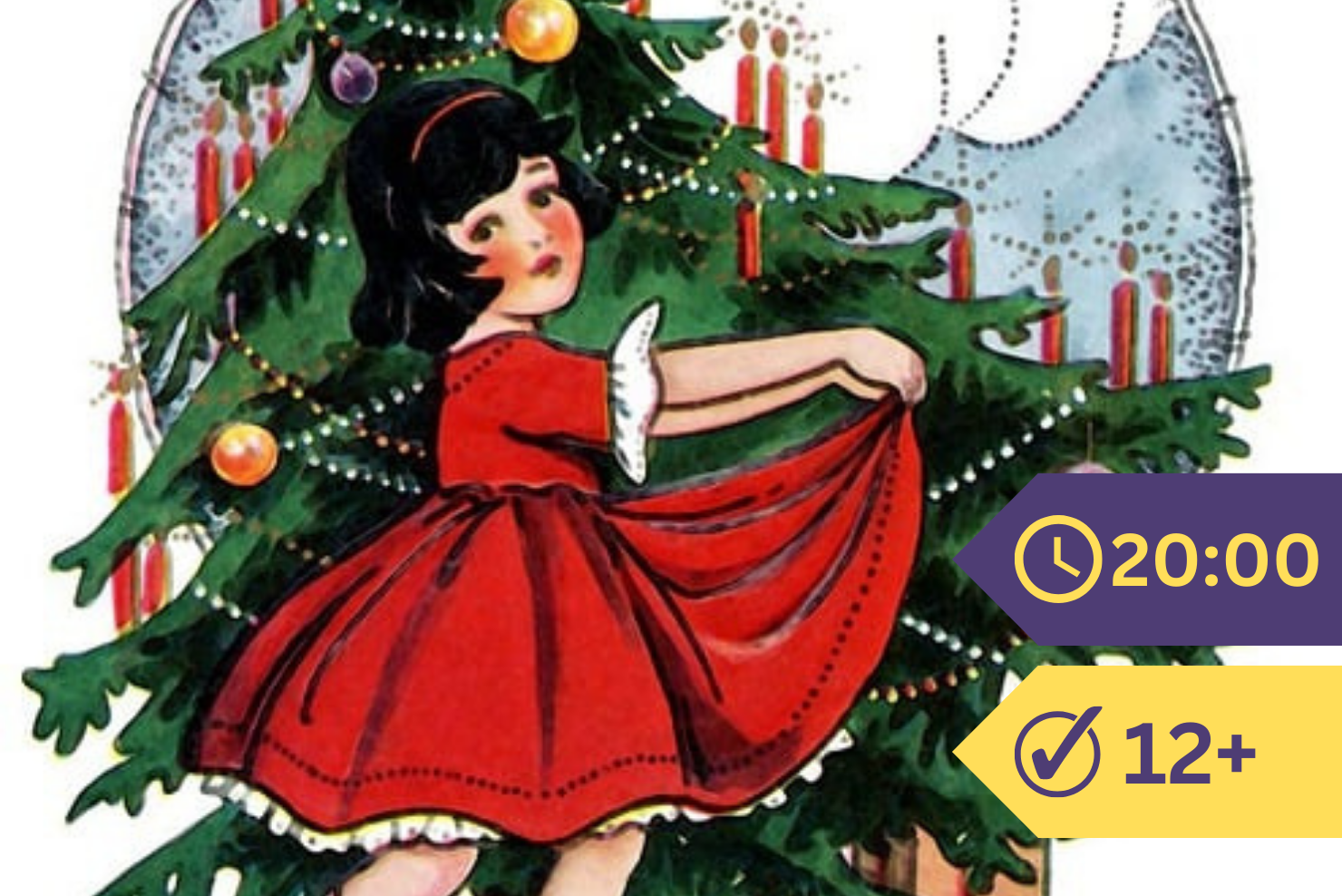
Presently she came to a large house where there seemed to be much mirth and festivity. The shutters were thrown open, and through the windows Barbara could see a beautiful Christmas tree in the centre of a spacious room — a beautiful Christmas tree ablaze with red and green lights, and heavy with toys and stars and glass balls and all the other things that children love. There was a merry throng around the tree, the children smiling and gleeful, and all in that house seemed content and happy. Barbara heard them singing, and their song was about the prince who was to come on the morrow.
This must be the house where the prince will stop, thought Barbara. How I would like to see his face and hear his voice — yet what would he care for me?
So Barbara crept on through the storm, shivering and downcast, yet thinking of the prince.
“Where are you going?” she asked of the wind as it overtook her.
“To the cathedral,” laughed the wind. “The great people are flocking there, and I will have a merry time among them, ha, ha, ha!”
And with laughter the wind whirled away and chased the snow toward the cathedral.
It is there, then, that the prince will come, thought Barbara. It is a beautiful place, and the people will pay him homage there. Perhaps I shall see him if I go.
So she went to the cathedral. Many folk were there in their richest apparel, and the organ rolled out its grand music, and the people sang wondrous songs, and the priests offered eloquent prayers — and the music and the songs and the prayers were all about the prince and his expected coming. The throng that swept in and out of the great edifice spoke always of the prince, the prince, the prince, until Barbara really loved him very much, for all the gentle words she heard the people say of him.
“Please, may I go and sit inside?” Barbara asked the sexton.
“No!” said the sexton gruffly, for this was an important occasion, and he had no idea of wasting words on a beggar child.
“But I will be very good and quiet,” pleaded Barbara. “Please — may I not see the prince?”
“I have said no and I mean it,” retorted the sexton. “What have you for the prince, or what cares the prince for you? Out with you, and stop blocking the doorway!”
So the sexton gave Barbara an angry push, and the child fell halfway down the icy steps of the cathedral. She began to cry. Some of the fine people entering at that moment laughed to see her fall.
“Have you seen the prince?” asked a snowflake, settling on Barbara’s cheek. It was the same little snowflake that had rested on her shawl an hour before, when the wind came galloping along in its boisterous search.
“Ah, no,” sighed Barbara through her tears. “But what cares the prince for me?”
“Do not speak so bitterly,” said the little snowflake. “Go to the forest, and you shall see him — for the prince always comes through the forest to the city.”
Despite the cold, and her bruises, and her tears, Barbara smiled. In the forest she could behold the prince coming on his way. And he would not see her, for she would hide among the trees and vines.
“Whirr-r-r, whirr-r-r!” It was the mischievous wind once more. It fluttered Barbara’s tattered shawl, set her hair streaming in every direction, and swept the snowflake from her cheek and sent it spinning through the air.
Barbara trudged toward the forest. When she came to the city gate the watchman stopped her, holding his big lantern up to her face, and asked who she was and where she was going.
“I am Barbara, and I am going into the forest,” she said boldly.
“Into the forest?” cried the watchman. “In this storm? No, child — you will perish!”
“But I am going to see the prince,” said Barbara. “They will not let me watch for him in the church, nor in any of their pleasant homes, so I am going into the forest.”
The watchman smiled sadly. He was a kindly man; he thought of his own little girl at home.
“You must not go to the forest,” he said gently. “You would not survive the cold.”
But Barbara would not stay. She slipped from his grasp and ran as fast as ever she could through the city gate.
“Come back! Come back!” cried the watchman. “You will perish in the forest!”
But Barbara would not heed his cry. The falling snow did not stop her, nor did the cutting blast. She thought only of the prince, and she ran straightway into the forest.
II
“What do you see up there, O pine tree?” asked a little vine in the forest. “You lift your head among the clouds tonight, and you tremble strangely, as if you saw wondrous sights.”
“I see only the distant hilltops and the dark clouds,” answered the pine tree. “And the wind sings of the snow-king tonight; to all my questions he answers only, ‘Snow, snow, snow,’ until I am weary of his refrain.”
“But the prince will surely come tomorrow?” inquired the tiny snowdrop that nestled close to the vine.
“Oh, yes,” said the vine. “I heard the country folk talking about it as they went through the forest today. They said the prince would surely come on the morrow.”
“What are you little ones down there talking about?” asked the pine tree.
“We are talking about the prince,” said the vine.
“Yes, he is to come on the morrow,” said the pine tree, “but not until the day dawns, and it is still all dark in the east.”
“Yes,” said the fir tree, “the east is black, and only the wind and the snow issue from it.”
“Keep your head out of my way!” cried the pine tree to the fir. “With your constant bobbing about I can hardly see at all.”
“Take that for your bad manners,” retorted the fir, slapping the pine tree smartly with one of her longest branches.
The pine tree would put up with no such treatment, so he hurled his largest cone at the fir, and for a moment or two it looked as if there were going to be a serious commotion in the forest.
“Hush!” cried the vine in a startled tone. “There is someone coming through the forest.”
The pine tree and the fir stopped quarrelling. The snowdrop nestled closer to the vine, and the vine hugged the pine tree very tightly. All were greatly alarmed.
“Nonsense!” said the pine tree, in a tone of assumed bravery. “No one would venture into the forest at such an hour.”
“Indeed! And why not?” cried a child’s voice. “Will you not let me watch with you for the coming of the prince?”
“Will you not chop me down?” inquired the pine tree gruffly.
“Will you not tear me from my tree?” asked the vine.
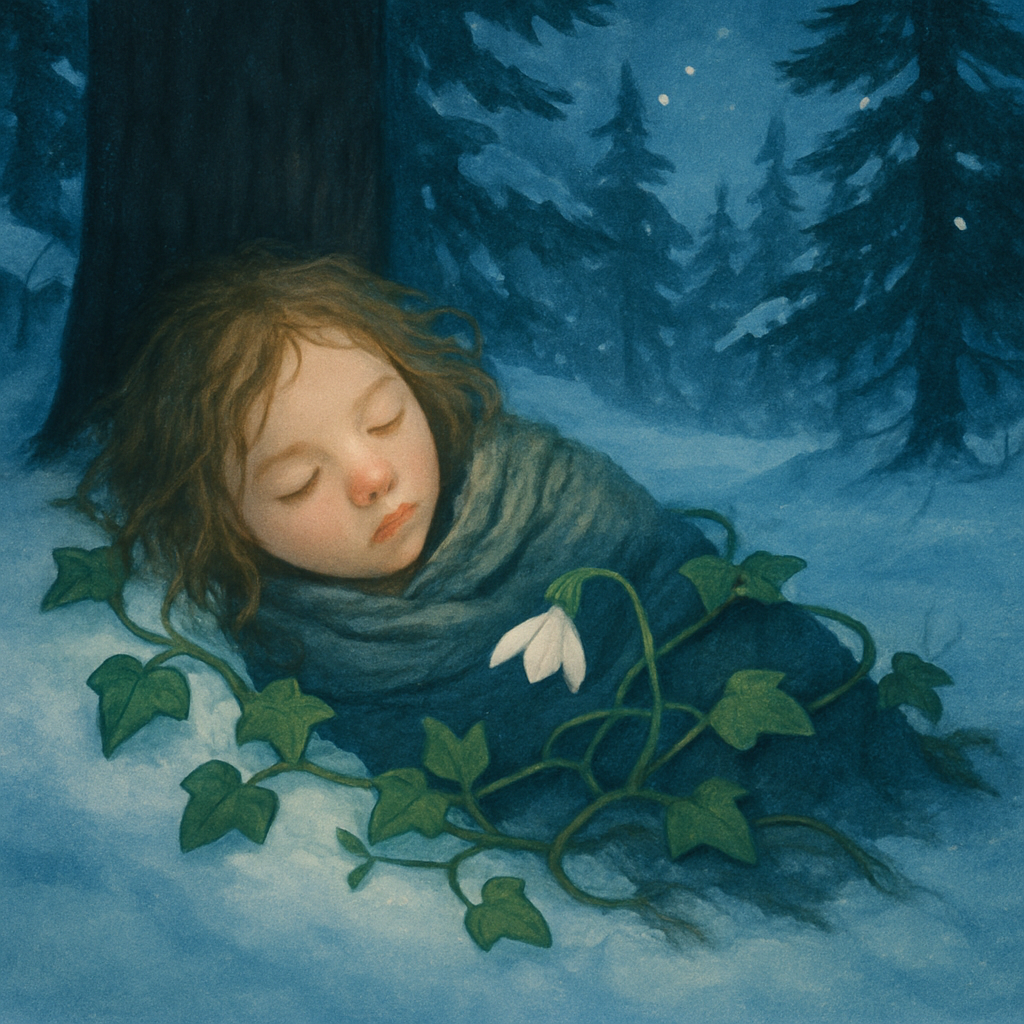
“Will you not pluck my blossoms?” plaintively piped the snowdrop.
“No, of course not,” said Barbara. “I have come only to watch with you for the prince.”
Then Barbara told them who she was, and how cruelly she had been treated in the city, and how she longed to see the prince, who was to come on the morrow. And as she talked, the forest and all who lived there felt a great compassion for her.
“Lie at my feet,” said the pine tree, “and I will protect you.”
“Nestle close to me, and I will warm your temples and your limbs,” said the vine.
“Let me rest upon your cheek, and I will sing you my little songs,” said the snowdrop.
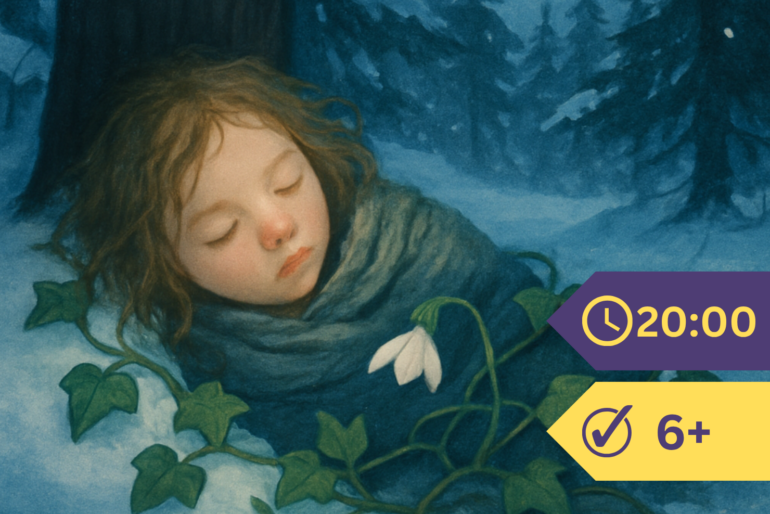
And Barbara felt very grateful for all these gentle kindnesses. She settled in the soft snow at the foot of the pine tree, and the vine wrapped warmly around her, and the little flower sang sweet songs to her.
“Whirr-r-r, whirr-r-r!” There was that noisy wind again, but this time it was gentler than it had been in the city.
“Here you are, my little Barbara,” said the wind, in kindly tones. “I have brought you the little snowflake. I am glad you came away from the city, for the people are proud and haughty there — oh, but I will have my fun with them!”
Then, having dropped the little snowflake on Barbara’s cheek, the wind whisked off to the city again. And we can imagine it played rare pranks with the proud folk on its return; for the wind, as you know, is no respecter of persons.
“Dear Barbara,” said the snowflake, “I will watch with you for the coming of the prince.”
And Barbara was glad, for she loved the little snowflake that was so pure and innocent and gentle.
“Tell us, O pine tree,” cried the vine, “what do you see in the east? Has the prince yet entered the forest?”
“The east is full of black clouds,” said the pine tree, “and the winds that hurry to the hilltops sing of snow.”
“But the city is full of brightness,” said the fir. “I can see the lights in the cathedral, and I can hear wondrous music about the prince and his coming.”
“Yes, they are singing of the prince in the cathedral,” said Barbara softly.
“But we shall see him first,” whispered the vine.
“Yes, the prince will come through the forest,” said the little snowdrop happily.
“Fear not, dear Barbara — we shall behold the prince in all his glory,” cried the snowflake.
Then all at once there was a strange commotion in the forest, for it was midnight, and the spirits came from their hiding places to prowl about and disport themselves. Barbara beheld them all in great wonder and trepidation, for she had never before seen the spirits of the forest, though she had often heard of them. It was a marvellous sight.
“Fear nothing,” whispered the vine. “Fear nothing — they dare not touch you.”
The antics of the wood-spirits continued but an hour, for then a cock crowed, and immediately, with a wondrous scurrying, the elves and the gnomes and the other grotesque spirits sought their abiding places in the caves and in the hollow trunks and under the loose bark of the trees. And then it was very quiet once more in the forest.
“It is very cold,” said Barbara. “My hands and feet are like ice.”
Then the pine tree and the fir shook the snow from their broad boughs, and it fell upon Barbara and covered her like a white mantle.
“You will be warm now,” said the vine, and it touched Barbara’s forehead gently. And Barbara smiled.
Then the snowdrop sang a lullaby about the moss that loved the violet. And Barbara said, “I am going to sleep. Will you wake me when the prince comes through the forest?”
And they said they would. So Barbara fell asleep.
III
“The bells in the city are ringing merrily,” said the fir, “and the music in the cathedral is louder and more beautiful than before. Can it be that the prince has already come into the city?”
“No,” cried the pine tree, “look to the east and see the Christmas day a-dawning! The prince is coming, and his pathway is through the forest!”
The storm had ceased. Snow lay upon all the earth. The hills, the forest, the city, and the meadows were white with the robe the storm-king had thrown over them. Content with his wondrous work, the storm-king himself had fled to his far northern home before the dawn of Christmas day. Everything was bright and sparkling and beautiful. And most beautiful was the great hymn of praise the forest sang that Christmas morning — the pine trees and the firs and the vines and the snow-flowers, all singing of the prince and his promised coming.
“Wake up, little one,” cried the vine, “for the prince is coming!”
But Barbara slept. She did not hear the vine’s soft calling, nor the great music of the forest.
A little snow-bird flew down from the fir tree’s bough and perched upon the vine, and carolled in Barbara’s ear of the Christmas morning and of the coming of the prince. But Barbara slept. She did not hear the carol of the bird.
“Alas,” sighed the vine, “Barbara will not awaken, and the prince is coming.”
Then the vine and the snowdrop wept, and the pine tree and the fir were very sad.
The prince came through the forest, clad in royal raiment and wearing a golden crown. Angels came with him, and the forest sang a great hymn — such a hymn as had never before been heard on earth. The prince came to the sleeping child and smiled upon her and called her by name.
“Barbara, my little one,” said the prince. “Awaken, and come with me.”
Then Barbara opened her eyes and beheld the prince. And it seemed as if a new life had come to her, for there was warmth in her body and a flush upon her cheeks and a light in her eyes that were divine. She was clothed no longer in rags, but in white flowing raiment, and upon her soft brown hair there was a crown like those which angels wear. And as Barbara arose and went to the prince, the little snowflake fell from her cheek upon her bosom, and became a pearl more precious than all other jewels upon earth.
And the prince took Barbara in his arms and blessed her, and turned and carried the little child with him back to his home, while the forest and the sky and the angels sang a wondrous song.
The city waited for the prince, but he did not come. None knew of the glory of the forest that Christmas morning, nor of the new life that came to little Barbara.