Long ago, when animals could talk, a community of cats lived in an abandoned house outside town. They had everything: good food, soft beds, and a house of their own. When a mouse was foolish enough to cross their path, they caught it for the pleasure of the chase, never to eat it. The townspeople said the cats had rid their grandparents of the rats and mice that once ate every grain in the fields, and perhaps that was why they were left in peace.
The cats could afford a servant, since they couldn’t cook or clean for themselves and wouldn’t eat raw meat. But most servants didn’t last long, and the saying in town was, when a woman was down to her last penny: “Well, I’ll go and live with the cats.”
Lizina wasn’t happy at home. Her mother liked Lizina’s older sister, Peppina, best, and Lizina often went hungry while Peppina feasted. One day she’d had enough.
“You’d all be glad to be rid of me,” she said. “So I’m going to live with the cats!”
“Go, then!” said her mother, and Lizina ran until she reached the cats’ door. The old cook had left that very morning, and Lizina was welcomed warmly.
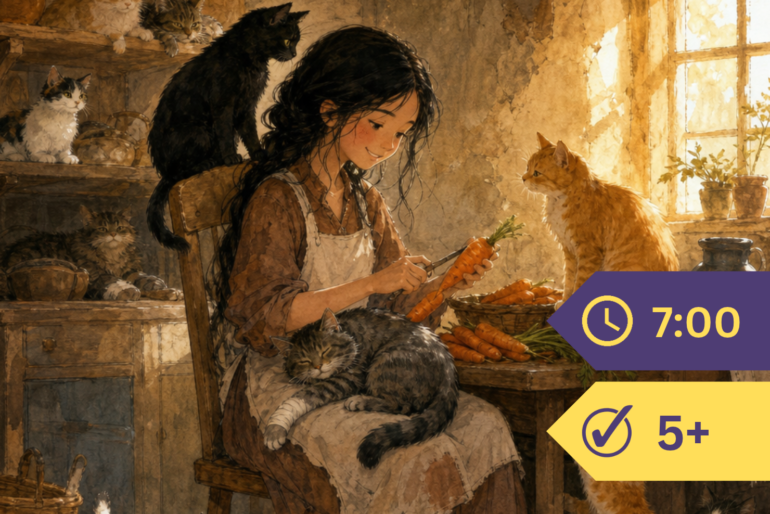
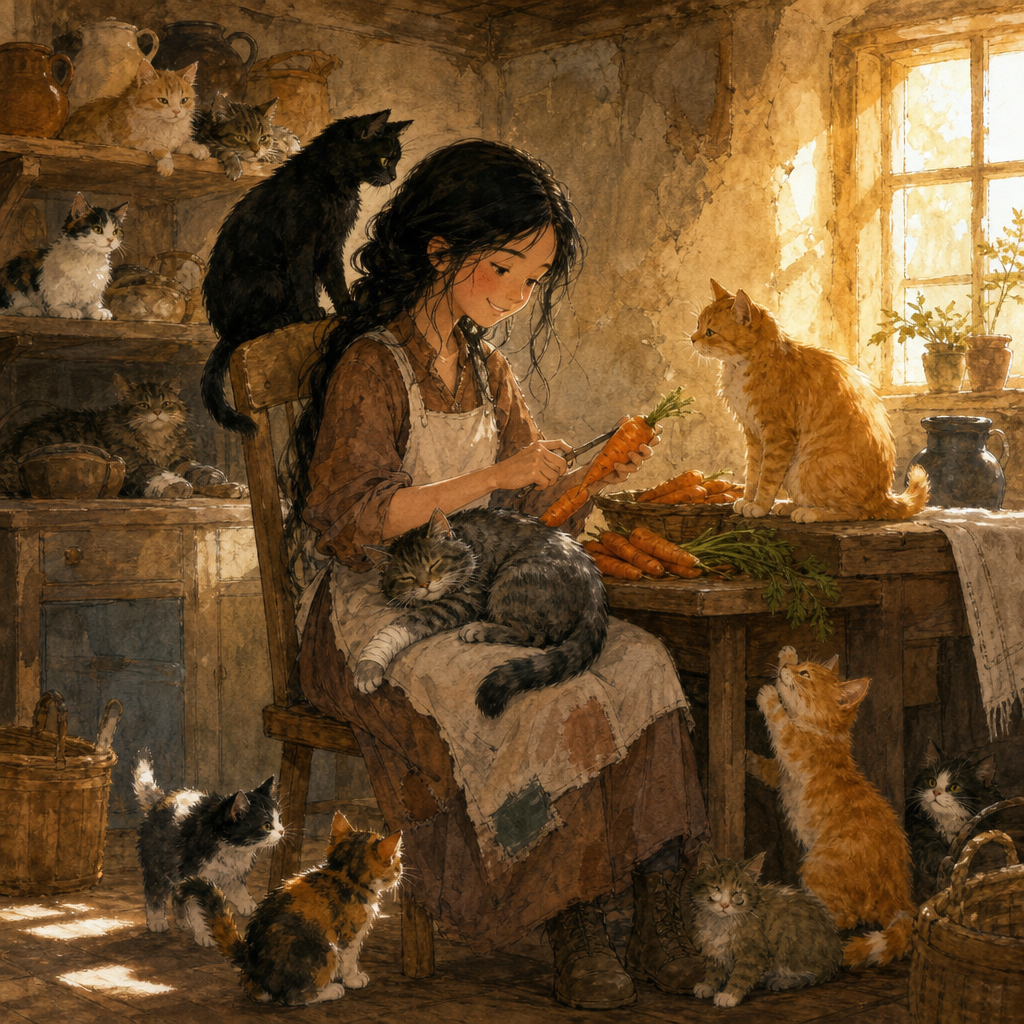
She went to work, but she was hindered at every step. A cat sat on her feet. A cat perched on the back of her chair. A cat sat on the table beside the carrots she was peeling, and half a dozen more prowled along the shelves. The room hummed with purring, which meant they were pleased, though Lizina couldn’t yet understand their language. She picked up tumbling kittens. She settled quarrels. She nursed the oldest cat of all, a tabby with a lame paw, on her lap. The house had never been so clean, the meals never so good, the sick never so well tended.
From time to time an old cat they called Father Gatto came down from his barn on the hill to look the colony over. “Is this nice black-eyed girl taking good care of you?” he asked.
“Oh yes!” said all the cats. “We’ve never had a servant like her.”
But Father Gatto noticed that Lizina grew sadder every day. One day he found her crying in the kitchen.
“No one’s unkind to me,” she said. “The cats are lovely. But I miss my mother and my sister.”
“Then you shall go home,” said Father Gatto, “and come back only if you want to. But first you must be rewarded. Follow me.”
He led her to a cellar she’d never seen, with two big jars: one full of oil, one full of something gleaming like gold. “Which shall I dip you in?” he asked, and showed all his sharp white teeth.
“The oil, please,” said Lizina shyly. She would never have dared to ask for gold.
“You’ve earned something better,” said Father Gatto, and plunged her into the golden jar. When she came out she shone from head to toe like a summer sun. Only her pink cheeks and her black hair kept their own colour.
“Go see your family,” said the old cat. “But when you hear the rooster crow, turn to face it. And if you hear a donkey bray, look the other way.”
Lizina kissed his white paw and set off. Just before she reached her mother’s house, a rooster crowed, and she turned to face it — and a golden star appeared on her forehead. A moment later a donkey brayed, and she very carefully did not look. Her mother and sister gasped at the sight of her. And when she took out her handkerchief, out came a handful of gold.
For a few days they lived happily, and Lizina gave them all the gold she had. But Peppina was wild with jealousy. She couldn’t scrub off the golden glow, and she couldn’t pull off the star. At last she took her sister’s basket and said, “I’ll go and get a little of the cats’ gold myself.”
The cats had not yet hired a new servant; they still missed Lizina too much. When they heard that Peppina was her sister, they ran to greet her. “She doesn’t look much like Lizina,” the kittens whispered. “Hush,” said the older cats. “Not every servant can be pretty.”
But Peppina wasn’t just plain; she was rude. On her first day she slammed the kitchen door on the tomcats. When a young cat hopped through the window, she cracked it with a rolling pin so hard it squalled for an hour. The dust piled up. The cobwebs hung. The beds weren’t made. She forgot to feed a mother cat’s kittens in the attic, and they grew weak and cold before anyone found them.
When Father Gatto came to visit, the whole colony was in an uproar. “Send her away!” they begged. “Lizina would understand.”
Father Gatto took Peppina down to the same cellar. “Which jar shall I dip you in?”
“The gold!” she said at once.
His yellow eyes flashed. “You haven’t earned it.” He flung her into the jar of oil, rolled her in the ashes by the stove, and sent her out of the door. “Go home. And if you hear a donkey bray, be sure to turn your head toward it.”
Peppina stumbled home, black as soot and furious. When a donkey brayed, she turned to face it. At once something swung from her forehead: a long, grey, hairy donkey’s tail. It would never come off.
Meanwhile, the king’s son had passed the house and seen Lizina sewing by the window. He’d come back again and again, and one day he whispered through the window, “Lovely girl, will you marry me?” and she’d said yes.
Now their mother, furious at Lizina’s good luck and at Peppina’s tail, shut Lizina in the old well-house. When the prince arrived to claim his bride, he found a girl swathed in a white veil. “That’s the custom,” said the mother, who had tucked Peppina’s tail up under the veil like a lock of hair. The prince was young and shy, so he said nothing and handed his bride into the carriage.
The road led past the cats’ old house, and all the cats were crowded at the windows, for word had spread that the prince’s bride would have a golden star on her forehead, and they knew it could only be their Lizina. As the carriage rolled by, they burst into song:
Mew, mew, mew! Prince, look behind you! Lizina’s down the well, and what you’ve got is Peppina.
The coachman understood cat-talk better than the prince. “Your Highness,” he said, reining in the horses, “do you hear what the cats are saying?” And the song rang out again, louder.
The prince threw back the veil, and there was Peppina, red-faced, with a donkey’s tail wound around her head. He turned the carriage round at once and drove straight back to her mother’s house. With his hand on his sword he demanded Lizina, and her mother hurried to the well-house and let her out.
Lizina’s gold dress shone so brightly that when the prince led her into the palace, the whole place lit up. They were married the next day, and every cat in the colony came to the wedding, with Father Gatto at the head.