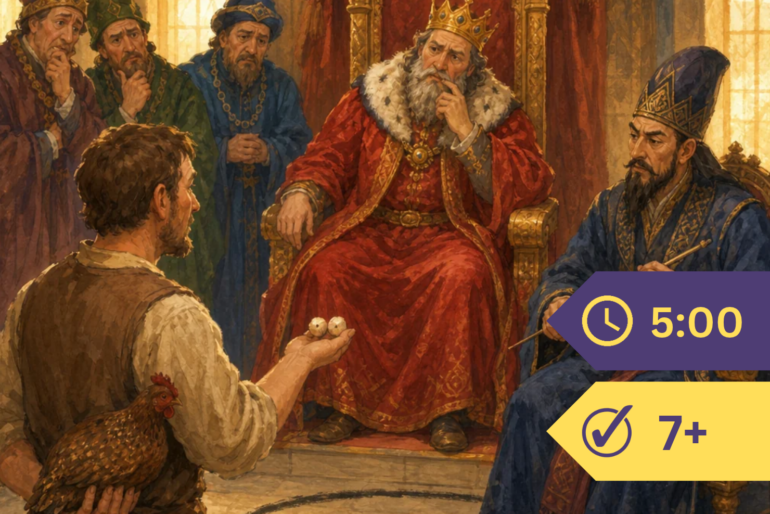
Once upon a time a king in a faraway country was sitting on his throne, hearing his people’s complaints and settling their disputes. There had been fewer cases than usual that morning, and he was about to go into his gardens when there was a sudden stir outside. The lord high chamberlain came in and asked whether His Majesty would be pleased to receive the ambassador of a powerful emperor in the east, one whom all the neighbouring kings feared. The king feared him as much as the rest. He ordered that the envoy be shown in at once and a banquet prepared in his honour. Then he settled back on his throne, wondering what the envoy would say.
The envoy said nothing. He walked up to the throne, stooped, and with a rod he was carrying drew a black circle on the floor all the way around it. Then he sat down on a nearby seat and ignored everyone.
The king and his courtiers were baffled and angry, but the envoy sat as still as a statue, and it soon became clear that no explanation was coming. The ministers were called into a hasty council, but not one could make sense of it. This made the king angrier still, and he told them that if they could not find someone who could explain the mystery by sunset, they would all lose their posts and much worse.
The ministers knew the king meant what he said. They quickly divided the city into districts and went house to house asking whether anyone could work out what the ambassador meant. Most people only stared. But one minister was more observant than the others. Entering an empty cottage, he found a swing moving by itself. He opened a door to a second room and found another swing, swinging gently. From the window he saw a patch of corn, and a willow branch that moved constantly with no wind, to scare away the sparrows. His curiosity growing, he went downstairs and found a large bright workshop where a weaver sat at his loom. All the weaver did was guide the threads, because the machine he’d invented, which swung the swings and the willow pole, also drove the loom.
When he saw the great wheel in the corner and guessed what it was for, the minister gave a sigh of relief. At the very least, a man who could invent such a thing might put him on the right track. Without further ado he told the story of the circle and said that whoever could explain it would be handsomely rewarded.
“Come with me at once,” he said. “The sun is low and there’s no time to lose.”
The weaver thought for a moment, then walked to a window. Outside stood a hen-coop with two knucklebones lying beside it. He picked up the knucklebones, took the hen from the coop, tucked it under his arm, and said to the minister, “I’m ready.”
In the hall the king still sat on his throne and the envoy on his seat. The weaver signalled the minister to stay where he was, walked up to the envoy and placed the knucklebones on the floor beside him. In reply, the envoy took a handful of millet seed from his pocket and scattered it around. The weaver set down the hen, who gobbled it up in a moment. At that the envoy rose without a word and left.
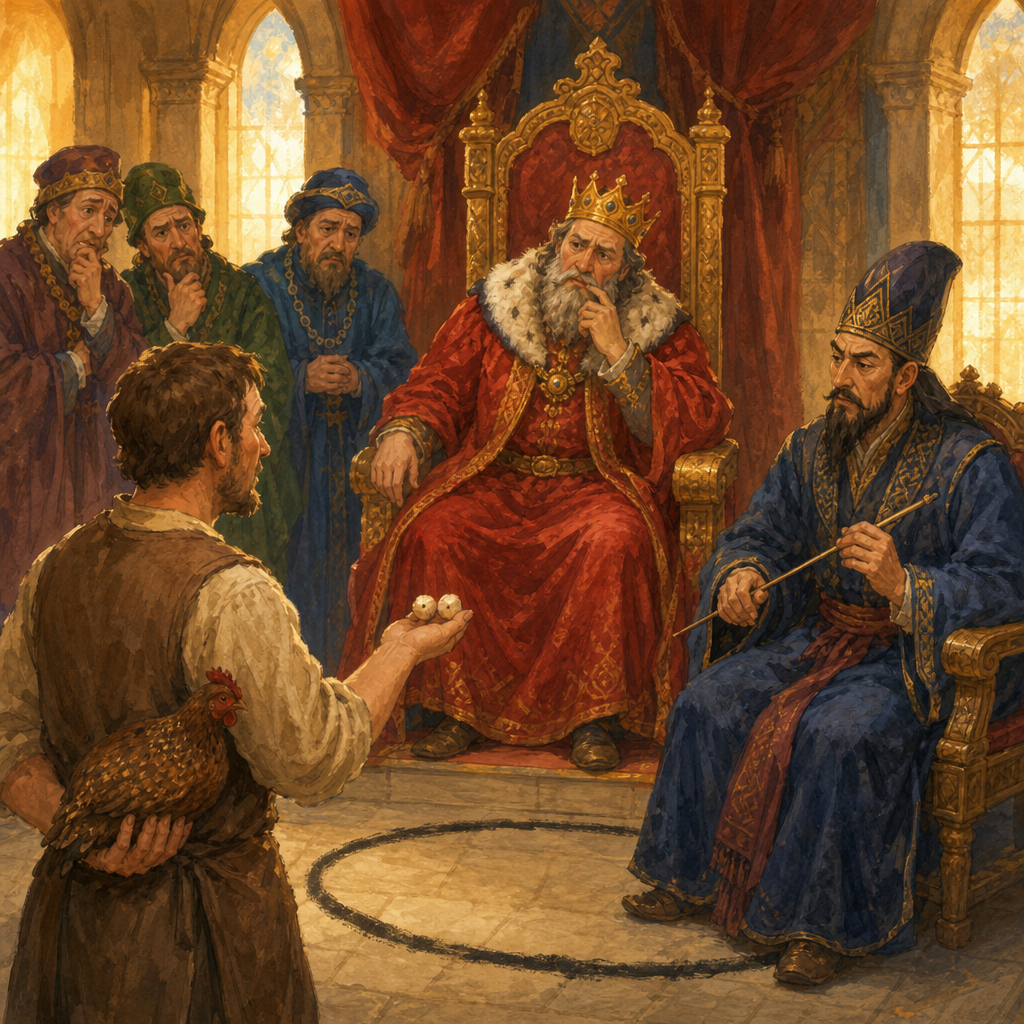
As soon as he was gone, the king beckoned to the weaver.
“You alone seem to have solved the riddle. Your reward will be great. But tell me, what did it all mean?”
“The circle drawn around your throne, Your Majesty, was the emperor’s message,” said the weaver. “It said: ‘If I send an army and surround your capital, will you lay down your arms?’ The knucklebones I set before him told him: ‘You are children compared with us. Toys like these are the only playthings you’re fit for.’ The millet he scattered stood for the number of soldiers his master can bring into the field. But when he saw the hen eat up the seed, he understood that one of our men can destroy a host of theirs.”
“I don’t think,” he added, “that the emperor will declare war.”
“You’ve saved me and my honour!” cried the king. “You will have wealth and glory. Name your reward, up to half my kingdom.”
“The little farm outside the city gates, as a wedding gift for my daughter. That is all I ask,” said the weaver, and it was all he would take. “But please remember, O king,” he said as he left, “that weavers also matter to a country, and that they are sometimes even cleverer than ministers!”