When the Christ Child was born in Bethlehem of Judea, long years ago, three kings rode out of the East on their camels bearing gifts to him. They followed the Star until at last they came to the manger where he lay—a little, newborn baby. Kneeling down, they placed their gifts beside him: gold, frankincense, and myrrh; they kissed the hem of the little white mantle that he wore, and blessed him. Then the kings rode away to the East again; but before they went they whispered a promise to the Christ Child.
And the promise? You shall hear it as the kings gave it, long years ago.
“As long as there be children on the earth, on every Christmas Eve we three kings shall ride on camels—even as we rode to thee this night; and even as we bore thee gifts so shall we bear gifts to every child in memory of thee, thou holy Babe of Bethlehem.”
In Spain they have remembered what the Christmas Kings promised; and when Christmas Eve comes, each child puts his sapatico—his little shoe—between the iron gratings of the window, so the kings may know a child lives in that house and leave a gift.
Often the shoe is filled with grass for the camels, and a plate of dates and figs is set beside it; for the children know the kings have far to go and may be hungry.
At day’s end, bands of children march out of the city gates to meet the kings. But always it grows dark before they come. The children grow afraid on the lonely road and hurry back to their homes, where the good madres hear them say one prayer to the Nene Jesu, as they call the Christ Child, and then tuck them into bed to dream of the Christmas Kings.
Long, long ago, there lived in Spain, in the crowded heart of a great city, an old woman called Doña Josefa. The street in which she lived was little and narrow—so narrow that if you leaned from Doña Josefa’s window you could touch with your fingertips the house across the way, and when you looked up, the sky seemed but a thin ribbon of blue tying the houses all together. The sun never found its way into that little street.
The people who lived there were very poor, as you can imagine; Doña Josefa was poor as well. But in one thing she was very rich: she knew more stories than there were feast days in the year—and that is a great many. Whenever she had a moment free from work—when she had no water to fetch from the public well, nor gold thread to stitch upon the altar cloth for the Church of Santa María del Rosario—she would run out into the street and call:
“Niños, niñas, come quickly! Here is a story waiting for you.”
And the children would come flying—like the gray palomas when corn is scattered for them in the Plaza. Ah, how many children there were in that little street! There were José and Miguel, and the niños of Enrique the cobbler—Alfredito and Juana and Esperanza—and the little twin sisters of Pancho the peddler; and Angela, María Teresa, Pedro, Edita, and many more. Last of all there were Manuel and Rosita. They had no father, and their mother was a lavandera who stood all day on the riverbank outside the city, washing clothes.
When Doña Josefa had called the children from all the doorways and dark corners, she would sit down in the middle of the street and gather them around her. This was quite safe—the street was far too narrow for a horse or wagon to pass. Sometimes a donkey would pick its slow way through, or a goat come nosing about for something to eat; but that was all.
It happened on the day before Christmas that Doña Josefa had finished her work and sat as usual with the children gathered close.
“Today you shall have a Christmas story,” she said; and she told them of the Three Kings and the promise they had made to the Christ Child.
“And is it true—do the kings still bring presents to children now?” Miguel asked.
Doña Josefa nodded. “Yes.”
“Then why have they never left us one? The Three Kings never pass this street on Christmas Eve—why is that, Doña?”
“Perhaps it is because we have no shoes to hold their gifts,” said Angela.
And this was true. The poor children of Spain went barefooted, and often never owned a pair of shoes until they were grown.
Manuel had listened quietly to the others; but now he tugged at the sleeve of Doña Josefa’s gown. “I know why the kings bring no gifts to us. Look at the street—it is too small. Their camels could never pass between the doorsteps. The kings must ride where the streets are broad and smooth and clean, where their long mantles won’t be soiled and torn and the camels won’t stumble. It is the children in the great streets—the children of the rich—who find presents in their sapaticos on Christmas morning. Is it not so, Doña Josefa?”
And Miguel cried: “Does Manuel speak true? Is it only the children of the rich?”
“Ah, chiquito mío, it should not be so! When the promise was given to the Nene Jesu there in Bethlehem, they said ‘to every child’—yes, every little child.”
“But it is not strange that they forget us,” Manuel said quietly. “Our little street is hidden in the shadow of the great ones.”
Then Rosita spoke, clasping her hands together. “I know! It is because we have no shoes—that is why the kings never stop. Perhaps Enrique would lend us the shoes he is mending—just for one night. If we had shoes in the windows, the kings would surely see that there are children here and leave a gift for each of us. Come, let us ask Enrique!”
“Madre de Dios, what a blessed thought!” cried all; and like the flock of gray palomas they swept down the street to the far end, where Enrique the cobbler hammered and stitched away all day on the shoes of the rich children.
Manuel stayed behind with Doña Josefa. When the last pair of little brown feet had disappeared into the sapatería, he said softly: “If someone could go out and meet the kings—to tell them about this little street, and how the children here have never had a Christmas gift—do you not think they might come tonight?”
Doña Josefa shook her head doubtfully. “If that were possible… but I have never heard of anyone who met the kings on Christmas Eve.”
All day the city hurried and bustled. In the great streets, flags waved from the rooftops, and wreaths of laurel and garlands of heliotrope and mariposa hung above the open doorways and in the windows. Sweetmeat sellers cried their wares, and the Keeper-of-the-City lit flaming torches to hang upon the gates and city walls. Everywhere there was merrymaking and gladness; for not only was this Christmas Eve, but the King of Spain was coming to keep his holiday in the city. Some whispered that he rode from the north, and with him rode his cousins—the kings of France and Lombardy—with a great following of nobles, knights, and minstrels. Others said the three kings rode all alone, as it was their wish.
As the sun was turning the cathedral spires to shafts of gold, bands of children, hand in hand, marched out of the city gates. They took the road toward the setting sun, believing it was the East.
“I have brought a basket of figs,” cried one.
“I have dates in a new pañuelo,” cried another.
“And I have a sack of sweet limes—so cooling after a long journey,” cried a third.
Each child in turn showed the small gift they were bringing for the kings. And as they walked, one child began to sing the Nativity Hymn, and in a moment others joined until the still evening air rang with happy voices:
Unto us a Child is born, Unto us a Gift is given. Hail with holiness the morn, Kneel before the Prince of Heaven. Blessed be this Day of Birth, God hath given his Son to earth. Jesu, Jesu, Nene Jesu, Hallelujah!
Behind the little hills the sun went down, leaving a million sparks of light upon the road.
“Yonder come the kings!” the children cried. “See, the splendor of their crowns and how the jewels sparkle on their mantles! They may be angry if they find us out so late—come, let us run home before they see us.”
The children turned and ran—back to the city gates, back to their homes, to the good madres watching for them and their own white beds ready and waiting.
But one they left behind on the road: a small, bare-limbed boy named Manuel. He watched until the children had disappeared within the gates, then turned again toward the setting sun.
I have no gift for the kings, he thought. But there is fresh green grass beside the road that I can gather for the camels.
He stopped, pulled up handfuls, and stuffed the grass inside the front of the little blue vestido he wore. He followed the road for a long way, until heaviness came to his eyes.
“How still it is here on the road… God has blown out his light and soon it will be truly dark. I wish I were with the others, safe inside the city—for the dark holds frightening things when one is all alone… Mamita will be coming home soon and bringing supper for Rosita and me. Perhaps tonight there will be an almond dulce, or pan de gloria—perhaps… I wonder if Rosita has remembered the little prayer I told her to keep saying. My feet hurt from the many stones; the night wind blows cold; I am weary and my feet stumble… Oh, Nene Jesu, listen! I make the prayer also: Send the three kings before Manuel is too weary and afraid!“
A few more steps he took along the road; and then, as a reed is blown down by the wind, Manuel swayed and slowly sank upon the ground, fast asleep.
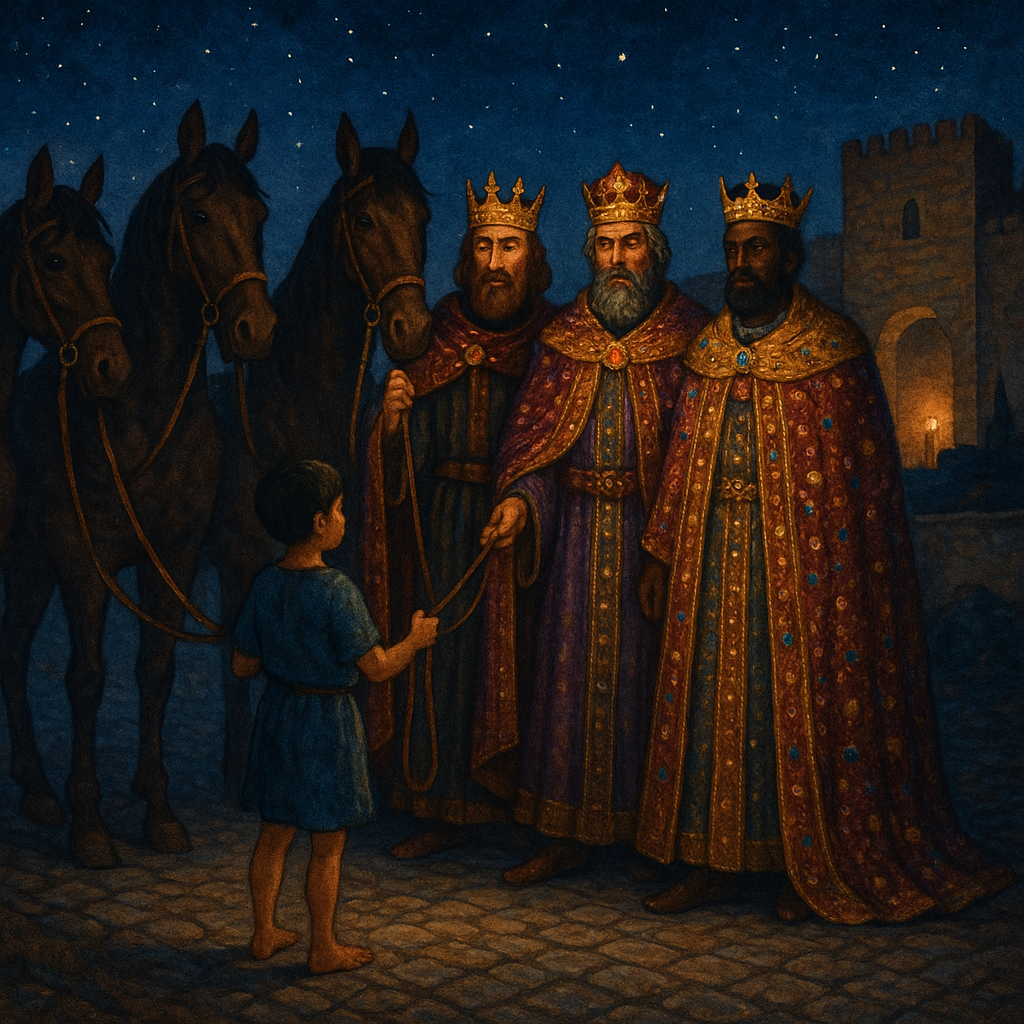
How long he slept, I cannot say; but a hand on his shoulder woke him. He opened his eyes, wondering—and saw them. The Three Kings. Tall and splendid they looked in the starlight, their mantles shimmering with countless gems. One stood over Manuel, asking what he did upon the road at such a late hour.
Manuel scrambled to his feet, thrusting his hand inside his shirt for the grass he had gathered. “It is for the camels, señor; I have no other gift. But you—you ride horses this Christmas Eve!”
“Yes, we ride horses. What is that to you?”
“Pardon, señores, nothing. The Three Kings may ride as they wish—only, we were told you rode on camels from the East.”
“What does the child want?” The voice was kind, but it carried a note of impatience—as though the one who spoke had work waiting and was anxious to be about it.
Manuel felt this keenly. What if there is not time, or not gifts enough? He laid an eager, pleading hand upon one king’s mantle. “I can hold the horses, if you will only come this once. It is a little street and hard to find, señores; I thought, perhaps, you might leave a present—just one small present—for the children there. You promised the Christ Child you would give to every child. Don’t you remember? There are many of us, señores, who have never had a Christmas gift.”
“Do you know who we are?”
Manuel answered joyfully: “Oh, yes, Excelencias—you are the Three Christmas Kings, riding from Bethlehem. Will you come with me?”
The kings spoke as one: “We will.”
One lifted Manuel onto his horse; and silently they rode into the city. The Keeper slumbered at the gates; the streets lay empty. On past the garlanded houses they went, unseen, through the great streets—until at last they came to the little street. The kings dismounted and placed their bridles in Manuel’s hands. Then, gathering up their precious mantles of silk and rich brocade, they passed down the little street.
With eyes that scarcely believed what they saw, Manuel watched them move from house to house—watched them reach between the iron gratings for the shoes that Enrique the cobbler had lent—and fill each one with shining gold pieces.
In the morning Manuel told the whole story to the children as they set off together to spend their golden doblón on toys and candy and sugared cakes. And they bought a gift for Doña Josefa too: a little figure of the Holy Mother with the Christ Child in her arms.
And so the promise made in Bethlehem was made again—given to a small child to carry, and by a small child kept. For many, many years—long after Manuel was grown and had little ones of his own—the kings remembered the little street, and brought their gifts there every Christmas Eve.