There was once a young man who sold chicory in the market, which was honest work but dull, and he sometimes allowed his attention to wander. One afternoon a woman in a grey cloak stopped at his stall and told him that if he went to a certain house on the edge of town and waited there every evening, something extraordinary would happen.
He thought about this for a few days and then went.
The house was empty, or seemed to be. He waited in the courtyard until long after dark. Then lights appeared in an upper window, and he heard music, and voices, and what seemed to be a great deal of company. He climbed the stairs.
The room at the top was full of people dancing. They were elegantly dressed and moved through a complicated set of figures with absolute precision, and no one looked at him when he came in. In the center of the room a young woman danced alone, or nearly alone — she was the focus of the dance, the one everyone else orbited, and she was beautiful in the specific way of someone who is not thinking about being beautiful at all.
He watched for a long time. Then the music stopped, the room went dark, and he was alone.
He came back the next night. And the next.
On the fourth night he managed to speak to her in the brief moment before the lights went out. She told him that she was enchanted — held in this house from sunset to sunrise, compelled to dance with a company of the dead, unable to leave or call for help. She had been there for seven years.
He asked what would break the enchantment.
She told him: he would have to come every night for thirty nights, see everything without flinching, and on the thirtieth night, when the dancing stopped and the room went dark, he must find her in the darkness and hold her hand without letting go until dawn.
He said he would do it.
He came every night for twenty-nine nights. He watched things that were difficult to watch — the dead danced as the dead dance, which is not quite like the living — and he did not flinch, or ran back to the market in the mornings and flinched there instead, where it didn’t count.
On the thirtieth night the music stopped. The lights went out. He moved through the darkness, found her hand, and held it.
Something tried to pull her away. He held on.
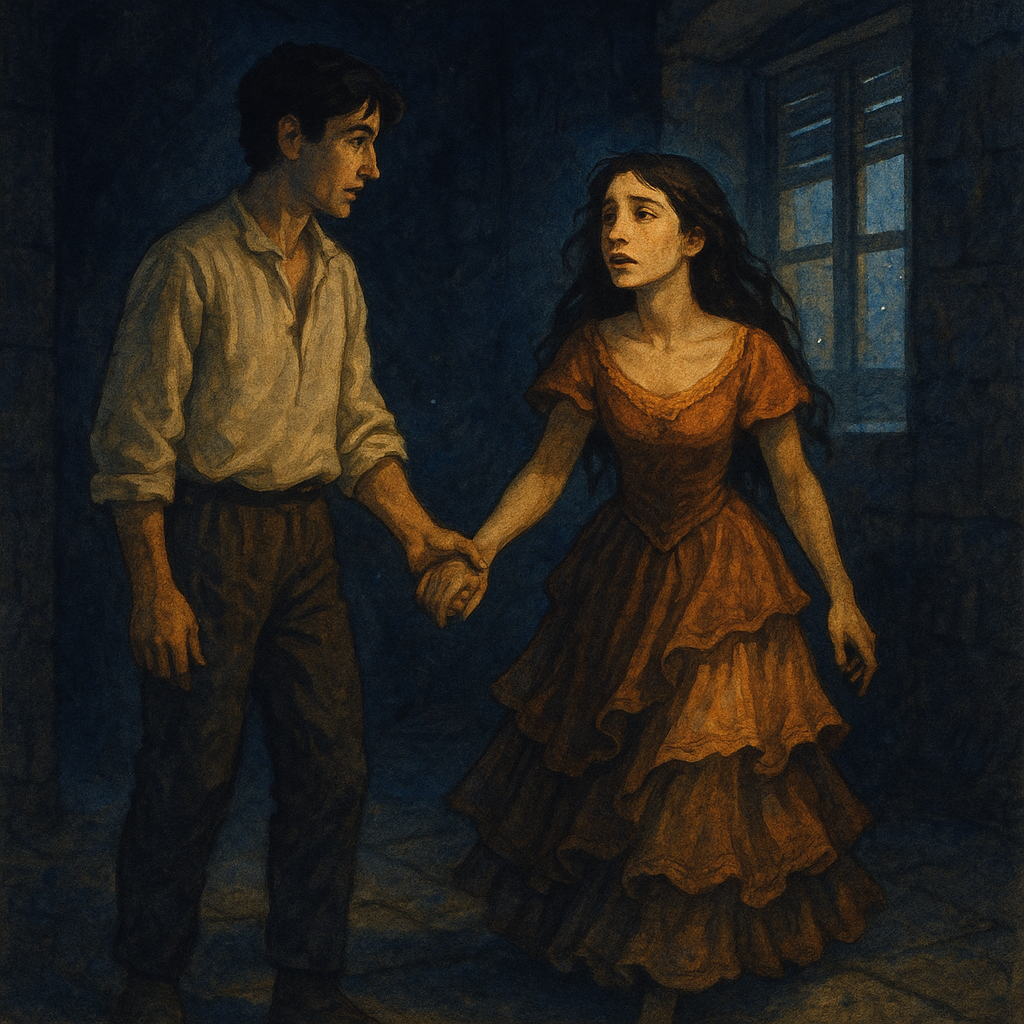
The room grew cold, then warm. Something howled in the walls of the house. He held on.
When the light came — the ordinary grey light of a Rome morning coming through the shutters — she was standing beside him, wearing a dress that was her own and not the dancing-dress, and the room around them was empty of everything but dust and old furniture.
She told him her name. He told her his. She said she would need some time to learn to live ordinarily again, after seven years. He said he had time. He sold chicory five days a week. Evenings were generally free.