There was once a king who meant well but had fixed ideas, and his fixed idea at the moment was that his daughter should marry an elderly king — rich and powerful, but old and very ugly. Every time he brought it up the girl begged and wept. He brought it up often.
At last she said: “If you insist I marry this old man, you must first do something for me.”
“Anything you like!” said the king.
“Then have made for me a great golden candelabrum — ten feet high, with a stem as wide as a man’s body, covered all over in golden ornaments and devices.”
This was ordered in great haste from the royal goldsmith, who brought it back in no time at all: a magnificent thing, gleaming and enormous. The king had it carried to his daughter’s room. She looked pleased. He went away satisfied.
That evening she called her chamberlain. “This great awkward thing is not at all what I wanted. Take it away first thing tomorrow morning, before my father wakes, and sell it for whatever you can get. Keep the money — I don’t want it.”
The chamberlain was delighted to have such a windfall. He rose early.
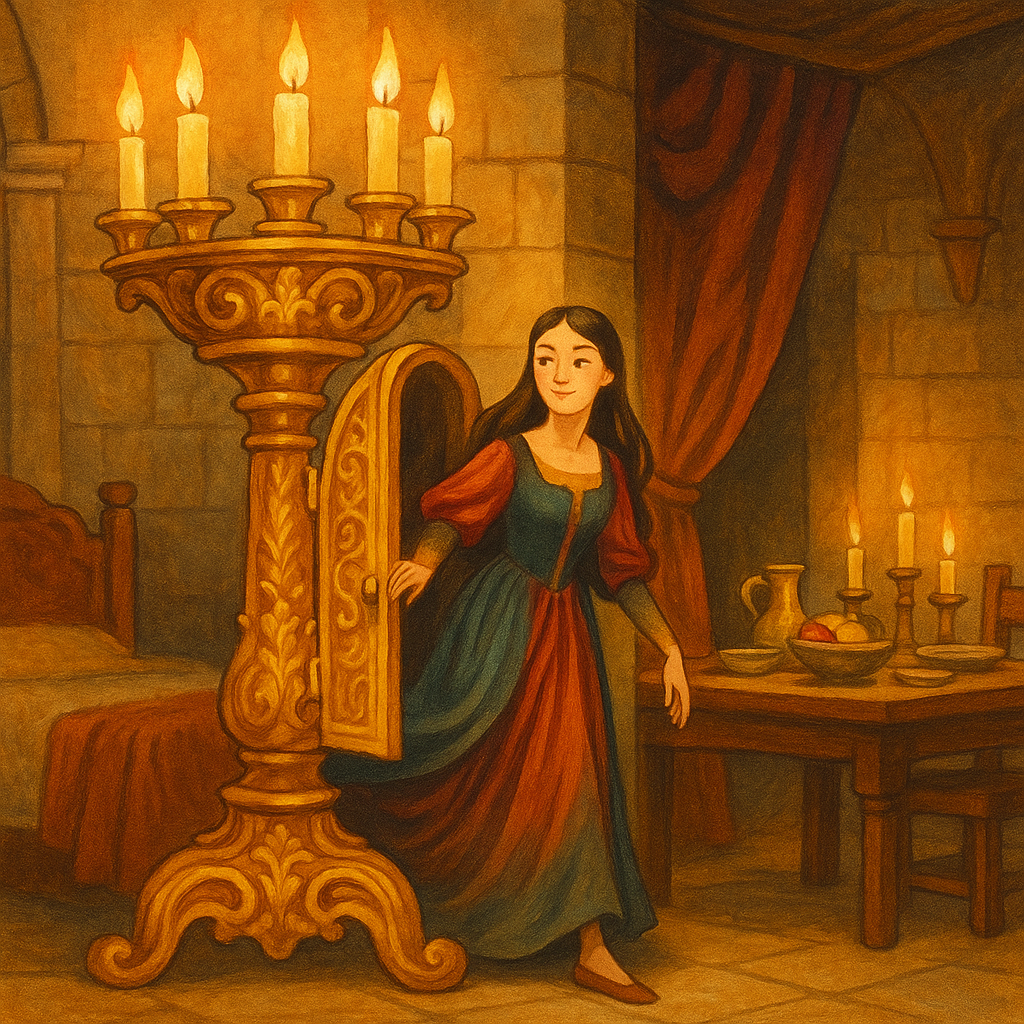
But the princess had risen earlier and was already inside the candelabrum.
He carried it out of the palace and away to the neighbouring kingdom, where he set it up in the market square and cried: “Who’ll buy my candelabrum! Who’ll buy my fine candelabrum!” The people marvelled at it, but no one would bid — it was too costly and too strange.
Word of it reached the king’s son of that country. He went to see for himself, decided at once that he must have it, and paid three hundred scudi. His servants carried it up to his rooms.
That evening the prince went to the theatre and told his servant to lay his supper on the table.
When he returned, his supper was eaten and all the dishes were disarranged.
“What is this?” he demanded. The servant had no explanation. The prince went to bed supperless.
The same thing happened the next night. On the third night, his curiosity got the better of him. He told his servant to lay the supper, then quietly locked himself inside the room and hid.
He had not waited long when the door of the candelabrum swung open, and out stepped the most beautiful princess he had ever seen. She sat down and ate his supper with every sign of appetite.
“Welcome!” cried the prince, stepping from his hiding place. “I had no idea what an honour it was being eaten by you.” He sat beside her, and they finished the meal together. After that she went back inside the candelabrum, and he told his servant to always bring up a double portion from then on.
From that day the prince no longer left his rooms. The king and queen noticed, called him to account, and told him it was time he thought about marrying.
“I’ll marry no one but the candelabrum,” said the prince.
They concluded he was mad and stopped mentioning it.
One day the queen-mother came unexpectedly to his room and found the candelabrum open, with a beautiful young woman sitting beside her son in conversation. She looked at the girl and said: “If this is what you meant by the candelabrum, you showed very good judgement.” She took the princess’s hand and brought her to the king.
She was given to the prince in marriage. And her own father, when he heard of the match, said it suited him far better than the elderly king he’d originally proposed.