Once upon a time a woman lived with her only son, whom she loved dearly. Their little cottage stood at the edge of a forest. They had no neighbours, and the place was so lonely that the boy was kept at home to keep his mother company.
One winter evening, as they sat together, a storm suddenly blew up and the wind flung the door open. The woman shivered and glanced over her shoulder as if she half expected to see something horrible behind her. “Go and shut the door,” she said quickly. “I feel frightened.”
“Frightened?” said the boy. “What does that feel like?”
“Well, just frightened,” said his mother. “A fear of something, you hardly know what, takes hold of you.”
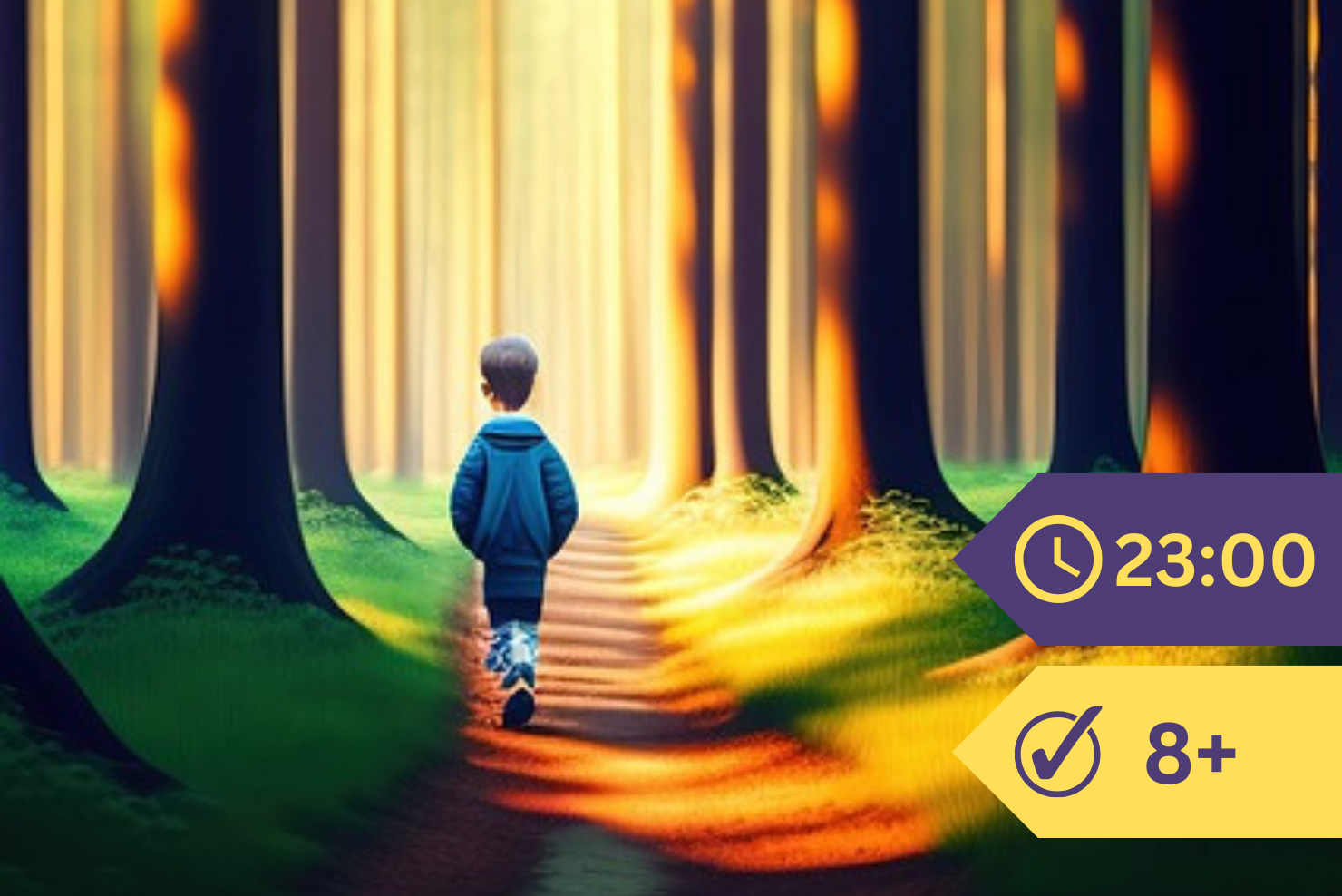
“It must feel very odd,” said the boy. “I’ll go out into the world and look for fear until I find it.” And the next morning, before his mother was even out of bed, he had left the forest behind.
After some hours he reached a mountain and started to climb. Near the top, in a wild and rocky spot, he came upon a band of fierce robbers sitting around a fire. The boy was cold and tired, and the bright flames looked wonderful. “Good evening, gentlemen,” he said, and he squeezed in between them until his feet nearly touched the burning logs.
The robbers stopped drinking and stared. At last the captain said, “No armed caravan dares come near us, and even the birds avoid our camp. Who are you to walk in so boldly?”
“I’ve left my mother’s house to look for fear,” said the boy. “Maybe you can show me where it is.”
“Fear is wherever we are,” said the captain.
“But where?” The boy looked around. “I can’t see it.”
“Take this pot and some flour, butter and sugar to the churchyard down there,” said the robber, “and bake us a cake for supper.” The boy, who was now nicely warm, jumped up cheerfully, slung the pot over his arm and ran down the hill.
At the churchyard he gathered sticks and lit a fire, filled the pot with water from a little stream, mixed the flour, butter and sugar, and set the cake to bake. Soon it was crisp and brown. He lifted it out and set it on a stone while he put out the fire. At that moment a hand reached up out of a grave, and a voice said:
“Is that cake for me?”
“Do you think I’d give the food of the living to the dead?” said the boy, laughing. He tapped the hand with his spoon, picked up the cake and went whistling up the mountainside.
“Well?” said the robbers as he held out the cake to the captain. “Did you find fear?”
“No. Was it there? I saw a hand come out of a grave, belonging to someone who wanted my cake. I rapped its fingers with my spoon and said no, and it disappeared. Oh, the fire is nice!” And he knelt in front of it, and did not notice the robbers glancing at each other in surprise.
“There’s another chance for you,” one said at last. “On the far side of the mountain is a deep pool. Go there, and you may meet fear on the way.”
“I hope so,” said the boy, and set off at once.
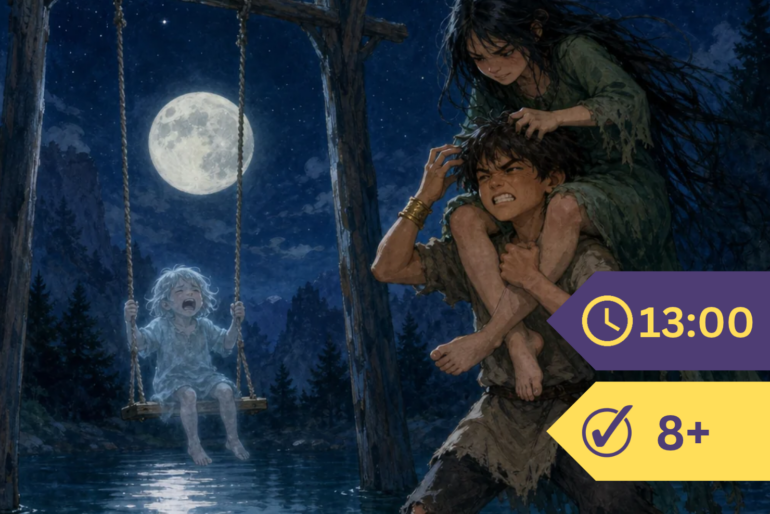
The pool was shining in the moonlight when he reached it. Over the water stood a tall swing, and in the swing a child sat crying bitterly.
“A strange place for a swing,” the boy thought. “I wonder why he’s crying.” But as he hurried toward the child, a girl ran up.
“I want to lift my little brother down,” she cried, “but the swing is so high I can’t reach him. If you stand at the edge of the pool and let me climb on your shoulders, I think I can.”
“Gladly,” said the boy, and in an instant she was on his shoulders. But instead of lifting the child, which she could easily have done, she clamped her feet so tightly on either side of his neck that he felt he would choke in a minute, or fall into the water. He gathered all his strength, gave a mighty heave and threw her backwards. As she hit the ground, a bracelet slid off her arm, and he picked it up.
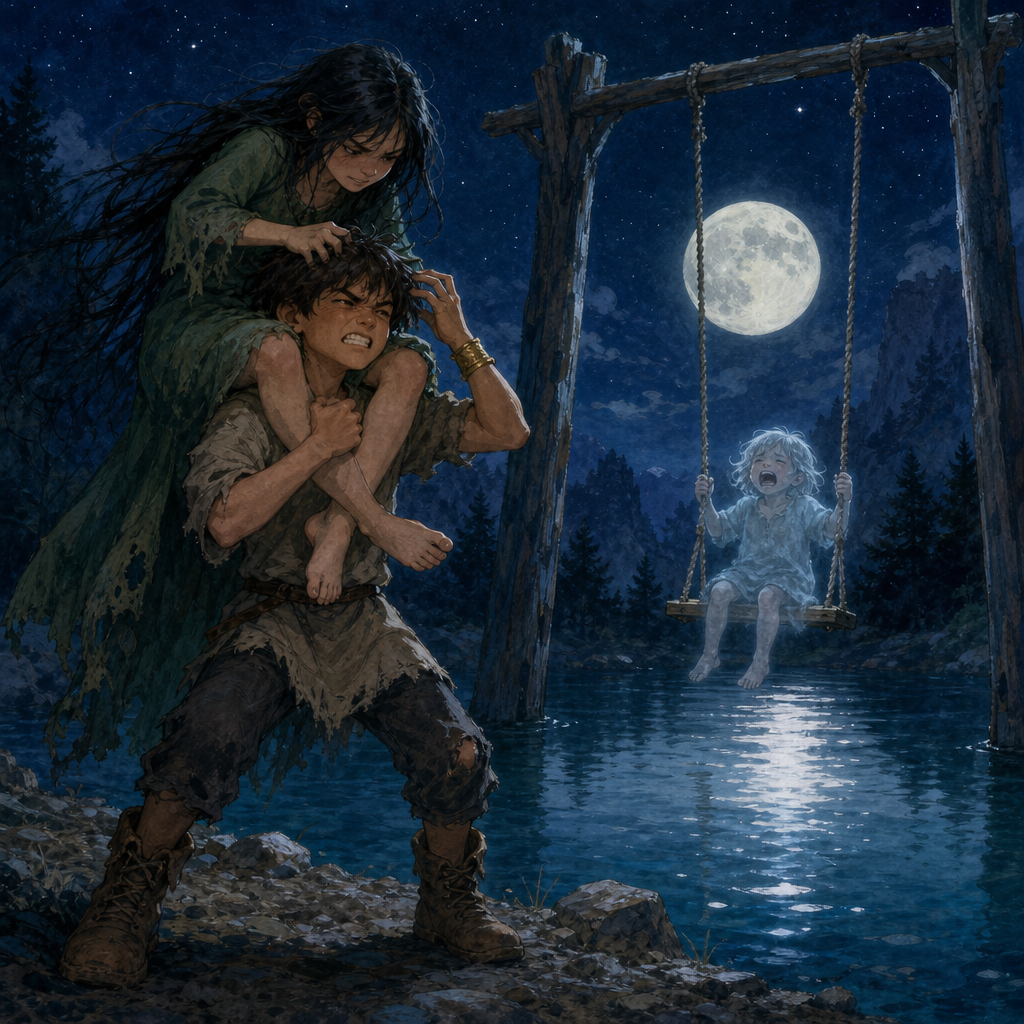
“I’ll keep this to remember all the odd things that have happened since I left home,” he thought, and he turned to look for the child. Both the child and the swing had vanished, and the first streaks of dawn were in the sky.
With the bracelet on his arm he set off for a small town on the plain on the other side of the mountain. Hungry and thirsty, he had just entered the main street when a man stopped him. “Where did you get that bracelet? It’s mine.”
“No, it’s mine,” said the boy.
“It is not. Give it to me, or you’ll be sorry!”
“Let’s go before a judge and tell him our stories,” said the boy. “If he decides for you, it’s yours. If for me, I keep it.”
The man agreed, and they went to the great hall where the kadi, the judge, was hearing cases. He listened carefully to both and gave his verdict. Neither had proved the bracelet was his, so the judge would keep it until its twin was brought before him.
The boy and the man looked at each other and their eyes said, Where will we find the other one? But there was no arguing with a judge, so they bowed and left.
The boy wandered he didn’t know where, and found himself on the seashore. Not far out a ship had hit a hidden rock and was sinking fast. The crew were crowded on deck, white as death, shrieking and wringing their hands.
“Have you met fear?” the boy shouted. The answer came over the waves: “Help! We’re drowning!”
He threw off his clothes and swam to the ship, where many hands pulled him aboard.
“The ship is tossed this way and that, and it will be sucked down any moment,” the crew cried. “Death is very near and we’re frightened!”
“Give me a rope,” said the boy. He tied one end around his body and the other to the mast, and dived into the sea. Down he went, down, down, until his feet touched the bottom. He stood up and looked around. There, sure enough, a sea-maiden with a wicked face was tugging at a chain she’d hooked onto the ship, dragging it bit by bit beneath the waves. He grabbed her by both arms and made her drop the chain. With the ship now steady above them, the sailors were able to float it gently off the rock. Then he picked up a rusty knife from a heap of seaweed at his feet, cut the rope from his waist, tied the sea-maiden firmly to a stone so she could cause no more mischief, said goodbye, and swam back to the beach where his clothes were waiting.
He dressed and walked on until he came to a beautiful shady garden full of flowers, with a clear little stream running through. It was a hot day and he was tired, so he went in and sat under a clump of bushes with sweet red blossoms, and soon fell asleep. A rush of wings and a cool breeze woke him. He raised his head carefully and saw three doves plunging into the stream. They splashed happily, shook themselves, and dived to the bottom of a deep pool. When they came up again, they weren’t doves any more, but three beautiful young women carrying a table of mother-of-pearl. On it they set cups made of pink and green shells, and one of them filled a cup from a crystal goblet and was lifting it to her lips when her sister stopped her.
“Whose health do you drink?”
“The youth who baked the cake and rapped my hand with his spoon when I reached out of the earth,” said the first, “and who wasn’t afraid like other men! And you, whose health?”
“The youth on whose shoulders I climbed at the edge of the pool, who threw me off so hard I lay unconscious for hours,” said the second. “And you, sister?”
“Down in the sea I took hold of a ship and shook it and dragged it until it was nearly lost,” said the third, and as she spoke she looked quite different from the way she’d looked with the chain in her hands. “But a young man came and freed the ship and tied me to a rock. I drink to him.” And all three lifted their cups and drank in silence.
As they set down their cups, the boy stepped out in front of them.
“Here I am, the one whose health you’ve drunk. Now give me the bracelet that matches the one I’m wearing. It must have fallen from one of you. A man tried to take it from me, and the judge kept it until I could show him its twin, and I’ve been wandering from place to place looking for it. That’s how I’ve ended up in all these strange places.”
“Come with us,” said the young women. They led him down a passage into a hall with many rooms off it, each more splendid than the last. From a shelf heaped with gold and jewels the eldest took a bracelet exactly like the one the judge was holding, and fastened it onto the boy’s arm.
“Take this to the judge, and he’ll give you the other.”
“I’ll never forget you,” said the boy. “But it may be a long time before we meet again, because I won’t rest until I’ve found fear.” And he went on his way, won the bracelet from the judge, and set out again on his search.
On and on he walked, but fear never crossed his path. One day he came to a large town where the streets and squares were so packed he could hardly squeeze through.
“Why is everyone gathered here?” he asked the man next to him.
“The ruler has died without children, so we need to choose a new one,” said the man. “Every morning, one of the sacred pigeons is let loose from the tower there, and the person it lands on will be our king. The pigeon is about to fly. Wait and see.”
Every eye was fixed on the tall tower in the middle of the main square. At the moment the sun stood directly above it, a door opened and a beautiful pigeon, shining pink and grey, blue and green, shot out into the air. On and on it flew, until at last it settled on the boy’s head. A great shout went up.
“The king! The king!” But as he listened, a vision flashed through his mind, quicker than lightning. He saw himself on a throne, spending his whole life trying, and never succeeding, to make poor people rich, sad people cheerful, and bad people good; never doing a single thing he really wanted; not even able to marry the girl he loved.
“No! No!” he cried, hiding his face in his hands. But the crowd thought he was overcome by the greatness waiting for him, and paid no attention.
“Let’s make sure. Release more pigeons,” they said. Every pigeon followed the first, and the cries grew louder. “The king! The king!” And as he heard them, a cold shiver, which he didn’t recognise, ran through him.
“This is fear, whom you’ve been looking for so long,” whispered a voice that seemed to reach him alone. The boy bowed his head, the vision flashed before his eyes once more, and he accepted his fate and prepared to spend his life with fear at his side.