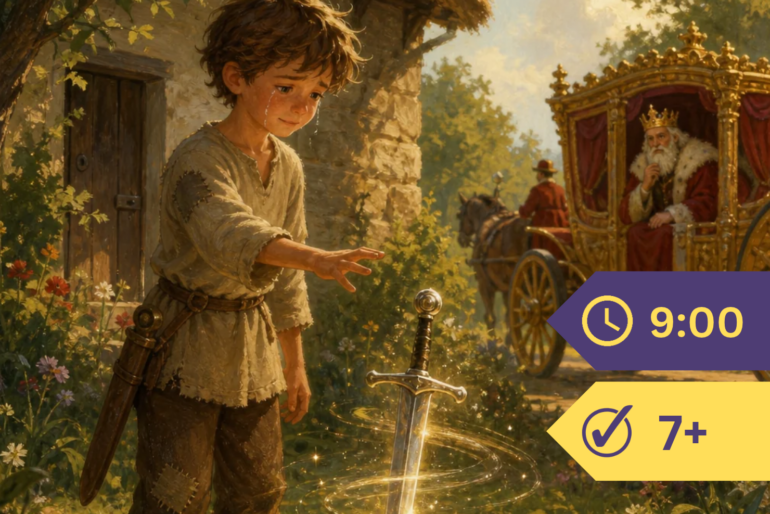
A poor widow had a little son who, at first glance, seemed like any other boy. But if you looked closer you’d see a scabbard hanging at his side, and as the boy grew, the scabbard grew too. The sword that went with it stuck out of the ground in the garden. Every day the boy tried to slide it in, and every day it was a little closer to fitting, until at last it slipped in easily. He tried it seven times to be sure, and each time it slid in more smoothly.
He was so happy that he resolved to tell no one, least of all his mother, who could keep nothing from the neighbours. But he couldn’t hide that something had happened.
“I had a wonderful dream,” he told her at breakfast, “but I can’t tell it to anyone until it comes true.”
“Of course you can tell me.” He wouldn’t. She grew angrier and angrier, and at last, in frustration, she sent him from the table. He ran to the garden and cried beside the little sword, which was turning around and around in its hole by itself. If anyone but the boy had tried to grab it, they’d have been badly cut. But when he stretched out his hand, it slid quietly into its scabbard.
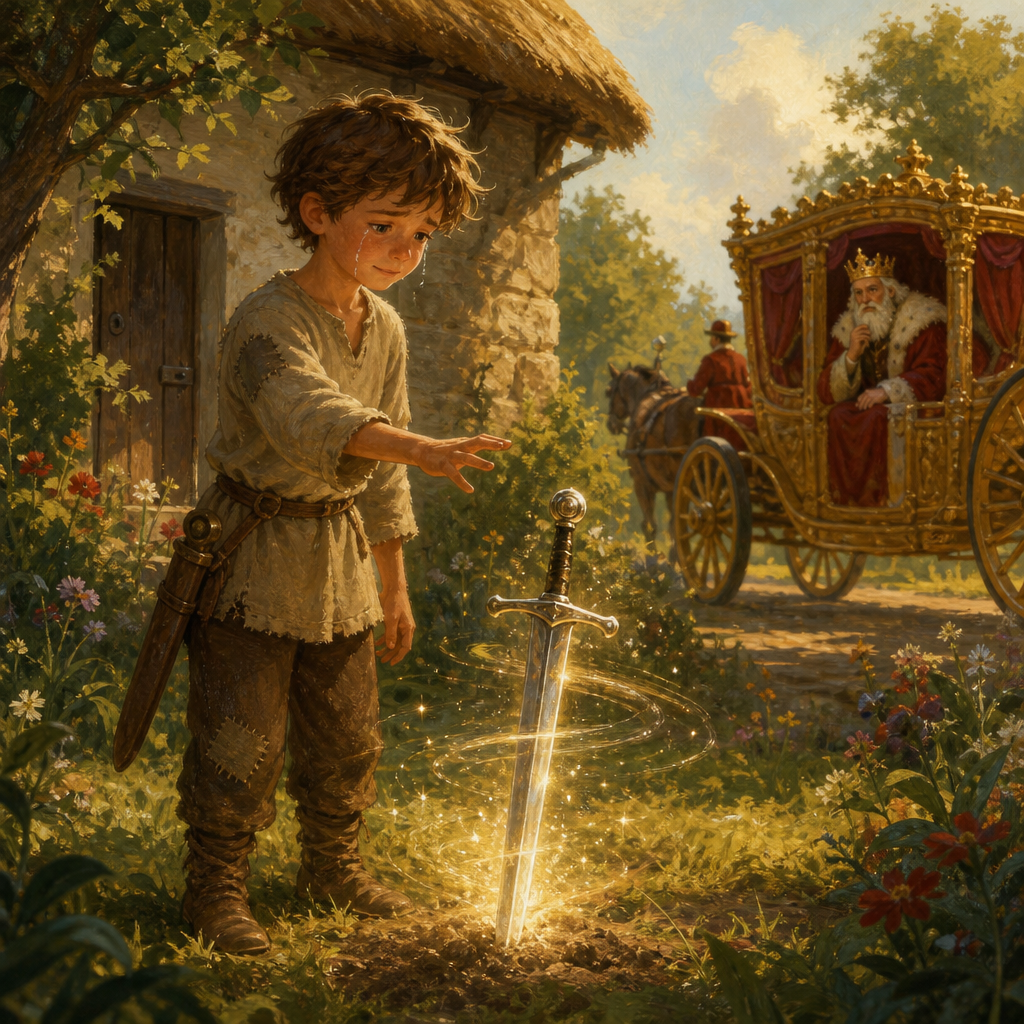
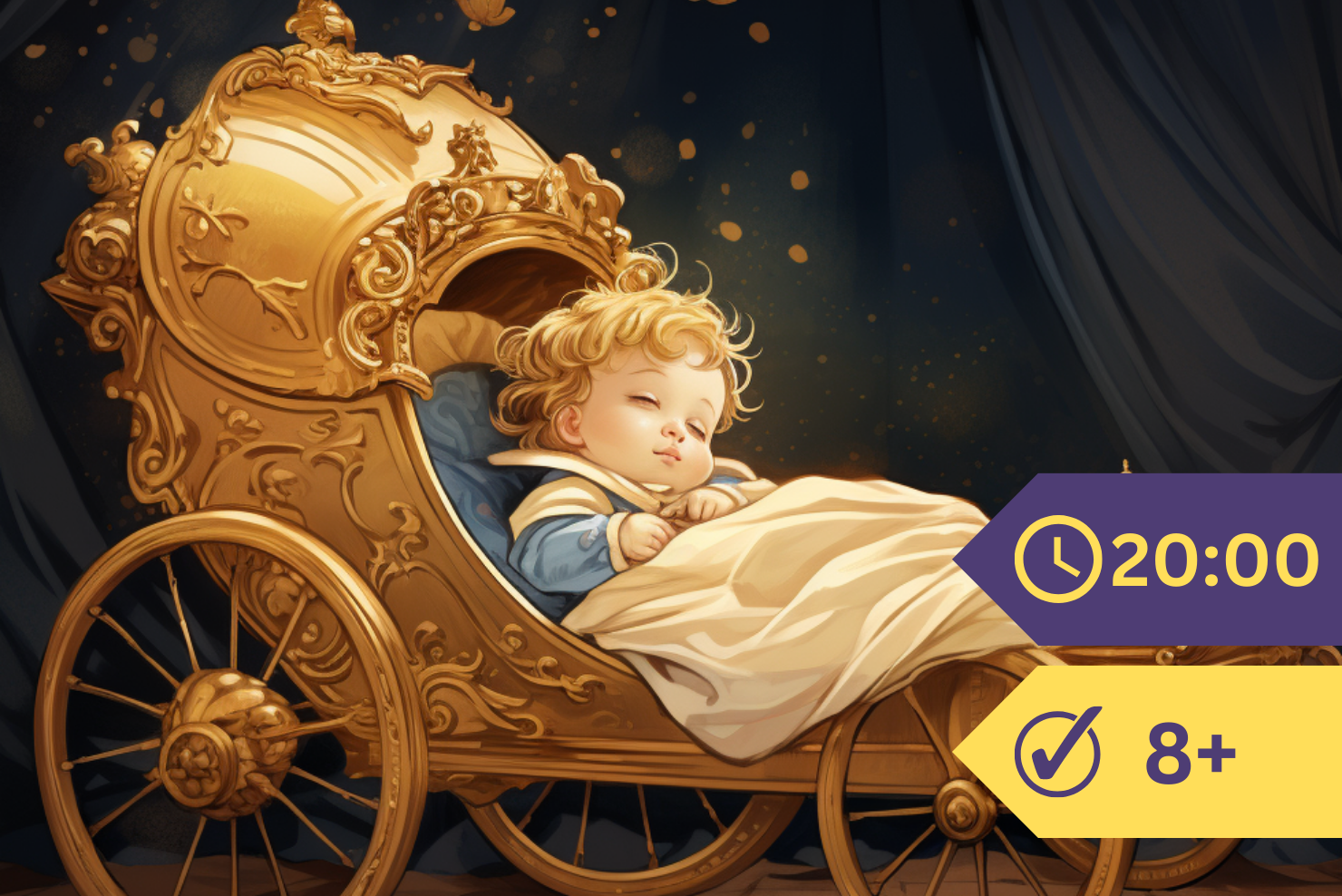
The king happened to drive by and heard the boy crying. He sent a servant to find out why. “His mother’s upset with him,” the servant reported. “Bring him here and tell him the king himself sends for him, and that the king can’t bear to hear anyone cry.” The boy wiped his eyes and came to the royal carriage.
“Will you be my son?” asked the king.
“If my mother allows it.”
The king sent word that if she’d give the boy to him, he’d grow up in the palace and marry the prettiest of his daughters. The widow was overjoyed and kissed the king’s hand. The boy asked permission to fetch something he’d left in the garden, and slid his sword into its scabbard. Then he climbed into the carriage.
On the way the king asked, “Why were you crying?”
“My mother was angry at me.”
“What about?”
“Because I wouldn’t tell her my dream.”
“Won’t you tell it to me?”
“Not even to you, Your Majesty. Not until it comes true.”
“I’m sure you will once we’re home,” the king said, smiling. But at the palace, none of the three princesses could coax it out of him either. “He’ll tell me,” said the eldest. “Not I,” said the boy. “He’ll tell me,” said the second. “Not I.” “He’ll tell me,” said the youngest, the prettiest of all. “I’ll tell nobody until it comes true.”
The king was sorry. He loved the boy dearly, but he couldn’t keep someone near him who refused every request. He sent him to live among the servants until he’d come to his senses. The sword clanked loudly as the boy was led off, but he said nothing. The servants were kind, their children shared their fruit, and he soon was cheerful again. He lived there for years.
The two older princesses married powerful kings across the sea. The youngest was picky, and turned up her nose at every suitor. One afternoon, when the king was at council and the queen was ill, she grew bored and wandered down to the servants’ quarters. Outside stood a youth, handsomer than any prince she had ever met, and she recognised him as her childhood playmate.
“Tell me your secret and I’ll marry you,” she said. He shook his head. She pushed. She stamped her foot. Angry, she ran to her father. “He insulted me.” The king, in a fury, ordered the young man put in a tower.
The princess had changed her mind by then, and met a mason on the road and asked him to cut a tiny hidden hole in the tower wall, big enough for a bottle and some bread. So the young man was walled up, but every morning she passed in food. Every third day the king’s secretary climbed a ladder and peered through a small window to check whether he was dead. Each time the report came back: he was fat and rosy. “There’s some magic here,” said the king.
One day a messenger arrived from a rival king across the border, with a letter and three canes. “My master asks which of these grew nearest the root, which in the middle, and which at the top. If you can’t tell, there will be war.” The king examined them and could see no difference. His daughter found him pale. “I’ll find the answer,” she said, and hurried to the tower.
“Go to bed as usual,” said the young man. “Tomorrow tell your father you dreamed the canes should be put in warm water. The one that sinks grew nearest the root; the one that floats, at the top; the middle one hangs between.”
It worked, and the rival king never knew how. The next year a letter came with three foals: which was born in the morning, which at noon, which at night? “If you can’t answer in three days, I’ll declare war.” The king despaired. The princess ran down to the tower again. “Pretend to scream in your sleep,” said the young man. “Say you dreamed the boy in the tower knew the answer.”
The tower was pulled down and the young man brought before the king. “I didn’t think you could survive so long without food. You’ve had time to think. If you can help me, I’ll pardon you.” The young man asked for three troughs, one with oats, one with wheat, one with barley. “The foal that eats oats was born in the morning; the one that eats wheat, at noon; the one that eats barley, at night.” There was no war that year.
The rival king was furious and consulted his aunt, a witch. “The king is too dull to have solved your riddles,” she said. “It’s the son of a poor widow, who, if he lives, will become King of Hungary. Get him here and be rid of him.” A new letter demanded the young man at once, alone. The king was heartbroken, but the young man only laughed. “Find me two lads exactly alike, and I’ll paint a mask to match.”
They found twin brothers, and the young man painted a mask so perfect that no one could tell the three apart. They set out together. At the rival court, they answered questions in unison, sat when one sat, rose when another rose. The rival king couldn’t tell them apart. “One has a cut in his sleeve tomorrow,” said the witch, and in the night she slipped into their room and snipped one sleeve. But the young man saw it first and cut the other two to match. At breakfast three cut sleeves. “I’m tired of this,” said the rival king. “Let them go home.”
The princess welcomed him back with joy, but not for long. A new demand came: send the young man alone. “Don’t cry,” he told her. “I’ll go at sunrise.” The witch waited at the gate and whispered, “You’ll never come out.” The sword clanked, and he did not look at her. As he crossed the threshold, fifteen armed men barred his way with the king at their head. The sword leapt from its scabbard and swept through them like a gale, scattering them, and went quietly back. That night the witch tried to steal the sword; it jumped out and lopped off her nose, which was iron and clanged on the floor. In the morning the king brought a whole army to capture him. The sword scattered them all, and the young man did not have a scratch.
At home the princess was in despair; he had been gone so long. She was leading troops herself, in uniform, when she met him on the road, with his little sword at his side. The troops cheered. The king announced that the young man had proved himself worthy to marry his daughter and rule the kingdom. But the young man said, “First I must see my mother.”
He rode home in state with a bodyguard. The old woman was frightened to see such an array at her door, and still more surprised when a handsome young man dismounted and kissed her hand. “Now, mother, you’ll hear my secret at last. I dreamed I would become King of Hungary, and my dream has come true. When I was a child and you begged me, I had to keep silent, or the king might have destroyed me. And if you hadn’t pressed me, none of this would have happened.”