In a part of Arabia where groves of palms and sweet-scented flowers give travellers rest after long journeys under burning skies, a young king named Lino reigned. He had grown up under the wise rule of his father, who had recently died. Though he was only nineteen, he didn’t believe, as many young men do, that he must change all the laws to show how clever he was. He was happy with the old ones, which had made the people content and the country prosperous. His subjects had only one complaint about him: he didn’t seem in any hurry to marry, in spite of their frequent prayers.
The neighbouring kingdom was ruled by the Swan Fairy, whose only daughter, Princess Hermosa, was as charming in her way as Lino was in his. The Swan Fairy kept an ambassador at the young king’s court. When he heard the citizens grumbling that Lino showed no sign of taking a wife, the good man decided to try his hand at matchmaking. “If there is anyone living who deserves Princess Hermosa,” he said, “it’s here. At least I can try to bring them together.”
Of course, it wouldn’t have been proper to offer the princess in marriage, and the trick was to work on the unsuspecting king so that the proposal would come from him. But the ambassador was used to the ways of courts. After several conversations about painting, which Lino loved, he led the talk to portraits and mentioned carelessly that a fine picture of his own princess had recently been painted. “Though as a likeness,” he added, “it’s perhaps hardly as good as this small miniature, painted a year ago.”
The king took it and looked closely.
“Ah,” he sighed, “this must be flattered! No woman could be such a miracle of beauty.”
“If you could only see her,” said the ambassador.
The king didn’t reply, but the ambassador wasn’t at all surprised when he was sent for the next morning.
“Since you showed me that picture,” Lino began, almost before the door was shut, “I haven’t been able to get the princess’s face out of my head. I’ve called you here to tell you I’m going to send special envoys to the Swan Fairy’s court to ask for her daughter’s hand.”
“I can’t speak for my mistress in so important a matter,” said the ambassador, stroking his beard to hide his satisfaction. “But I know she’d be highly honoured by your proposal.”
“If that’s so,” cried the king, beaming, “then instead of sending envoys I’ll go myself and take you with me. My preparations will be ready in three days, and we’ll set out.”
Unluckily for Lino, on his other side lived a powerful magician named Ismenor, king of the Isle of Lions, who had a daughter named Riquette. She was vain and sharp-tempered, and her father thought her the most wonderful creature who ever lived. Riquette had also fallen in love with a portrait, and it was of King Lino. She begged her father to give him to her as a husband. Ismenor, who thought no man alive deserved his treasure, was about to send his chief minister to King Lino when he learned that the king had already left for the Swan Fairy’s court. Riquette was beside herself and begged her father to prevent the wedding, and Ismenor promised he would. He called for a sly little groom named Rabot, cast some spells, and carried them both to a rocky valley through which the king and his escort were bound to pass. When he heard hooves, the magician took out an enchanted handkerchief that made anyone touching it invisible. He gave one end to Rabot and held the other himself, and they walked unseen among the horsemen. But there was no sign of Lino. That was natural, because the king, tired out by the excitement and effort of the last few days, had sent the heavy coaches laden with presents for the princess ahead and stopped to rest under the palms with a few friends. There Ismenor found them all sound asleep. He cast a spell to keep them from waking until he wished, stripped the king of his clothes and dressed him in Rabot’s. Then he touched Rabot with his ring and said:
“Take the shape of Lino until you have married the daughter of the Swan Fairy.”
So great was the magician’s power that Rabot truly believed he was the king!
When the groom had mounted Lino’s horse and ridden off, Ismenor woke the king, who stared in astonishment at the grubby clothes he was wearing. Before he could look around, the magician swept him up in a cloud and carried him off to his daughter.
Meanwhile Rabot caught up with the others, who never guessed he wasn’t their master.
“I’m hungry,” he said. “Give me something to eat at once.”
“If Your Majesty pleases,” said the steward, “the tents aren’t even pitched, and supper will be an hour at least. We thought…”
“Who taught you to think?” said the false king rudely. “You’re a fool! Get me some horsemeat right now. It’s the best meat in the world!”
The steward could hardly believe his ears. King Lino, the most polite man under the sun, speaking to a faithful servant that way! And wanting horsemeat! He was so delicate in his appetite that he lived mostly on fruit and cakes. Well, well, you never knew what people would come to, and anyhow the steward had better obey at once if he wanted to keep his head on his shoulders. Perhaps love had driven the king mad, and he’d come right again later.
Whatever excuses the old servants made for their master, by the time the procession reached the Swan Fairy’s capital, there were no horses left, and they had to walk up to the palace on foot. Hiding their surprise as best they could, they begged the king to follow them. The Swan Fairy and her daughter were waiting on a low balcony, and the king stopped underneath.
“Madam,” he said, “you may be surprised that I’ve come to ask for your daughter’s hand in so informal a way. But the journey is long, I was hungry and ate my horse, which is the best meat in the world, and I made my courtiers eat theirs too. But for all that I’m a great king and I want to be your son-in-law. Now that’s settled, where’s Hermosa?”
“Sire,” said the queen, not a little displeased and amazed, “you have my daughter’s portrait. If it made so little impression on you that you don’t recognise her at once…”
“I don’t remember any portrait,” said Rabot. “Perhaps it’s in my pocket.” He searched everywhere while the ladies-in-waiting looked on, astonished, but of course found nothing. When he’d finished, he turned to the princess, who stood there blushing and angry. “If it’s you I’ve come to marry, I think you’re very beautiful. If I’d seen your portrait, I’m sure I’d have remembered it. Let’s have the wedding as soon as possible. Meanwhile, I’d like to go to sleep, because your country is very different from mine and after walking over stones and sand for days one needs a rest.”
And without waiting for a reply he told a page to lead him to his room, where he was soon snoring so loudly he could be heard at the other end of town.
As soon as he was out of sight, the poor princess threw herself into her mother’s arms and burst into tears. For fifteen days she’d had King Lino’s portrait constantly before her, and the letter from their ambassador about the young man’s grace and charm had never left her pocket. True, the portrait was a faithful likeness, but how could so fair an outside hold so rough and rude a soul? She might even have forgiven that if he’d shown any of the signs of love and admiration she was used to. As for her mother, the poor Swan Fairy was so bewildered by her son-in-law’s extraordinary manners that she could hardly speak.
Things were in this state when King Lino’s chamberlain asked for a private audience with the queen. As soon as they were alone he told her he feared his master had suddenly gone mad or fallen under some magician’s spell.
“I was astonished before,” he said. “But now that he’s failed to recognise the princess and no longer has her portrait, which he never parted with for an instant, my amazement knows no bounds. Perhaps, madam, your fairy gifts can find the cause of this change in a man whose courtesy was the talk of the kingdom.” With a low bow, he left.
The queen stood thinking hard. Suddenly her face cleared. She went to an old chest in a secret room and took out a small mirror. In this mirror she could see faithfully reflected whatever she wished, and at that moment she most wished to see King Lino as he really was.
The chamberlain was right! The man snoring on the bed until the whole palace shook was not the king. Her real son-in-law was in dirty clothes, locked in one of Ismenor’s strongest towers, kissing the portrait of Hermosa. It had escaped the magician’s notice because Lino had hidden it, tied up in his hair. She called her daughter and told her to look too, and Hermosa had the pleasure of gazing at Lino, who was behaving exactly as she could have wished. The mirror was still in her hand when the prison door opened and in came Riquette, who seemed from her raised eyes to be begging Lino for some favour, which he refused. Of course Hermosa and her mother couldn’t hear what was said, but from Riquette’s angry face as she stormed out, it was easy to guess. Then the mirror showed more: Riquette, furious at being rejected, had ordered him left in the cold, dark cell with nothing to eat, and Hermosa, in horror, dropped the mirror and would have fallen if her mother hadn’t caught her.
“Control yourself, my child,” said the fairy. “We need all our wits if we’re to rescue the king from these wicked people. First we must learn who the man is who has taken his name and face.”
She picked up the mirror and wished to see the false lover, and the glass showed a dirty, greasy groom lying in her state bed in his stable clothes.
“So this is Ismenor’s trick! We’ll have our revenge, whatever it costs. But we must be careful not to let him guess we know, because his magic is stronger than mine and I must be prudent. First I’ll leave you, and if the false king asks why, say I’ve had to settle some matters on the borders of my kingdom. Meanwhile treat him politely and arrange festivals to amuse him. If he seems suspicious, you can even give him to understand that, when you marry, I intend to hand the crown over to your husband. Now goodbye!” The Swan Fairy waved her hand and a cloud came down and hid her. No one imagined that the beautiful white cloud blowing so fast across the sky was the chariot carrying the Swan Fairy to Ismenor’s tower.
The tower stood in the middle of a forest, so the queen thought that under cover of the dark trees she could easily slip to earth unseen. But the tower was so thoroughly enchanted that the more she tried to reach the ground, the harder something held her back. At last, with all her power, she managed to descend to the foot of the tower, and there, weak and faint, she began working her spells. She found that she could only beat Ismenor with a stone from the ring of Gyges. But how was she to get the ring? Her magic book told her Ismenor guarded it day and night among his most precious treasures. She must have it, though, and meanwhile the first step was to see the royal prisoner himself. So she took out her tablets and wrote:
The bird that brings you this letter is the Swan Fairy, mother of Hermosa, who loves you as much as you love her.
She went on to tell him of the wicked plot he’d been the victim of. Then she changed quickly into a swallow and began to circle the tower until she found the window of Lino’s prison. It was so high that bars seemed unnecessary, especially since four soldiers stood in the passage outside, so the fairy was able to enter and even hop onto his shoulder. But he was so busy gazing at the princess’s portrait that it was some time before she could get his attention. At last she gently scratched his cheek with the corner of the note, and he looked round with a start. Seeing the swallow, he knew help had come. He tore open the letter and wept for joy at the words in it, and asked a thousand questions about Hermosa that the swallow couldn’t answer, though by repeated nods she signalled him to read on. “Must I really pretend to want to marry that horrible Riquette?” he cried when he’d finished. “Can I get the stone from the magician?”
So the next morning, when Riquette paid her daily visit, he received her far more graciously than usual. The magician’s daughter couldn’t contain her delight at the change. When she said so, Lino told her that he’d had a dream that had revealed Hermosa’s unfaithfulness, and that a fairy had appeared and told him that if he wished to break the bonds tying him to the faithless princess and give his heart to Ismenor’s daughter, he must have a stone from the ring of Gyges, now owned by the magician, for a day and a night. Riquette was so enchanted that she flung her arms round the king’s neck and kissed him, much to his disgust. He would much rather have faced the soldiers’ sticks. But there was nothing for it, and he did his best to look pleased until Riquette relieved him by saying she must lose no time asking her father for the precious stone.
The request came as a great surprise to Ismenor, and at once his suspicions were aroused. But however he thought about it, he couldn’t see how the king, so closely guarded, could have spoken to the Swan Fairy. Still, he would do nothing hastily. Hiding his alarm, he told Riquette his only wish was to make her happy, and since she wanted the stone so much, he would fetch it. He went into the room where he worked his spells, and soon found that his enemy the Swan Fairy was at that moment inside his grounds.
“So that’s it!” he said, smiling grimly. “She shall have a stone, by all means, but a stone that will turn anyone who touches it to marble.” He placed a small ruby in a box and returned to his daughter.
“Here is the talisman that will win you King Lino’s love,” he said. “But be sure to give it to him unopened, or the stone will lose all its power.” With a cry of joy, Riquette snatched the box and ran to the prison, followed by her father, who held the enchanted handkerchief tight so that he could watch invisibly. As he expected, the Swan Fairy was waiting at the foot of the tower for the stone that the king was to throw down to her, having been careless enough to appear in her own shape. She eagerly caught the box as it fell from the king’s hands, but the moment her fingers touched the ruby, she felt a strange hardening, her limbs stiffened, and her tongue could barely say the words: “We are betrayed.”
“Yes, you are betrayed!” cried Ismenor in a terrible voice. “And you,” he said, dragging the king to the window, “shall turn into a parrot, and remain a parrot until you can persuade Hermosa to crush your head.”
He’d barely finished before a blue parrot flew out into the forest. The magician got into his winged chariot and flew to the Isle of Swans, where he turned everyone into statues, just as he found them, even Rabot. Only Hermosa was spared, and he ordered her into his chariot beside him. In a few minutes they reached the Forest of Wonders, where the magician got down and dragged the unhappy princess out after him.
“I’ve turned your mother to stone and your lover into a parrot,” he said, “and you are to become a tree, and a tree you will remain until you crush the head of the person you love best in the world. But I’ll leave you your mind and memory, so your suffering will be a thousand times worse.”
Ismenor could not have invented a more terrible fate if he’d tried for a hundred years. The hours dragged for the poor princess, who longed for a woodcutter’s axe to end her misery. How could they be freed? And even if King Lino did fly that way, there were thousands of blue parrots in the forest. How would she know him, or he her? As for her mother, that was too awful to think about. So, being a clever woman, she kept on thinking.
Meanwhile the blue parrot flew around the world, making friends wherever he went, until one day he came to the castle of an old wizard who had just married a beautiful young wife. Her name was Grenadine, and she had a very dull life and was delighted to have a playmate. She gave him a golden cage to sleep in and delicious fruits to eat. There was only one way he disappointed her: he never talked like other parrots.
“If you only knew how happy it would make me, I’m sure you would try,” she often said. But the parrot didn’t seem to hear.
One morning she left the room to pick flowers. Finding himself alone, the parrot hopped onto the table, took up a pencil, and wrote some verses on a piece of paper. He’d barely finished when a noise startled him. He dropped the pencil and flew out the window.
No sooner had he dropped it than the wizard lifted a corner of the curtain over the doorway and came into the room. Seeing a paper on the table, he picked it up, and was astonished to read:
Fair princess, to win your grace, I will hold discourse with you; Silence, though, were more in place Than chatt’ring like a cockatoo.
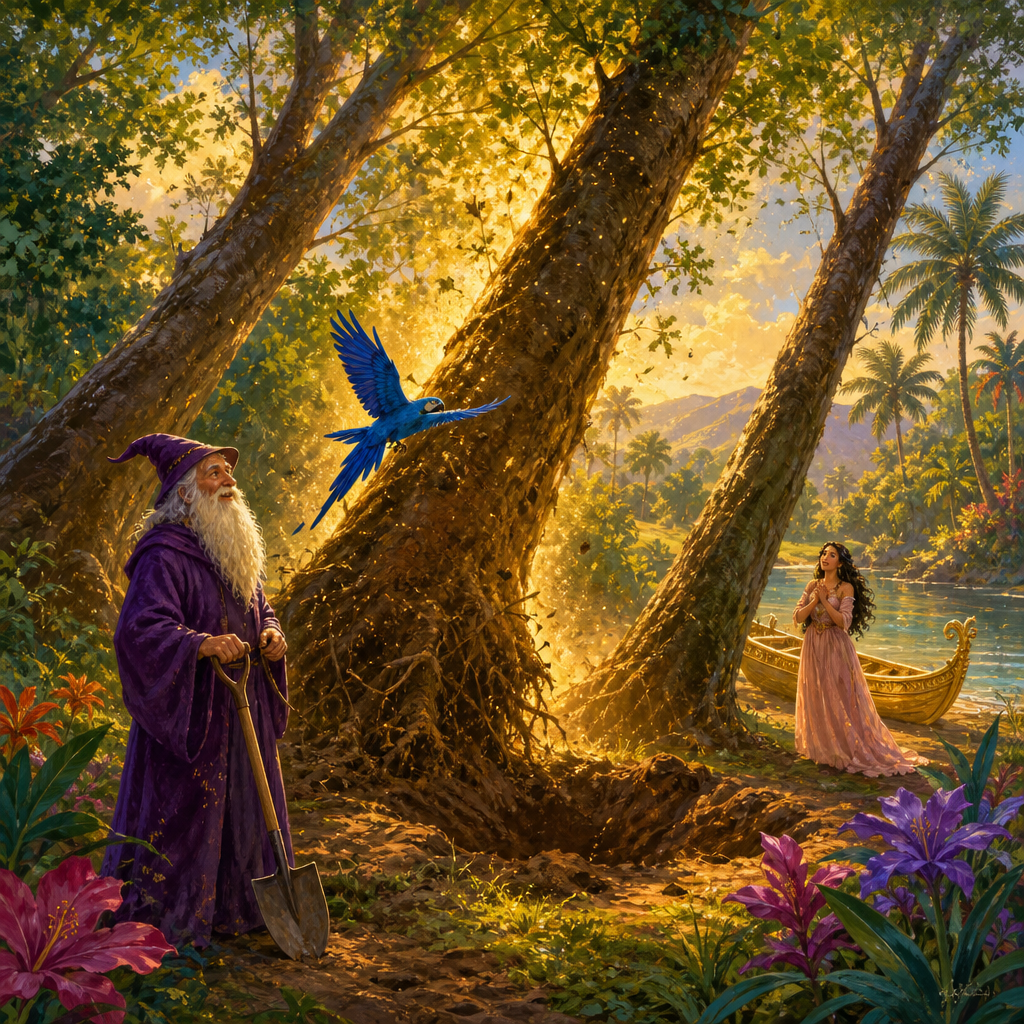
“I half suspected it was enchanted,” the wizard murmured. He fetched his books and searched them, and found that the bird was in fact a king who had fallen under the wrath of a magician, and that magician was the man the wizard hated most in the world. He read on eagerly in search of a way to break the spell and at last, to his great joy, found the cure. He hurried to his wife, who was lying on cushions under the tree where the parrot perched, and told her that her favourite was really the king of a great country. If she would whistle for the bird, they’d all go to a certain spot in the Forest of Marvels, “where I’ll restore him to his own shape. But you mustn’t be afraid or cry out, whatever I do,” he added, “or everything will be spoiled.” The wizard’s wife jumped up, delighted, and began to whistle the song the parrot loved. The parrot, who didn’t want it known that he’d been listening, waited until she turned her back and then flew down and landed on her shoulder. They climbed into a golden boat that carried them to a clearing in the forest where three tall trees stood by themselves.
“I need these trees for my magic fire,” said the wizard to his wife. “Put the parrot on that branch, he’ll be perfectly safe, and go yourself to a little distance. If you stay too close you might get your head crushed when they fall.”
At these words the parrot suddenly remembered Ismenor’s prophecy and held himself ready, his heart beating at the thought that one of those trees might be Hermosa. Meanwhile the magician took a spade and loosened the earth around the roots of all three trees so they would fall together. The moment the parrot saw them totter, he spread his wings and flew right under the middle one, which was the most beautiful. There was a crash, and then Lino and Hermosa were standing face to face, hand in hand.
After the first moments, the princess thought of her mother. She fell at the feet of the wizard, who was smiling with delight at the success of his plan, and begged him to help them once more and give the Swan Fairy back her shape.
“That isn’t easy,” he said, “but I’ll see what I can do.” He transported himself to his palace to fetch a little bottle of poisoned water, waited until nightfall, then set out for Ismenor’s tower. Had Ismenor consulted his books he would have seen what his enemy was doing and protected himself, but he’d eaten and drunk too much and gone to bed and was sleeping heavily. The wizard turned himself into a bat, flew into the room, hid in the curtains and poured all the liquid over Ismenor’s face, and the magician died without a groan. At that very moment the Swan Fairy became herself again, because no magician, however powerful, can cast spells that last beyond his own life.
When the Swan Fairy returned to her capital, she found all her courtiers waiting at the gate to welcome her. In their midst, beaming with happiness, stood Hermosa and King Lino. Standing behind them, though a long way off, was Rabot. His dirty clothes had been replaced by clean ones, since his heartfelt wish was granted and the princess made him head of her stables.
And here we must say goodbye to them all, sure that they had many happy years ahead after the terrible trials they had been through.