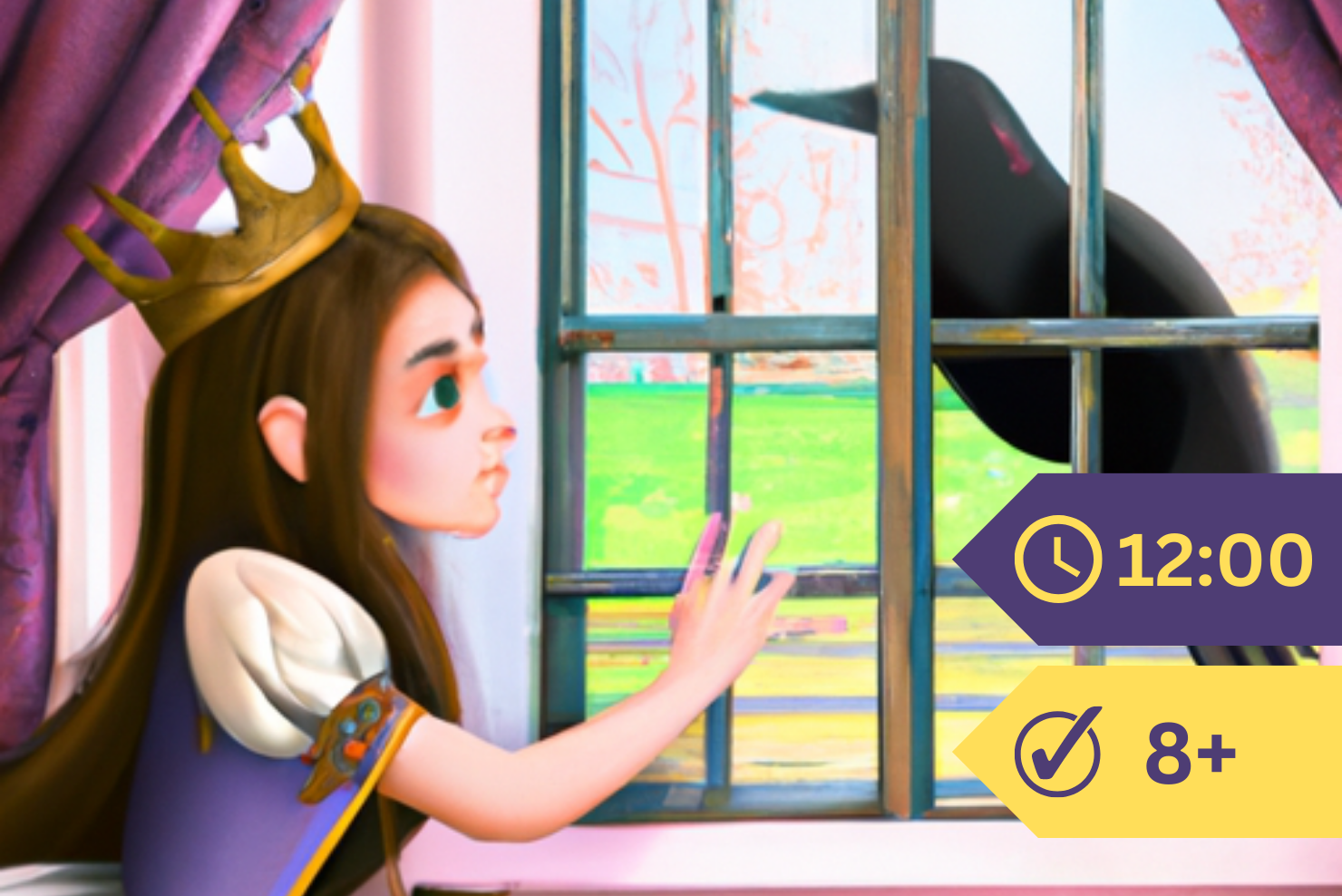
Three soldiers served in the same army: a Scot, an Englishman and an Irishman. One day they decided to run away at the first chance. The chance came, and they took it. For two days they traveled through a great forest with nothing to eat or drink and not a house in sight, and every night they climbed into the trees to keep away from wild animals. On the second morning the Scot saw a great castle far away from the top of his tree. He thought to himself that he would surely die if he stayed in the forest with nothing but grass roots to eat. As soon as he came down, he set off for the castle without a word to the others. (Perhaps hunger had changed their natures, so that each cared only about saving himself.) He walked most of the day, and it was late when he reached the castle, where he found nothing but closed doors and no smoke rising from the chimneys. He thought there was nothing left but to die, and lay down by the wall. Then he heard a window open high above him, looked up, and saw the most beautiful woman he had ever seen.
“It must be luck that sent you to me,” he said.
“It is,” she said. “What do you need?”
“Food and drink. I’m dying of hunger.”
“Come in. There’s plenty of both here.”
He went in. She opened a large room where a number of men lay fast asleep, set food in front of him, and then showed him to a bed in the same room. He lay down and fell into a deep sleep.
Now back to the two he’d left behind. When night fell, the Englishman climbed into the same tree the Scot had used, and at dawn he looked around in all directions and saw the castle too. He set off without a word to the Irishman, and everything happened to him just as it had to the Scot.
The Irishman was left alone, sad and puzzled about where the others had gone. When night came he climbed into the same tree. At dawn he saw the castle and set off for it. He found no smoke or sign of life. But soon he heard the window open overhead, and looked up and saw the most beautiful woman. He asked for food and drink, and she answered kindly and heartily that he could have both if he came inside. He gladly did, and she set before him food and drink finer than he’d ever seen. The room had a bed with diamond rings hanging from every loop of the curtains, and everything in it astonished him so much that he forgot he was hungry. Seeing that he wasn’t eating, she asked what he wanted, and he said he wouldn’t eat or drink until he knew who she was, where she’d come from and who had put her there.
“I’ll tell you,” she said. “I’m an enchanted princess. My father promised that whoever frees me from the spell will have a third of his kingdom while he lives and all of it after he dies, and he’ll marry me too. If I ever saw a man likely to manage it, it is you. I’ve been here sixteen years, and no one who ever came to this castle has asked me who I am except you. All the others lie asleep in the big room downstairs.”
“Tell me, then,” said the Irishman, “what’s the spell, and how can you be freed?”
“There’s a little room here. If a man can stay in it from ten o’clock till midnight three nights in a row, I’ll be free.”
“I’m your man,” he said. “I’ll do it.”
She brought him a pipe and tobacco, and he went into the room. Before long he heard hammering and knocking on the outside of the door, and a voice told him to open it.
“I won’t,” he said.
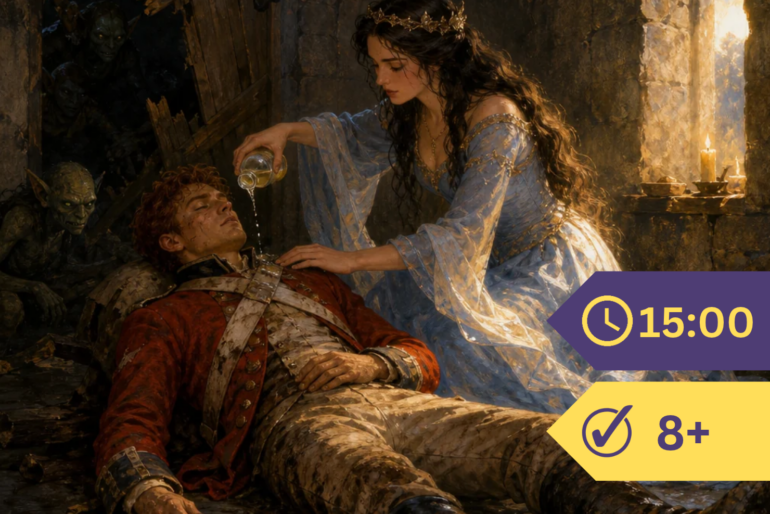
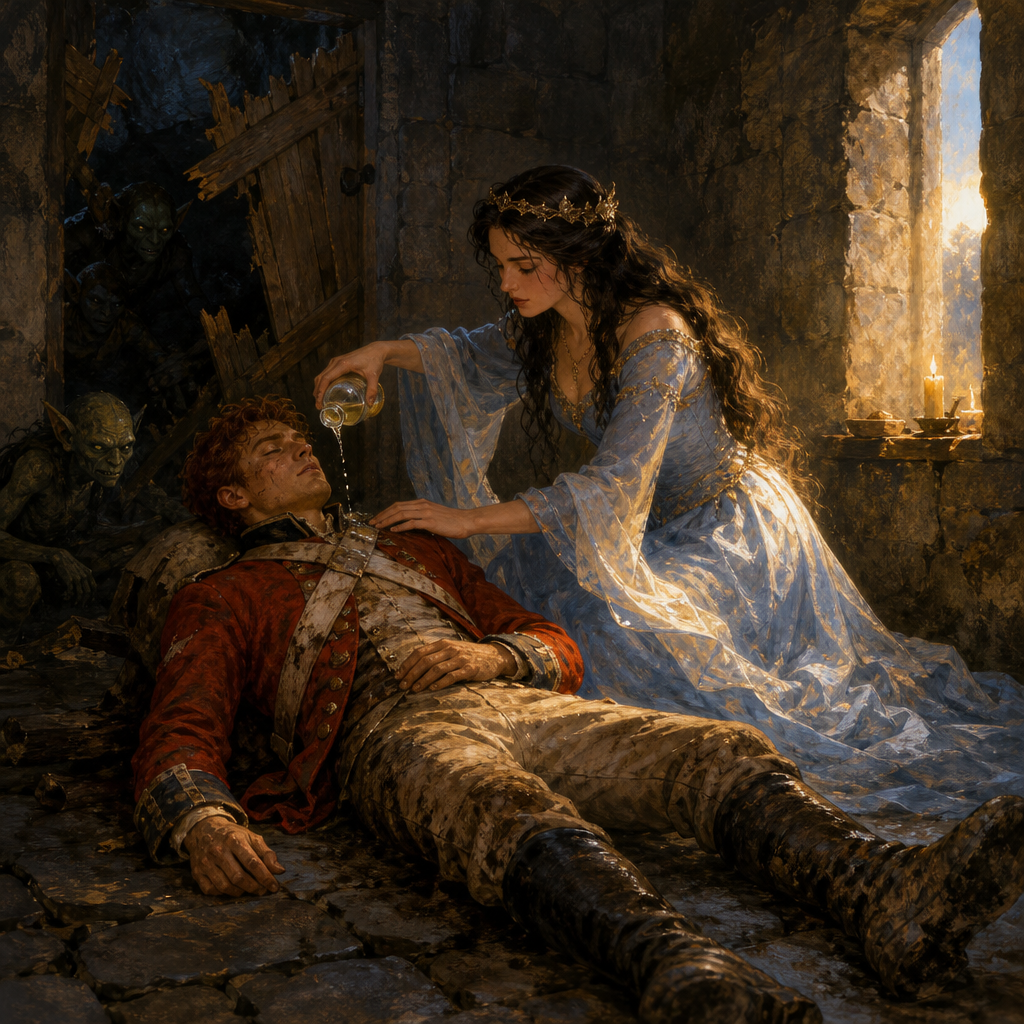
The next moment the door flew in, and the creatures behind it with it. They knocked him down, kicked him, and knelt on his body till midnight. Then the cock crowed and they vanished. By then he was more dead than alive. When daylight came, the Princess found him lying on the floor, unable to speak. She took a bottle and rubbed him from head to toe, and he was as sound as ever. But after what he’d been through, he didn’t want to try again. She begged him to stay, saying the next night wouldn’t be so bad, and at last he gave in.
Near midnight he heard them ordering him to open the door, and this time there were three for every one the night before. He didn’t move to go out or open the door, but before long they broke it down and were on top of him. They grabbed him and tossed him up to the ceiling, or leapt over him, until the cock crowed and they all disappeared. In the morning the Princess went to see if he was alive, held the bottle to his nose, and he came to. The first thing he said was that he’d be a fool to keep getting himself half-killed for anyone he’d ever seen, and he was leaving. She pleaded: one more night would free her. “And if there’s a single spark of life in you at dawn, this bottle will make you as sound as ever.”
He stayed. That night there were three for every one of the night before, and it didn’t seem likely he’d see morning. At dawn the Princess found him lying on the floor as if dead. She couldn’t tell whether he was breathing. She put her hand on his wrist and found a faint pulse. She poured the contents of the bottle over him, and before long he stood up as well as ever. The business was finished, and the Princess was free of the spell.
She told him she had to leave for now but would come back in a few days in a carriage drawn by four grey horses. He said, “Don’t go! I’ve paid dearly for you these three nights, and now you’re leaving?” But in the blink of an eye she was gone. Before she went, she’d given him a little rod that would wake the sleeping men, some of whom had been asleep for sixteen years.
Left alone, he lay down on three chairs, and in came a little fair-haired boy.
“Where did you come from, lad?”
“I’ve come to prepare your food.”
“Who told you to?”
“My mistress, the Princess who was under the spell and is now free.”
So the Irishman knew she had sent the boy to wait on him. The boy also told him that his mistress wanted him ready at nine o’clock the next morning, when she’d come for him in the carriage as promised. He was delighted. Next morning, as the time drew near, he went out into the garden. But the little fair-haired boy took a big pin from his pocket and stuck it in the back of the Irishman’s coat without his noticing, and he fell sound asleep.
Soon the Princess arrived in her carriage with four horses and asked the boy if his master was awake. “No,” said the boy. “That’s a shame,” she said. “When the night isn’t long enough for him to sleep! Tell him that if he doesn’t meet me here at this time tomorrow, he’s unlikely ever to see me again.” As soon as she was gone, the boy pulled the pin out and the Irishman woke at once. “Have you seen her?” he asked.
“Yes. She told me to say that if you don’t meet her at nine tomorrow, you’ll never see her again.”
He was heartbroken, and couldn’t understand why sleep had fallen on him just when she was coming. He went to bed early, to rise in time. When nine o’clock approached, he went out to the garden to wait, with the boy beside him. But the boy took the chance to stick the pin in his coat again, and he fell asleep as before. At nine exactly the Princess arrived and asked if his master was up. “No, he’s asleep, as he was yesterday.” “Oh dear,” she said. “I’m sorry for him. Wasn’t last night’s sleep enough? Tell him he’ll never see me here again. Here’s a sword to give him from me, and my blessing with it.”
She left, the boy pulled out the pin, and the Irishman woke. “Have you seen her?” The boy said yes, and showed him the sword. The Irishman was ready to throttle the boy out of sheer vexation, but when he glanced over his shoulder, the boy had vanished.
Alone, he thought to go into the room where the men lay asleep. There among them he found his two comrades who’d run away with him. He remembered what the Princess had said, touched them with the rod, and they woke at once. He gave them as much silver and gold as they could carry when they left. It took him a long time to wake all the others, because the two castle doors were crowded with them all day.
But the loss of the Princess nagged at him day and night. Finally he decided to travel the world and see if anyone could tell him where she was. He took the best horse in the stable and set out. For three years he traveled through forests and wildernesses, and found no one who could tell him anything. At last he fell into such despair that he almost gave up. Then, as he drew the sword she’d sent him, he noticed writing along one side of the blade: You will find me in the Blue Mountains. That gave him new heart. He decided to go on in hope of finding someone who could tell him where the Blue Mountains were. After riding a long way without thinking where he was headed, he saw a distant light and rode toward it. It came from a little house, and when the man inside heard the horse’s hooves he came out to see who it was.
“I’ve lived here three hundred years,” said the old man, “and in all that time I haven’t seen a single human being but you.”
“I’ve been wandering for three years,” said the Irishman, “looking for anyone who can tell me where the Blue Mountains are.”
“Come in and stay the night. I have a book with the history of the world. I’ll go through it tonight, and if there’s a Blue Mountains in it, we’ll find out.”
The Irishman stayed, and at dawn the old man said he hadn’t slept a wink, but there wasn’t a word about the Blue Mountains. “I’ll tell you what: if there’s such a place, my brother knows. He lives nine hundred miles from here.” The Irishman said his horse would never manage nine hundred miles. “That doesn’t matter,” said the old man. “I have a whistle. Blow it, and you’ll be at my brother’s house before nightfall.”
He blew the whistle, and the Irishman couldn’t tell where on earth he was until he found himself at another old man’s door. This one also said it had been three hundred years since he’d seen anyone, and asked where he was going.
“I’m looking for someone who can tell me where the Blue Mountains are.”
“Stay tonight. I have a book of the world’s history. By daybreak I’ll know, if it’s in there at all.”
The Irishman stayed, but there wasn’t a word in the book. Seeing him downcast, the old man said he had a brother nine hundred miles away who might know, and he’d get him there before night with his whistle. He blew it, and the Irishman landed at the third brother’s door by nightfall. This old man, too, hadn’t seen anyone in three hundred years.
“Where are you going?”
“I’m asking for the Blue Mountains.”
“I’ve never heard of them. But if they exist, I’ll find them. I’m master of all the birds in the world. I only have to blow my whistle and every bird will come to me. I’ll ask each one where it came from, and if any can tell us about the Blue Mountains, that’s how we’ll learn.”
He blew his whistle, and all the birds of the world gathered. He asked each where it had come from, but none had come from the Blue Mountains. After he’d been through them all, he noticed a big Eagle was missing and wondered why. Soon he saw something huge in the sky, darkening it. It came closer and grew bigger, and it was the Eagle. When she landed, the old man scolded her for being late.
“I couldn’t help it,” she said. “I had twenty times farther to come than any bird here.”
“Where from?”
“The Blue Mountains.”
“Indeed! And what’s happening there?”
“They’re getting ready today for the wedding of the King’s daughter. For three years she’s refused to marry anyone, hoping the man who freed her from the spell would come. Now she can’t wait any longer, because three years is what she agreed with her father.”
The Irishman knew she’d been waiting for him, and despaired, for he had no hope of ever reaching the Blue Mountains. The old man saw how sad he looked, and asked the Eagle what she’d take to carry the man to the Blue Mountains on her back.
“Sixty cattle,” she said, “cut into quarters. Every time I look over my shoulder, he must throw a quarter into my mouth.”
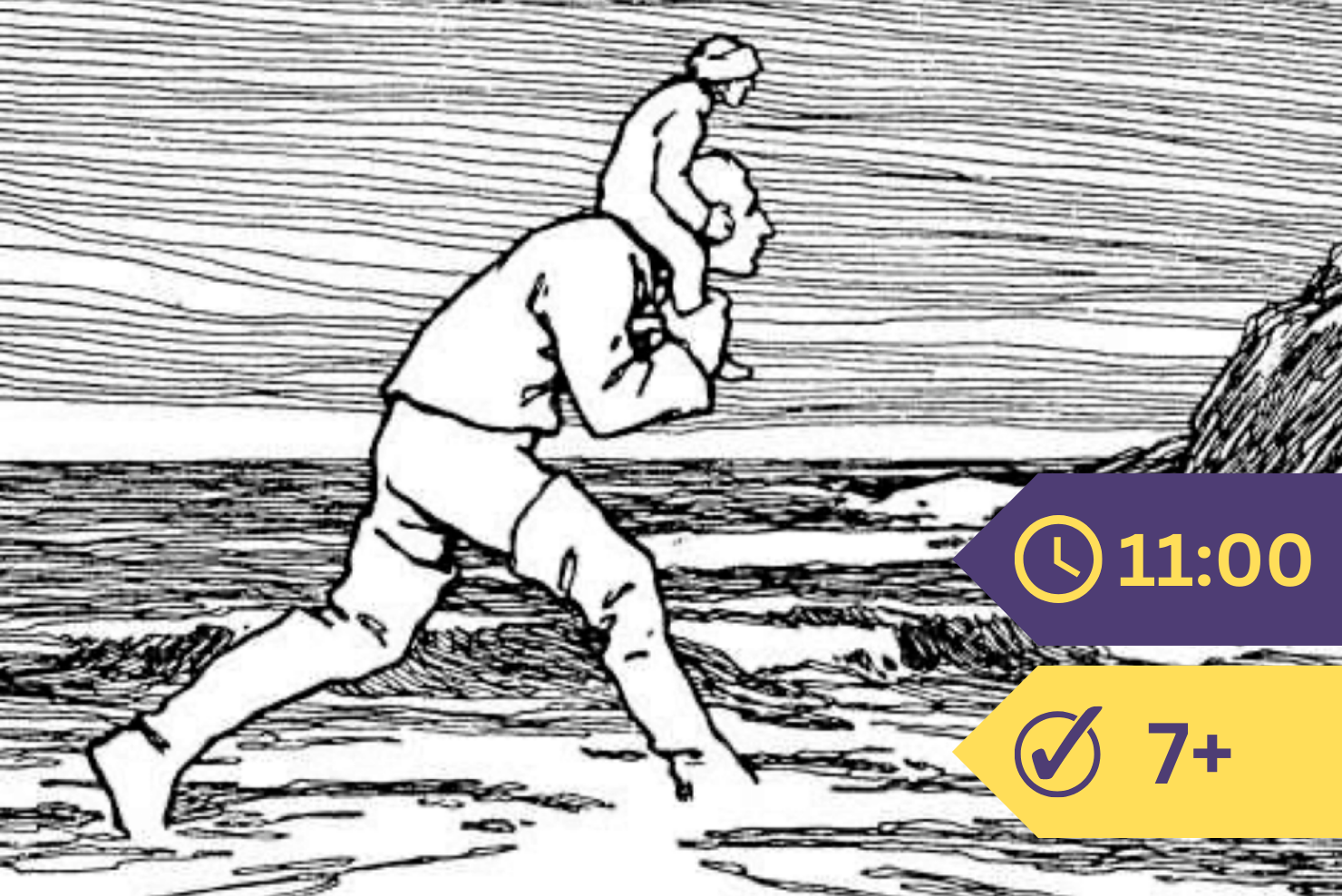
They went hunting and by evening had all the beef. They cut it into quarters as she’d told them. The Eagle lay down while they piled the meat on her back. They needed a ladder of fourteen steps to reach her back. Then the old man told the Irishman to mount and to throw a quarter of beef every time she looked round. At the old man’s word, the Eagle took off.
As they neared the borders of the Blue Mountains, the beef ran out. When the Eagle looked over her shoulder, the Irishman had nothing to feed her but a stone, which he threw between her tail and her neck. She turned a somersault and threw him off into the sea, into the bay in front of the King’s palace. Luckily his toes just touched the bottom, and he waded ashore.
In the town all the streets were bright with lights, and the Princess’s wedding was just beginning. He went into the first house he came to, which belonged to the King’s hen-wife.
“What’s all the noise and light?”
“The Princess is being married tonight against her will. She’s been waiting every day for the man who freed her from the spell.”
“Here’s a guinea for you. Go and bring her here.”
The old woman went, and soon returned with the Princess. She and the Irishman recognised each other. They were married, and the wedding went on for a year and a day.