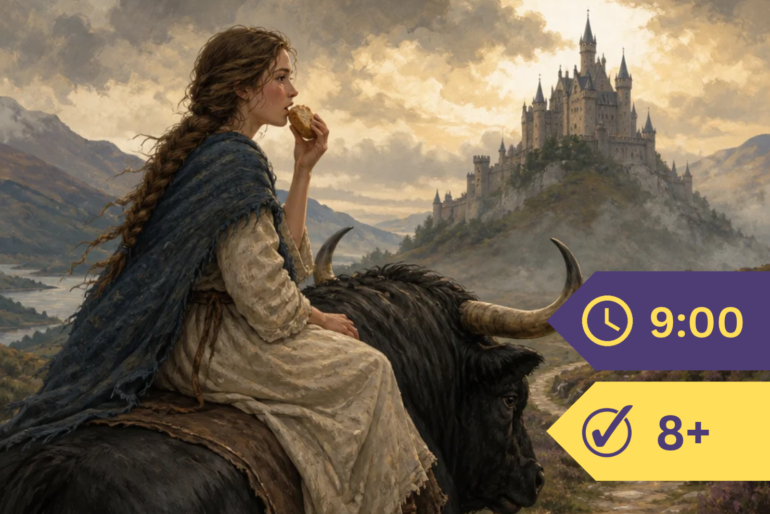
In Norway, long ago, there lived a lady with three daughters. One day the eldest said to her mother, “Mother, bake me a bannock and roast me a collop, for I’m going out to seek my fortune.”
Her mother did so, and the daughter set off for the house of an old witch-washerwife and told her purpose. The old woman told her to stay a while and look out of her back door each day to see what she could see. The first day, the girl saw nothing. The second day, nothing. On the third day she saw a coach-and-six coming along the road. She ran in and told the old woman.
“Well,” said the old woman, “that’s for you.” So they took her into the coach and galloped away.
The second daughter said the same to her mother, and went to the old woman, as her sister had done. On the third day she looked out of the back door and saw a coach-and-four coming along the road. “That’s for you,” said the old woman, and off she went.
Then the youngest daughter said, “Mother, bake me a bannock and roast me a collop, for I’m going to seek my fortune.” Her mother did so, and she went to the old witch-wife, who sent her to look out of the back door. The first day she saw nothing. The second day, nothing. On the third day she came back and said she had seen nothing but a huge Black Bull, coming roaring along the road.
“Well,” said the old woman, “that’s for you.”
When she heard this, the girl was nearly beside herself with grief and terror. But she was lifted onto the Bull’s back, and away they went.
On and on they traveled until the girl grew faint with hunger.
“Eat out of my right ear,” said the Black Bull, “and drink out of my left ear, and set aside what you don’t finish.”
She did as he said, and felt wonderfully refreshed. They went a long way, and a hard way, until at last they came in sight of a big and beautiful castle.

“We must stay there tonight,” said the Bull, “for my eldest brother lives there.”
Soon they were at the gates. The girl was lifted down and taken inside, and the Bull was sent off to a field for the night. In the morning she was taken into a fine, shining parlor and given a beautiful apple. “Don’t break it,” she was told, “until you are in the worst trouble any person ever was in. It will get you out of it.”
Then she was set on the Bull’s back again, and they traveled far, and farther than I can tell, until they came in sight of a still lovelier castle, much farther away than the first.
“We must stay there tonight,” said the Bull, “for my second brother lives there.”
Again she was lifted down and made welcome, and the Bull was sent to the field. In the morning she was taken into a rich and handsome room and given the finest pear she had ever seen. She was told the same thing: “Don’t break it until you are in the worst trouble there ever was, and it will get you out of it.”
Then she was lifted onto the Bull’s back, and away they went. They traveled a long way, and a hard way, until they came in sight of the biggest castle yet, and the farthest away.
“We must stay there tonight,” said the Bull, “for my youngest brother lives there.”
The same thing happened. In the morning she was taken into the finest room of all and given a plum, with the same warning: “Don’t break it until you are in the worst trouble anyone could be in, and it will get you out of it.” Then the Bull was brought back, and she was set on his back again.
On they went until they came to a dark and gloomy glen, where they stopped and the girl climbed down.
“Here you must stay,” said the Bull, “while I go and fight the Devil. Sit on that stone and don’t move hand or foot until I come back, or I’ll never find you again. If everything around you turns blue, I have beaten the Devil. But if everything turns red, he has conquered me.”
She sat down on the stone, and after a while everything around her turned blue. She was so overjoyed that her friend had won that she lifted one foot and crossed it over the other.
The Bull came back and searched for her, but he could never find her.
She sat there a long time, weeping, until she was worn out. At last she got up and wandered off, she didn’t know where. On she went until she came to a great hill of glass. She tried everything she could to climb it, but couldn’t. She went all around the bottom, sobbing and looking for a way over, until at last she came to a blacksmith’s house.
The smith said that if she would serve him for seven years, he would make her iron shoes to climb the glassy hill. At the end of seven years she got her iron shoes, climbed the glassy hill, and came to the old washerwife’s cottage.
There she heard about a gallant young knight who had left some bloodstained shirts to be washed. Whoever could wash them clean was to be his wife. The old woman had scrubbed until she was worn out, and then set her own daughter to it, and the two of them washed, and washed harder, hoping to win the knight. But try as they might, they couldn’t get out a single stain.
At last they set the stranger girl to work. The moment she began, the stains came out pure and clean. But the old woman told the knight it was her own daughter who had done it.
So the knight and the old woman’s daughter were to be married. The stranger girl was heartbroken, for she loved him dearly.
Then she remembered her apple. She broke it open and found it full of gold and jewels, the richest she had ever seen.
“All of these are yours,” she told the daughter, “if you will put off your wedding for one day and let me spend the night alone in his room.”
The daughter agreed. But the old woman had made a sleeping drink and given it to the knight, and he drank it and never woke until morning. All night long the girl sat by his bed, sobbing and singing:
Seven long years I served for thee,
The glassy hill I climbed for thee,
The bloody shirt I wrung for thee;
And wilt thou not waken and turn to me?
The next day she didn’t know what to do for grief. She broke open the pear and found it full of jewels far richer than those in the apple. With these she bargained for a second night in the knight’s chamber. But the old woman gave him another sleeping drink, and again he slept until morning. All night she sighed and sang as before.
He still slept, and she nearly lost all hope. But that day, while the knight was out hunting, someone asked him what the noise and moaning had been in his bedchamber all the night before. He said he’d heard no noise. But they assured him there had been, and he decided to stay awake that night and find out.
On the third night, with the girl caught between hope and despair, she broke her plum. It held the richest jewels of all. She struck her bargain as before, and the old woman took the sleeping drink to the knight’s chamber. But he told her he couldn’t drink it without some sweetening. While she went to fetch honey, he poured the drink away, so that when she returned she thought he had drunk it.
They all went to bed, and the girl began to sing, as before:
Seven long years I served for thee,
The glassy hill I climbed for thee,
The bloody shirt I wrung for thee;
And wilt thou not waken and turn to me?
He heard her, and he turned to her. She told him everything that had happened to her, and he told her everything that had happened to him. The old washerwife and her daughter were sent away for good. And the knight and the girl were married, and they are living happily to this day, for all I know.