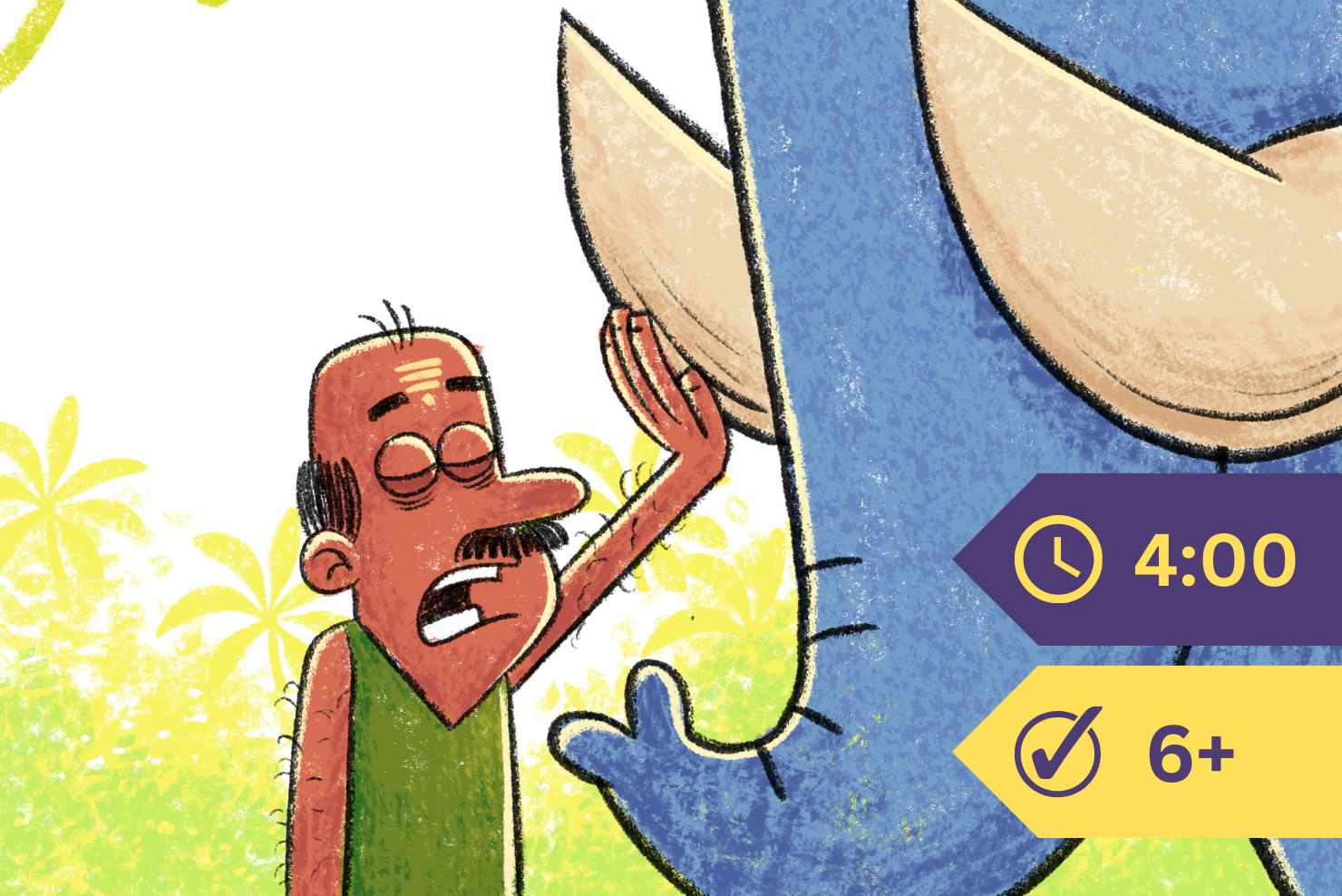
Once there lived a king who understood the language of all birds, beasts and insects. A fairy godmother had given him the gift, but it was a troublesome one, because if he ever revealed anything he learned that way, he would turn into stone. How he’d managed never to slip before this story begins, I can’t say, but he had grown up safely, married a wife, and was as happy as kings generally are.
This king was a Hindu, and when a Hindu sits down to eat, he has a nice little spot on the ground, freshly plastered with mud, and he sits in the middle of it wearing very little, which is quite different from the way we do it.
One day the king was eating his dinner in just such a spot, and his wife sat opposite to wait on him and keep him company. As he ate, a few grains of rice fell on the ground. A little ant, hunting for food, seized one and began to haul it off. Just outside the king’s circle, he met another ant, and the king heard the second say:
“Dear friend, do give me that grain of rice and go get yourself another. My boots are so dirty that if I walked into the king’s eating place I’d spoil it, and that would be very rude.”
But the ant with the rice only replied:
“If you want rice, go and get it. Nobody will notice your muddy boots. And you don’t think I’m going to carry rice for all our relatives, do you?”
The king laughed.
The queen looked herself up and down. She couldn’t see anything about her that was funny, so she said, “What are you laughing at?”
“Did I laugh?”
“Of course you did. And if you think I’m ridiculous, say so, instead of behaving so strangely! What are you laughing at?”
“Nothing.”
“You did laugh, and I want to know why.”
“I’m afraid I can’t tell you,” said the king.
“You must,” said the queen. “If you laugh when there’s nothing to laugh at, you must be ill or mad. What’s wrong?”
Still the king refused, and still the queen declared she would know. For days it went on. She gave him no peace, until the poor man was nearly out of his mind and felt that life was hardly worth living if this continued. He thought he might as well tell her the secret and take the consequences.
“But if I’m to turn into stone,” he thought, “I’m not going to lie on some dusty highway to be kicked about by every passer-by, thrown at dogs, played with by naughty children, and be miserable. I’ll be a stone at the bottom of the cool river, rolling gently along until I find a safe place to rest forever.”
So he told his wife that if she’d ride with him to the middle of the river, he’d tell her what he’d laughed at. She thought he was joking and agreed. Their horses were brought and they set out.
On the way they came to a fine well in the shade of tall, spreading trees, and the king suggested they get down, drink some cool water and rest a little. The queen agreed. They dismounted and sat in the shade by the well.
An old billy goat and his wife were grazing nearby. As the king and queen sat there, the nanny goat came to the edge of the well, looked over, and saw lovely green leaves growing in tender shoots out of the well’s side.
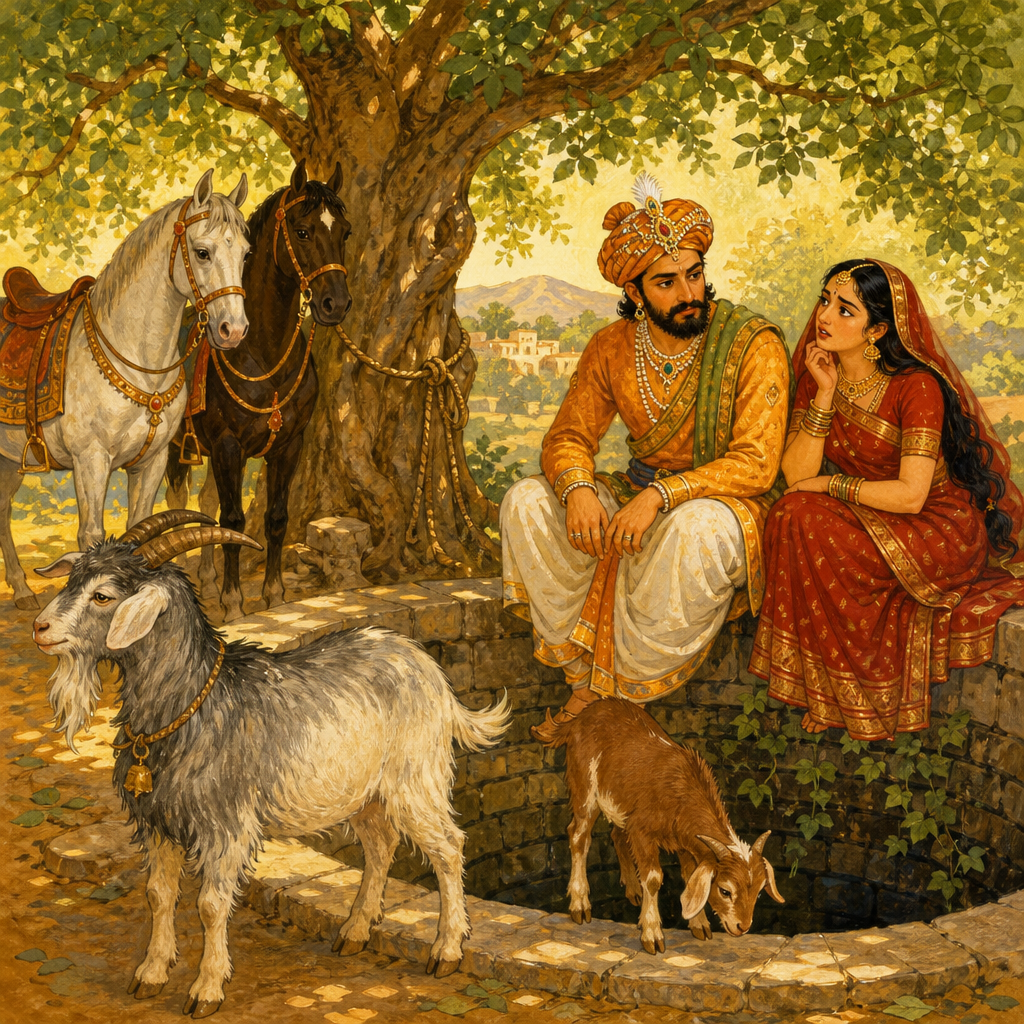
“Oh!” she called to her husband. “Come and look. My mouth is watering. Come and get them for me!”
The billy goat wandered up, looked over, and then looked rather crossly at his wife.
“You want me to get you those leaves? Have you thought how I’m supposed to reach them? If I tried, I’d fall in the well and drown!”
“Why would you fall in?” cried the nanny goat. “Do try!”
“I’m not going to be so silly,” said the billy goat.
But the nanny goat wept and begged.
“Look,” said her husband. “There are plenty of fools in the world, but I’m not one of them. This silly king here is going to throw his life away just because he can’t cure his wife of asking questions. Well, I know how to cure you of your foolishness, and I’m going to.” And he turned his back and walked off, and stayed so firmly out of reach for the rest of the afternoon that by evening the nanny goat had made up her mind the leaves in the well weren’t worth having.
The king, who had understood every word, laughed again.
The queen looked at him suspiciously. But the king stood up and went over to where she sat.
“Are you still determined to find out what I was laughing at the other day?” he asked.
“Quite,” said the queen crossly.
“Then I’ve made up my mind,” said the king, tapping his boot with his riding whip. “I’m not going to tell you. And I have also made up my mind that this will be the last time you ask.”
“What do you mean?” asked the queen nervously.
“I just watched a billy goat say a plain ‘no’ and mean it,” said the king. “He didn’t argue, he didn’t give in, and in the end his wife dropped the whole thing. I’d rather not quarrel with you. But I’ve decided not to tell you, and I’m not going to change my mind, however long we sit here. So let’s ride home, and let’s not ask each other questions the other can’t answer.”
The queen looked at him for a long while. Then she went home, and so did the king, and it’s said they were both happier and wiser than before.