There were once three brothers who cut wood for a living, and none of them was especially clever — but the youngest was the furthest from clever of all. He was so simple that his brothers and all the neighbours called him Scioccolone, the great simpleton, and Scioccolone he was to everyone.
Every day they cut wood. Every evening they staggered home with it. Every day was exactly like the one before. This went on for years.
Then one day — the kind of day that comes along only rarely, which is probably just as well — the three brothers strayed out of the shade of the forest into the open field beyond, and there, lying on the grass in the full blaze of the midday sun, they found three beautiful young women fast asleep.
“Look at those silly girls sleeping in this heat,” said the eldest brother.
“They’ll get sick,” said the second.
“We should cut some branches and build them a shade,” said Scioccolone.
His brothers laughed at him and walked away.
Scioccolone dug four holes, cut four young trees for uprights, tied branches across, stuffed the roof with broad leaves from the forest, and built the whole thing in the full sun through the hottest hours of the day — because three people were sleeping unprotected and he couldn’t leave them there. When he was done he stood gazing at them, unable to go.
They woke. They looked at the shade, and at him, and poured out their thanks.
Here the story does not go the way you might expect. Scioccolone was red-faced, sweating, and not improved by the heat. Three beautiful young women looking at him showed no sign of falling in love.
But they were not ordinary young women. They were fairies who had taken human form for an afternoon, for reasons of their own. And they were not ungrateful.
The first said: “I give you this — one day you shall be a king.”
Scioccolone blinked. A king? He could see the incongruity of it quite clearly, and it didn’t appeal to him. He was too kind to say so, and too honest to pretend gratitude he didn’t feel. He grinned awkwardly and stood there.
The second fairy saw his expression. “You didn’t like that gift. But our sister gave it because it was the best she had, and when it comes true you’ll find it suits you better than you think. Now — for mine, you choose. What do you want?”
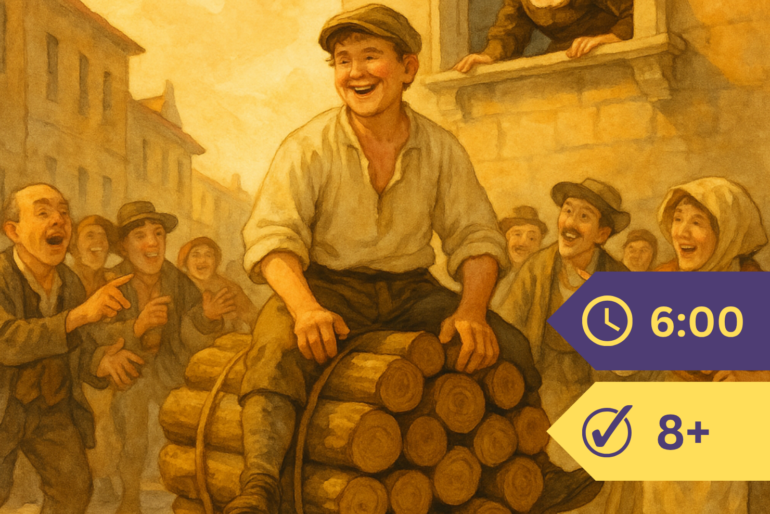
Scioccolone thought. Then he said: “I’d like — when I’ve finished tying up the logs this evening — instead of having to stagger home carrying them — I’d like to get astride the bundle and have it carry me home.”
He grinned at the thought of it.
“Granted,” said the second fairy.
The third fairy said: “And my gift — you may wish for anything.”
Scioccolone thought about this for a long time. Every time he fixed on a wish he thought of something else he’d need to go with it. Finally he blurted out: “Promise me that whatever I wish for will come true — then if I forget something now I can wish for it later!”
“Granted,” said the third fairy.
They disappeared. Scioccolone went back to his work.
“I do wish the logs were already cut and tied,” he muttered as he walked — just as he might say it any tired evening, not thinking of the fairy at all. When he reached his work spot, the logs were cut and neatly tied.
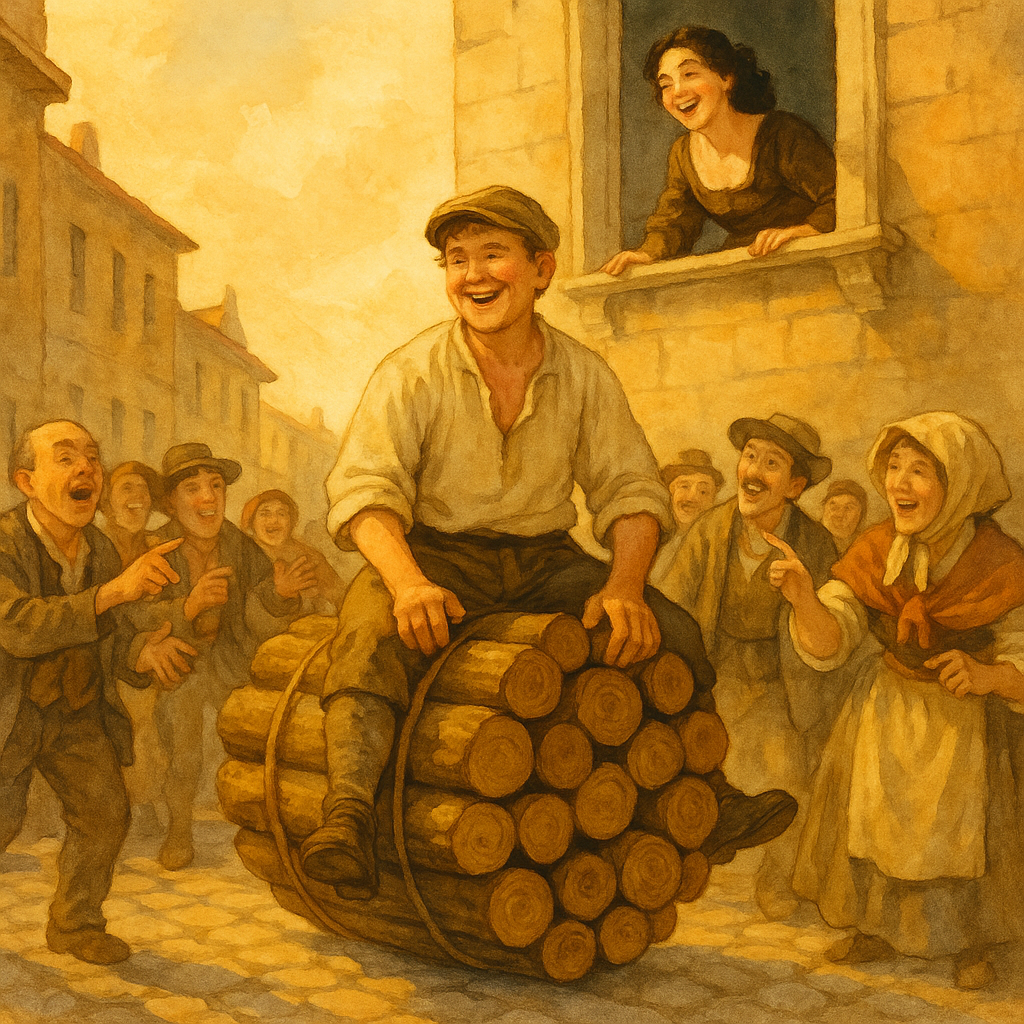
He got astride the bundle. It rolled off by itself, carrying him. He couldn’t steer — that hadn’t been in the wish — but the bundle seemed to know where it was going, and he reasoned that wherever it went was probably better than home, where people called him Scioccolone.
The bundle rolled into a great city. The entire population came out to see a man riding a rolling log bundle. At a window of the palace, the king’s daughter looked out. She had never in her life been known to laugh. Now she laughed — for the first time.
Scioccolone heard her clear laugh above all the rest, looked up, saw her bright face at the window, and made a wish — the careless, instinctive kind you make when you see something wonderful: I wish I might have a little son, and that beautiful princess to be the mother.
Then the bundle carried him on, out of the city, and he sold it to a wood merchant for enough money to live like a gentleman for a year.
Some time later there was a great commotion in the city. The king’s daughter had been delivered of a son, and nobody knew who the father was — including the princess herself. The king summoned every man in the city, one by one, to the baby. “Is this your father?” he asked each time. “No,” said the baby, each time. Last of all they brought Scioccolone. “Is this your father?” The baby rose up joyfully from its cradle and said: “Yes! That is my father!”
The king was furious. He gave his daughter to this clown and banished them both forever.
Scioccolone was delighted. All he’d wanted was a beautiful wife, and here one was. The princess wept the whole way.
When he saw how unhappy she was, Scioccolone felt unhappy too — and then he remembered his wish-gift, and started wishing. He wished for a pleasant estate. He wished for a fine house in the middle of it, with gardens and farms and carriages and servants. He wished for fruits and flowers and all the good things of life. When none of this made the princess much happier, he thought a little longer, and then wished that he himself might be given a handsome person, polished manners, and an educated mind of the sort the princess would admire.
All his wishes were fulfilled. And the princess found that she loved him very much, and they were very happy.
They had been living quietly on their estate for some time when the king came riding by on a hunt and noticed a prosperous villa where none had been before. He rode in to inquire, found Scioccolone — entirely transformed — invited himself to stay, and had a conversation so full of wisdom that when he rose to leave he said: “I’ve long been looking for a man to succeed me. Come to the palace, and when I die the kingdom is yours.”
Scioccolone agreed. A few days later he moved to the palace with his wife and son — and the king’s delight, when he discovered that his elegant new heir’s wife was his own daughter, could hardly be expressed.
After some years the old king died, and Scioccolone became king. And the first fairy’s gift came true as well, exactly as she’d said it would.