I. Three Brothers and Three Wonders
A Sultan of the Indies had three sons and a niece. The princes were Houssain, Ali, and Ahmed, the youngest. Their cousin, Princess Nouronnihar, had lost her father when she was very small, and the Sultan had raised her in the palace beside his sons.
He had planned to marry her to a neighbouring prince. But all three of his sons were in love with her, and none would give way. So the Sultan, who adored anything strange and rare, came up with a plan.
“Each of you will travel to a different country,” he said. “Whoever brings me the most extraordinary thing shall marry your cousin. I’ll give you each money for the journey and for the purchase.”
The princes agreed. Each dressed as a merchant and took a trusted officer disguised as a servant. They rode together the first day and slept at an inn where the road split in three. At supper they agreed to travel for a year and then meet at the same inn, so they could go home together. At dawn they embraced and each took a different road.
Houssain came to Bisnagar, where the markets were vaulted and shaded, each street given over to one trade. There were linens painted with beasts and flowers, silks from Persia, porcelain from China, and jewellers’ stalls glittering with pearls and rubies. Everywhere there were rose-sellers, for in that city nobody goes out without a flower in his hand or a garland on his head.
Tired from walking, Houssain accepted a merchant’s offer to sit in his shop. A crier passed with a worn little carpet, six feet square, crying it at thirty purses. Houssain thought that absurd. The crier said the price would soon rise to forty. “Whoever sits on this carpet,” he said, “is carried in an instant wherever he wishes to go.”
He offered to prove it. In the back of the shop, Houssain and the crier sat down, and Houssain wished himself in his room at the khan. They were there at once. He paid forty gold pieces and gave the crier twenty more for himself.
He could have flown to the meeting place that very day. But he was curious about the king and the customs of Bisnagar, so he stayed some months. Then he grew so homesick for the Princess that he sat on the carpet and flew to the inn, where he waited, passing for a merchant.
Ali went to Persia and reached Shiraz. In the bazaar a crier was calling out a small ivory tube, a foot long, for thirty purses. Ali was sure the man was mad and asked a shopkeeper. “He was sane yesterday,” said the shopkeeper. “He’s one of our best criers. Ask him.”
The crier showed Ali that the tube had a glass at each end. “Look through this one and you’ll see whatever you wish,” he said.
Ali wished to see his father and saw the Sultan on his throne, healthy, in the middle of his council. Then he wished to see Nouronnihar, the person he loved best after his father, and saw her laughing among her women. He bought the glass and later went home with a caravan to the inn, where he found Houssain waiting.
Ahmed went to Samarkand. In the bazaar a crier held up an artificial apple and cried it at thirty-five purses. “It looks like nothing,” the crier admitted, “but a sick person who smells it is cured, even a dying one.” A crowd gathered, and several people swore it had saved their lives. It had been made by a philosopher who studied plants and minerals all his life. He died suddenly, leaving a widow and many small children, who now had to sell it.
Someone in the crowd had a friend near death. Ahmed agreed to pay forty purses if the apple worked, and it did. He paid, joined the next caravan, and arrived at the inn in perfect health.
II. The Dying Princess
When the brothers met, they showed each other their treasures. Ali looked through the glass to check on the Princess, and what he saw made him go pale. She was dying.
“Quickly,” said Houssain. The three of them sat on the carpet, wished themselves at her side, and arrived in a moment. Ahmed held the apple to her face. A few moments later, she opened her eyes and sat up as if waking from a deep sleep. She thanked all three princes, and Ahmed most warmly.
The Sultan was overjoyed. But when the princes asked him to name the winner, he thought for a long time.
“Ahmed, your apple saved her. But you would never have known she was ill without Ali’s glass, and you’d never have arrived in time without Houssain’s carpet. Each of you was needed. I can’t choose among you.”
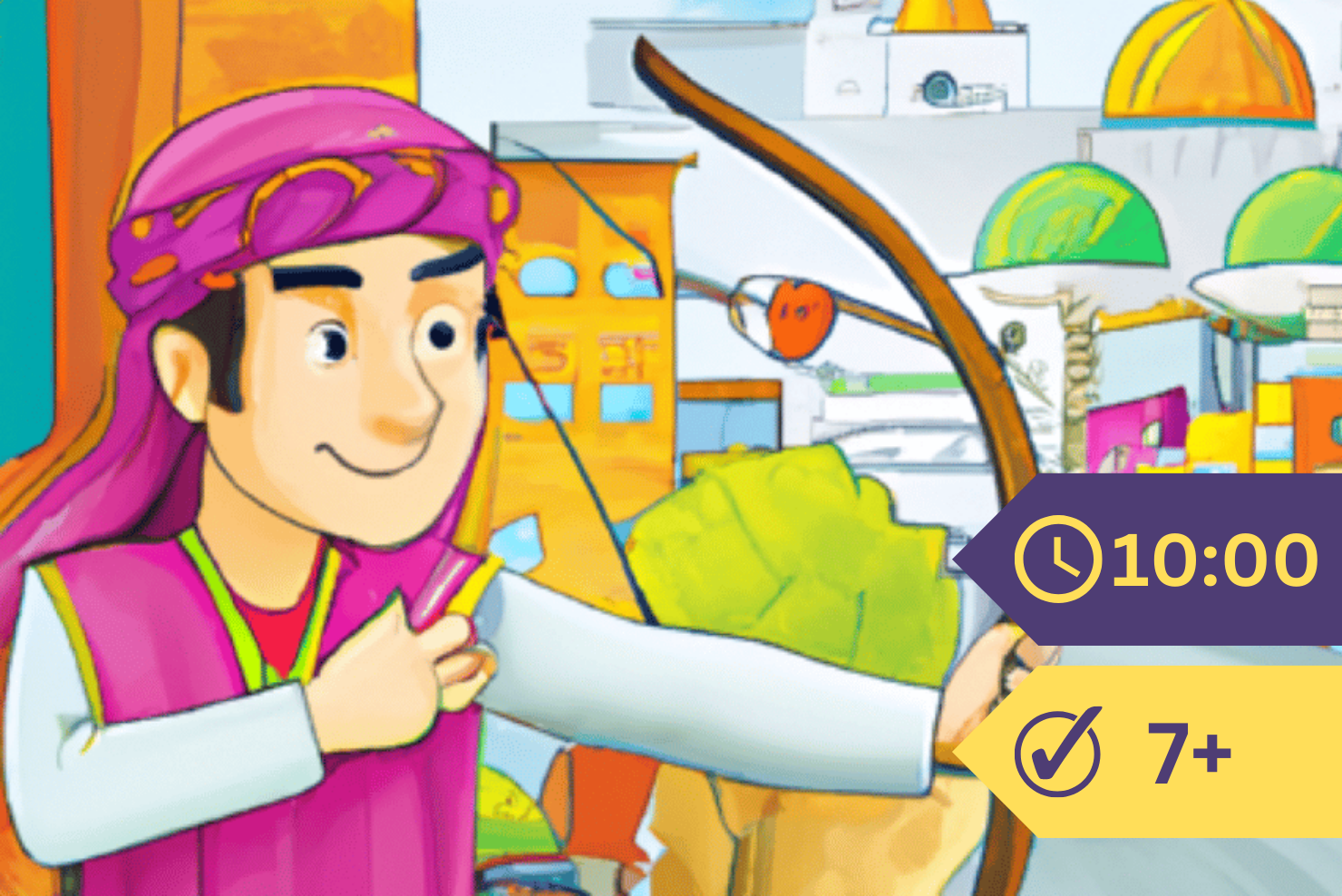
So he set a different test. “Take a bow and arrow and come to the great plain. I’ll give the Princess to whoever shoots farthest.”
Houssain shot first. Ali shot far beyond him. Ahmed shot last, and his arrow simply vanished. Everyone searched, and nobody found it. The Sultan gave the prize to Ali, and the wedding was held a few days later.
Houssain could not bear it. He left the court and became a hermit. Ahmed stayed away from the wedding too, but he did not give up the world. He could not stop wondering where his arrow had gone. He slipped away from his attendants and walked straight out from the place where the others’ arrows had landed. He went on and on, long past the point where it seemed foolish, until he reached a wall of steep rocks in a barren land, four leagues from where he’d started.
III. The Fairy Under the Rocks
At the foot of the rocks lay an arrow. It was his own, and it was lying flat on the ground, as if it had bounced off the stone. “No one living could shoot that far,” Ahmed thought. “There’s a mystery here. Maybe fortune is paying me back for what it took.”
He found a cave, and inside it an iron door with no lock. He pushed, and it swung open on a gentle slope. At the bottom, a strange new light replaced the dark. Ahead lay a magnificent palace, and a lady came out to meet him with a crowd of beautiful women around her. They were so finely dressed that he could not tell which one was the mistress.
“Come nearer, Prince Ahmed,” said the lady. “You are welcome.”
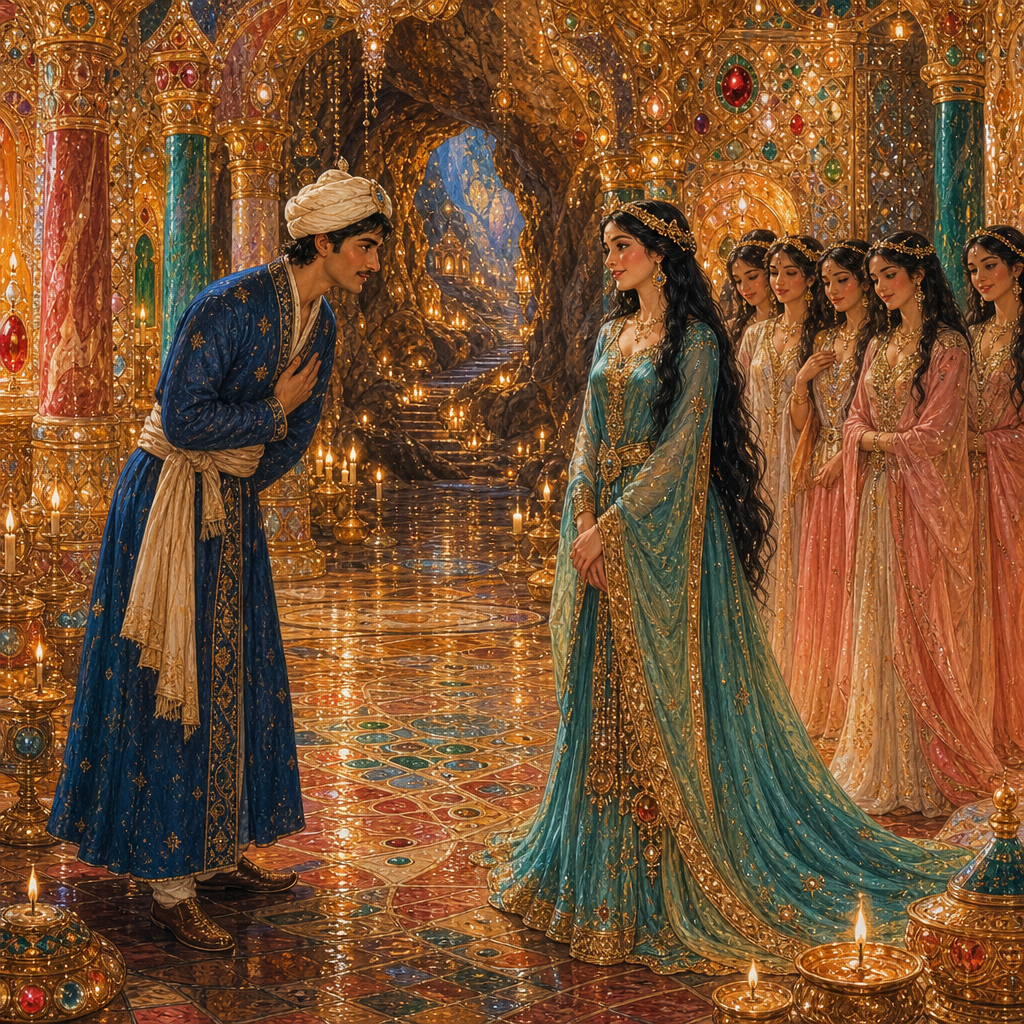
Ahmed was astonished to hear his name in a place he’d never heard of, so close to his father’s city. She led him into a hall and explained.
“I am Paribanou, daughter of one of the most powerful genies. I thought you deserved a better fate than marrying Nouronnihar. I was there when you drew your bow, and I knew your arrow wouldn’t beat Houssain’s. So I caught it in the air and sent it against these rocks. Now it’s up to you to take the chance I’m giving you.”
She looked at him tenderly and blushed. Ahmed understood, and he did not need long to decide. Paribanou was far more beautiful than the Princess, clever and kind, and plainly very rich. “Madam,” he said, “if I could spend my life as your servant, I’d be the happiest of men.”
“Won’t you pledge your faith, as I pledge mine?”
“Gladly. I give you my heart without reserve.”
“Then you are my husband and I am your wife.”
She showed him her palace, with halls of diamonds, rubies, and emeralds set among agate and jasper, and marble of every colour. At the feast that night, hundreds of scented candles stood in perfect order, women sang to the sound of every kind of instrument, and Ahmed found every dish better than any food made by men. The celebrations went on for days.
IV. A Father’s Suspicion
After six months Ahmed began to miss his father. Paribanou let him go, with some advice. “Don’t tell the Sultan about our marriage, or who I am, or where you live. Tell him you’re happy and that you came to put his mind at ease.” She sent twenty mounted gentlemen to ride with him.
The Sultan was overjoyed to see Ahmed, and he scolded him gently for being away so long. Ahmed told him a story of his adventures and left out the Fairy. He asked only for leave to visit often. The Sultan wanted him to stay, or at least to say where he could be found. “I’m sorry, Father,” Ahmed said. “That is part of the secret.”
The Sultan let it go. Ahmed stayed three days and went home on the fourth.
For a month Ahmed hardly mentioned his father, and Paribanou guessed why. “You haven’t forgotten the Sultan?” she asked. “You shouldn’t stay away on my account.” So he went again, richer and finer each time. After some months, the Sultan’s favourite viziers began whispering that this mysterious wealth could only mean one thing: Ahmed was winning the people’s hearts to steal the throne.
The Sultan refused to believe it. But the idea took root. In secret, without telling his grand vizier, he sent for a sorceress and told her to follow his son. She waited at the rocks where Ahmed had found his arrow. When Ahmed rode by the next morning, he vanished before her eyes. She searched the rocks but found no door, because the iron gate could only be seen by people the Fairy wished to admit.
She came back a month later and lay at the foot of the rocks, groaning, pretending to have a fever. Ahmed was kind-hearted, and he stopped. He had her lifted onto a horse and brought into the Fairy’s courtyard. “Princess,” he said, “I’ve promised this woman help. I’m sure you won’t refuse.”
Paribanou had her carried inside. Then she whispered to Ahmed, “That woman is not sick. I think she’ll cause you trouble. But don’t worry, I’ll protect you.” Ahmed answered that he’d never wronged anyone and wouldn’t stop doing good just because someone might misuse it.
The Fairy’s women put the sorceress to bed on a golden sofa and gave her a dish of the Water of the Fountain of Lions, a cure for every fever. An hour later she was up and dressed, praising the potion. They led her through a series of rooms, each grander than the last, to a hall where the Fairy sat on a throne of solid gold covered in jewels. The sorceress was so dazzled that she forgot her thanks. Then she hurried back to the Sultan and told him how rich the Fairy was and how dangerous it might be.
The favourites wanted the Prince killed. The sorceress advised something cleverer. “Make him ask her for wonders. Sooner or later she’ll tire of him and send him away. Start with a tent small enough to carry in one hand, but big enough to shelter your whole army.”
V. Three Impossible Requests
The Sultan asked for the tent. Ahmed was dismayed, but he agreed to try. “If I don’t come back,” he said, “you’ll know she said no. I only ask you to remember that you’re the one who put me in this position.”
Ahmed told Paribanou, nervously, that the request came from his father and not from him. She laughed. “Is that all?” She sent for her treasurer, Nourgihan, and asked for the largest tent in the treasury. Nourgihan returned with something that fit in the palm of her hand. Ahmed thought it was a joke, but the treasurer set it up, and it stretched from the palace gate to the horizon, big enough to shelter two armies. “It gets bigger or smaller depending on how many people it needs to cover,” said Paribanou.
The Sultan was astonished. And a few days later, he asked for more.
“I hear your wife has a water that cures every fever. Bring me a bottle.”
Paribanou frowned. “This is wicked of him. The Fountain of Lions stands in the courtyard of a great castle, and four lions guard the gate. Two sleep while two keep watch. But don’t be afraid.” She gave him a ball of thread, a bottle, and instructions. “Take two horses, with a sheep cut into quarters on the second. Throw the thread ahead of you after you pass the iron gate. It will roll to the castle gate and stop. Throw each lion a quarter of the sheep, ride in, fill the bottle without getting off your horse, and ride out.”
Ahmed did exactly as she said. The lions were so busy eating that he passed straight through. On the way home, two lions followed him. He drew his sabre, but they only walked beside him, as gently as dogs, all the way to the gates of the Sultan’s palace. Then they turned around and went back, to the terror of everyone who saw them.
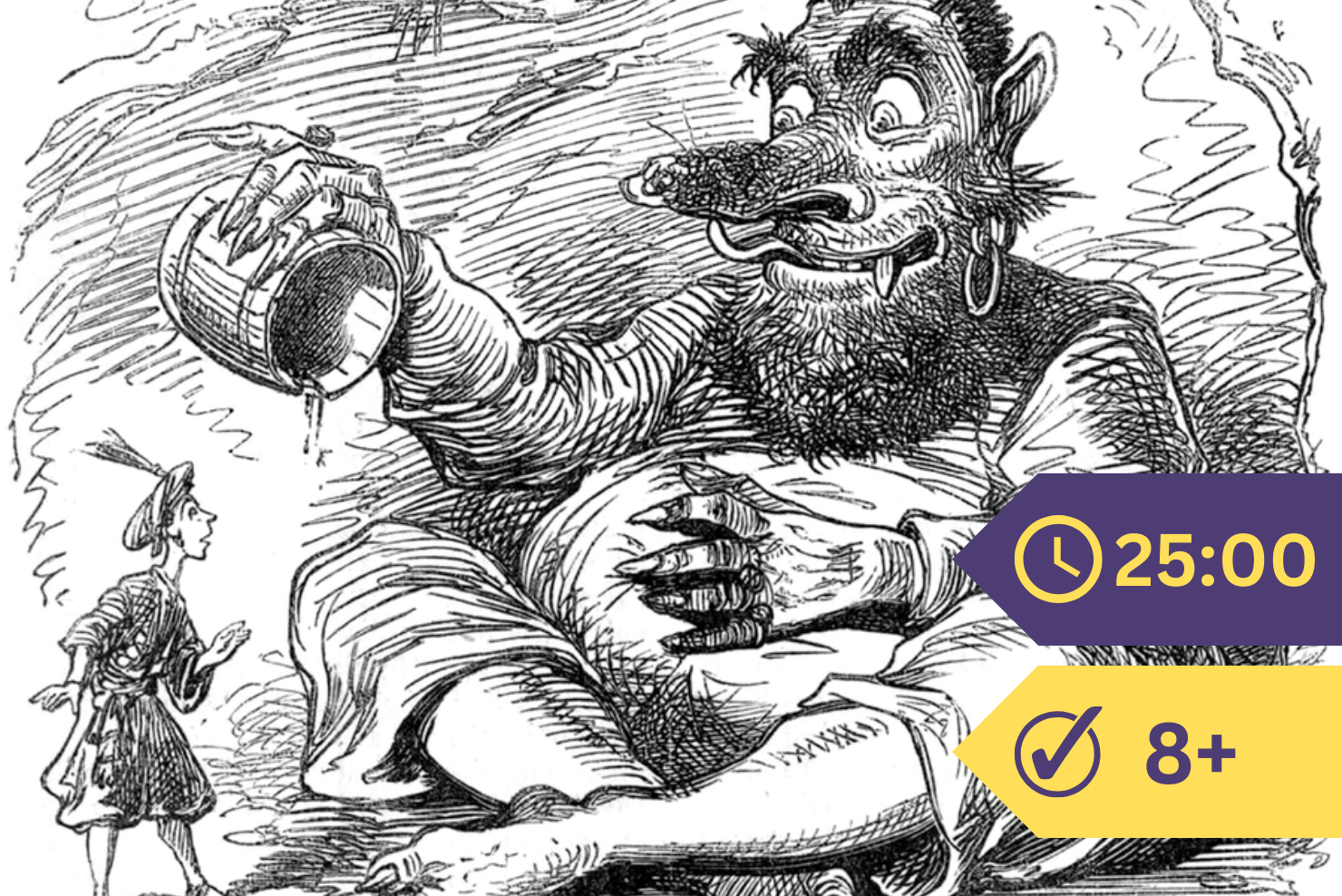
The Sultan thanked Ahmed. Privately, he grew more jealous than ever. He sent for the sorceress again, and she gave him a new plan. The next day, in front of the court, the Sultan said, “One last thing, and I’ll ask nothing more of you. Bring me a man a foot and a half tall, with a beard thirty feet long and an iron bar on his shoulders weighing five hundred pounds.”
Ahmed was sure no such man existed. He went home and told Paribanou, who was unconcerned. “He’s my brother, Schaibar. We share the same father, but he’s nothing like me. He’s quick to anger and quicker to strike, but he’s just as quick to help anyone he likes. He looks exactly as your father describes. Don’t be frightened.”
“Frightened?” said Ahmed. “He’s your brother. I’ll honour him as mine.”
Paribanou had a fire lit in a golden dish and dropped perfume into it. Smoke rose in a thick cloud. A moment later, a small, fierce figure came striding out of it, his long beard held up in front of him, his mustaches tucked behind his ears, his tiny eyes deep-set in a large head, a heavy iron bar on his shoulder. His look could have turned the blood cold in a man’s veins. Ahmed stood calmly beside the Fairy.
“Who is this?” Schaibar asked.
“My husband, Ahmed, the Sultan of the Indies’ son. I didn’t invite you to the wedding because you were away on an expedition, and I didn’t want to pull you from it.”
Schaibar’s face softened. “If he’s your husband, I’ll do whatever he asks.”
“His father wants to meet you. Ahmed will lead you to his court.”
“He only has to show me the way.”
The next morning, Schaibar and Ahmed set out together. When they reached the capital, people ran and hid, shops slammed shut, and the guards fled their posts. They walked up empty streets and through empty halls to the council chamber, where the Sultan sat on his throne.
Schaibar strode up to the throne. “You asked for me,” he said. “Here I am. What do you want?”
The Sultan clapped his hands over his eyes. Schaibar, offended after such a long walk, raised his iron bar. Ahmed threw himself between them. “Brother, he’s my father!”
The bar stopped a hand’s breadth from Ahmed’s head and came down on the marble floor instead. The whole hall shook, a crack ran to the far wall, and the courtiers dove under the benches.
“Who gave him such advice?” Schaibar growled, and the favourites were dragged out, shaking. Ahmed asked mercy for the grand vizier, who had always advised his father well. The sorceress was found trying to creep out. “Learn to feign sickness again,” said Schaibar, and he sent her and the flatterers out of the city, never to return.
The Sultan slowly uncovered his eyes. He saw his youngest son standing between him and an iron bar, the same son he’d sent to the lions. He was ashamed. “I asked you for things no father should ask,” he said. “Forgive me.”
Ahmed forgave him. From then on there was no more secret between the two courts. The Sultan welcomed Paribanou as his daughter, and Ahmed and his wife visited as often as they liked. Ali and Nouronnihar lived happily at court, and Houssain stayed in his hermitage, content.