They say there was once a peasant whose wife had died, leaving him a daughter of extraordinary beauty—a girl so lovely that no one in the land could compare with her. After some time he married again: a widow who had a daughter of her own, a girl as homely and misshapen as the first was fair.
One day, when everyone else was out and only the fair daughter was at home, the king came riding by from the hunt, thirsty after his long ride. He stopped at the cottage and asked her for a glass of water. When he saw how fair she was, and with what grace she brought it to him, he said, “Fair maiden, if you are willing, I will return in eight days and make you my wife.”
“Indeed I am willing, Your Majesty,” she answered, and the king rode away.
When the stepmother came home, the simple-hearted girl told her everything. The stepmother congratulated her warmly—but in her heart, she was already scheming. Before the eight days were up, she locked the fair maiden in the cellar.
When the king arrived, the stepmother went out to meet him with a smiling face. “Good day, Your Majesty! What is your royal pleasure?”
“To marry your daughter,” the king answered.
The stepmother brought out her own daughter—wrapped in a wide mantle, her face hidden behind a thick veil with a hood pulled over that.
“Rest assured,” said the king, “that your daughter will be my tenderest care. But you must take those wrappings off.”
“By no means, Your Majesty!” cried the stepmother. “And pray, do not remove them yourself. You have seen how beautiful she is—but that beauty depends on one condition: if a breath of air touches her skin, she loses it entirely. Please, Your Majesty, let the veil remain.”
So the king called for an extra veil and another hood, and wrapping the girl even more carefully, handed her into the carriage he had brought, closed the door, and rode beside it all the way to the palace. There, wrapped in all her veils, the stepmother’s daughter was married to the king.
The stepmother returned home flushed with triumph—but her triumph soon curdled into worry. What am I to do with the other girl? she thought. Sooner or later she’ll get out of the cellar, the king will see her, and all will be lost. Not knowing what to do, she went to a witch for help.
“Do this,” said the witch, and she gave her a long pin with a golden head. “Drive this into the maiden’s head, and she will become a dove. Then keep her in a cage, and no one will ever see her as a maiden again.”
So the stepmother bought a cage and, taking the golden pin down to the cellar, drove it into the fair maiden’s head—holding the cage open as she did so.
The moment the pin entered her head, the maiden became a dove. But instead of flying into the cage, she flew straight over the stepmother’s head and away—far away, and out of sight.
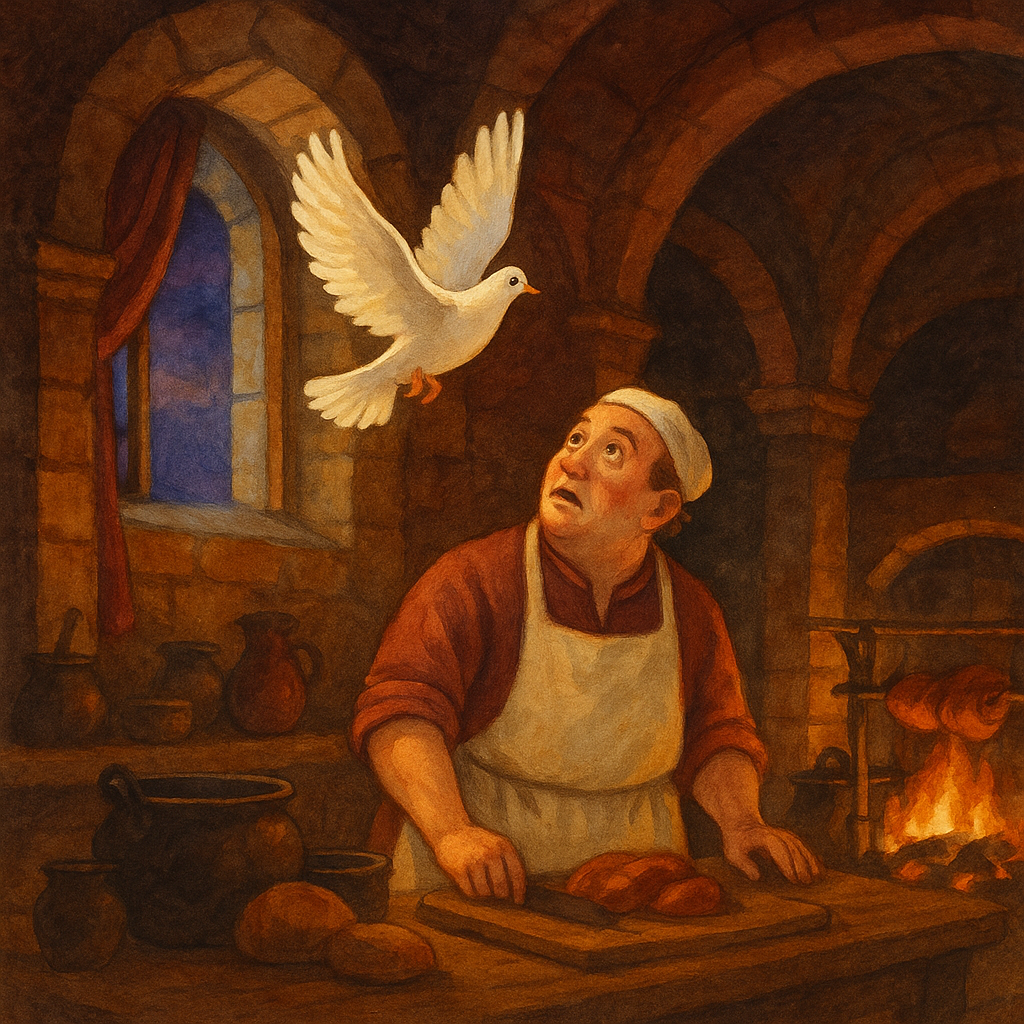
She flew on and on until she reached the king’s palace, right to the kitchen window, where the cook was busy preparing a great dinner in honour of the new queen. He heard the poor little dove beating her wings against the glass, and—afraid she would hurt herself—he opened the window.
In flew the dove. Three times she circled his head, and each time she sang:
O cook, O cook of the royal kitchen,
What shall we do with the queen?
Sleep, all of you, soundly—
And burnt be the meal that might have been!
By the third round, the cook had fallen into a deep sleep, the dinner left untended burnt to charcoal, and when the king sat down to table with his veiled bride, there was nothing before him.
“Where is the dinner?” the king demanded.
“Forgive me, Your Majesty,” said the chamberlain. “The dinner is burnt black, and the cook is asleep in the kitchen—so soundly that no one can wake him.”
“Fetch a dinner from the inn,” said the king, “and bring the cook to me when he wakes.”
In time the cook came to himself and was brought before the king.
“You have served me faithfully for many years,” the king said. “How is it that today—the day I honour my bride—you let everything burn and leave the royal table empty?”
“Your Majesty, the dinner had been of the finest,” the cook replied. “Everything was nearly ready. But then a dove flew in at the window and circled my head three times, singing each time:
O cook, O cook of the royal kitchen,
What shall we do with the queen?
Sleep, all of you, soundly—
And burnt be the meal that might have been!
After that, a deep sleep fell on me, and I remember nothing more.”
“A most singular dove,” said the king. “Find her and bring her to me, and you shall be forgiven.”
The cook went to look, and met the dove halfway—she was already flying toward him.
“There she is, Your Majesty,” said the cook, placing the dove gently in the king’s hands.
“So you spoiled my dinner, did you, palombelletta?” said the king. “Never mind—you are a dear little thing, and I forgive you.” He tucked her inside his coat and began to stroke her, murmuring, “Palombelletta bella, palombelletta bella!”
As he stroked her, his fingers found something hard through the feathers—the golden head of a long pin. “What’s this in your head, palombelletta dear?” he said—and pulled it out.
At once the dove was gone, and in the king’s arms stood the fair maiden, as beautiful as he had first seen her at the cottage door.
“Are you not the maiden who promised to marry me?” the king exclaimed.
“The very same, and no other,” she replied.
“Then who is this?” He turned to the veiled figure beside him and pulled away the veil. And then he understood everything.
He sent for the stepmother and had her and her daughter punished for what they had done.