On a sandy moor in Jutland, where the wind is so strong that trees won’t grow, lived a farmer and his wife with their two sons. Rasmus, the elder, was happy to tend sheep like his father. Niels, the younger, wanted to be a hunter. He got hold of an old flintlock musket and shot at everything he saw, until he became a wonderful shot. Some said there wasn’t much more to him than that. They changed their minds later.
When the parents grew old, the mother decided she wanted to see the Pope in Rome. They sold the sheep, locked up the house, and set out on foot. Niels took his gun. “What do you want that for?” said Rasmus. But Niels couldn’t be happy without it.
It was high summer, too hot to walk by day, and too risky by night. One evening they came to an inn at the edge of a forest. “Let’s stay here,” said Rasmus. “What? We can’t travel by day for the heat and we stop at night?” said Niels. “We’ll never get to Rome.” The old people sided with Niels. They went on until the road split in two with no signpost. “We’ll wait for morning,” said Niels. “One of us will keep watch till midnight.”
Rasmus took the first watch. When a big stag stepped out of the trees, he borrowed Niels’s gun and shot it. The bang woke Niels. “I shot a stag!” said Rasmus proudly. “That’s nothing,” said Niels. “I’ve shot a sparrow, which is much harder.”
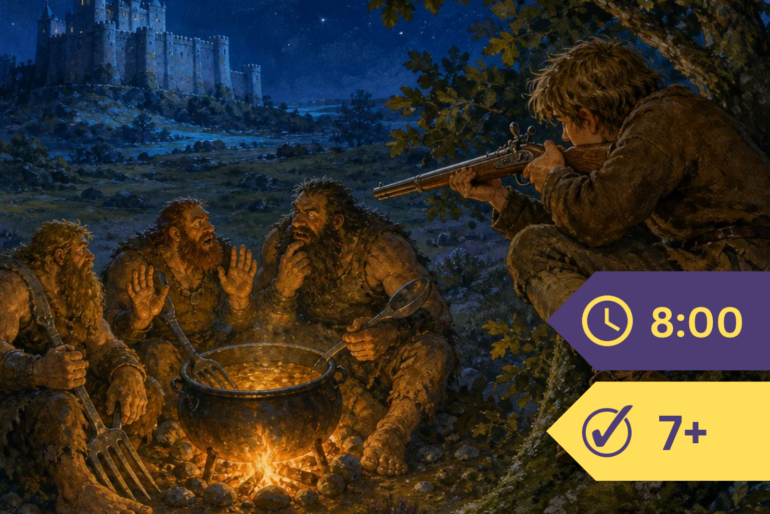
Niels took the watch. To stay warm, he climbed a tree at the forest edge to look at the open country. Far off, a fire burned, and three giants sat beside it eating broth and beef from an enormous pot. Their spoons were as big as spades, their forks as big as hay-forks. Niels was scared at first. Then, since the giants were far away, he started to think it was rather funny, and slid down for his gun.
From the tree, he aimed at the first giant’s fork just as it rose to his mouth. Bang! The handle jerked, and the prongs jabbed the giant in the chin. “Stop that!” he growled at his neighbour. “I didn’t touch you,” said the second giant. They almost came to blows. The third giant calmed them down. While they quarrelled, Niels reloaded. Bang! The second giant’s fork shattered. Another quarrel. “Fools,” said the third. “We have to work together if we’re to get the better of the king of this country. Sit down. I’ll sit between you.”
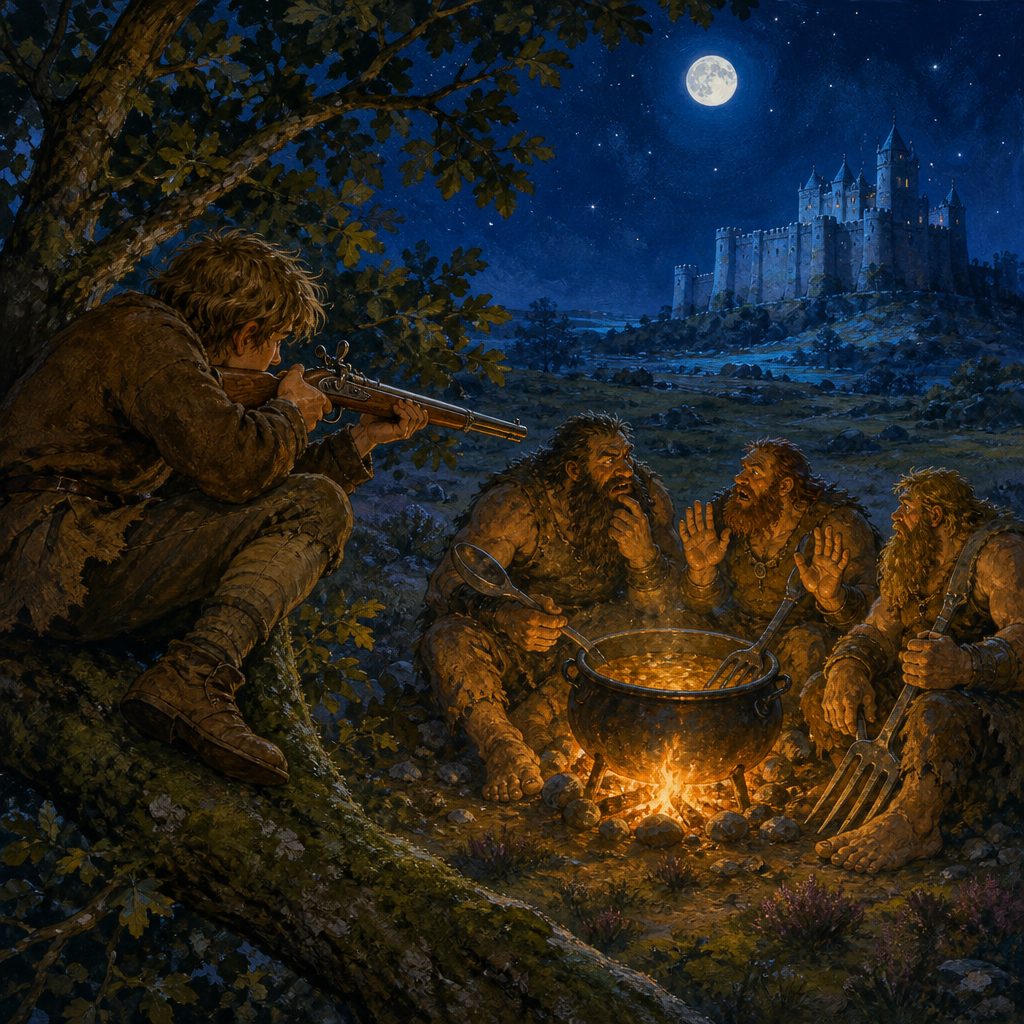
Niels thought it was marvellous fun. “Thrice is lucky.” Bang! The third giant’s fork snapped in two.
“If I were as foolish as you, I’d lose my temper too. But I see what’s going on.” He strode off toward the tree and caught Niels as he slid down. “Stay where you are, or I’ll put my foot on you.”
They carried him to the fire. “You deserve no mercy. But you’re a good shot, so we’ll spare you if you help us. There’s a castle nearby where the king’s daughter lives. We want to carry her off, but it’s guarded. We’ve put everyone in the castle to sleep with magic, but there’s a little black dog we can’t charm, and as soon as we climb the wall it will bark and wake everyone. Shoot the dog before it barks, and we’ll let you go and give you a reward.”
Niels had no choice. At the castle, the rampart was too high even for the giants. “I’ll throw you over,” said one. “I might break my neck and then who’d shoot the dog?” said Niels. “You’ll land as softly as on a feather bed,” said the giant, and he was right. The thump woke the little dog, but before it could bark, Niels fired and it fell silent.
“Open the gate for us,” called the giant. On his way, Niels wandered into the great hall. It was brightly lit and empty. On the wall hung a huge unsheathed sword; beneath it, a silver-mounted drinking horn with a verse engraved round the rim: Whoever drinks the wine I hold / Can wield the sword that hangs above; / Then let him use it for the right, / And win a royal maiden’s love.
He took a sip, but still couldn’t lift the sword. “Maybe I have to drink all of it.” He drained the horn, and the sword came off the wall as light as a feather, and he felt strong enough for anything. Before he left he peeked into the princess’s chamber: she lay asleep, a gold-hemmed handkerchief on the table and a pair of gold-embroidered slippers on the floor. He tore the handkerchief in two and put half and one slipper in his pocket, thinking that a sheep-farmer’s son couldn’t hope to win a royal maiden. Killing the giants, though, would surely be “for the right.”
At the gate there were a big door and a small one. He opened the small one. “Open the big one!” said the giants. “The bars are too heavy for me,” said Niels. “You can stoop.” The first giant ducked in. Niels swung the sword, and that giant never straightened up. The second giant ducked in, and the same. The third was slower. “Hurry up, grandfather,” said Niels, “I haven’t got all night.” So the third came in too. (It’s remarked that giants weren’t given fair play in this story!)
Dawn was coming, so Niels ran back to the forest and slid into place by the others, who were still asleep. In the morning they set out again; when Rasmus asked about the sword, Niels waved vaguely. “Found it. Back that way.” Behind them, the castle woke up to a courtyard full of fallen giants, an empty horn, and a missing sword. The princess reported half her handkerchief and a slipper gone. A messenger was sent to the king, who knew nothing. “We must find him,” said the princess. “If he’ll marry me, I can’t honourably refuse, after what my father had engraved on that horn.” Her advisers suggested she build a house by the highway with a sign: Whoever tells the story of his life may stay here three nights free. Many travellers told many strange stories. None mentioned giants.
Meanwhile Niels and his family trudged on toward Rome. Winter came, and at the foot of a great mountain range, they asked a passing man the way. He held up his foot. The sole of his shoe was worn thin as paper, with a hole in it. “They were new when I left Rome.” The old people lost heart and turned for home.
On the return journey they reached the forest where they’d slept before, and found a big new house. “Free lodging,” read the sign over the door. “We can’t afford it,” said the old people. “It’s free!” said Niels, who had read it. They were well fed. The princess’s steward asked each of them for his life story. The father said, “There’s nothing to tell.” Rasmus piped up, “Well, I shot a stag near here.” The steward took the report to the princess. “Did you question all of them?” “Well, not directly.” “You’re getting careless. I’ll go myself.”
She knew Niels at once, and he knew her, and his heart sank: she must be here to find the thief. He told a dull story. Then Rasmus said, “Don’t forget the sword you found near here.” “Where is it?” said the princess. The steward fetched it. She recognised it. “Where did you get this?” Silence. “Empty his pockets.” Out came the slipper and half a handkerchief.
“Send for my father at once,” she said.
“Let me go,” Niels pleaded. “I did you as much good as harm.”
“Who said anything about harm?” said the princess, and smiled. Niels began to hope. The king came; the princess was willing and so was Niels, and in a few days the wedding bells were ringing. Niels was made an earl first, and looked as noble as any in his robes. When the old king died, Niels ruled in his place. Whether his parents stayed in the castle, went home to the moor, or were sent to Rome in a carriage and four, all the chroniclers of his reign have neglected to say.